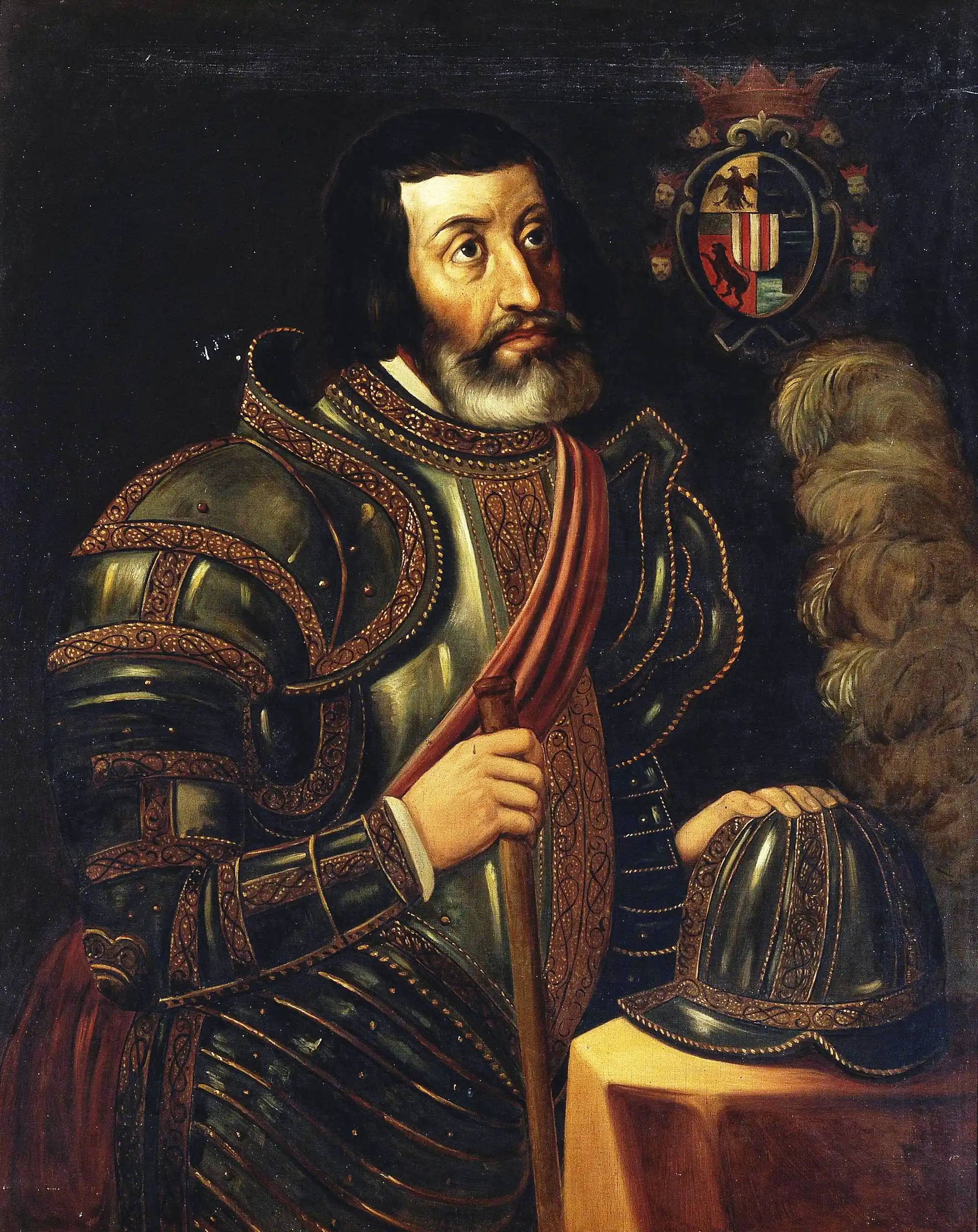
Hernán Cortés
 Mexico
explorer•governor•conquistador
Also known as: Hernando Cortés, Fernando Cortés, Hernán Cortés de Monroy y Pizarro Altamirano
Birthday
1485
Birth Sign
Unknown
Birthplace
Medellín, Spain
Age
Died at 62
About
Hernán Cortés was a Spanish conquistador, military commander, and explorer who led the expedition that toppled the Aztec Empire and brought much of what is now Mexico under Spanish rule in the early 16th century. He is the most famous and most controversial figure of the Spanish conquest of the Americas. Cortés was a brilliant strategist and ruthless opportunist, whose actions reshaped the history of the New World.
As of 2026, his legacy remains a subject of intense debate. In Mexico, he is often viewed as a destroyer of indigenous civilization, while in Spain he is celebrated as a national hero. His expeditions opened the door to centuries of Spanish colonial rule, and he remains a symbol of the clash between the Old and New Worlds.
Cortés's name is inseparable from the fall of Tenochtitlan, the Aztec capital, in 1521. His ability to forge alliances with indigenous enemies of the Aztecs, combined with superior weaponry and the devastating impact of smallpox, allowed his small force to conquer an empire of millions. He later became Governor of New Spain, but his later years were marked by political intrigue and a quest for recognition.
Early Life & Background
Hernán Cortés was born around 1485 in the small town of Medellín, in the Extremadura region of Spain. His parents, Martín Cortés de Monroy and Catalina Pizarro Altamirano, were of minor nobility. They were poor but proud, and they sent their son to study law at the University of Salamanca at the age of fourteen. Cortés was intelligent and clever, but he was also restless and ambitious. After two years, he grew bored with academic life and dropped out, eager to seek adventure in the New World.
In 1504, at the age of nineteen, Cortés sailed to Hispaniola, the Spanish colony in the Caribbean. There he worked as a notary and became a landowner, but he soon joined the expedition to conquer Cuba in 1511. Under Governor Diego Velázquez, Cortés rose quickly, becoming the alcalde, or chief magistrate, of Santiago de Cuba. He was known for his charisma and his skill at playing the political game. However, he also had a rebellious streak. He once was imprisoned by Velázquez for standing up his wedding to the governor's sister-in-law, Catalina Suárez. He eventually married her, but the incident showed his willingness to defy authority.
By 1518, Cortés had established himself as a wealthy and influential man in Cuba. But he wanted more. When Velázquez chose him to lead an expedition to the mainland, Cortés saw his chance. He poured all his resources into the venture, buying ships, weapons, and supplies. When Velázquez, fearing his ambition, tried to recall the mission at the last minute, Cortés ignored the order and set sail anyway. It was a defiant act that would change history.
Career Growth
In February 1519, Cortés left Cuba with eleven ships, about 500 soldiers, and 100 sailors. He landed on the coast of the Yucatán Peninsula, where he encountered the Mayan people. He soon acquired Doña Marina, a native woman who became his interpreter and mistress. Her linguistic skills and understanding of local politics proved invaluable.
Cortés founded the settlement of Veracruz and, in a bold move, had himself elected captain general, thereby breaking his allegiance to Governor Velázquez. He then marched inland, forming alliances with indigenous groups who resented Aztec rule, such as the Tlaxcalans. In November 1519, he entered Tenochtitlan, the magnificent Aztec capital, where he was welcomed by Emperor Montezuma II. Cortés quickly took Montezuma hostage, but the situation deteriorated. A Spanish massacre during a festival sparked a massive Aztec uprising, and Cortés was forced to flee the city on the famous Noche Triste (Sad Night) in June 1520, losing many men and much of his treasure.
He regrouped with his allies and, with the help of smallpox epidemics that ravaged the Aztec population, laid siege to Tenochtitlan in 1521. After a brutal 75-day siege, the city fell on August 13, 1521. Cortés ordered the destruction of the Aztec temples and built Mexico City on the ruins. He was appointed Governor and Captain-General of New Spain, but his authority was often challenged. In 1541, he returned to Spain to plead his case before the king, but he was largely ignored. He died in 1547, bitter and relatively forgotten.
Career Timeline
Public Image & Style
Cortés's public image is one of the most contested in history. In the Spanish-speaking world, he was long celebrated as a heroic conqueror, but in Mexico and among indigenous peoples, he is reviled as a genocidal invader. He is often depicted in art and literature as a brilliant but ruthless leader, a man of contradictions. His image has been used to symbolize both the glory and the brutality of the Spanish Empire.
Fame & Fandom
Hernán Cortés commands a legacy that transcends simple historical biography, functioning instead as a polarizing cultural flashpoint where history collides with modern political identity. He does not possess a traditional fandom of adoring fans or organized clubs; rather, he is the subject of intense, often hostile public discourse divided between those who revere him as a foundational hero of Spanish heritage and those who condemn him as the architect of indigenous genocide. This mythological engagement intensified in 2026 when diplomatic tensions flared over tributes to his conquests, turning his memory into a battleground for legal decrees and national narratives. The debate over his atrocities, reignited by government publications and high-profile visits, ensures his name remains a dominant force in global cultural conversation without the softening touch of celebrity worship. His influence persists through statues, street names, and academic debates that refuse to let the past rest. These dynamics are quantified by the iFANN Global Fame Rankings, which track his enduring resonance across media coverage and consumption signals worldwide. Hernán Cortés is currently the 14th most famous person in Mexico, holding steady from the previous cycle. He ranks as the 13th most famous person from Mexico in the same period. Furthermore, he stands as the 11th most famous person in Latin America, maintaining his position against a shifting landscape of regional icons.
Interesting Facts and Legends
Hernán Cortés was a distant cousin of Francisco Pizarro, the man who would later topple the Inca Empire. Before his conquests, he studied at the University of Salamanca but abandoned his studies after just two years. Known for his reckless gambling and womanizing, these habits frequently landed him in trouble while he served in Cuba. His warhorse, named Motilla, was among the first horses brought to the mainland and served as a critical military asset. He also kept a pet dog named Macho, a Spanish greyhound that fought alongside him in battle. Cortés documented his campaigns in a series of letters to King Charles V known as the Cartas de Relación, which remain vital historical documents today. A ghost map from Europe provides visual proof of the city's destruction, cementing the story of the siege as a verified event rather than folklore. In 2026, the narrative of his atrocities gained new life when the Mexican government published decrees from Charles I of Spain, reigniting debates about whether he should be remembered as a criminal. Even his portrait as the 1st Marquis of the Valley of Oaxaca serves as an iconic image representing his rise from minor noble to imperial power. Legends surround his fall of Tenochtitlan, particularly the burning of his own ships to ensure total commitment from his men. Another enduring story involves La Malinche, his interpreter, whose role has shifted from traitor to a complex symbol of the mother of the Mexican race in modern retellings.
Notable Quotes
“I and my companions suffer from a disease of the heart that only gold can cure.”
“We have a God who is the true God, and we have a king, and we have a sword.”
“I have decided to stay here and fight, for I would rather die fighting than return in disgrace.”
Family & Personal Life
Hernán Cortés was born to Martín Cortés de Monroy and Catalina Pizarro Altamirano. He had a sister named Catalina. He married Catalina Suárez Marcayda in 1516, but she died in 1522. He later married Juana Ramírez de Arellano y Zúñiga, with whom he had several children. He also had a son, Martín Cortés, with Doña Marina. His legitimate son, Martín Cortés y Ramírez de Arellano, continued the family line.
Notable Connections
Relationships & Dating History
Cortés's personal life was as eventful as his military career. He first became involved with Catalina Suárez, the sister-in-law of Governor Velázquez. He initially refused to marry her, leading to his imprisonment, but he eventually wed her in 1516. Catalina died in 1522, reportedly under mysterious circumstances, though no foul play was proven.
During the conquest, he took Doña Marina, also known as La Malinche, as his mistress and interpreter. She bore him a son, Martín, in 1522. Their relationship was complex, as she was both an ally and a symbol of the conquest.
After Catalina's death, Cortés married Juana Ramírez de Arellano y Zúñiga, a noblewoman, in 1529. They had several children, including his legitimate heir, Martín Cortés. At the time of his death in 1547, he was married to Juana.
- MarriedCatalina Suárez Marcayda1516 - 1522His first wife, died in 1522.
- DatedDoña Marina1519 - 1529Mistress and interpreter, mother of his son Martín.
- MarriedJuana Ramírez de Arellano y Zúñiga1529 - 1547His second wife, married until his death.
Death & Aftermath
Died
December 2, 1547 (aged 62)
Death Place
Castilleja de la Cuesta, Seville, Spain
Cause of Death
Complications from chronic gout
The death of Hernán Cortés was recorded by his family and attending physicians in Castilleja de la Cuesta as a natural conclusion to decades of suffering. On December 2, 1547, the conquistador passed away at his estate near Seville, Spain, at approximately sixty-two years of age. His final months had been defined by severe pain from chronic gout, an ailment that restricted his mobility and kept him in seclusion while he managed his estates and wrote reports for the King. Contemporary accounts dismiss rumors of syphilis, affirming gout as the primary factor in his decline. Immediate reaction among Spanish nobility involved quiet mourning and tributes to his role in expanding the empire, though no public processions marked the event. Cortés received a private funeral attended by close associates before being interred in the Colegio de San Gregorio in Valladolid.
His remains were later transferred to the Monastery of San Jerónimo in Cuernavaca, Mexico, where they rest today. The legal aftermath focused on disputes over his titles and lands between his heirs and the Spanish Crown, matters that continued long after his burial. In modern times, the figure of Cortés has become a flashpoint for historical debate rather than a source of unified remembrance. Political leaders in Mexico and Spain have frequently clashed over his legacy, with some condemning his actions as genocide while others celebrate him as a foundational national hero. This polarization ensures that his name remains central to discussions of colonial history, often sparking controversy rather than celebration whenever statues are erected or commemorations proposed.
Net Worth (Estate Value)
As a historical figure, Cortés's net worth is not documented, but he amassed great wealth through the conquest and subsequent looting of the Aztec Empire. He received a share of the treasure, including gold and silver, and was granted vast encomiendas, which gave him control over indigenous labor. He was awarded the title Marquis of the Valley of Oaxaca, which came with extensive lands. However, much of his fortune was spent on expeditions and lawsuits. At his death, his estate was in debt, but his family retained significant wealth.
Awards Won (1)
Cortés did not receive formal awards in his lifetime, but he was granted the title Marquis of the Valley of Oaxaca by King Charles V in 1529, a hereditary honor in recognition of his conquests.
1529 · Nobility
Conquest of Mexico
Known For
Conquest of the Aztec Empire
1521 · Leader
Fall of Tenochtitlan
1521 · Conquistador
Keywords
Sources
Quick Facts
- Profession
- explorer, governor, conquistador
- Born
- 1485
- Birthplace
- Medellín, Spain
- Died
- December 2, 1547
- Death Place
- Castilleja de la Cuesta, Spain
- Gender
- Male
- Spouse
- Catalina Suárez Marcayda, Juana Ramírez de Arellano y Zúñiga
Personal Details
- Full Name
- Hernán Cortés de Monroy y Pizarro Altamirano
- Spouse
- Catalina Suárez Marcayda, Juana Ramírez de Arellano y Zúñiga
- Education
- University of Salamanca (law, dropped out)
Frequently Asked Questions
How did Hernán Cortés die?
What is Hernán Cortés known for?
What was Hernán Cortés's relationship with Doña Marina?
Was Hernán Cortés a hero or a villain?
How did Hernán Cortés conquer the Aztec Empire with so few men?
Similar People
Join the community
fans discussing