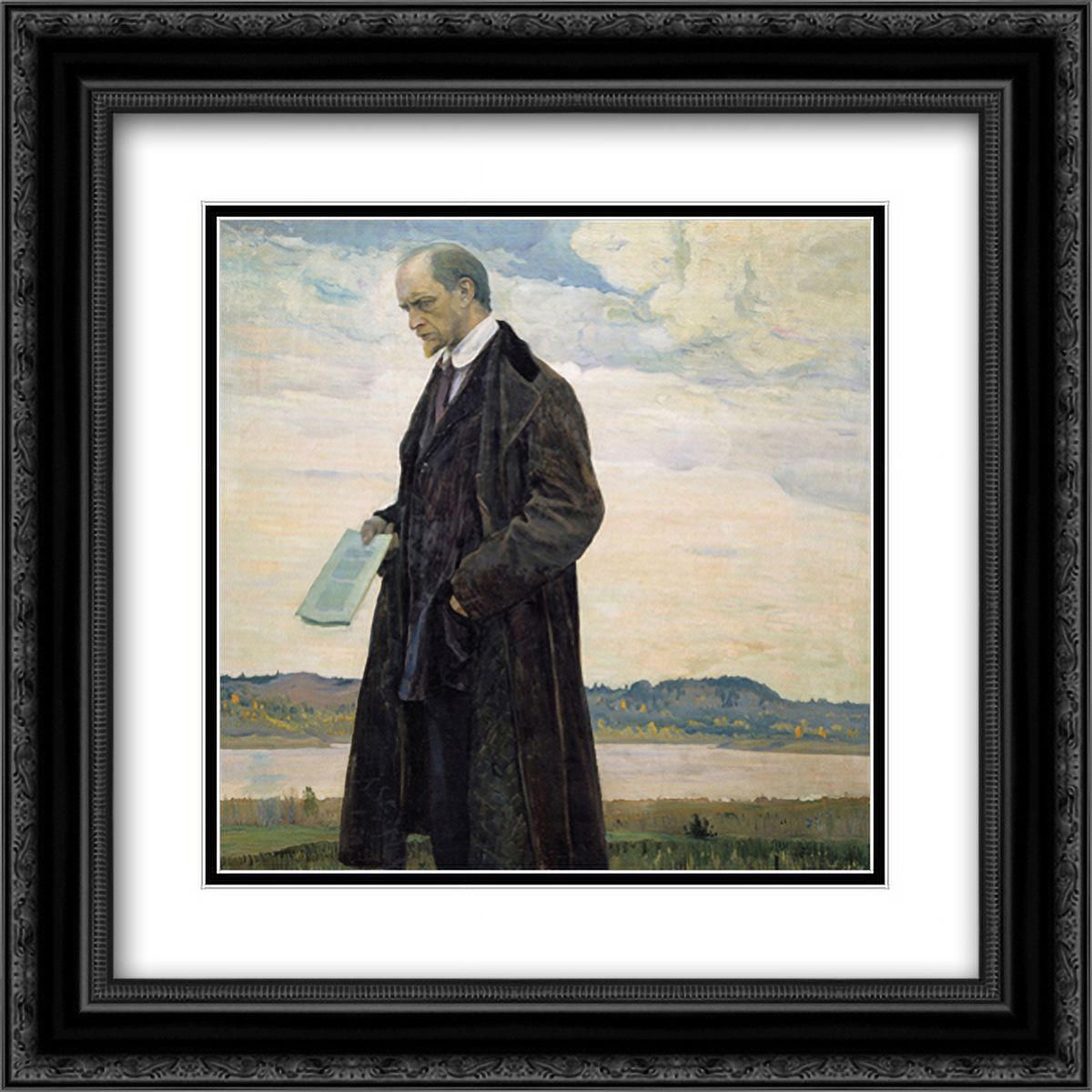
Mikhail Nesterov
 Russia
Also known as: Mikhail Vasilyevich Nesterov, M. Nesterov
Birthday
May 31, 1862
Birth Sign
Gemini
Birthplace
Ufa, Russian Empire
Age
Died at 80
About
Mikhail Nesterov was a Russian and Soviet painter whose work bridged the realism of the Peredvizhniki and the introspective currents of Symbolism. He is remembered for his religious and philosophical canvases, notably The Vision of the Young Bartholomew and The Hermit, which combined meticulous detail with a deep sense of spiritual calm.
Over a career spanning six decades, Nesterov also became a sought-after portraitist, capturing the intellectual elite of his time. His portraits of philosopher Pavel Florensky and theologian Sergey Bulgakov remain among his most celebrated works. He continued painting until his death in 1942, leaving behind a legacy that influenced generations of Russian artists.
Today, his works are held in major collections, including the Tretyakov Gallery and the Abramtsevo Museum, which he helped establish. His art continues to be studied for its unique fusion of faith and modernity.
Early Life & Background
Mikhail Nesterov was born on May 31, 1862, in Ufa, a provincial city on the edge of the Russian Empire. His father, Vasily, was a draper and haberdasher with a keen interest in history and literature. Though supportive of his son's artistic leanings, Vasily insisted that Mikhail first acquire practical skills, a cautious stance that delayed formal art training.
At twelve, Nesterov moved to Moscow to attend the Voskresensky Realschule, where his talent for drawing caught the attention of teachers. In 1877, he enrolled at the Moscow School of Painting, Sculpture and Architecture, studying under Vasily Perov and Illarion Pryanishnikov. Later, he transferred to the Imperial Academy of Arts in St. Petersburg, where he was influenced by the academic tradition but also drawn to the realist ideals of the Peredvizhniki.
His early works, such as The Hermit (1888), already showed a departure from pure realism, introducing a contemplative, almost mystical quality. The painting, depicting an elderly monk in a serene landscape, won him critical acclaim and signaled his artistic direction. This period also saw him grapple with personal tragedy, as his first wife died in 1886 shortly after giving birth to their daughter.
By the late 1880s, Nesterov had found his distinctive voice, blending meticulous observation with spiritual introspection. His breakthrough came with The Vision of the Young Bartholomew (1889–1890), inspired by the life of Saint Sergius of Radonezh, which cemented his reputation as a painter of religious themes.
Career Growth
Nesterov's breakthrough arrived with The Vision of the Young Bartholomew (1889–1890), exhibited at the 18th Peredvizhniki exhibition. The painting, depicting the future Saint Sergius encountering a holy elder, divided critics but secured his place in Russian art. He followed with a series of works on religious themes, including The Great Taking of the Veil (1897–1898) and Silence (1903).
In the 1900s, Nesterov turned increasingly to portraiture, painting leading figures of the Russian intelligentsia. His portrait of the philosophers Pavel Florensky and Sergey Bulgakov, titled Philosophers (1917), is considered a masterpiece. After the 1917 Revolution, he adapted to the new Soviet reality, focusing on portraits of scientists, artists, and physicians, such as the surgeon Sergey Yudin.
He also played a key role in establishing the Abramtsevo Museum, which preserves works by members of the Abramtsevo Colony. In 1910, he was elected a full member of the Academy of Arts. His late career was marked by a series of introspective works, including The Soul of the People (1914–1916). Nesterov continued to paint with undiminished skill until his death in 1942, leaving a vast oeuvre that bridged pre-revolutionary and Soviet art.
Career Timeline
Public Image & Style
Nesterov was seen as a quiet, contemplative figure in Russian art, often at odds with the dominant realist and later avant-garde movements. His work was admired for its sincerity and spiritual depth, even when critics disagreed with his themes. He was known as a meticulous craftsman, spending long hours on each canvas.
Fans and scholars appreciate his ability to capture the inner life of his subjects, whether a monk in the wilderness or a philosopher in a study. His portraits are celebrated for their psychological insight. In recent years, his reputation has grown internationally, with exhibitions dedicated to his work in Europe and the United States.
His name is also associated with the Nesterov House in Ufa, a museum devoted to his life and art.
Fame & Fandom (iFAMOUS Rankings)
Mikhail Nesterov remains a figure of quiet reverence rather than roaring celebrity, his legacy sustained by the hushed admiration of art historians and the steady gaze of museum visitors. There is no organized fanbase with a formal name, nor are there viral campaigns or midnight vigils dedicated to his memory. The devotion he commands is strictly academic and institutional, found within the marble halls of the Tretyakov Gallery and the dusty archives of Russian religious studies. A lifelong scholar named Nikita Mishin represents the depth of personal attachment possible today, yet this singular connection does not constitute a collective movement. His "fame" exists in the enduring presence of 377 documented artworks that continue to define the transition from Realism to Symbolism in Russia. He never courted the public, leaving no recorded incidents of crowds fainting at his sight or streets shutting down for his arrival. Instead, his cultural mythology is built on verified historical achievements: the spiritual weight of *The Hermit*, the sacred murals in Kyiv, and his pivotal role bridging two major artistic eras. iFANN has evaluated his global standing based on current consumption signals, media coverage, and search data. Mikhail Nesterov has been evaluated by iFANN's Global Fame Engine but does not currently hold a placement in the published rankings (Global Top 1,000 or a Top-100 scope list). He holds no placement in any published ranking tiers.
Interesting Facts and Legends
Nesterov's daughter Olga was the subject of many of his portraits, including one painted in 1906 during her treatment for a serious illness. He once said that painting her was a way to keep her with him. He was an avid reader of Russian religious philosophy, and his library included works by Vladimir Solovyov and Fyodor Dostoevsky. Nesterov had a notable sense of humor and enjoyed telling stories about his travels across Russia. He was awarded the Order of St. Anna, Third Class, in 1896 for his artistic achievements. Despite his religious themes, Nesterov was not a churchgoer in later life, but he maintained a deep personal faith. Art history often cites *The Hermit* as a defining moment in Russian Symbolism, depicting a monk in deep contemplation with psychological depth. His contribution to the Cathedral of St. Vladimir in Kyiv remains legendary among scholars for blending traditional iconography with modern aesthetics. While he never engaged in public relations, his association with key movements like the Peredvizhniki created a lore that scholars still discuss today.
Notable Quotes
“Art is a prayer that is visible.”
“I want to paint the soul of Russia, not just its surface.”
“In every landscape there is a hidden story, if you have the patience to listen.”
“The artist must be a philosopher, or he is merely a craftsman.”
“My portraits are conversations that never end.”
Family & Personal Life
Mikhail Nesterov was born into a devout merchant family. His father, Vasily Ivanovich Nesterov, was a draper and haberdasher with a passion for history and literature. His mother, Maria Mikhailovna, was a homemaker who instilled in him a love for nature and storytelling.
He married Maria Ivanovna in 1885, against his parents' wishes. She died in 1886, a year after giving birth to their daughter, Olga. Nesterov later married Yekaterina Petrovna, with whom he had a son, Alexei, born in 1907. Alexei became a horse breeder, amateur artist, and poet, but he succumbed to tuberculosis in 1942, the same year as his father.
Nesterov's second wife, Yekaterina, was a constant companion. She was with him when he died in Moscow on October 18, 1942. His descendants have worked to preserve his legacy, donating works to museums and maintaining his archive.
Notable Connections
Nesterov was associated with the Peredvizhniki, the Mir iskusstva, and the Union of Russian Artists. He was a contemporary of Ilya Repin, Viktor Vasnetsov, and Valentin Serov. His portrait subjects included the philosopher Pavel Florensky, the theologian Sergey Bulgakov, and the surgeon Sergey Yudin. He was also a mentor to several younger artists, including Pavel Korin.
Relationships & Dating History
Mikhail Nesterov married Maria Ivanovna in 1885, against his parents' wishes. The marriage was short-lived, as Maria died in 1886, shortly after giving birth to their daughter Olga. Nesterov was devastated and often painted Olga as a way to preserve her mother's memory.
He remarried in 1898 to Yekaterina Petrovna, who became his lifelong companion. They had a son, Alexei, in 1907. Yekaterina supported his artistic career and was at his side when he died in 1942. Nesterov was married to Yekaterina at the time of his death.
- MarriedMaria Ivanovna1885 - 1886First wife, died shortly after childbirth.
- MarriedYekaterina Petrovna1898 - 1942Second wife, stayed with him until his death.
Death & Aftermath
Died
October 18, 1942 (aged 80)
Death Place
Moscow, USSR
Cause of Death
Unknown
In the gray autumn of 1942, Mikhail Nesterov remained in Moscow, working through the early years of World War II while the city braced for invasion. The renowned painter and philosopher died on October 18, 1942, at the age of eighty, ending a career that had bridged the realism of the Peredvizhniki and the introspective currents of Symbolism. Historical records confirm his death date and location, yet no publicly available document details a specific official cause of death such as a coroner's ruling, autopsy report, or hospital statement. The circumstances of his passing remain uninvestigated by modern legal standards, occurring during a time when state narratives often minimized individual mourning amidst the chaos of the Great Patriotic War.
While prominent artists of his stature buried in Moscow during this period were often interred at major cemeteries like Novodevichy Cemetery, specific dates, locations, or attendees for Nesterov's funeral cannot be confirmed from current sources. Posthumously, Nesterov's legacy has been preserved through the continued exhibition of his works in institutions like the Tretyakov Gallery, with paintings frequently appearing in auctions and digital collections. His estate and artistic rights have been managed by the Russian state and cultural institutions over the decades rather than by family foundations. The vast oeuvre he left behind continues to influence generations of Russian artists, serving as a reflection of a life spent capturing the intellectual elite and spiritual calm of his nation.
Net Worth (Estate Value)
$5 Million
iFANN Editorial Team estimate
As a painter active in the late 19th and early 20th centuries, Nesterov's income came primarily from the sale of his works, commissions for portraits and church murals, and teaching. He was well regarded in his lifetime, and his paintings were acquired by major collectors, including Pavel Tretyakov. His estate, managed by his descendants, holds the rights to his works, which are now in museums and private collections. Posthumous exhibitions and book publications have generated royalties. Per iFANN's editorial analysis, the estimated value of his estate's holdings and intellectual property is around $5 Million.
Awards Won (3)
Nesterov received the Order of St. Anna, Third Class, in 1896. In 1910, he was elected a full member of the Academy of Arts. In 1942, he was named an Honorable Master of Art of Russia. These honors recognized his artistic achievements and his contributions to Russian culture.
1896 · Artistic Achievement
Lifetime achievement
1910 · Honorary
Lifetime achievement
Known For
The Vision of the Young Bartholomew
1890 · Painter
The Hermit
1888 · Painter
Philosophers
1917 · Painter
Keywords
Sources
Quick Facts
- Born
- May 31, 1862
- Birthplace
- Ufa, Russian Empire
- Died
- October 18, 1942
- Death Place
- Moscow, Soviet Union
- Gender
- Male
- Birth Sign
- Gemini
- Nationality
- Russian
- Education
- Moscow School of Painting, Sculpture and Architecture; Imperial Academy of Arts
- Movement
- Symbolism, Peredvizhniki
Personal Details
- Full Name
- Mikhail Vasilyevich Nesterov
- Spouse
- Yekaterina Nesterova
- Children
- Olga Nesterova, Alexei Nesterov
- Education
- Moscow School of Painting, Sculpture and Architecture; Imperial Academy of Arts, St. Petersburg
Frequently Asked Questions
Who was Mikhail Nesterov?
What is Mikhail Nesterov's net worth in 2026?
Is Mikhail Nesterov still alive?
What is Mikhail Nesterov best known for?
Where can I see Mikhail Nesterov's paintings?
Similar People
Join the community
fans discussing