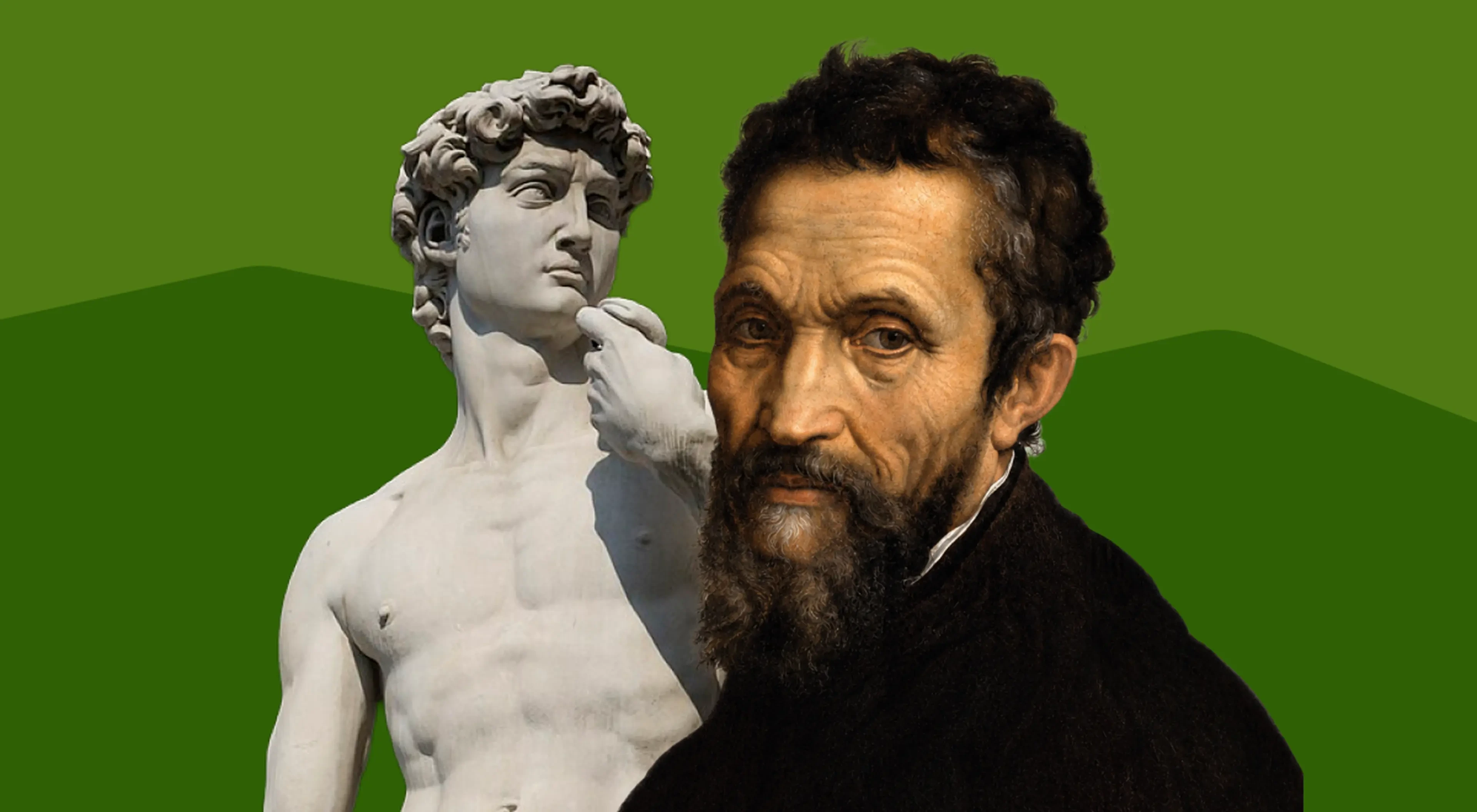
Michelangelo
sculptor•painter•architect•poet
Also known as: Michelangelo Buonarroti, Michelangelo di Lodovico Buonarroti Simoni
Birthday
March 6, 1475
Birth Sign
Pisces
Birthplace
Caprese Michelangelo, Republic of Florence
Age
Died at 88
Height
Medium height, broad-shouldered and powerfully built
About
Michelangelo di Lodovico Buonarroti Simoni was an Italian sculptor, painter, architect, and poet of the High Renaissance. He is best known for the Pietà, David, the ceiling of the Sistine Chapel, and The Last Judgment, along with his design for the dome of St. Peter's Basilica. Born in 1475 and active mostly in Rome from his thirties, he was the first Western artist to have a biography published during his lifetime, Giorgio Vasari's Lives (1550), which called him divino. He died in Rome on February 18, 1564, at 88. His surviving letters, sketches, and memoirs make him one of the best-documented artists of the 16th century, and his terribilità, the awe-inspiring quality of his work, shaped generations of artists who followed. He never married and had no children; his heir was his nephew Leonardo Buonarroti.
Early Life & Background
Michelangelo was born on March 6, 1475, in Caprese, where his father Lodovico served briefly as a Florentine magistrate; the family soon returned to Florence. His mother Francesca di Neri del Miniato died when he was six, and he was raised largely by a wet nurse in Settignano, a stonecutter's village, a detail he later joked made him absorb hammer and chisel with his milk.
Against his father's wishes he was apprenticed in 1488, at 13, to Domenico Ghirlandaio's workshop, then transferred to the household of Lorenzo de' Medici, where he studied the Medici sculpture collection and met the humanist circle. His earliest surviving painting, The Torment of Saint Anthony (after Schongauer), dates to about 1487–88, when he was roughly 12 or 13; the work drew renewed press attention in 2026. He carved the Battle of the Centaurs and the Madonna of the Stairs around 1490–92. After Lorenzo's death in 1492 and the Medici expulsion, he fled to Bologna and then Venice, arriving in Rome in 1496 at 21.
Career Growth
In Rome, Bacchus (1496–97) established him, and the Pietà (1498–99, St. Peter's) made his name at 24. He returned to Florence in 1501 and carved David from a discarded block (1501–04), unveiled to civic acclaim. He painted the Doni Tondo (c. 1503–04) and in 1505 was summoned to Rome by Pope Julius II for the papal tomb, a project that consumed forty years and was never completed to plan.
He painted the Sistine Chapel ceiling (1508–12) and The Last Judgment on the altar wall (1536–41); he designed the Laurentian Library and New Sacristy in Florence (from 1519 and 1520s), pioneering Mannerist architecture; and at 71, in 1546, he succeeded Antonio da Sangallo the Younger as architect of St. Peter's Basilica, reworking the plan so the western end was built to his design and the dome completed after his death. In 2026, restoration work began on The Last Judgment, and a bust in an Italian basilica was re-attributed to him after centuries of obscurity.
Career Timeline
Public Image & Style
Michelangelo's public persona was that of the divino artista, a genius recognized in his own lifetime. Contemporaries admired his terribilità, the quality that instilled awe in viewers, and his name became synonymous with artistic mastery. He was known for his fierce independence, his insistence that he was a sculptor rather than a painter, and his frugal habits. Vasari's biography and Condivi's Life shaped the image of a solitary, driven genius, an image that has persisted for centuries.
Fame & Fandom (iFAMOUS Rankings)
iFANN has not yet collected fame data for Michelangelo, so no ranking is available. He does not appear on the September 2026 iFAMOUS Rankings flagship list. The fanbase has no formal name, but his work draws millions of visitors to the Sistine Chapel, the Accademia, and St. Peter's each year, and reproductions of David and the Sistine ceiling circulate worldwide. Modern scholarship and restoration projects, such as the 2026 work on The Last Judgment, keep his name in the news.
Interesting Facts and Legends
Contemporaries describe him as of medium height, broad-shouldered and powerfully built, with a broken nose from a punch by the sculptor Pietro Torrigiano in his youth, a widely repeated story. He was famously frugal, burned many of his own drawings, and wrote poetry to the end. Asked to paint the Sistine ceiling, he reportedly retorted that painting was not his profession; he insisted he was a sculptor and never aspired to be a painter. A story fans still retell is his claim that every block of stone has a statue inside it and it is the task of the sculptor to discover it. He also joked that he absorbed hammer and chisel with his wet nurse's milk in Settignano.
Notable Quotes
“Every block of stone has a statue inside it and it is the task of the sculptor to discover it.”
“Painting is not my profession.”
Family & Personal Life
Michelangelo was the son of Lodovico di Leonardo Buonarroti Simoni, a Florentine magistrate, and Francesca di Neri del Miniato, who died when he was six. He was raised largely by a wet nurse in Settignano, a stonecutter's village. He never married and had no children; his heir was his nephew Leonardo Buonarroti, whose descendants preserved the family home as the Casa Buonarroti in Florence. His closest emotional attachments were to Tommaso de' Cavalieri and Vittoria Colonna, though neither was a family relationship in the conventional sense.
Notable Connections
Leonardo da Vinci, Raphael, Lorenzo de' Medici, Pope Julius II, Vittoria Colonna, Tommaso de' Cavalieri, Giorgio Vasari.
Relationships & Dating History
Michelangelo never married and is not documented as having had a wife, fiancée, or publicly acknowledged romantic partner of either sex. The two emotional relationships most discussed by scholars are with the nobleman Tommaso de' Cavalieri, whom he met in Rome around 1532 and to whom he addressed passionate sonnets and drawings, and with Vittoria Colonna, the widowed marchesa of Pescara, whom he met around 1538 and who was his closest intellectual and spiritual companion until her death in 1547. His poetry also contains love poems addressed to men, which later editors censored. He died unmarried in 1564, with no partner and no children.
Death & Aftermath
Died
February 18, 1564 (aged 88)
Death Place
Rome, Italy
Cause of Death
Natural causes following a short illness
Michelangelo died in Rome on February 18, 1564, at the age of 88, in the house where he had lived and worked for decades. Giorgio Vasari, in his Lives of the Artists, reports that Michelangelo worked almost to the end, including on the Rondanini Pietà, before a brief fever carried him off. The reported cause was natural causes following a short illness, consistent with his advanced age; the exact nature of the last illness varies among period accounts. No documented final public appearance survives.
The body was brought from Rome to Florence, and the city gave him the send-off reserved for its greatest sons. In 1564 the Accademia del Disegno staged an elaborate memorial ceremony with a towering catafalque and formal orations, and he was buried in Santa Croce beneath a monument carrying allegories of Painting, Sculpture, and Architecture. Public mourning in both cities was immediate and widespread, the kind usually reserved for princes.
His papers and estate passed to his family and to his nephew Leonardo Buonarroti, whose descendants preserved the family home as the Casa Buonarroti in Florence, where his drawings and letters are still kept. The 2026 re-attribution of a bust in an Italian basilica and renewed scholarly attributions of paintings to him have prompted fresh coverage of his legacy, though these are scholarly distinctions rather than awards.
Net Worth (Estate Value)
No reliable net worth figure exists for Michelangelo. He lived in the 16th century, and modern financial estimates are not applicable. His estate passed to his family and to his nephew Leonardo Buonarroti, whose descendants preserved the Casa Buonarroti. His works are now priceless cultural treasures held by museums and the Vatican.
Awards & Accolades
View 2 records, honours and achievementsKnown For
Pietà
1498–99 · Sculptor
David
1501–04 · Sculptor
Sistine Chapel ceiling
1508–12 · Painter
The Last Judgment
1536–41 · Painter
St. Peter's Basilica dome
1546–64 · Architect
Keywords
Sources
Quick Facts
- Profession
- sculptor, painter, architect, poet
- Born
- March 6, 1475
- Birthplace
- Caprese Michelangelo, Republic of Florence
- Died
- February 18, 1564
- Death Place
- Rome, Italy
- Gender
- Male
- Birth Sign
- Pisces
Personal Details
- Full Name
- Michelangelo di Lodovico Buonarroti Simoni
- Height
- Medium height, broad-shouldered and powerfully built
- Education
- Apprenticed to Domenico Ghirlandaio, 1488; studied in the household of Lorenzo de' Medici
Frequently Asked Questions
What is Michelangelo most famous for?
Did Michelangelo ever marry?
How did Michelangelo die?
What happened to Michelangelo when he was 13?
What is Michelangelo's most famous quote?
Similar People
Join the community
fans discussing