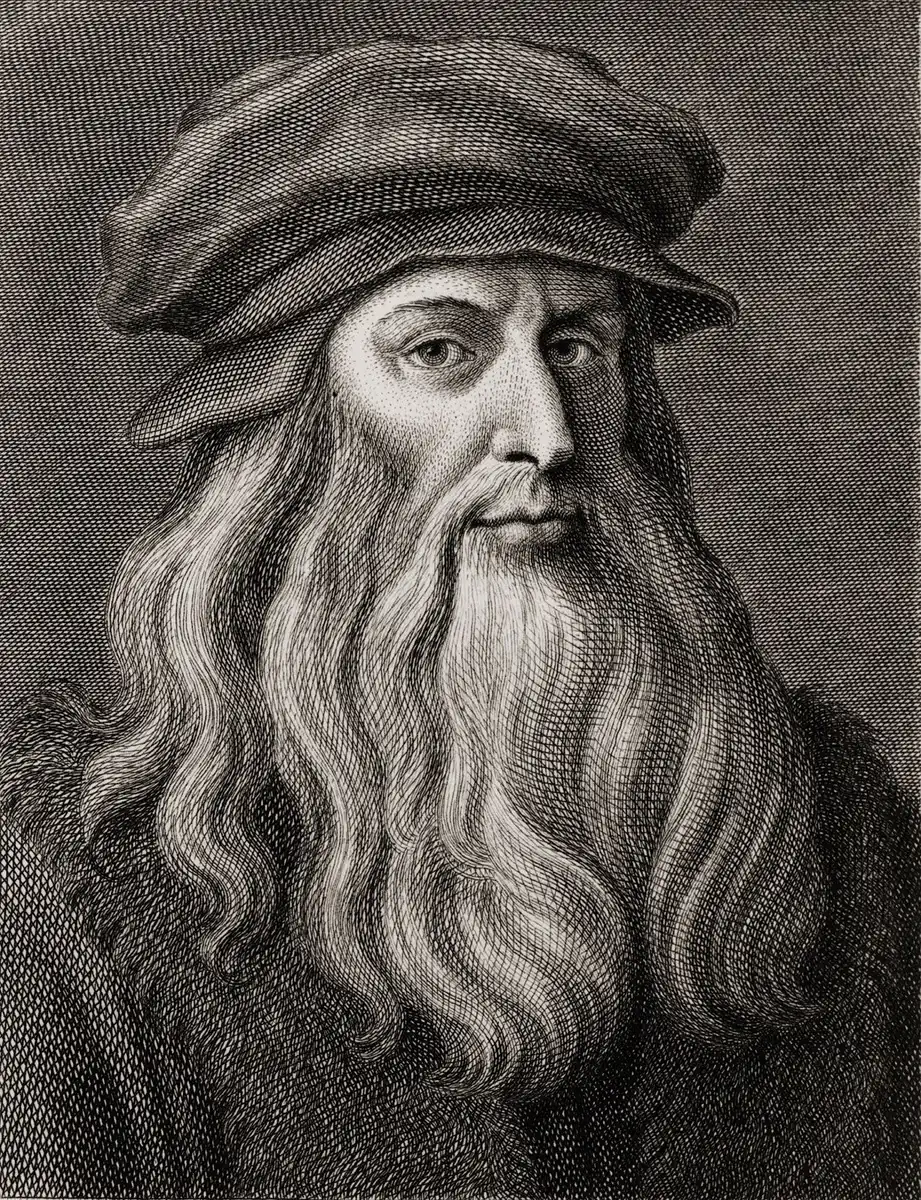
Leonardo da Vinci
Birthday
April 15, 1452
Birth Sign
Aries
Birthplace
Anchiano, Vinci, Republic of Florence (present-day Italy)
Age
Died at 67
Height
5 ft 7 in (170 cm)
About
Leonardo da Vinci was an Italian polymath of the High Renaissance whose range of genius across art and science has made him a byword for the curious, all-encompassing human mind. He is most famous as a painter, and on the strength of a small surviving body of work, including the Mona Lisa and The Last Supper, he is counted among the greatest artists who ever lived, admired for his mastery of light, expression, and atmospheric depth. Yet painting was only one facet of his restless intellect. Leonardo filled thousands of notebook pages with drawings and observations on anatomy, engineering, flight, hydraulics, botany, geology, and optics, often anticipating discoveries by centuries and dissecting cadavers to understand the body with a precision unusual for his age. His sketches of flying machines, war engines, and the workings of muscles and water reveal a mind constantly probing how things work. Many of his projects went unfinished and much of his scientific work remained private, unpublished in his lifetime, so his influence as a thinker emerged only later. Working across Florence, Milan, Rome, and finally France, he embodied the Renaissance ideal of uniting art and inquiry. He endures as perhaps history's most celebrated symbol of human creativity and intellectual ambition.
Early Life & Background
Leonardo was born on April 15, 1452, in the hamlet of Anchiano near Vinci, the illegitimate son of Ser Piero, a Florentine notary, and Caterina, a young peasant woman. Because his parents were not married, he could not follow his father into the notary profession, which may have freed him to pursue art. He spent his first five years in Anchiano, then lived with his father, grandparents, and uncle Francesco in Vinci. His father married a 16-year-old girl named Albiera, who loved Leonardo but died young. Leonardo recorded only two childhood incidents: a kite dropping from the sky and hovering over his cradle, its tail feathers brushing his face, which he regarded as an omen; and discovering a cave while exploring mountains, torn between terror at a possible monster and curiosity to see inside. He received a basic informal education in vernacular writing, reading, and commercial mathematics at an abacus school. His artistic talent was recognized early, and around age 14 his father sent him as an apprentice to the leading Florentine painter Andrea del Verrocchio. In Verrocchio's workshop, Leonardo learned painting, sculpture, and technical skills, and is said to have served as the model for Verrocchio's bronze statue of David. In 1472, at age 20, he qualified as a master in the Guild of Saint Luke but continued working as an assistant in Verrocchio's studio. On January 10, 1478, he received his first recorded independent commission, a large altarpiece for the Chapel of San Bernardo, for which he obtained a cash advance of 25 florins, but he never delivered the work, a pattern of unfinished commissions that would plague his career.
Career Growth
In 1482, Leonardo entered the service of Duke Ludovico Sforza of Milan, abandoning his first commission in Florence, The Adoration of the Magi. He spent 17 years in Milan, producing the first version of The Virgin of the Rocks in 1483, a six-foot-tall altarpiece that experimented with sfumato, the smoky blending of edges. In the 1490s he created the Vitruvian Man drawing, exploring ideal human proportions. Between 1495 and 1498 he painted The Last Supper on the dining room wall of the monastery of Santa Maria delle Grazie, commissioned by Sforza. After the French invasion of Milan in 1499, Leonardo returned to Florence in 1500. There, between 1503 and 1505, he painted the Mona Lisa, his most famous work, and created The Battle of Anghiari, a large mural now lost. He returned to Milan in 1506 with his pupil Salaì, then worked in Rome under Giuliano de' Medici from 1513 to 1516. In 1516 he accepted an invitation from King Francis I of France, moving to Clos Lucé near Amboise with the title of first painter, architect, and mechanic of the king. He died there on May 2, 1519, at age 67, leaving his manuscripts and artistic works to his pupils Francesco Melzi and Salaì.
Career Timeline
Public Image & Style
Leonardo is the archetypal Renaissance Man, the embodiment of human curiosity and creativity. His public image combines artistic genius with scientific brilliance, and the most recognized depiction of him is his self-portrait from around 1512, showing an elderly man with long flowing hair and beard. In media, he is consistently portrayed as visionary, eccentric, endlessly curious, and often tormented by his inability to finish projects. He appears in popular culture from The Da Vinci Code to Assassin's Creed. No official fandom name exists, but enthusiasts often call themselves Leonardians. Fan culture centers on visiting his works in museums, studying his notebooks, and recreating his inventions. Social media accounts dedicated to him share his quotes, artworks, and notebook sketches with a reverential tone.
Fame & Fandom (iFAMOUS Rankings)
In the annals of human achievement, few names command the same silent awe as Leonardo da Vinci. He stands not merely as a painter but as the 4th most famous person in Art & Design, a title anchored firmly by his enduring influence on visual culture the 4th most famous person in Art & Design. This ranking reflects a global attention span that stretches across five centuries, tracking how media coverage, search trends, and cultural consumption keep his legacy alive long after his death. While modern celebrities chase viral moments, Leonardo's fame is built on the slow burn of museums, textbooks, and digital archives that reintroduce his genius to new generations. His fanbase has no formal name; there are no organized clubs or self-identified groups chanting his moniker. Instead, engagement manifests through institutional reverence and digital reconstruction projects like Leonardotheka, which reunited his fragmented manuscripts in 2026. Scholars, artists, and tourists form a diffuse community united by curiosity rather than fandom rituals. Recent discoveries, from potential DNA findings to studio works confirmed at the Metropolitan Museum of Art, fuel this ongoing fascination. The iFANN Global Fame Rankings capture this unique phenomenon where a man who died in 1519 remains more relevant today than many living stars. His story is one of unfinished sketches and visionary leaps, yet his presence in the collective consciousness is absolute.
Interesting Facts and Legends
Leonardo wrote his personal notes in mirror script, reading right to left, likely to protect his ideas. He dissected over 30 human cadavers to study anatomy, defying the controversial norms of his time. A left-handed and ambidextrous master, he spent 17 years in Milan yet completed only about six paintings, leaving dozens of projects incomplete. His notebooks contain over 20,000 pages of observations on flying machines, parachutes, diving suits, military tanks, and sewage systems, designs centuries ahead of their era. He was a vegetarian who reportedly bought caged birds solely to release them. Serving as a party organizer for the Duke of Milan, he created elaborate stage machinery for court festivities. The Mona Lisa was never delivered to its commissioner; Leonardo kept it until his death. Beyond these facts, legends persist: a widely retold story claims he said, 'Once you have tasted flight, you will forever walk the earth with your eyes turned skyward,' capturing his obsession with aviation. In August 2026, scientists highlighted his detailed drawing of a wingless blister beetle, a niche piece of lore showcasing his microscopic observational skills. Another enduring tale suggests he left works unfinished due to perfectionism, though historians argue shifting interests played a larger role.
Notable Quotes
“Simplicity is the ultimate sophistication.”
“Learning never exhausts the mind.”
“The noblest pleasure is the joy of understanding.”
“Art is never finished, only abandoned.”
“I have been impressed with the urgency of doing. Knowing is not enough; we must apply. Being willing is not enough; we must do.”
“The painter has the Universe in his mind and hands.”
“Water is the driver of nature.”
Family & Personal Life
Leonardo's father, Ser Piero da Vinci, was a Florentine notary who had multiple marriages and did not have surviving children until his third and fourth marriages. His mother, Caterina, married an artisan after Leonardo's birth and had four daughters and a son. Leonardo maintained relationships with his half-siblings later in life. He never married and had no known children. His closest companions were his pupils Salaì and Francesco Melzi, who were with him at his death. He had no documented pets.
Notable Connections
Relationships & Dating History
Leonardo da Vinci kept his private life intensely secret, but his relationships with his pupils have been the subject of analysis since the 16th century. His most intimate companion was Gian Giacomo Caprotti da Oreno, known as Salaì, who entered his household in 1490 at about age 10. Salaì remained with Leonardo for nearly 30 years as pupil, assistant, and companion. Walter Isaacson's biography states the relationship was intimate and homosexual. Leonardo described Salaì as a liar, thief, stubborn, and glutton, yet kept him close. Salaì was named in Leonardo's will, receiving some manuscripts and works. Around 1506, Francesco Melzi, the son of a nobleman, joined Leonardo and became his most devoted pupil and companion. Writing to inform Leonardo's brothers of his death, Melzi described Leonardo's feelings for his pupils as both loving and passionate. Melzi was the primary heir of Leonardo's notebooks and preserved them after his death. Leonardo never married and had no known romantic relationships with women. As of 2026, Leonardo died on May 2, 1519, with Francesco Melzi at his side.
- DatedSalaì (Gian Giacomo Caprotti da Oreno)1490 - 1519Pupil, assistant, and likely romantic partner; remained with Leonardo for nearly 30 years until his death.
- DatedFrancesco Melzi1506 - 1519Devoted pupil and companion; was with Leonardo at his death and inherited his notebooks.
Death & Aftermath
Died
May 2, 1519 (aged 67)
Death Place
Amboise, Indre-et-Loire, France
Cause of Death
Natural causes, likely stroke or heart failure
The stone walls of the Château du Clos Lucé in Amboise held a quiet final chapter for Leonardo da Vinci, who spent his last years as the royal painter and mechanic to King Francis I. On May 2, 1519, the polymath passed away at the age of 67 within these French grounds, likely succumbing to natural causes such as a stroke or heart failure after suffering paralysis in his right arm that hindered his painting. Historical tradition records that he received the last rites of the Catholic Church before dying peacefully in the presence of the King and his devoted pupil Francesco Melzi.
The funeral service took place the following day at the Collegiate Church of Saint-Florentin, attended by representatives of the French royal family and clergy, where he was buried in the Chapel of Saint-Hubert. This resting place was later lost when the church was destroyed during the French Revolution, leaving no physical marker to mark his grave today. King Francis I reportedly wept upon hearing the news, declaring that no one could equal the artist, while Melzi worked to preserve the manuscripts and artworks left behind. Centuries later, his legacy endures through foundations dedicated to science and art.
Net Worth (Estate Value)
$2 Billion
iFANN Editorial Team estimate
Per iFANN's editorial analysis, Leonardo da Vinci's estate is valued at approximately $2 Billion as of 2026, though this figure remains largely symbolic given that most of his works are owned by museums rather than private collectors. The Mona Lisa alone is considered priceless, with some estimates suggesting it could fetch over $2 billion if ever auctioned, yet it remains French state property at the Louvre. Salvator Mundi sold for $450.3 million in 2017, marking the highest price ever paid for a painting. Fewer than 20 authenticated paintings survive today. Leonardo's notebooks, held by institutions like the Bibliothèque Ambrosiana and the British Library, hold immense historical value. Revenue generated from tourism, exhibitions, and merchandise tied to his name brings in billions annually, but these funds flow to museums and governments, not a single estate. There is no active manager for the estate; his works remain dispersed across public and private collections worldwide.
Awards Won (1)
Leonardo da Vinci lived and died before the establishment of modern award ceremonies. He received no formal prizes in his lifetime. His recognition came through prestigious commissions and the title of First Painter, Architect, and Mechanic of the King, granted by Francis I of France in 1516. Posthumously, he is universally regarded as one of the greatest artists and thinkers in history.
1516 · Title
Service to King Francis I
Known For
Mona Lisa
1505 · Painter
The Last Supper
1498 · Painter
The Virgin of the Rocks
1483 · Painter
Vitruvian Man
1490 · Draughtsman
Lady with an Ermine
1490 · Painter
Salvator Mundi
1500 · Painter
Keywords
Sources
Quick Facts
- Profession
- painter, engineer, astronomer
- Born
- +1452-04-15
- Birthplace
- Anchiano
- Died
- +1519-05-02
- Death Place
- Clos Lucé
- Gender
- Male
- Birth Sign
- Aries
Personal Details
- Full Name
- Leonardo di ser Piero da Vinci
- Height
- 5 ft 7 in (170 cm)
- Education
- Abacus school in Vinci; apprenticeship with Andrea del Verrocchio in Florence
Frequently Asked Questions
What is Leonardo da Vinci famous for?
Was Leonardo da Vinci married?
How many paintings did Leonardo da Vinci actually finish?
What did Leonardo da Vinci invent?
How much is the Mona Lisa worth?
Similar People
Join the community
fans discussing