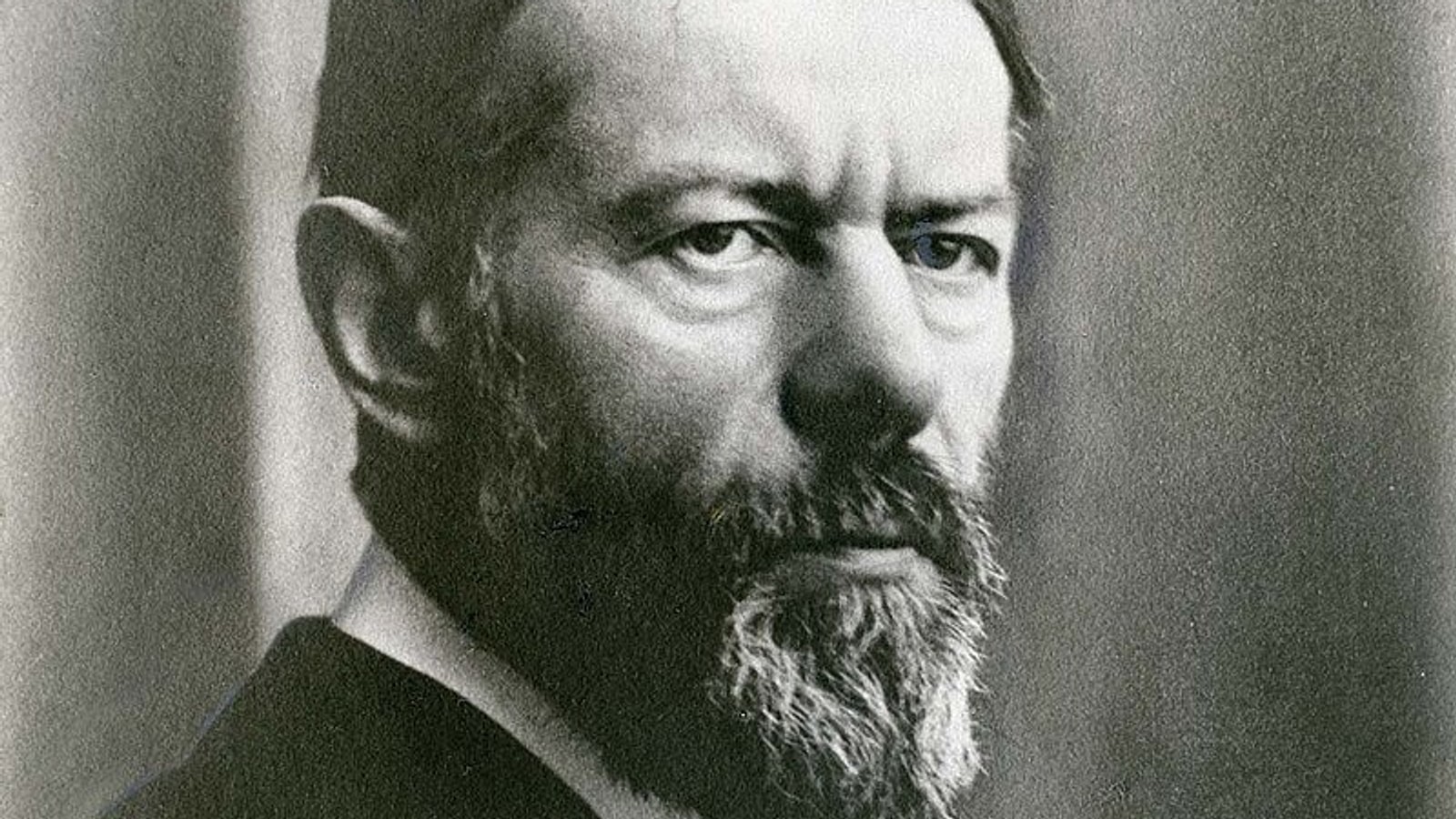
Max Weber
 Germany
Also known as: Maximilian Carl Emil Weber, Max Weber Sr.
Birthday
April 21, 1864
Birth Sign
Taurus
Birthplace
Erfurt, Prussia (now Germany)
Age
Died at 56
About
Max Weber was a German sociologist, economist, and jurist, widely regarded as one of the founding figures of modern sociology. His work on rationalization, bureaucracy, and the Protestant ethic reshaped how scholars understand the development of Western capitalism and the nature of social action.
Weber's influence extends across disciplines, from sociology and political science to economics and religious studies. His concept of verstehen, or interpretive understanding, became a cornerstone of qualitative research. His lectures, particularly "Politics as a Vocation," remain essential reading for students of political theory.
Though he died in 1920, his ideas continue to spark debate and inspire research. His magnum opus, Economy and Society, unfinished at his death, was posthumously edited by his wife and remains a foundational text in sociology.
Early Life & Background
Born in Erfurt, Prussia, to Max Weber Sr., a prominent lawyer and liberal politician, and Helene Fallenstein, a deeply religious and socially engaged woman, Weber grew up in a household steeped in politics and intellectual life. His father served in the Prussian House of Deputies and the Reichstag, hosting leading politicians and scholars at home. The family had attained considerable wealth in the German linen industry.
After enrolling at the University of Heidelberg in 1882, Weber studied law, history, theology, and economics. He took a year off for military service in Strasbourg, then continued his studies at the University of Berlin. His early university years were marked by beer drinking and fencing before he applied himself seriously to his coursework.
Weber earned his doctorate in law in 1889 with a dissertation on medieval trading companies, written under Levin Goldschmidt and Rudolf von Gneist, and completed his habilitation in 1891 on Roman agrarian history under August Meitzen. He lived with his parents for seven years, feeling oppressed by his authoritarian father, until his marriage in 1893.
While weighing a legal career, Weber accepted a research commission from the Verein für Sozialpolitik, producing the East Elbian Report on the displacement of German agricultural workers in East Prussia by Polish migrant laborers. The report's acclaim led to his appointment as professor of economics at Freiburg in 1894, and then at Heidelberg in 1896.
Career Growth
After a period of severe mental illness that forced him to withdraw from teaching in 1899, Weber made a remarkable comeback with the publication of The Protestant Ethic and the Spirit of Capitalism in 1904–05. This work argued that Calvinist values of hard work and thrift fueled the rise of modern capitalism, and it became a foundational text in sociology.
During World War I, Weber initially supported German war aims but later became a vocal critic and advocate for democratization. He delivered his celebrated lectures "Science as a Vocation" and "Politics as a Vocation" in 1919. In the post-war period, he co-founded the German Democratic Party and helped draft the Weimar Constitution.
Weber resumed teaching in Vienna and Munich in 1918, but his life was cut short by pneumonia on June 14, 1920. His unfinished Economy and Society was posthumously edited by his wife and published in 1921–22, cementing his legacy as a towering figure in social theory.
Career Timeline
Public Image & Style
Weber's public image is that of a rigorous, systematic thinker whose work on rationalization and bureaucracy continues to shape academic discourse. He is celebrated for his interpretive sociology, which focuses on understanding the subjective meanings individuals attach to their actions.
His lecture "Politics as a Vocation" remains legendary, with its famous imagery of politics as "drilling through hard boards" requiring "passion and a sense of proportion." Scholars and students across disciplines engage with his works, and his ideas are central to sociology, political science, and economics curricula worldwide.
There is no official fandom name, but his "fans" are intellectuals who find in his work a profound analysis of modernity and its discontents.
Fame & Fandom
Max Weber stands as the 53rd most famous person in Germany, a position he has held steady from the previous cycle, while simultaneously ranking as the 22nd most famous figure in Art & Design. These placements reflect his enduring resonance across national and disciplinary boundaries within the iFANN Global Fame Rankings. His legacy continues to command attention through scholarly engagement and cultural memory rather than fleeting pop-culture moments.
Despite this sustained visibility, Max Weber does not possess a formal fandom or organized fanbase. As an academic figure who passed away long before the era of digital celebrity worship, there are no unofficial fan names, rituals, birthday billboards, or charity drives bearing his name. The audience for his work consists entirely of students, scholars, and researchers in sociology, economics, and political science who study his texts with reverence. This community operates through academic discourse rather than fan campaigns, social media hashtags, or chart pushes. There are no records of him interacting with fans, nor are there any legendary viral incidents involving crowds fainting or streets shutting down. While recent news items occasionally reference individuals with the same name, such as a high school distance runner, these figures hold no connection to the sociologist's legacy. The only 'legend' surrounding Weber is the well-documented account of his severe nervous breakdown in 1897 following his father's death, a verified historical event that shaped his later introspection but remains a matter of biographical fact rather than folklore.
Interesting Facts and Legends
Max Weber was known to sing the Herwegh "Reiterlied" near the end of his life: "The anxious night is over now; we are riding quietly, we are riding to perdition." He described himself as "a member of the bourgeois class," reflecting his family's prosperous background. His widow destroyed his personal chronology about his mental illness, possibly fearing its contents. Weber's mental health crisis included stays at a sanatorium in Bad Urach and travels to Corsica and Italy to recuperate. At his death, many in the academic community might have thought the news referred to his brother Alfred, a professor of economics at Heidelberg.
A pivotal moment often retold in academic circles concerns the severe nervous breakdown Weber suffered in 1897 shortly after his father's death. This event left him unable to work for several years, forcing a retreat from public life until his recovery in the early 1900s. Scholars frequently cite this period as the crucible that deepened his introspection and ultimately shaped his theoretical works on rationalization and social action. While his thesis in *The Protestant Ethic and the Spirit of Capitalism* sparked decades of debate regarding religion and economic behavior, it did not result in on-stage disruptions or extraordinary physical reactions from audiences, as Weber remained a professor and writer rather than a performer.
Notable Quotes
“Politics is like drilling through hard boards: it takes both passion and a sense of proportion.”
“I am a member of the bourgeois class.”
“The anxious night is over now; we are riding quietly, we are riding silently, we are riding to perdition.”
Family & Personal Life
Weber's father, Max Weber Sr., was a lawyer and National-Liberal politician who served in the Prussian House of Deputies (1868–97) and the Reichstag (1872–84). His mother, Helene Fallenstein, was a highly educated woman devoted to religious and social causes, particularly charity work for the poor. The tension between his hedonistic father and humanitarian mother shaped Weber's childhood.
He married his distant cousin Marianne Schnitger in 1893. Marianne became a prominent feminist activist and author, and after Weber's death, she edited Economy and Society for publication and wrote a biography of him. The marriage produced no children.
Weber's younger brother, Alfred, was also an economist and professor at Heidelberg.
Notable Connections
Weber is often grouped with Karl Marx and Émile Durkheim as the three founding fathers of sociology. His wife, Marianne Weber, was a feminist activist and his literary executor. His younger brother, Alfred Weber, was also an economist. Talcott Parsons led the post-war effort to translate and promote Weber's work in America.
Relationships & Dating History
Weber married his distant cousin Marianne Schnitger in 1893, and they remained together until his death in 1920. Marianne was a prominent feminist and author who later edited Economy and Society and wrote a biography of Weber. The marriage produced no children.
Joachim Radkau's 2005 biography, drawing on family archives, revealed unpublished correspondence between Weber and the women closest to him, including his wife, mother, and mistresses, offering a fuller picture of his emotional life. Specific details of these relationships are documented in that correspondence, though the women are not named in available sources.
At the time of his death, Weber was married to Marianne, who survived him.
- MarriedMarianne Weber1893 - 1920CurrentDistant cousins; she became a feminist activist and edited his posthumous works.
Death & Aftermath
Died
June 14, 1920 (aged 56)
Death Place
Munich, Bavaria, Germany
Cause of Death
Acute lobar pneumonia following streptococcal infection
Tributes poured in from peers such as Werner Sombart, Ferdinand Tönnies, and Georg Simmel, who recognized Weber as one of the founding fathers of modern sociology. Max Weber died on June 14, 1920, in Munich, Germany, at the age of 56. His final days were spent bedridden at the University Hospital after a severe case of streptococcal infection contracted in October 1919 while working in a military hospital worsened into acute lobar pneumonia. Historical records confirm his health had been deteriorating since late 1919, with no disputed accounts regarding the cause or circumstances of his passing. The funeral was a private affair held shortly after his death on June 17, 1920, at St. Martin's Church in Munich. The service was attended primarily by family members, close colleagues, and students, including his wife Marianne Weber, who delivered the eulogy.
Weber was cremated, and his ashes were interred in the family plot in Heidelberg. Following his death, his works experienced significant surges in sales and academic study, particularly after the translation of his essays into English in the 1930s and 1940s. His widow, Marianne Weber, edited and published many of his unfinished manuscripts, including Economy and Society, which was released in 1921 and became a foundational text in sociology. She managed his literary rights and publications until her own death in 1954, ensuring his intellectual property remained intact. Numerous institutions and foundations have since been named in his honor, including the Max Weber Foundation in Germany and the Max Weber Program at the European University Institute.
Net Worth (Estate Value)
$10 Million
iFANN Editorial Team estimate
As a deceased academic who died in 1920, no contemporary net worth figures exist in the traditional sense. His estate's primary asset remains his intellectual property, including his published and unpublished works. His widow, Marianne, managed his literary estate, preparing Economy and Society for posthumous publication and publishing her biography of him in 1926. Weber's works remain in print and are continuously translated and studied globally, generating ongoing royalties for his estate. The Munich-based Weber Gesamtausgabe has been producing scholarly editions of his works. Per iFANN's editorial analysis, the enduring significance of his ideas suggests a substantial ongoing value, with the total estimated at $10 Million.
Awards & Accolades
View 3 records, honours and achievementsKnown For
The Protestant Ethic and the Spirit of Capitalism
1905 · Author
Economy and Society
1922 · Author
Politics as a Vocation
1919 · Lecturer
Keywords
Sources
Quick Facts
- Profession
- sociologist, economist, jurist
- Born
- April 21, 1864
- Birthplace
- Erfurt, Prussia (now Germany)
- Died
- June 14, 1920
- Death Place
- Munich, Germany
- Gender
- Male
- Spouse
- Marianne Weber
- Birth Sign
- Taurus
Personal Details
- Full Name
- Maximilian Carl Emil Weber
- Spouse
- Marianne Weber
- Education
- University of Heidelberg, University of Berlin, University of Göttingen
Frequently Asked Questions
What is Max Weber's theory of bureaucracy?
What is the Protestant ethic and the spirit of capitalism?
What did Max Weber mean by 'verstehen'?
Was Max Weber married and did he have children?
How did Max Weber die?
Similar People
Join the community
fans discussing