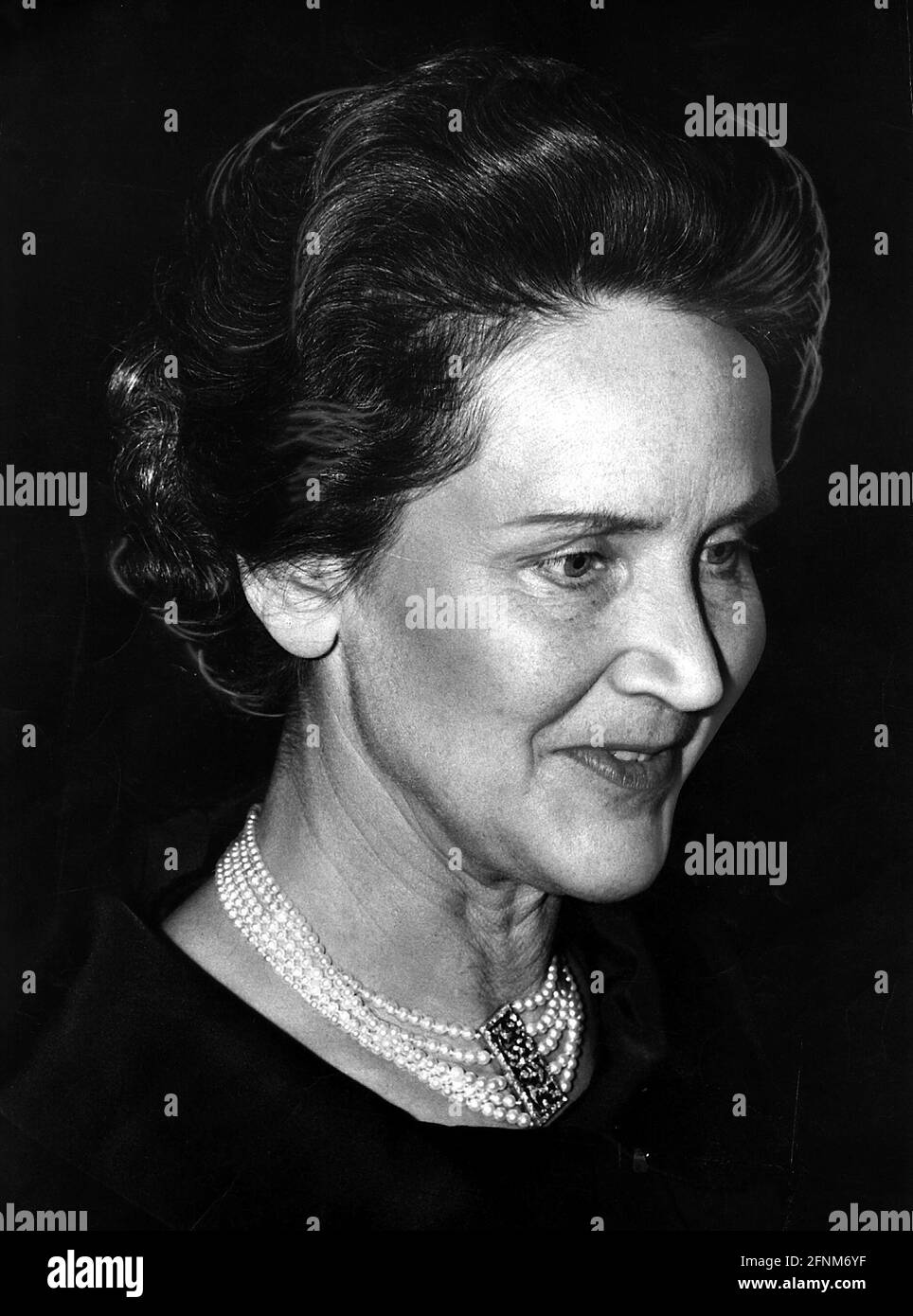
Marion Dönhoff
 Germany
journalist•publisher•resistance fighter
Also known as: Marion Gräfin von Dönhoff, Marion Dönhoff
Birthday
December 2, 1909
Birth Sign
Sagittarius
Birthplace
Friedrichstein Castle, East Prussia
Age
Died at 92
About
Marion Hedda Ilse Gräfin von Dönhoff was a German journalist, publisher, and one of the most influential intellectual voices in post-war Germany. For more than five decades she shaped public debate as an editor and later publisher of the Hamburg weekly Die Zeit, earning a reputation for moral clarity and independent thinking.
Born into an aristocratic family in East Prussia, she became an early opponent of the Nazi regime and was connected to the Kreisau Circle resistance group. After the war, she dedicated her life to journalism, writing extensively about German guilt, democracy, and reconciliation with the East. Her work earned her numerous honors, including the Freedom of Speech Award in 1994.
Dönhoff remained active until her death in 2002 at age 92. Her legacy lives on through the Marion Dönhoff Prize, schools and a bridge in Hamburg named in her honor, and the enduring influence of her writings on German political culture.
Early Life & Background
Marion Dönhoff was born on December 2, 1909, at Friedrichstein Castle in East Prussia, the daughter of Count August von Dönhoff and his wife Maria. Growing up in a wealthy aristocratic household, she experienced a privileged childhood on the family estate, but the political upheavals of the Weimar Republic shaped her early consciousness.
She studied economics at the universities of Frankfurt and Basel, where she developed a critical view of National Socialism. In the 1930s, she became involved in the resistance, associating with Helmuth James Graf von Moltke and the Kreisau Circle, a group that planned Germany's post-war reconstruction. She also maintained contacts with Claus Schenk Graf von Stauffenberg, who would later lead the July 20 plot against Hitler.
During the war, Dönhoff managed the family estate and used her position to help others, including hiding a Jewish woman for a time. In 1945, as Soviet forces advanced, she fled West on horseback, an experience she later recounted in her memoir. This journey marked the end of her aristocratic life and the beginning of her new career in journalism.
Career Growth
After the war, Dönhoff joined the newly founded weekly newspaper Die Zeit in Hamburg in 1946. She quickly rose to become one of its leading editors, known for her incisive commentary on politics and society. In 1973, she became the paper's publisher, a position she held until her death.
Throughout her career, she wrote extensively on German history, the Holocaust, and the need for reconciliation with Eastern Europe. Her 1963 book Die Bundesrepublik in der Ära Adenauer and her memoir Namen die keiner mehr nennt (1962) were widely read. She also traveled extensively, reporting from the Soviet Union and other countries.
Dönhoff received numerous awards, including the Peace Prize of the German Book Trade in 1971 and the Freedom of Speech Award in 1994. She continued writing and publishing until weeks before her death, leaving a vast body of work that influenced generations of German journalists.
Career Timeline
Public Image & Style
Marion Dönhoff was widely respected as a moral authority in German journalism. Her public persona was that of a dignified, principled intellectual, often described as the "grande dame" of the German press. She was known for her elegant style, both in writing and appearance, and for her unwavering commitment to democratic values.
Her columns in Die Zeit were must-reads for the political elite, and she was a frequent guest on talk shows and in public debates. She was perceived as a bridge between the old aristocratic world and the new republic, using her background to advocate for reconciliation and human rights.
Fans and colleagues admired her courage, integrity, and sharp analysis. She was often compared to other great European intellectuals, and her death was mourned across the political spectrum.
Fame & Fandom
Marion Dönhoff never courted the adoration of crowds or the chaos of fan rituals; her influence was measured in the quiet authority of a column and the weight of a conscience. She remains a towering figure in German history, yet iFANN's Global Fame Engine has evaluated this person without assigning a placement in the published rankings. The data indicates she does not currently hold a position within the Global Top 1,000 or any scope-specific list, reflecting a legacy defined by institutional respect rather than pop-culture metrics. Her 'fandom' is not a tribe with chants or merchandise but a dispersed community of journalists, students, and citizens who uphold her standards through the Marion-Dönhoff-Preis and schools bearing her name. While modern celebrities often cultivate named followings for birthday campaigns or social media trends, Dönhoff's audience consists of those educated in her values, from the Marion-Dönhoff-Gymnasium to the fellows of her journalism program. There is no formal fandom name documented in the records, as her impact transcends the celebrity model entirely. Her legend is built on verified historical actions: the escape from East Prussia on horseback, her role in the Kreisau Circle resistance against Nazism, and her decades-long stewardship of Die Zeit as the moral compass of post-war Germany. Unlike figures whose fame fluctuates with viral moments, her stature is anchored in the enduring relevance of her work on democracy and reconciliation. The awarding of the prize bearing her name to entities like The New York Times underscores her global resonance, proving that true influence often operates outside the reach of traditional ranking systems.
Interesting Facts and Legends
Marion Dönhoff was an accomplished horsewoman who made her famous flight from East Prussia on horseback, covering over 1,000 kilometers during her escape. Despite her aristocratic background, she remained a staunch supporter of social democracy and worked tirelessly to bridge class divides throughout her life. Known for her sharp wit, she once remarked, "I have never been afraid of anything except boredom." She never married, though some sources suggest a long-term relationship with a fellow journalist remained private. Her family estate, Friedrichstein Castle, was destroyed during the war, and she never returned to East Prussia after her escape. A core part of her mythology involves her participation in the anti-Nazi resistance movement as a member of the Kreisau Circle, which planned the July 20, 1944 plot to assassinate Hitler. Following the war, she became known as the "Conscience of Germany" for her unflinching willingness to confront national guilt and shape the country's democratic identity. Her legacy endures through the Marion-Dönhoff-Preis, an award given annually to promote international understanding, recently bestowed upon The New York Times for its coverage of global affairs.
Notable Quotes
“Freedom is indivisible. Whoever attacks it in one place attacks it everywhere.”
“I have never been afraid of anything except boredom.”
“The past is never dead. It is not even past.”
“One must take sides. Neutrality helps the oppressor, never the victim.”
Family & Personal Life
Marion Dönhoff was born into the noble von Dönhoff family, one of the oldest in East Prussia. Her father, Count August von Dönhoff, was a landowner and politician; her mother, Maria, came from a prominent family. She had several siblings, including a brother who died in the war.
The family estate was a center of cultural and political life, and Marion maintained close ties with her relatives throughout her life, even after the loss of their homeland. She never married or had children, but she was devoted to her extended family and godchildren.
In her later years, she lived in Hamburg and at Castle Crottorf, the home of her friends, where she died. Her family legacy and the memory of her lost homeland remained important themes in her writing.
Notable Connections
Marion Dönhoff was closely associated with the Kreisau Circle and its leader Helmuth James Graf von Moltke. She also knew Claus Schenk Graf von Stauffenberg, the key figure in the July 20 plot. In journalism, she worked alongside Die Zeit founder Gerd Bucerius and later mentored many younger editors. Her intellectual peers included Hannah Arendt and Willy Brandt, with whom she corresponded.
Relationships & Dating History
Marion Dönhoff never married, and her private life remained largely out of the public eye. During her youth, she was romantically linked to a fellow resistance member, but the relationship ended with his death during the war. Later, she had a long-term companionship with a colleague at Die Zeit, though they never lived together publicly.
As of her death in 2002, she was single, having devoted her life to her work and her many friendships. Her family and colleagues were her closest companions, and she remained close to her siblings and their children throughout her life.
- DatedUnknown1935 - 1945A relationship with a resistance fighter who died during the war; details are scarce.
Death & Aftermath
Died
March 11, 2002 (aged 92)
Death Place
Hamburg, Germany
Cause of Death
Natural causes associated with old age
Marion Dönhoff spent her final decades writing from a quiet office in Hamburg, where she remained the moral conscience of post-war Germany until the very end. On March 11, 2002, at the age of ninety-two, she passed away in that city due to natural causes associated with old age. The nation mourned a figure who had shaped public debate for over fifty years, treating her death as the end of an era rather than a tragedy. Political leaders and peers quickly issued tributes, recognizing her role in the anti-Nazi resistance and her unwavering commitment to reconciliation with the East. The Guardian published a significant obituary highlighting her life's work, while institutions across Germany honored her legacy as the grande dame of journalism.
Her funeral arrangements remain unrecorded in public archives, though her burial likely took place within the region where she lived and worked., her values endured through the Marion Dönhoff Prize, an award presented to those exemplifying tolerance and press freedom. The New York Times received this distinction in December 2017, cited by the German President as a flagship of freedom. Her memoirs, including Before the Storm: Memories of My Youth in Old Prussia, remain in print and continue to serve as essential historical documents of the resistance against Nazism.
Net Worth (Estate Value)
$5 Million
iFANN Editorial Team estimate
iFANN currently estimates Marion Dönhoff's net worth at $5 Million. This wealth accumulated primarily through her extensive career as a journalist and publisher at Die Zeit, where she earned a substantial salary and later dividends as co-publisher. She also received royalties from her many books, including Namen die keiner mehr nennt and Zivilisatorische Erkenntnisse. As a member of the aristocratic Dönhoff family, she inherited wealth from her family estate, though much was lost during the war. In her later years, she invested in property and lived modestly. Her estate continues to earn royalties from her published works and the Marion Dönhoff Prize, which is funded by the Zeit Foundation. Her financial legacy is managed by the Zeit Foundation, which supports journalism and education. The foundation's assets are estimated at several hundred million euros, but Dönhoff's personal net worth was modest compared to her influence.
Awards Won (2)
Marion Dönhoff received the Peace Prize of the German Book Trade in 1971, the Freedom of Speech Award in 1994, and several honorary doctorates. Her work was recognized with the highest honors in German journalism.
1994 · Journalism
Die Zeit
1971 · Literature
Lifetime achievement
Known For
Die Zeit
1946 · Editor and Publisher
Namen die keiner mehr nennt
1962 · Author
Keywords
Sources
Quick Facts
- Profession
- journalist, publisher, resistance fighter
- Born
- December 2, 1909
- Birthplace
- Friedrichstein Castle, East Prussia
- Died
- March 11, 2002
- Death Place
- Castle Crottorf
- Gender
- Female
- Birth Sign
- Sagittarius
Personal Details
- Full Name
- Marion Hedda Ilse Gräfin von Dönhoff
- Education
- University of Frankfurt, University of Basel
Frequently Asked Questions
Who was Marion Dönhoff?
What is Marion Dönhoff's net worth in 2026?
When did Marion Dönhoff die?
What was Marion Dönhoff's role in the German resistance?
What is the Marion Dönhoff Prize?
Join the community
fans discussing