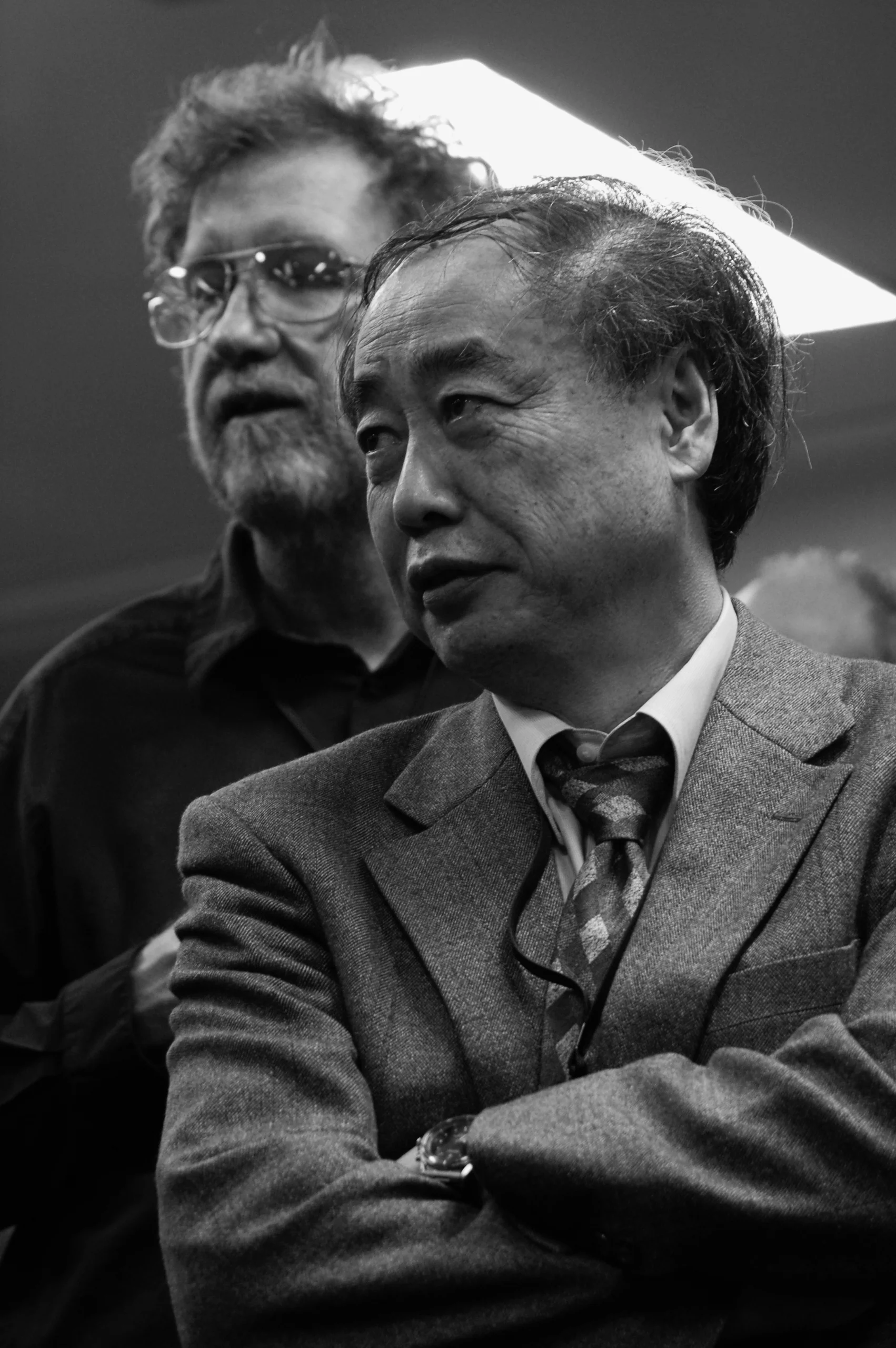
Makoto Kobayashi
 Japan
JapanBirthday
April 7, 1944
Birth Sign
Aries
Birthplace
Nagoya, Japan
Age
82 years old
About
Makoto Kobayashi is a Japanese theoretical physicist who shared the 2008 Nobel Prize in Physics for a prediction that fundamentally changed our understanding of the universe. Working with Toshihide Maskawa, he showed in 1973 that at least three families of quarks must exist to explain why matter and antimatter behave asymmetrically. That insight, now encoded in the Cabibbo-Kobayashi-Maskawa matrix, became a pillar of the Standard Model of particle physics.
Today Kobayashi is professor emeritus at the High Energy Accelerator Research Organization (KEK), where he spent decades leading research. His quiet persistence and deep theoretical insight earned him not only the Nobel but also the Sakurai Prize, the Japan Academy Prize, and the Asahi Prize. For particle physicists, his name is synonymous with the elegant mathematics that explains why the universe is made of matter rather than nothing at all.
Early Life & Background
Born in Nagoya during World War II, Kobayashi's early life was marked by upheaval. His father, a physician named Hisashi, died when Makoto was just two years old, and the family home was destroyed in air raids. They moved in with his mother's family, and young Makoto grew up as a quiet child who loved to read.
His cousin Toshiki Kaifu would later become Japan's 51st Prime Minister, but physics, not politics, captured Kobayashi's imagination. He enrolled at Nagoya University, earning his bachelor's degree in 1967 and his doctorate in 1972 under the supervision of Shoichi Sakata. It was Sakata's school of particle physics that shaped his thinking and set the stage for the breakthrough that would come just a year after graduation.
Career Growth
The breakthrough arrived in 1973. Collaborating with Toshihide Maskawa, Kobayashi published a paper introducing the Cabibbo-Kobayashi-Maskawa matrix, a framework explaining how quarks change flavor and why CP symmetry is violated. Initially the work drew little attention, but as particle accelerators confirmed its predictions, its importance became undeniable.
Kobayashi spent most of his career at Nagoya University's research institute and then at KEK, where he served as a professor and, from 2003, as director of the Institute of Particle and Nuclear Studies. The Nobel Prize came in 2008, shared with Maskawa and Yoichiro Nambu. He also received the Sakurai Prize and Japan Academy Prize in 1985, the Asahi Prize in 1995, and the High Energy and Particle Physics Prize in 2007.
Career Timeline
Public Image & Style
In the world of particle physics, Kobayashi is revered as a quiet giant. Colleagues describe him as thoughtful and reserved, a stark contrast to the flashier figures in the field. He rarely gave interviews and let his work speak for itself.
His public image is that of a dedicated scientist who spent decades in the lab and at the blackboard, driven by curiosity rather than fame. When the Nobel Prize came, it felt like a long-overdue recognition of a career built on patience and precision.
Fame & Fandom (iFAMOUS Rankings)
Makoto Kobayashi is currently evaluated by the iFANN Global Fame Engine but does not hold a placement in the published rankings, standing outside the Global Top 1,000 and all Top-100 scope lists. While he commands immense respect within the scientific community as a Nobel laureate, his fame remains distinct from the viral celebrity culture tracked by global popularity metrics. The physicist's recognition is anchored in the verified, high-level achievements of his career rather than mass-market consumption signals or fan-driven chart pushes. There is no single unified fandom name for any individual bearing this name across science, manga, or mecha design, and no organized fanbase campaigns, birthday billboards, or fan-funded projects are documented for him. His audience consists of general readers, scientists, and anime enthusiasts who appreciate their respective works individually without a centralized identity capable of driving major cultural movements. The legends surrounding him are academic milestones, such as the 50th anniversary celebration of the Kobayashi-Maskawa theory, rather than the folklore or viral incidents that define pop icons. Even with recent commercial activity like capsule toy releases for related characters, these remain isolated events rather than evidence of a coordinated fan movement. The lack of a formal fandom name reflects the nature of his influence, which is profound yet quiet, operating through the enduring power of discovery and art rather than the noise of modern stardom.
Interesting Facts and Legends
Before his rise to prominence, Makoto Kobayashi was shaped by the theories of his doctoral advisor, Shoichi Sakata, whose own model of elementary particles deeply influenced the young physicist's early thinking. Despite his towering reputation in the field, he remained known for his modesty, rarely seeking the spotlight even after decades of groundbreaking work. A lesser-known family connection saw his cousin, Toshiki Kaifu, serve as Prime Minister of Japan from 1989 to 1991, though the two men maintained distinct professional paths. It is also a common point of confusion that he is not related to the manga artist of the same name who created 'What's Michael?' and designed mecha for the Gundam series. The Cabibbo-Kobayashi-Maskawa matrix bears his name, building directly on earlier work by Nicola Cabibbo. In the realm of legends, the 2008 Nobel Prize ceremony in Stockholm stands as the defining moment where he received one-fourth of the prize money, officially recognizing the discovery of broken symmetry origins. Decades later, the scientific community continues to honor this insight, with CERN hosting a special event in April 2023 to celebrate fifty years of the Kobayashi-Maskawa theory, reaffirming its status as a pillar of the universe's structure.
Notable Quotes
“The universe is not symmetric. That is the mystery we tried to solve.”
“I was just curious about why there is more matter than antimatter.”
“Science is a collaborative effort, even if one name goes on the paper.”
“I never expected such a high honor for work done so long ago.”
Family & Personal Life
Kobayashi married Sachiko Enomoto in 1975, and they had a son, Junichiro, born in 1977. Sachiko passed away from cancer at just 39 years old. In 1990, he remarried Emiko Nakayama, whose father was a mathematician. The couple has a daughter, Yuka.
Family remained a grounding force throughout his career. Despite the demands of theoretical physics, Kobayashi kept his personal life private and devoted. His second wife Emiko has been a steady presence at his side for over three decades.
Notable Connections
Kobayashi's most important collaboration was with Toshihide Maskawa, with whom he shared the 2008 Nobel Prize. His doctoral advisor, Shoichi Sakata, shaped his early thinking. At KEK, he worked alongside Yoji Totsuka, and he was a contemporary of Yoichiro Nambu, who shared the same Nobel for separate contributions to symmetry breaking.
Relationships & Dating History
Kobayashi married Sachiko Enomoto in 1975. The couple had a son, Junichiro, born in 1977. Sachiko died of cancer at age 39, leaving Kobayashi a widower.
In 1990, he remarried Emiko Nakayama, the daughter of a mathematician. They have a daughter, Yuka. As of 2026, Kobayashi and Emiko remain married, living quietly in Japan.
- MarriedSachiko Enomoto1975 - presentFirst wife, died of cancer at age 39.
- MarriedEmiko Nakayama1990 - presentCurrentSecond wife, daughter of a mathematician.
Salary, Net Worth In 2026
$1 Million
iFANN Editorial Team estimate
As a theoretical physicist, Kobayashi's earnings came primarily from his academic salary and research grants throughout his career. Nobel Prize winners receive a cash award; in 2008, the prize money was 10 million Swedish kronor, with Kobayashi receiving one-fourth of that share. Per iFANN's editorial analysis, estimates of his net worth in 2026 sit at around $1 Million, reflecting a lifetime of academic work rather than commercial ventures. He has no known business interests or endorsement deals, and his wealth is modest compared to celebrity scientists who have built media empires. The figure represents a conservative valuation of a life dedicated to pure research, devoid of the lucrative side hustles often seen in other fields.
Awards Won (5)
Kobayashi won the 2008 Nobel Prize in Physics, shared with Toshihide Maskawa and Yoichiro Nambu. Earlier, he received the Sakurai Prize and the Japan Academy Prize in 1985, the Asahi Prize in 1995, and the High Energy and Particle Physics Prize in 2007. These honors recognized his foundational work on CP violation and quark families.
2008 · Physics
Discovery of the origin of the broken symmetry which predicts the existence of at least three families of quarks
2007 · Physics
CP violation and the CKM matrix
Known For
Cabibbo-Kobayashi-Maskawa matrix
1973 · Co-creator
Nobel Prize in Physics
2008 · Laureate
Keywords
Sources
Quick Facts
- Profession
- theoretical physicist
- Born
- April 7, 1944
- Birthplace
- Nagoya, Japan
- Gender
- Male
- Birth Sign
- Aries
Personal Details
- Full Name
- Makoto Kobayashi
- Spouse
- Emiko Nakayama
- Children
- 2 (Junichiro, Yuka)
- Education
- Nagoya University (B.S. 1967, D.Sc. 1972)
Frequently Asked Questions
Who is Makoto Kobayashi?
What is Makoto Kobayashi known for?
When was Makoto Kobayashi born?
Where is Makoto Kobayashi from?
What did Makoto Kobayashi win the Nobel Prize for?
Similar People
Join the community
fans discussing