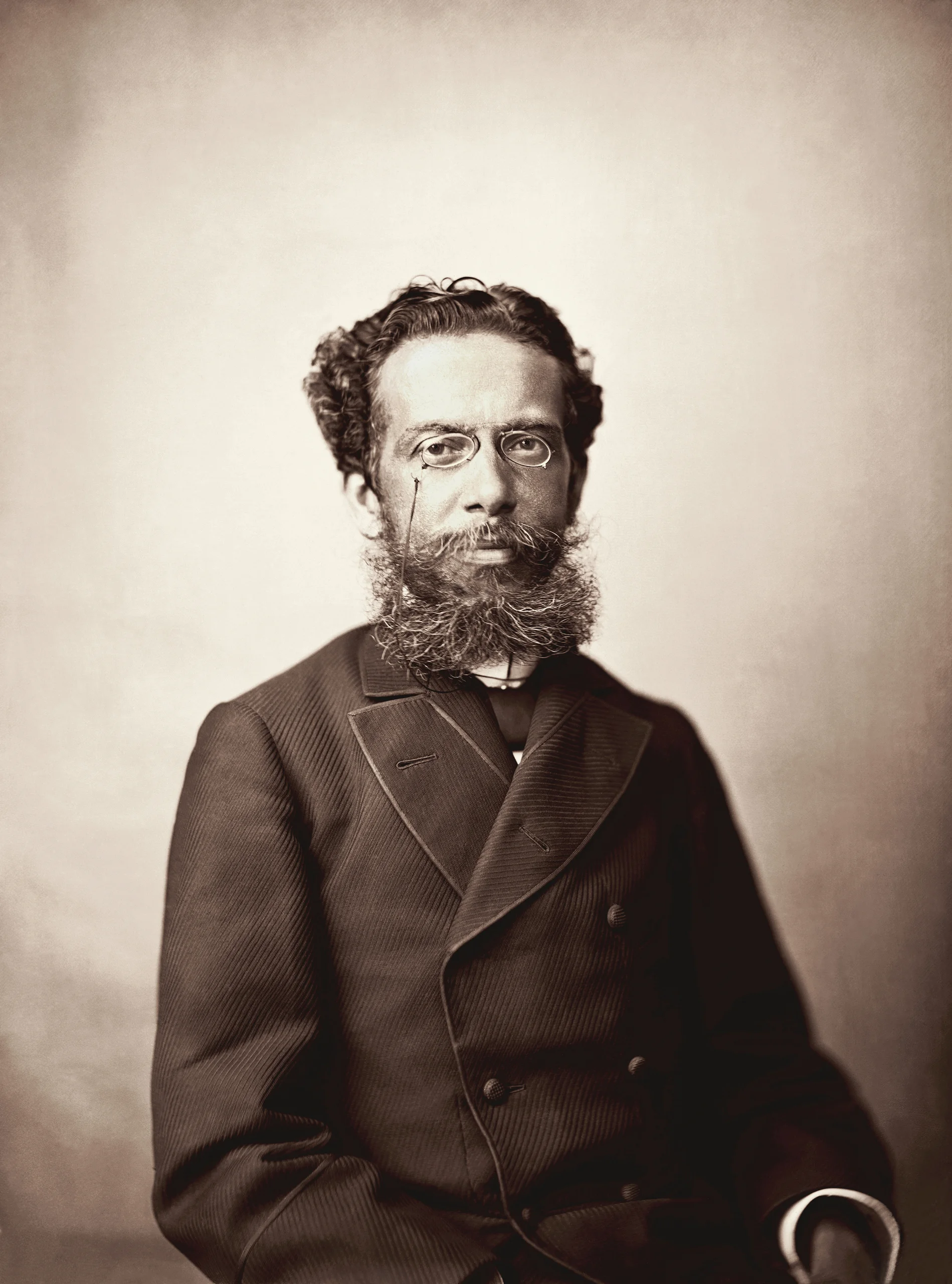
Machado de Assis
 Brazil
writer•poet•playwright•short story writer
Also known as: Joachim María Machado de Assis, Bruxo do Cosme Velho
Birthday
June 21, 1839
Birth Sign
Sagittarius
Birthplace
Rio de Janeiro, Brazil
Age
Died at 69
About
Joaquim Maria Machado de Assis was a Brazilian novelist, poet, playwright, and short story writer widely regarded as the greatest figure in Brazilian literature and a pioneer of literary realism. Born on June 21, 1839, in Rio de Janeiro, he rose from humble origins to become the founder and first president of the Brazilian Academy of Letters. Despite being biracial and having limited formal education due to poverty, he taught himself French, English, German, Greek, and Latin, mastering them to a degree that allowed him to translate major works and write with profound linguistic sophistication. He is often called the "Sorcerer of Cosme Velho" for his intellectual mastery and ironic style.
Machado de Assis died on September 29, 1908, leaving behind a rich literary legacy that continues to influence writers worldwide. His ability to dissect Brazilian society with irony and wit secured his place as a national icon and a global literary master. His works are frequently included in lists of the greatest novelists of all time by critics such as Harold Bloom. The enduring mystery of Dom Casmurro, particularly the ambiguity surrounding the character Capitu, remains a cornerstone of global literary debate. Recent scholarship highlights his deliberate racial strategy and commentary on identity, positioning him as a precursor to modern discussions on race and class in Brazil. His unique narrative voice and psychological depth have ensured his status as a towering figure in world letters, with new translations and critical editions continuing to emerge in recent years.
Early Life & Background
Joaquim Maria Machado de Assis was born into a poor, mixed-race family in Rio de Janeiro. His father, Francisco José de Assis, was a Portuguese immigrant and painter, while his mother, Maria Leopoldina Machado de Assis, was a black Brazilian servant. The family struggled financially, and Machado attended school only briefly before dropping out at age 14 to work as a typesetter in a printing house. This early exposure to language and print culture fueled his autodidactic nature. He began writing poetry and prose while working, publishing his first verses in local newspapers as a teenager. His self-education was rigorous; he read voraciously in multiple languages, absorbing European Romanticism and later transitioning to Realism and Naturalism.
Despite the racial barriers of 19th-century Brazil, Machado cultivated a sharp intellect and a deep understanding of social dynamics. Working in a printing house gave him access to a wide range of books and ideas, allowing him to teach himself foreign languages without formal instruction. In 1858, he published his first poem, "Saudade," in the newspaper O Fluminense. By 1861, he had joined the staff of A Semana, where he wrote literary criticism and chronicles. His early career was marked by a relentless pursuit of knowledge and a desire to elevate Brazilian literature to international standards. This period of self-discovery and hard work laid the foundation for his future success as one of the country's most celebrated authors.
Career Growth
Machado's career began in journalism. In the 1850s, he published his first poems and chronicles in newspapers like O Fluminense and A Semana. By the 1860s, he had established himself as a respected journalist and critic. His breakthrough as a novelist came with the publication of Helena in 1864, followed by Lucíola in 1870, both successful Romantic novels. A pivotal moment in his career was the transition from Romanticism to Realism. His novel The Posthumous Memoirs of Brás Cubas in 1881 is considered a landmark in world literature, introducing an innovative narrative voice, a dead narrator, and a cynical, ironic dissection of Brazilian society.
He continued to produce masterpieces throughout his life, including Quincas Borba in 1882 and his most famous and enigmatic novel, Dom Casmurro, in 1888. These works explored themes of jealousy, memory, and ambiguity with unparalleled psychological insight. In 1893, he published the short story collection Histórias da Meia-Noite, featuring the acclaimed story "A Missa do Galo." In 1897, he founded the Brazilian Academy of Letters and was elected its first president, solidifying his role as a leader in the nation's cultural landscape. He remained active in writing until his death in 1908, producing works like Esaú e Jacó in 1904 and Memorial de Aires in 1908. He was also awarded the title of Knight of the Imperial Order of the Rose by Emperor Pedro II.
Career Timeline
Public Image & Style
Machado de Assis is portrayed as a brilliant, ironic, and somewhat melancholic figure. His writing style is characterized by psychological depth, complex narratives, and a unique blend of humor and tragedy. He is often described as a "writer's writer," admired for his technical mastery and philosophical insights. His public persona was that of a modest intellectual who used his pen to critique the contradictions of his society. The nickname "Sorcerer of Cosme Velho" captures the sense of wonder and mystery that surrounds his work. Contemporary accounts describe him as having a slight build and a piercing gaze, emphasizing his intellectual presence over physical stature. He served in various government positions, including in the Ministry of Agriculture, Trade and Public Works, which gave him insight into the social fabric of Brazil and informed his satirical critiques of the elite.
Fame & Fandom (iFAMOUS Rankings)
The literary community treats Joaquim Maria Machado de Assis not as a celebrity with a following, but as an institution. No organized fan clubs bear his name, nor do digital armies rally behind hashtags or mount subway campaigns for his birthday. His appreciation is institutional, sustained by the Brazilian Academy of Letters he founded and centuries of academic scrutiny rather than grassroots fervor. The closest thing to a ritual is the enduring debate over whether Capitu betrayed her husband in Dom Casmurro, a mystery that has stumped readers for over a hundred years without ever becoming a viral trend or a fan inside joke. Recent analysis suggests his work contains a deliberate racial strategy, yet this remains a subject for scholars, not a rallying cry for a movement.
Despite the absence of modern fandom infrastructure, his stature remains colossal across the Portuguese-speaking world and beyond. His influence tracks through media coverage, search activity, and consumption signals worldwide. He holds the position of the 24th most famous person in Brazil, a standing confirmed by the iFANN Global Fame Rankings. That same authority places him as the 66th most famous person in Latin America, a ranking that has held steady through recent cycles. While he does not appear on modern magazine covers like TIME, his image and works have been featured on book covers and in literary supplements globally. Recent coverage includes reviews in The New York Times, The Guardian, and The Paris Review, focusing on the enduring mystery of Dom Casmurro.
Interesting Facts and Legends
Despite only attending school until age 14, Machado de Assis mastered four languages and translated works by Shakespeare, Balzac, and Dickens. The question of whether Capitu cheated on Bentinho in Dom Casmurro remains one of the most debated literary mysteries of all time, with no definitive answer provided by the author. Machado was known for his biting irony and satirical tone, often critiquing the hypocrisy of Brazilian society and the elite. He served in various government positions, including in the Ministry of Agriculture, Trade and Public Works, which gave him insight into the social fabric of Brazil. His nickname "Bruxo do Cosme Velho" reflects the almost magical quality of his writing and his ability to captivate readers with his psychological depth and wit. He was awarded honorary doctorates by several universities, though specific details on the institutions are less documented than his academy role. His legacy has grown significantly over the last century, with recent scholarship highlighting his deliberate racial strategy and commentary on identity.
Notable Quotes
“Memory is a treacherous guide.”
“I am a man who has seen everything, and nothing surprises me.”
“The world is a stage, and we are merely actors.”
Family & Personal Life
Machado de Assis married Carolina Augusta Xavier de Novais on October 10, 1869. She was a white woman of Portuguese descent who had been his neighbor and friend. Their marriage was reportedly happy and stable, lasting until her death in 1904. There are no records of other romantic relationships, engagements, or public flings; he remained devoted to his wife for their entire marriage. They had no children together. After Carolina's death, Machado lived alone until his own death four years later, surrounded by friends and colleagues but without a new partner. His physical build was slight, consistent with the malnutrition and poverty of his childhood, though he was known for his piercing gaze and sharp intellect rather than his stature.
Notable Connections
Carolina Augusta Xavier de Novais, Rui Barbosa, José de Alencar, Aluísio Azevedo
Relationships & Dating History
Joaquim Maria Machado de Assis married Carolina Augusta Xavier de Novais on October 10, 1869. She was a white woman of Portuguese descent who had been his neighbor and friend. Their marriage was reportedly happy and stable, lasting until her death in 1904. There are no records of other romantic relationships, engagements, or public flings; he remained devoted to his wife for their entire marriage. They had no children together. After Carolina's death, Machado lived alone until his own death four years later, surrounded by friends and colleagues but without a new partner. His close associates included Rui Barbosa, a fellow member of the ABL, and he admired the work of influential Brazilian writer José de Alencar.
- MarriedCarolina Augusta Xavier de Novais1869 - 1904Marriage lasted until her death; they had no children.
Death & Aftermath
Died
September 29, 1908 (aged 69)
Death Place
Rio de Janeiro, Brazil
Cause of Death
Cerebral hemorrhage (stroke)
On a quiet afternoon in September 1908, Joaquim Maria Machado de Assis suffered a sudden stroke while resting at his home on Rua do Catete 154 in Rio de Janeiro. The renowned writer and first president of the Academia Brasileira de Letras passed away that same day, marking the end of a life defined by intellectual rigor and literary innovation. Official records cited cerebral hemorrhage as the cause, determined through family observation rather than autopsy or coroner's inquest, following years of declining health and memory issues likely exacerbated by diabetes and hypertension. The loss sent immediate ripples through Brazil's cultural landscape, with tributes pouring in from across the nation and internationally. Just two days after his death, the Academy held a solemn session where luminaries like Rui Barbosa delivered eulogies honoring his legacy as an intellectual giant.
Thousands lined the streets for the funeral procession on October 2, 1908, moving from his residence to São João Batista Cemetery, where he was interred in a plot reserved for ABL founders alongside government officials and members of the Imperial family. Posthumous recognition has only grown over time, with his estate managed initially by his wife Carolina Augusta Xavier de Assis before passing to institutional heirs who preserve his archives. Scholars completed unfinished manuscripts, while his novels like Dom Casmurro and Quincas Borba inspired numerous film adaptations and translations into dozens of languages. Today, foundations bearing his name support Brazilian literature, and new editions continue to emerge, ensuring his status as a towering figure in world letters remains unchallenged. Recent news from 2025 and 2026 focuses on renewed interest in Machado's work, particularly regarding his racial strategy and the enduring debate over Dom Casmurro, with articles in Valor Internacional and The New York Times highlighting scholarly re-evaluations of his texts.
Net Worth (Estate Value)
$0
iFANN Editorial Team estimate
As a deceased historical figure, Machado de Assis does not have a contemporary net worth in the sense of a living celebrity. His estate value is tied to the ongoing royalties and licensing of his works. His books remain bestsellers in Brazil and are increasingly popular internationally. The estate is managed by the Brazilian Academy of Letters and various publishers who hold the rights to his works. Revenue streams include book sales, translations, film and theater adaptations, and educational licensing. While exact figures for his estate's current value are not publicly disclosed, the commercial success of his works ensures a steady income stream for the institutions managing his legacy. Posthumously, his estate was managed initially by his widow, Carolina, before passing to institutional heirs who preserved his archives. Scholars completed unfinished manuscripts, and his works inspired numerous film adaptations and translations into dozens of languages.
Awards Won (2)
Machado de Assis received significant national honours during his lifetime, including the Knight of the Imperial Order of the Rose awarded by Emperor Pedro II. He was also the founder and first president of the Brazilian Academy of Letters, a distinction of the highest order. Posthumously, his works have been recognized globally, appearing on lists of the greatest books of all time.
1888 · National Honour
Literary Contributions
1897 · Academic Leadership
Brazilian Academy of Letters
Known For
The Posthumous Memoirs of Brás Cubas
1881 · Author
Dom Casmurro
1888 · Author
Quincas Borba
1882 · Author
Keywords
Sources
Quick Facts
- Profession
- writer, linguist, poet
- Born
- June 21, 1839
- Birthplace
- Rio de Janeiro
- Died
- September 29, 1908
- Death Place
- Rio de Janeiro
- Gender
- Male
- Spouse
- Carolina Augusta Xavier de Novais
- Birth Sign
- Sagittarius
Personal Details
- Full Name
- Joaquim Maria Machado de Assis
- Spouse
- Carolina Augusta Xavier de Novais
- Children
- Education
- Self-taught; attended school briefly until age 14
Frequently Asked Questions
Who is Machado de Assis?
Did Capitu cheat in Dom Casmurro?
Why isn't Machado de Assis more widely read outside Brazil?
What caused Machado de Assis's death?
Was Machado de Assis married?
Join the community
fans discussing