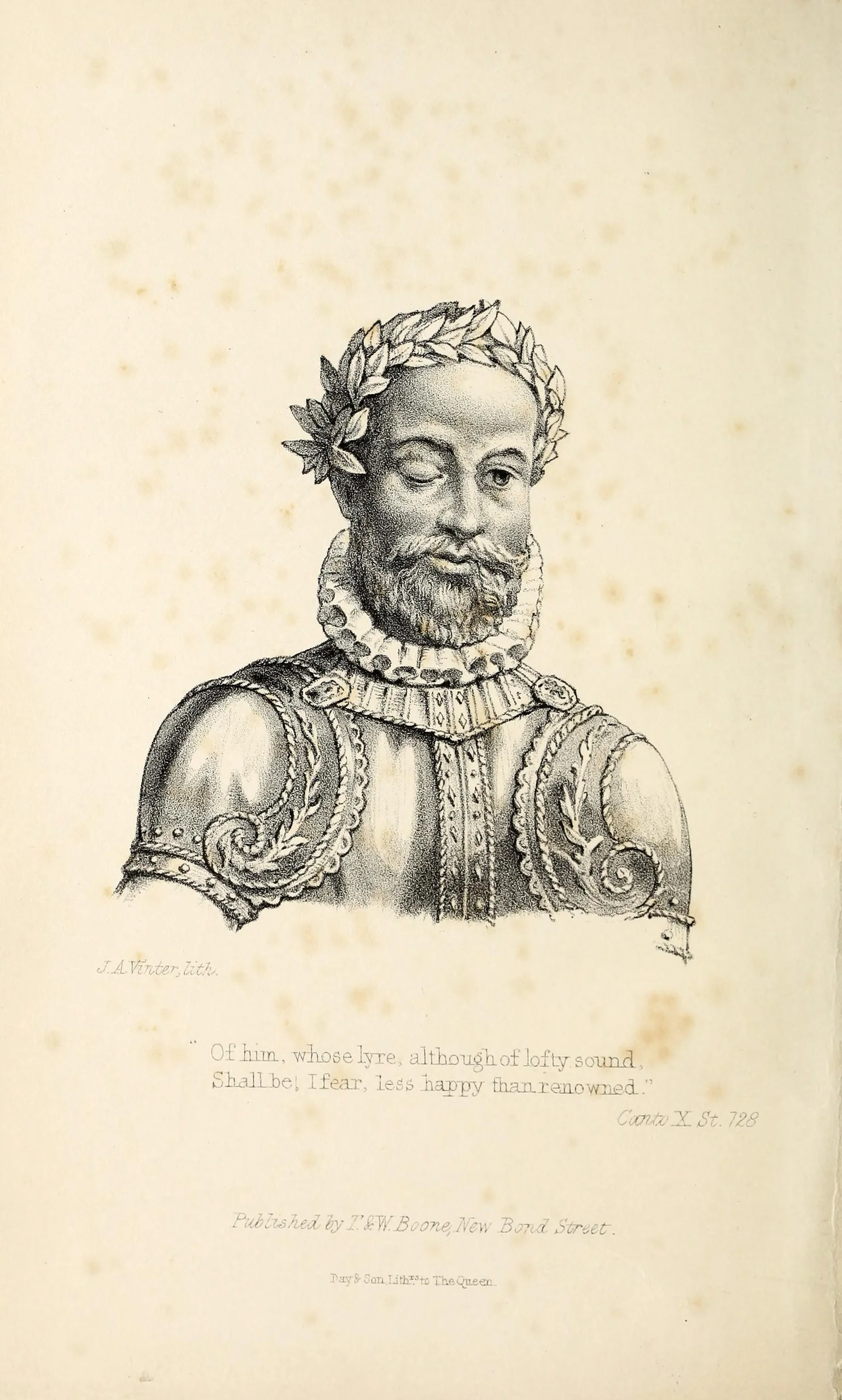
Luís de Camões
 Portugal
Also known as: Camoens, Camoëns, Luís Vaz de Camões
Birthday
May 10, 1524
Birth Sign
Taurus
Birthplace
Lisbon, Portugal
Age
Died at 56
About
Luís Vaz de Camões was a Portuguese poet widely recognized as the greatest voice of the Portuguese language. Born in Lisbon around 1524, he lived through an era defined by maritime exploration and imperial expansion. His career spanned decades of military service, exile, and literary struggle before he produced Os Lusíadas, an epic masterpiece that immortalized Vasco da Gama's voyage to India. Critics frequently rank him alongside Homer, Virgil, Dante, Shakespeare, and Milton for his mastery of verse and narrative structure.
Camões died on June 10, 1580, in Lisbon, leaving behind a legacy that transcends his own lifetime. While he wrote numerous lyrical poems and plays, most remained unpublished until after his death. His surviving works established the standard for the Portuguese language and shaped the nation's cultural identity. Today, he is revered not just as a writer but as a national icon whose birthday and death day are celebrated together as Portugal's National Day.
Early Life & Background
Luís de Camões was born into a modest noble family in Lisbon around 1524 or 1525. His father, Simão Vaz de Camões, served as a minor official, while his mother, Ana de Sá de Macedo, came from an impoverished noble lineage. Early biographical details are scarce, but sources indicate he likely spent part of his childhood in the Alentejo region before moving to Lisbon to escape a plague outbreak sweeping the countryside in the 1530s. His education was rigorous, focusing on Latin, Greek, and classical literature, which provided the foundation for his later poetic achievements.
Before achieving literary fame, Camões led a turbulent life characterized by military service and constant displacement. He joined the Portuguese military in Morocco in 1547, where he lost his right eye in battle against the Moors. This injury became a defining feature of his biography and a recurring motif in his poetry. Following his return to Lisbon, his boisterous behavior and satirical writings led to multiple imprisonments. In 1553, he was exiled to Portuguese territories in Africa and Asia, a period that would deeply influence his worldview and literary output.
Career Growth
Camões' enduring legacy rests on his epic masterpiece, Os Lusíadas, published in 1572. This work chronicles Vasco da Gama's voyage to India, interweaving historical narrative with classical mythology and Portuguese national identity. The poem was so influential that King Sebastian granted Camões a pension of 15,000 réis annually in recognition of his service, though this was often delayed or insufficient. Despite financial struggles, he continued to write lyrical poetry and dramas throughout the 1560s and early 1570s.
His career milestones include serving in various conflicts in Asia, including campaigns in Malacca and Ternate, and suffering shipwrecks, notably near the Mekong Delta where legend says he saved Os Lusíadas by throwing it into the sea before swimming ashore. After years of struggle, he returned to Portugal in 1569 and finally received royal patronage. Although he wrote numerous sonnets, eclogues, and plays, most were not published during his lifetime. His collected works, such as Rimas (Lyrics), gained prominence posthumously, cementing his status as the national poet.
Career Timeline
Public Image & Style
Camões is portrayed as the "Father of the Nation," a tragic hero whose life mirrored the rise and fall of the Portuguese Empire. His image is one of resilience, intellectual brilliance, and national pride. Media portrayals emphasize his suffering and ultimate triumph through literature, positioning him as a symbol of Portuguese identity. Historically, he is depicted with a missing right eye, a result of his military service in Morocco, which adds to the romanticized narrative of his sacrifice for the crown.
Fame & Fandom (iFAMOUS Rankings)
iFANN has not yet collected fame data for Luís de Camões. As a figure from the 16th century, he does not appear in modern global fame rankings based on contemporary digital signals like search volume or social media engagement. However, his cultural standing remains absolute within Portuguese history and world literature.
While there is no modern fanbase in the pop-culture sense, Camões commands a devoted community of scholars, students, and Portuguese nationals who revere him. The "fans" are primarily cultural preservationists and educators. Notable activities include the annual recitation of Os Lusíadas on June 10 and the maintenance of his tomb as a pilgrimage site. The term "Camonians" is sometimes used informally to describe admirers of his work. His legacy is kept alive through academic institutions, literary societies, and national commemorations rather than viral trends or celebrity culture.
Interesting Facts and Legends
It is popularly believed that Camões swam to shore while clutching the manuscript of Os Lusíadas after a shipwreck in the Mekong Delta, saving the epic from destruction. His use of the Lisbon dialect helped standardize the Portuguese language, influencing its grammar and vocabulary for centuries. For centuries, his burial site was unknown until a tombstone was discovered in the Jerónimos Monastery in the 19th century, though debates continue about whether it is truly his. He was imprisoned for mocking the nobility and the king's court, showing his rebellious streak despite his eventual royal patronage. The Portuguese language itself is sometimes referred to as the "language of Camões" due to the standardizing influence of his work.
Notable Quotes
“Love is a fire that burns unseen, a wound that aches yet is not felt...”
“Since my eyes don't tire of weeping...”
“The sea is vast, but the heart is vaster.”
Family & Personal Life
Camões was born into a modest noble family. His father, Simão Vaz de Camões, was a minor official, and his mother, Ana de Sá de Macedo, was also from a noble but impoverished lineage. There is no evidence of siblings mentioned in historical records. He died unmarried and reportedly alone, leaving no known children. His funeral was reportedly paid for by charity, and he was buried in a pauper's grave, a stark contrast to the glory of his literary works.
Notable Connections
King Sebastian, Vasco da Gama, Fernando Pessoa
Relationships & Dating History
Information regarding Luís de Camões' romantic relationships is sparse and largely based on poetic inference rather than documented history. There are no verified records of marriages, engagements, or specific partners with dates and names comparable to modern celebrity dating histories. His poetry, particularly the Rimas, contains passionate addresses to a mysterious beloved known only as "Inês" or "the fair one," leading scholars to speculate about a lifelong unrequited love or a muse who inspired his lyricism. Some biographical traditions suggest he had a relationship with a woman named Inês de Castro or a mistress in Goa, but these lack concrete documentary evidence. Consequently, there are no confirmed children, divorces, or public statements regarding relationships. As of the historical record ending in 1580, Camões died unmarried and reportedly alone.
Death & Aftermath
Died
June 10, 1580 (aged 56)
Death Place
Lisbon, Portugal
Cause of Death
Plague and starvation
Luís de Camões died on June 10, 1580, in Lisbon at the age of approximately 56. The circumstances surrounding his final days were tragic and marked by extreme poverty. Historical accounts suggest he succumbed to a combination of plague and malnutrition after losing his modest pension and falling into destitution. He was reportedly buried in a pauper's grave within the Jerónimos Monastery without a marker, a somber end for the man who had chronicled the grandeur of the Portuguese Empire.
The public reaction to his death was initially muted due to the political turmoil of the Spanish conquest of Portugal that same year, but reverence grew rapidly as his literary value became undeniable. By the 19th century, his legacy had solidified into a national symbol. Archaeological efforts in the mid-1800s led to the discovery of a tombstone in the monastery ruins, which scholars identified as his resting place. This finding transformed the site into a shrine where generations of Portuguese citizens pay homage to their greatest son.
In the centuries following his burial, posthumous recognition has been extensive. His works have been continuously published, translated, and studied globally, generating significant royalties managed by cultural foundations and the Portuguese state. The date of his death, June 10, was officially designated as the "Day of Portugal, Camões, and the Portuguese Communities," ensuring his memory is honored annually with ceremonies, literary readings, and cultural events across Portugal and its former colonies. In 2026, the 500th anniversary of his birth sparked renewed global celebrations, including new monuments in Lisbon and international academic symposia dedicated to his life and work.
Net Worth (Estate Value)
$0
iFANN Editorial Team estimate
Luís de Camões died in poverty in 1580. Historical records do not support any calculation of net worth in modern currency. He left behind no significant estate, and his funeral was reportedly paid for by charity. Posthumous earnings from his works are managed by the Portuguese state and literary foundations, generating royalties and licensing fees for editions of his works, but these do not constitute a personal estate value attributable to him. Therefore, his net worth at death is estimated at zero, and his estate is non-existent in the traditional sense.
Awards & Accolades
View 6 records, honours and achievementsKnown For
Os Lusíadas
1572 · Author
Keywords
Sources
Quick Facts
- Profession
- poet, playwright, writer
- Born
- 1524
- Birthplace
- Lisbon
- Died
- 1580-06-10
- Death Place
- Lisbon
- Gender
- Male
Personal Details
- Full Name
- Luís Vaz de Camões
- Education
- University of Coimbra (attended)
Frequently Asked Questions
When was Luís de Camões born?
What is Luís de Camões famous for?
How did Luís de Camões die?
Did Luís de Camões get married?
Why is June 10 special in Portugal?
Similar People

Join the community
fans discussing