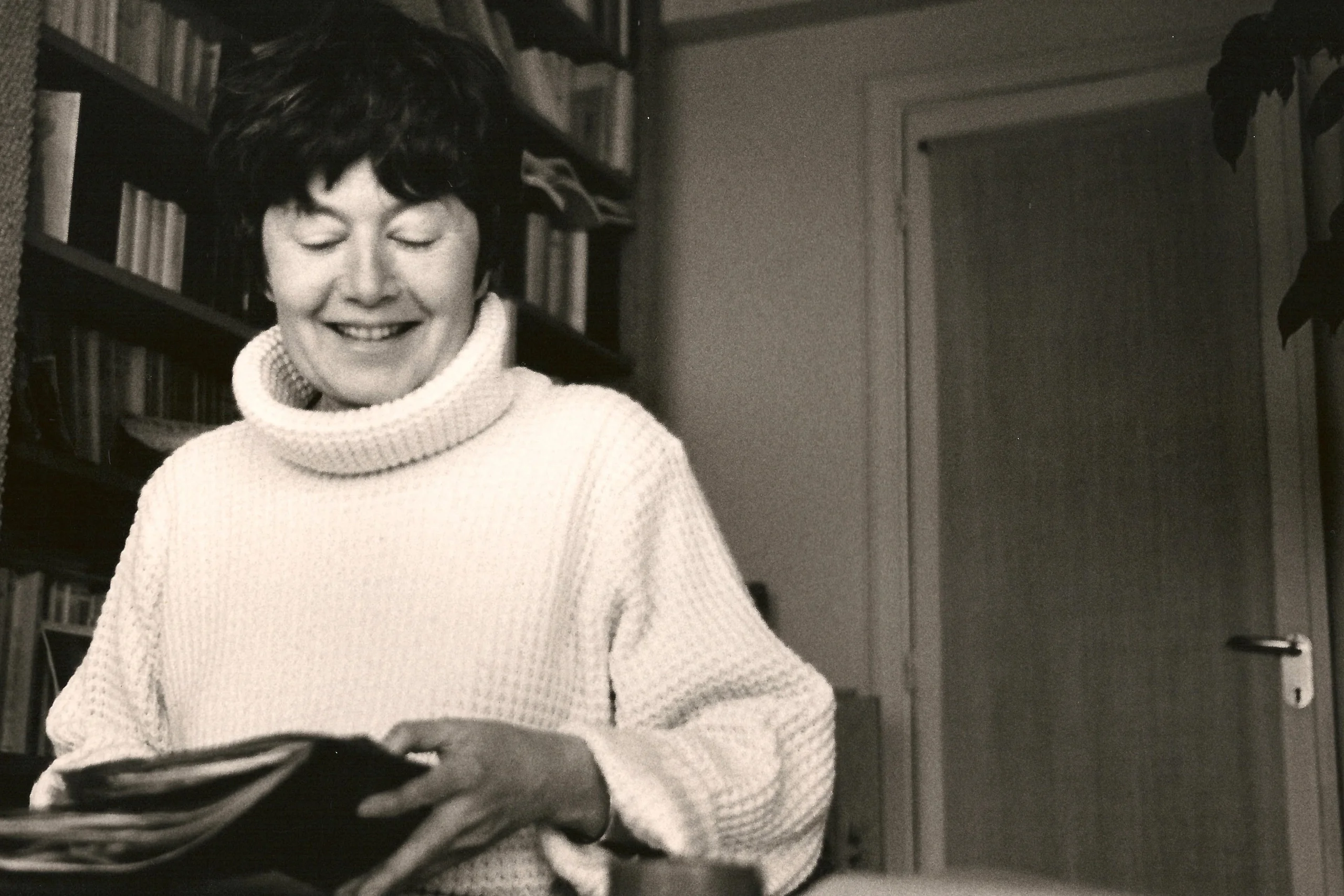
Luce Irigaray
 Belgium
philosopher•linguist•university teacher
Birthday
May 3, 1930
Birth Sign
Taurus
Birthplace
Blaton, Belgium
Age
96 years old
About
Luce Irigaray is a Belgian-born French philosopher, linguist, psycholinguist, psychoanalyst, and cultural theorist. Her interdisciplinary work examines how language shapes gender and identity, exposing the patriarchal structures embedded in Western thought. She is a central figure in French difference feminism, a school of thought that insists on the distinct experiences and perspectives of women.
Irigaray's influence spans philosophy, linguistics, and psychoanalysis. Her books have been translated into dozens of languages, and her ideas continue to animate debates in gender studies, continental philosophy, and critical theory. She has taught and researched at institutions across Europe, and her writing remains a touchstone for scholars and activists alike.
Early Life & Background
Born on May 3, 1930, in Blaton, a small town in the French-speaking region of Belgium, Luce Irigaray grew up in a Catholic family. Her early education took place in Belgium, where she developed an early interest in languages and philosophy. She studied philosophy, linguistics, literature, and psychology, eventually earning a doctorate in philosophy and literature.
Irigaray's intellectual formation was deeply shaped by her training in psychoanalysis. She worked with Jacques Lacan and was a member of his École Freudienne, though she would later break with him over his phallocentric theories. Her early career included teaching and research positions, and she was involved in the activist circles of Brussels in the 1970s, where feminist and leftist politics were fermenting.
Before her breakthrough, Irigaray published essays and participated in conferences, but it was her doctoral work that would set the stage for her major statement. She defended her thesis in 1974, a work that would become Speculum of the Other Woman, a critique that would cost her her position at the University of Vincennes and mark the beginning of her public career.
Career Growth
Irigaray's breakthrough came in 1974 with the publication of Speculum of the Other Woman. The book, which critiqued the phallocentrism of Western philosophy from Plato to Freud, caused a scandal in French intellectual circles. She was dismissed from her teaching position at the University of Vincennes, a move that only amplified her notoriety.
She followed with This Sex Which Is Not One in 1977, a collection of essays that engaged with Lacan and political economy, further cementing her reputation. Throughout the 1980s and 1990s, she published steadily, including Elemental Passions (1982), a response to Merleau-Ponty, and The Forgetting of Air in Martin Heidegger (1999). Her work has been translated into over twenty languages, and she has held visiting professorships at universities across Europe and North America.
In recent years, Irigaray has continued to write and lecture, exploring themes of breath, the divine, and the ethics of sexual difference. Her 2024 essay on the compositional history of her early work, published in a July 2024 article, shows her ongoing engagement with her own intellectual legacy.
Career Timeline
Public Image & Style
Irigaray is known for her distinctive intellectual style, which blends rigorous philosophical analysis with lyrical, essayistic prose. She is often associated with French difference feminism, a label she has both embraced and complicated. Her work has been celebrated by feminist scholars for its radical rethinking of language and subjectivity, but also critiqued by those who see her focus on sexual difference as essentialist. In public, she presents herself as a serious, disciplined thinker, and her writing often carries a spiritual or mystical dimension that sets her apart from more secular feminist theorists.
Fame & Fandom (iFAMOUS Rankings)
In the quiet corridors of Belgian academia, Luce Irigaray has quietly climbed the global consciousness to become the 83rd most famous person from Belgium, a drop from her previous standing at 81st last cycle. This placement within the iFANN Global Fame Rankings reflects a sustained resonance that transcends the typical lifecycle of academic theory. Her work on sexual difference and language does not rely on viral spikes or fleeting trends; instead, it anchors itself in the deep currents of cultural discourse, tracking global attention across media coverage, search activity, and consumption signals worldwide. While she holds this specific national rank, her intellectual footprint extends far beyond borders, influencing how scholars and students engage with gender studies across continents.
Unlike pop icons who command stadiums, Irigaray's following is defined by its intensity rather than its volume. There is no official fandom name for her movement, nor do fans gather to celebrate merchandise or chart positions. Her audience consists of philosophers, linguists, and theorists who treat her texts as essential reading. They do not chant slogans but debate concepts like the critique of patriarchal language in seminar rooms. The rituals here are intellectual: reading dense works like The Way of Love, analyzing her divergence from Lacanian orthodoxy, and publishing peer-reviewed critiques in journals such as Hypatia. She interacts with this community strictly through lectures and publications, devoid of social media meet-and-greets or celebrity worship. No fan campaigns have ever emerged to fund subway ads or birthday billboards. Instead, her legacy is built on the slow, deliberate accumulation of ideas that continue to animate debates in continental philosophy. This disciplined engagement proves that fame need not be loud to be profound, as her status as a leading thinker remains secure without the machinery of modern celebrity culture.
Interesting Facts and Legends
Luce Irigaray was trained as a psychoanalyst and practiced for several years before distancing herself from Lacanian orthodoxy. She holds a black belt in judo, a fact she has mentioned in interviews alongside her philosophical pursuits. Her favorite philosopher is reportedly Spinoza, whose work she has engaged with critically throughout her career. Known for writing in a lyrical, almost poetic style, some critics find her prose difficult while others view it as liberating. She has stated that she does not consider herself a feminist in the traditional sense, preferring the label of a thinker of sexual difference.
While there are no viral legends or crowd-disrupting moments associated with her public appearances, her intellectual milestones serve as the defining narratives of her life. One enduring story involves her 1985 publication which challenged the commodification of women and unleashed the feminine into Western thought. Another key moment occurred during her participation in discussions at the Museo Reina Sofía regarding violence, where she presented her views on the intersection of faith and feminism. These events are not folklore but verified intellectual engagements that shaped the trajectory of feminist theory. Unlike entertainment figures who generate myths through performance, Irigaray's lore is written in books and debated in academic halls, cementing her place as a serious, disciplined thinker whose influence spans decades.
Notable Quotes
“Each sex has a relation to madness.”
“Your silence exists as does my self gathering.”
“Sexual difference is probably the issue in our time.”
“Any theory of the subject has always been appropriated by the masculine.”
Family & Personal Life
Details about Irigaray's family life are scarce. She was born to a Catholic family in Blaton, Belgium, but little is known about her parents or siblings. She has never publicly discussed her romantic relationships or whether she has children. Her personal life remains private, and she has chosen to focus public attention on her work.
Notable Connections
Luce Irigaray is associated with the tradition of French feminism, alongside thinkers like Simone de Beauvoir, Hélène Cixous, and Julia Kristeva. She was a student of Jacques Lacan and later a critic of his work. Her philosophy engages with major figures such as Plato, Aristotle, Descartes, Kant, Hegel, Heidegger, and Merleau-Ponty.
Relationships & Dating History
Salary, Net Worth In 2026
As of 2026, Luce Irigaray's net worth is not publicly documented. As an academic and philosopher, her income has primarily come from university salaries, book royalties, and lecture fees. Her books have been translated into many languages and remain in print, providing a steady stream of royalties. She has held prestigious visiting positions, which often come with higher compensation. However, without public financial disclosures, any specific figure would be speculative.
Awards & Accolades
View 1 records, honours and achievementsKnown For
Speculum of the Other Woman
1974 · Author
This Sex Which Is Not One
1977 · Author
Elemental Passions
1982 · Author
The Forgetting of Air in Martin Heidegger
1999 · Author
Keywords
Sources
Quick Facts
- Profession
- philosopher, linguist, university teacher
- Born
- May 3, 1930
- Birthplace
- Blaton, Belgium
- Gender
- Female
- Birth Sign
- Taurus
- Education
- Doctorate in philosophy and literature
Personal Details
- Education
- Doctorate in philosophy and literature
Frequently Asked Questions
What is Luce Irigaray known for?
What are Luce Irigaray's major works?
What is Luce Irigaray's philosophy?
Where was Luce Irigaray born?
Is Luce Irigaray still alive in 2026?
Similar People
Join the community
fans discussing