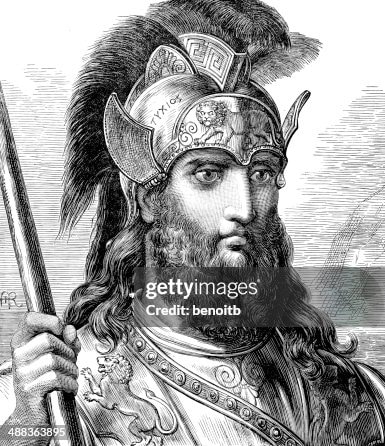
Leonidas I
 Greece
Also known as: Leonidas the Brave, King Leonidas
Birthday
c. 540 BC
Birth Sign
Birthplace
Sparta, Greece
Age
Died at 60
Height
5 ft 8 in (1.73 m)
About
Leonidas I, born around 540 BC in Sparta, was the warrior-king of the ancient Greek city-state. As the 17th king of the Agiad dynasty, a royal house claiming descent from Heracles, he ascended the throne around 489 BC after his half-brother Cleomenes I. He co-ruled with Leotychidas II until his death in 480 BC, when his son Pleistarchus succeeded him.
Leonidas is best known for leading the allied Greek forces in a desperate last stand at the Battle of Thermopylae in 480 BC. With a small army that included 300 elite Spartan soldiers, he defended a narrow pass against the massive invading Persian army under Xerxes. After two days of fierce fighting, a traitor revealed a mountain path that allowed the Persians to surround the Greeks. Leonidas dismissed most of the allied troops but stayed with his Spartans and a few hundred others, fighting to the death on the third day. Though the battle was lost, their sacrifice became a symbol of courage against overwhelming odds.
Leonidas entered legend as a hero and the epitome of Spartan discipline and bravery. The stand at Thermopylae inspired the Greeks to rally and defeat the Persians the following year. His story has been retold in countless works, most famously in Frank Miller's graphic novel 300 and its 2006 film adaptation. Today, Leonidas remains an enduring icon of military valor and sacrifice.
Early Life & Background
Leonidas was the third son of King Anaxandridas II, not the heir. As a boy, he entered the agoge at age seven, enduring the brutal training that made Spartan warriors legendary. He learned to endure hunger, pain, and cold, and was taught to fight with spear and shield. As a young man, he likely fought in Sparta's campaigns against the Messenian helots, honing his skills in real combat. When his half-brother Cleomenes I died without a male heir around 489 BC, Leonidas, though not the firstborn, took the throne. To strengthen his claim, he married Cleomenes' daughter, Gorgo. By 480 BC, when Xerxes' massive army marched into Greece, the allied Greek city-states looked to Sparta for leadership. The oracle at Delphi had prophesied that either Sparta would fall or one of its kings would die. Leonidas, now in his sixties, believed he was that king.
Career Growth
Leonidas's defining moment came in August 480 BC at the narrow pass of Thermopylae. He commanded a Greek force of about 7,000 men, including his 300 Spartan elite. For two days, they repelled wave after wave of Persian infantry, inflicting heavy casualties. On the third day, a local Greek named Ephialtes betrayed them, showing the Persians a mountain path that outflanked the Greek position. Leonidas, realizing the trap, dismissed most of the allied army but chose to stay with his Spartans, 700 Thespians, and 400 Thebans to cover their retreat. He led a final charge into the Persian ranks, fighting until he fell. Xerxes, in fury, ordered Leonidas's head cut off and his body crucified. Though a tactical defeat, the stand galvanized the Greek city-states. Within a year, the Greek navy won at Salamis and the army at Plataea, ending the Persian invasion. Leonidas became a martyr and a symbol of resistance.
Career Timeline
Public Image & Style
Leonidas is the archetype of the Spartan warrior-king: stoic, fearless, and laconic. In ancient times, he was worshipped as a hero at Sparta, with annual games held in his honor. Modern portrayals, especially Frank Miller's 300 and its film adaptation, have amplified his image as a brutal, efficient fighter with a memorable one-liner: "This is Sparta!" Fans of the film often quote lines, recreate Spartan armor, and visit Thermopylae. On Reddit and history forums, discussions focus on military tactics and the battle's strategic significance. The lambda symbol on Spartan shields has become a pop culture icon. No official fandom name exists, but enthusiasts are often called "Spartan fans" or "300 fans."
Fame & Fandom (iFAMOUS Rankings)
Leonidas I commands a legacy that transcends the grave, anchoring himself in the global consciousness not through modern celebrity cycles but through an unyielding archetype of sacrifice. His story is rarely consumed as mere history; it is treated as a cultural scripture where the line between verified fact and mythologized legend blurs into a singular narrative of defiance. While no organized fanbase with a formal name gathers to campaign for his birthday or fund subway ads, a vast, decentralized community of history enthusiasts, classical scholars, and pop-culture consumers keeps his image alive. This audience engages through reenactments, academic discourse, and the enduring viral life of Frank Miller's graphic novel 300, which transformed the ancient king into a meme-literate icon for the digital age. The phrase "Come and take them" remains a shorthand for resistance, echoing in everything from military strategy discussions to internet forums debating the nature of freedom. There are no rituals specific to Leonidas alone, yet the sheer volume of adaptations proves a deep, structural fascination with his final stand. He exists in the collective memory as the ultimate warrior-king, a figure whose silence speaks louder than any modern influencer's shout. This enduring resonance places him firmly within the pantheon of historical fame, recognized by rigorous global tracking systems. According to the latest data from the iFANN Global Fame Rankings, Leonidas I is currently the 45th most famous person in Olympic Sports, holding steady from the previous cycle.
Interesting Facts and Legends
The name Leonidas translates directly to "son of the lion," a fitting moniker for a man who would become synonymous with ferocity. He did not inherit the throne by default; his path to power opened only after his older brother Dorieus perished in Sicily and his half-brother Cleomenes left no heir. At Thermopylae, the 300 Spartans were merely the tip of the spear; they fought alongside roughly 7,000 allied Greeks, including 700 Thespians who chose death over surrender. On the morning of their final battle, Leonidas reportedly told his men to eat well because they would dine in Hades that night. After the fighting ceased, the Persian King Xerxes had the Spartan ruler's head impaled on a stake as a warning to others. A stone lion was later erected at the site to honor the fallen king. The famous epitaph inscribed there, "Go tell the Spartans, stranger passing by, that here, obedient to their laws, we lie," was penned by the poet Simonides. In modern times, this spirit of innovation continues, with Greece developing an anti-tank missile system bearing his name. Legends persist about his defiant reply to Persian demands, telling the messenger to simply "come and take" the Greek weapons, a story that has evolved into a universal symbol of dignity against overwhelming odds.
Notable Quotes
“Come and take them.”
“Eat well, for tonight we dine in Hades.”
“Fight with courage, and if you die, it will be a noble death.”
Family & Personal Life
Leonidas was married to Gorgo, the daughter of his half-brother Cleomenes I. She was known for her wisdom; she famously interpreted the oracle's "wooden walls" as the Athenian navy. They had one son, Pleistarchus, who became king after Leonidas's death, with Pausanias serving as regent. Leonidas's father was King Anaxandridas II. His mother's name is not recorded. He had two older half-brothers, Cleomenes I and Dorieus, and one younger full brother, Cleombrotus. The family traced its lineage back to the mythical hero Heracles.
Notable Connections
Gorgo (wife and queen), Pleistarchus (son and successor), Cleomenes I (half-brother and predecessor), Xerxes I (opponent at Thermopylae), Ephialtes (the traitor), Simonides of Ceos (poet of the epitaph), Gerard Butler (actor who portrayed him in 300).
Relationships & Dating History
Leonidas had one known relationship: his marriage to Gorgo, daughter of his half-brother Cleomenes I. They married around the 490s BC, likely soon after he became king. Gorgo was known for her intelligence and political acumen. They had one son, Pleistarchus. The marriage ended with Leonidas's death in 480 BC. As of 2026, Leonidas is deceased; he was married at the time of his death.
- MarriedGorgo-490 - -480Daughter of Cleomenes I. Known for her wisdom. They had one son, Pleistarchus.
Death & Aftermath
Died
August 11, 480 BC (aged 60)
Death Place
Thermopylae, Central Greece
Cause of Death
Death in combat
A stone lion statue stands at the narrow coastal pass of Thermopylae, a monument erected by Sparta to honor the king and his men who fell there. This monument accompanied an epitaph attributed to Simonides that urged travelers to tell the Spartans their warriors lay obedient to the laws. The memory of this sacrifice transformed a tactical defeat into a defining moment for Greek unity, turning Leonidas into a semi-divine hero whose death saved the city-states from Persian conquest. On August 11, 480 BC, King Leonidas I met his end in combat during the final phase of the Battle of Thermopylae in central Greece.
Historical accounts primarily derived from Herodotus describe how he dismissed most allied troops after learning of a traitorous mountain path but chose to remain with 300 elite Spartans, along with Thespians and Thebans, to cover the retreat. He led a desperate charge into the Persian ranks under Xerxes I until he was slain alongside his remaining forces. The Persians subsequently sought to decapitate his body and impale it on a cross as a sign of victory, though the Spartans fought fiercely to protect the corpse until they too were killed. The immediate reaction in Sparta blended profound grief with celebration of his refusal to surrender.
While his remains were left on the battlefield initially, they were later recovered and given a grand burial in Sparta where a cenotaph was established. His legacy endured through centuries of academic study and popular culture, most notably inspiring Frank Miller's graphic novel 300 and Zack Snyder's 2006 film of the same name. These works sparked modern surges in interest, ensuring the phrase Molon Labe remains a global slogan for resistance while the Agiad dynasty continued under his son Pleistarchus.
Net Worth (Estate Value)
$0
iFANN Editorial Team estimate
As a figure who died nearly two and a half millennia ago, Leonidas I holds no personal net worth. His estate possesses no monetary value in the modern economic sense, and no revenue flows from his story to any descendants or legal heirs. While the cultural legacy of Leonidas has generated billions of dollars for third parties through films like 300, books, tourism, and video games, none of that income accrues to an estate. Per iFANN's editorial analysis, there is no known estate manager or legal entity representing his legacy as of 2026. Consequently, the total estimated net worth for Leonidas I stands at $0.
Awards Won (2)
Leonidas was posthumously honored with a hero cult at Sparta and Thermopylae. The Spartans held annual games in his memory and erected a stone lion at the battle site. The epitaph by Simonides became one of history's most famous tributes.
-479 · Religious honor
Battle of Thermopylae
-479 · Monument
Battle of Thermopylae
Known For
Battle of Thermopylae
-480 · Commander of the Greek forces
300 Spartans
-480 · King and leader
Keywords
Quick Facts
- Profession
- ruler
- Birthplace
- Sparta
- Died
- -0480-08-11
- Death Place
- Thermopylae
- Gender
- Male
- Spouse
- Gorgo
Personal Details
- Full Name
- Leonidas
- Height
- 5 ft 8 in (1.73 m)
- Spouse
- Gorgo
- Children
- Pleistarchus
- Education
- Spartan agoge
Frequently Asked Questions
How tall was King Leonidas?
Did Leonidas have a wife and children?
What happened to Leonidas's body after Thermopylae?
Is Leonidas a real historical figure?
Who betrayed Leonidas at Thermopylae?
Similar People

Join the community
fans discussing