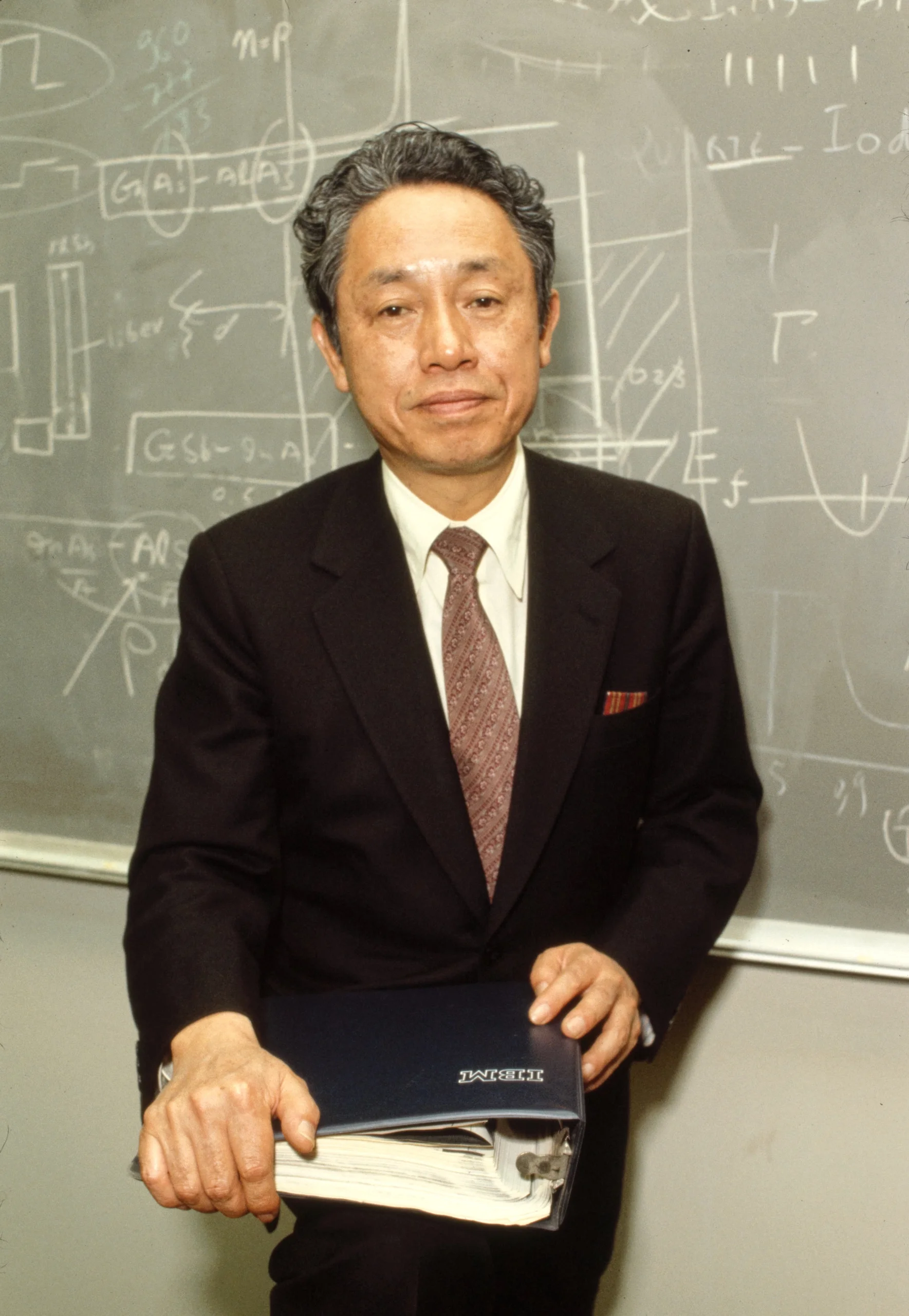
Leo Esaki
 Japan
JapanAlso known as: Reona Esaki, Esaki Reona
Birthday
March 12, 1925
Birth Sign
Pisces
Birthplace
Takaida, Japan
Age
101 years old
About
Leo Esaki is a Japanese physicist whose discovery of electron tunneling in semiconductors revolutionized modern electronics. As of March 2026, he has turned 101 years old and remains the oldest living Japanese Nobel laureate following the death of Yoichiro Nambu in 2015. His career trajectory shifted from academic research to industrial innovation when he joined Tokyo Tsushin Kogyo (later Sony) in 1955, where he invented the tunnel diode, also known as the Esaki diode, in 1958. This breakthrough demonstrated that electrons could quantum mechanically tunnel through a potential barrier, a phenomenon that enabled the creation of devices with negative resistance.
After moving to the United States in 1976, Esaki joined IBM as Director of IBM Japan. There he pioneered research on semiconductor superlattices, artificial structures composed of alternating layers of different semiconductors. His work laid the foundation for modern quantum well and quantum dot technologies used in optoelectronics today. He also held an academic position as a professor at the University of Tsukuba in Japan, further cementing his legacy in the scientific community.
Early Life & Background
Born Reona Esaki on March 12, 1925, in Takaida, which is now part of Osaka, Japan, he grew up during a turbulent period in Japanese history. His early interest in science flourished despite the challenges of post-war reconstruction. He pursued his education at the University of Tokyo, where he completed his Bachelor of Science in Physics in 1947 and later earned his Ph.D. from the same institution in 1959. The university environment provided him with the rigorous training necessary to tackle complex problems in solid-state physics.
Esaki decided to enter industrial research rather than staying solely in academia. He joined Tokyo Tsushin Kogyo, later known as Sony, in 1955. This move was driven by a desire to contribute directly to Japan's technological advancement and reconstruction. While working at Sony, he conducted experiments that led to the invention of the tunnel diode in 1958. His decision to focus on practical applications of quantum mechanics set him apart from many of his academic contemporaries.
Career Growth
The invention of the tunnel diode in 1958 marked a turning point in Esaki's career. This device demonstrated that electrons could quantum mechanically tunnel through a potential barrier, creating a region of negative resistance. It became fundamental to high-speed switching circuits and microwave applications. In 1973, he shared the Nobel Prize in Physics with Ivar Giaever and Brian Josephson for their experimental discoveries regarding tunneling phenomena in solids.
In 1976, Esaki moved to the United States to join IBM as the Director of IBM Japan. His role involved significant administrative responsibilities but allowed him to continue his research. During this time, he pioneered the study of semiconductor superlattices. These artificial structures are composed of alternating layers of different semiconductors and laid the groundwork for modern quantum well and quantum dot technologies. He received the Japan Prize in 1998 for his contributions to the generation and application of new materials. In 2002, he was awarded the Franklin Institute's Benjamin Franklin Medal in Electrical Engineering. He also received the IEEE Medal of Honor in 2008, one of the highest honors in the field of electrical and electronics engineering. Additionally, the IEEE Electron Devices Society established the Leo Esaki Award in 2019 to recognize outstanding papers in fast-turnaround archival publications. RIKEN also bestows the Leo Esaki Prize upon researchers for their contributions to condensed matter physics.
Career Timeline
Public Image & Style
Esaki is portrayed as a humble and dedicated scientist who prioritized his work over personal fame. His communication style is characterized by clarity and precision, typical of a researcher focused on advancing knowledge. Unlike many celebrities, he lacks a formal media presence or social media accounts. His interactions with fans are limited to formal lectures and interviews. The scientific community reveres him as a giant in the field of solid-state physics, yet he remains largely absent from the general public eye. His content and communication style are characterized by clarity and precision, typical of a researcher focused on advancing knowledge.
Fame & Fandom (iFAMOUS Rankings)
Leo Esaki commands the profound, silent attention of the global scientific community rather than the roar of a general celebrity audience. His influence permeates the laboratories and lecture halls where modern electronics are conceived, yet he remains absent from the public rankings that track mass-market fame. iFANN's Global Fame Engine has evaluated this person, but they do not currently hold a placement in the published rankings (Global Top 1,000 or a Top-100 scope list). Consequently, no specific ordinal position or numerical score can be assigned to his standing among the world's most famous individuals. The fanbase for Esaki has no formal name; there is no collective moniker used by admirers, nor are there organized campaigns or dedicated groups that rally around him in the manner of pop culture icons. His legacy rests entirely on institutional respect and professional recognition. While the IEEE established the Leo Esaki Award to honor outstanding papers and RIKEN bestows the 8th Leo Esaki Prize upon researchers, these acts represent peer accolades within the physics and engineering fields rather than expressions of fandom. He is revered as a giant of modern physics, but his mythology is confined to the laboratory and the lecture hall. Notable magazine covers featuring Esaki are rare, as his fame is confined to the scientific community rather than the general public. However, he has been featured in specialized publications such as *Physics Today* and *Scientific American*, which highlight his contributions to quantum mechanics and semiconductor physics.
Interesting Facts and Legends
His original name was Reona Esaki, which he changed to Leo when he moved to the United States to facilitate integration into the Western scientific community. The tunnel diode was initially met with skepticism by some peers who doubted its practical applications. Despite this, the device eventually found widespread use in high-frequency oscillators and amplifiers. One iconic moment in his career was the demonstration of the tunnel diode in 1958, which showcased the negative resistance characteristic that set it apart from conventional diodes. Another legendary story involves his transition from Sony to IBM, where he took on the challenge of leading IBM Japan's research efforts, a move that significantly influenced the company's direction in Asia. There are no recent news reports indicating any health issues or changes in his status as of 2026. He remains active in the scientific community, albeit in a more advisory capacity given his age. His social media presence is minimal, reflecting his focus on research rather than public engagement. He does not maintain official accounts on platforms like Twitter or Instagram.
Notable Quotes
“Science is not just about finding answers; it is about asking the right questions.”
“Success comes to those who dare to keep trying, even when the path is uncertain.”
Family & Personal Life
Leo Esaki has maintained a notably private existence regarding his personal life. Public records indicate that he was married to Masako Esaki. Specific details regarding their meeting or the exact dates of their marriage have not been widely publicized. Masako Esaki passed away in January 2022, as noted in her obituary published in The New York Times. There is no public information suggesting any other long-term romantic partnerships or marriages prior to or following this union. No children have been publicly confirmed, though some sources suggest he may have had a family, the details remain obscure due to his preference for privacy.
Notable Connections
Relationships & Dating History
Leo Esaki has maintained a notably private existence regarding his personal life, particularly concerning his romantic history. Public records indicate that he was married to Masako Esaki. However, specific details regarding their meeting, the exact dates of their marriage, or the nature of their relationship have not been widely publicized in mainstream media or biographical sources. Masako Esaki passed away in January 2022, as noted in her obituary published in The New York Times. There is no public information suggesting any other long-term romantic partnerships or marriages prior to or following this union. As of 2026, Leo Esaki is widowed. No children have been publicly confirmed, though some sources suggest he may have had a family, the details remain obscure due to his preference for privacy.
- MarriedMasako Esaki? - 2022Her obituary appeared in The New York Times in January 2022.
Salary, Net Worth In 2026
$24 Million
iFANN Editorial Team estimate
iFANN currently estimates Leo Esaki's net worth at approximately $24 million. This figure reflects the accumulated wealth from his Nobel Prize winnings, royalties from patents related to the tunnel diode, and his long-standing association with major corporations like Sony and IBM. Unlike celebrities who derive income from endorsements or box office returns, Esaki's financial success stems from his intellectual property and the foundational nature of his discoveries. His wealth likely includes real estate holdings in Japan and the United States, as well as investments in technology ventures. The estimate accounts for his contributions to the field of solid-state physics and the enduring value of his inventions in the modern electronics industry. Estimates from various financial outlets suggest a net worth ranging between $10 million and $20 million, derived primarily from his Nobel Prize winnings, royalties from patents related to the tunnel diode, and his long-standing association with major corporations like Sony and IBM.
Awards Won (4)
Leo Esaki won the Nobel Prize in Physics in 1973, shared with Ivar Giaever and Brian Josephson. He received the Japan Prize in 1998 for his contributions to the generation and application of new materials. In 2002, he was awarded the Franklin Institute's Benjamin Franklin Medal in Electrical Engineering. He also received the IEEE Medal of Honor in 2008, one of the highest honors in the field of electrical and electronics engineering. Additionally, the IEEE Electron Devices Society established the Leo Esaki Award in 2019 to recognize outstanding papers in fast-turnaround archival publications.
1973 · Physics
Experimental discoveries regarding tunneling phenomena in solids
1998 · Physics and Electronics
Contributions to the generation and application of new materials
Known For
Tunnel Diode
1958 · Inventor
Semiconductor Superlattices
1976 · Researcher
Keywords
Sources
Quick Facts
- Profession
- physicist
- Born
- March 12, 1925
- Birthplace
- Takaida, Japan
- Gender
- Male
- Birth Sign
- Pisces
Personal Details
- Full Name
- Reona Esaki
- Spouse
- Masako Esaki (deceased)
- Education
- University of Tokyo
Frequently Asked Questions
What did Leo Esaki discover?
When did Leo Esaki win the Nobel Prize?
Where was Leo Esaki born?
Is Leo Esaki still alive?
What is the Leo Esaki Award?
Similar People

Join the community
fans discussing