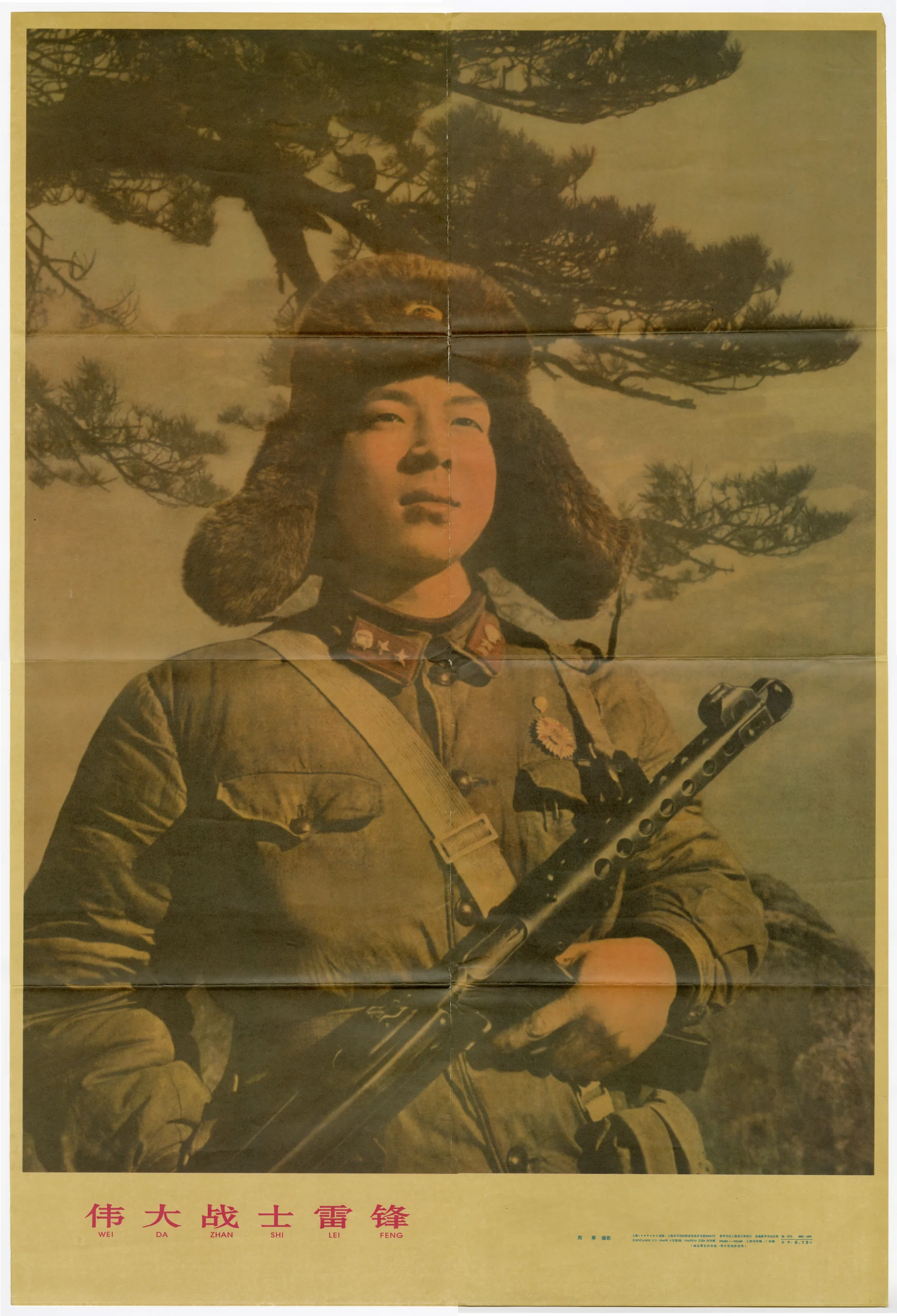
Lei Feng
 China
ChinaAlso known as: Lei Zhengxing, Comrade Lei Feng
Birthday
December 18, 1940
Birth Sign
Sagittarius
Birthplace
Wangcheng District, Hunan, China
Age
Died at 21
About
Lei Feng, born Lei Zhengxing on December 18, 1940, in Wangcheng District, Hunan, was a soldier in the People's Liberation Army who became the most famous propaganda icon in Chinese history. His short life ended on August 15, 1962, when he was just 21, killed in an accident while guiding a truck. Yet his posthumous fame far outstripped anything he achieved while alive. In 1963, Chairman Mao launched a national campaign with the slogan "Learn from Comrade Lei Feng," turning a low-ranking soldier into a symbol of selflessness, modesty, and unwavering devotion to the Communist Party.
Lei's story, as promoted by the state, was one of humble origins and pure altruism. Orphaned at a young age, he joined the army in 1960 and quickly gained a reputation for helping comrades, donating his savings to disaster relief, and spending his spare time reading Mao's works. His diary, later published and widely distributed, was filled with entries extolling the virtues of serving the people and dedicating one's life to the revolution. The government encouraged citizens to emulate his frugality, his willingness to put others first, and his absolute loyalty to Mao Zedong. This "Lei Feng spirit" became a cornerstone of socialist morality, promoted in schools, workplaces, and the media for decades.
After Mao's death in 1976, Lei's image did not fade. Chinese state media continued to hold him up as a model of earnestness and service, adapting his legacy to suit changing political winds. His face still appears on T-shirts, posters, and memorabilia, and March 5th is observed as "Learn from Lei Feng Day" in China. However, the historical accuracy of his life has long been questioned. Western scholars have often dismissed his diary as pure propaganda, while more recent Chinese research suggests the diary was heavily edited and embellished, though not entirely fabricated. For many ordinary Chinese, the relentless promotion of Lei has bred cynicism and even mockery. Yet his endurance as a symbol through decades of political upheaval speaks to the power of a well-crafted narrative, one that continues to shape the image of selfless service in China today.
Early Life & Background
Lei Feng was born Lei Zhengxing on December 18, 1940, into a poor peasant family in Wangcheng District, Hunan Province. His childhood was marked by tragedy. During the Japanese occupation, his father was killed by Kuomintang soldiers, his elder brother died of tuberculosis, and his younger brother starved to death. His mother, unable to bear the losses, committed suicide, leaving Lei orphaned at a young age. He was taken in by relatives and worked as a cowherd for wealthy families.
After the Communist victory in 1949, Lei's fortunes changed. He gained access to literacy programs and joined the Communist Youth League. He was known for his dedication to self-study, particularly of Mao Zedong's works. In 1960, he enlisted in the People's Liberation Army and was assigned to the transport unit of the Engineering Corps, stationed in Anshan, Liaoning Province. His early years in the army set the stage for his later reputation.
Career Growth
Lei Feng's military career was brief but notable. Within the army, he built a reputation for extraordinary selflessness. He donated his modest savings to disaster relief and to fellow soldiers' families, spent his spare time reading Mao's works, and performed countless small acts of service. He was promoted to sergeant and served as a squad leader. His motto, as later publicized, was "serving others without any thought of self-interests."
His death on August 15, 1962, at age 21, was a freak accident. While guiding a truck as it backed up at a military compound in Anshan, he was struck by a falling telephone pole. The official account says he was killed instantly, though some reports suggest the truck hit the pole that fell on him.
In February 1963, Mao Zedong launched a national campaign with the slogan "Learn from Comrade Lei Feng," transforming the obscure soldier into China's most important propaganda icon. Lei's diary was published and distributed in millions of copies, filled with entries extolling selflessness and devotion to Mao. The campaign was unprecedented in scale and continued through the Cultural Revolution and beyond.
In the post-Mao era, the state adapted his image to new political priorities, making him a symbol of "socialist spiritual civilization." His legacy has been kept alive through annual commemorations, a 2015 magazine, and even a Lei Feng-themed KFC in Changsha in 2019. As of 2026, the "Lei Feng Spirit" continues to be promoted internationally, with foreign officials like an Italian mayor praising it.
Career Timeline
Public Image & Style
Lei Feng's iconic visual representation is that of a young PLA soldier in uniform, often depicted with a warm smile, sometimes holding Mao's writings. His image appears on propaganda posters, T-shirts, and memorabilia. The "Lei Feng spirit" (雷锋精神) is the official term for his legacy: selflessness, frugality, modesty, hard work, and absolute loyalty to the Communist Party. Public attitudes toward him have shifted over time. During the Mao era, he was genuinely revered. In the post-Mao era, relentless state promotion bred cynicism among many ordinary Chinese. Contemporary China still observes "Learn from Lei Feng Day" annually, but with ambivalence. Western observers have generally treated Lei as a propaganda construct, questioning his historical accuracy.
Fame & Fandom (iFAMOUS Rankings)
The collective following of Lei Feng defies modern definitions of fandom. There are no fan clubs, no organized voting blocs, and no merchandise driven by personal idolatry. Instead, millions of Chinese citizens participate in a state-sponsored movement known as the 'Spirit of Lei Feng,' treating his memory as a moral compass rather than a celebrity persona. Adherents do not stream content or attend concerts; they engage in annual acts of service on March 5th, dubbed 'Learn from Lei Feng Day,' where volunteers clean streets, visit the elderly, and perform community work in his name. This ritualistic altruism functions as the primary interaction between the public and the icon, mediated through his posthumous diary which remains a staple in school curricula. The movement is institutionalized, led by government bodies and the PLA, ensuring that his legacy of selflessness endures as a pillar of civic education rather than a fleeting pop culture trend. While he lacks a formal fanbase name like those found in music or film, his influence permeates daily life across the nation. His status as a global symbol of revolutionary virtue has been recognized by international institutions, including references at the United States Military Academy at West Point. According to the iFANN Global Fame Rankings, Lei Feng is currently the 79th most famous person in China, a position holding steady from the previous cycle.
Interesting Facts and Legends
Lei Feng was born Lei Zhengxing but adopted the name meaning 'Thunder Wind' to signify his revolutionary rebirth. The New Yorker once described him as 'the yeti of Chinese Communist history.' A KFC in Changsha was transformed into a memorial restaurant featuring his statue, while a magazine bearing his name launched in 2015 to revive his relevance. The metaphor of the 'bolt that never rusts' from his diary remains a standard phrase in political discourse today.
A widely retold legend concerns his death on August 15, 1962, in Fushun, Liaoning Province, where he allegedly died after being struck by a falling telephone pole while guiding a truck. Though some alternative narratives suggest electrocution or other causes, this specific accident remains the dominant story taught in schools. Another iconic moment occurred in 1963 when Chairman Mao's calligraphy inscription, 'Learn from Comrade Lei Feng,' instantly elevated the low-ranking soldier to a national deity, sparking crowds eager to embrace his spirit. This event marked the birth of a state-mandated 'fandom' where citizens performed altruistic acts on March 5th, now known as Lei Feng Day, turning his diary entries into moral scripture for generations.
Notable Quotes
“I want to be a bolt that never rusts.”
“Serving others without any thought of self-interests.”
“My life is limited, but serving the people is unlimited. I will devote my limited life to the unlimited cause of serving the people.”
Family & Personal Life
Lei Feng was orphaned in childhood. His father was killed by Kuomintang soldiers, his elder brother died of tuberculosis, and his younger brother starved to death. His mother committed suicide, leaving him with no surviving immediate family. He had no known spouse, children, or siblings. His tragic family history was later used in propaganda to highlight the contrast between his suffering under the old society and the salvation offered by the Communist Party.
Notable Connections
Lei Feng's legacy is inextricably linked to Mao Zedong, whose 1963 endorsement created his posthumous fame. Chinese journalist Cheng Shigang investigated the diary's authenticity, questioning its accuracy. The PLA leadership compiled, edited, and published Lei's diary after his death, shaping his image for propaganda purposes.
Relationships & Dating History
There is no documented romantic or dating history for Lei Feng. This is consistent with his portrayal as a figure of total devotion to the party and the revolution, with no personal attachments that might complicate his image as a selfless servant of the people. He died unmarried at age 21, and no credible source documents any romantic relationship, engagement, or marriage.
Death & Aftermath
Died
August 15, 1962 (aged 21)
Death Place
Fushun, Liaoning, China
Cause of Death
Crushed by falling telephone pole
The military command in Fushun, Liaoning Province, announced the death of Private Lei Feng as an on-the-job accident shortly after the incident occurred on August 15, 1962. The soldier was directing a truck during volunteer road construction work when a wooden telephone pole struck by the vehicle fell and crushed him instantly. Official accounts describe the event as a tragic mishap at the construction site. Within months, the Communist Party transformed this accidental fatality into a national narrative of sacrifice. Chairman Mao Zedong issued the famous directive "Learn from Comrade Lei Feng" in March 1963, launching a massive campaign that turned his personal diary into a bestseller and his image into a ubiquitous symbol of selflessness.
A public military ceremony followed his death, where he was buried in the Fushun Revolutionary Martyrs' Cemetery, attended by high-ranking officers who would later lead the propaganda effort. The state subsequently erected a memorial hall and statue at his gravesite, which remains a pilgrimage destination for students and youth groups. Posthumous releases included films, operas, and the publication of his writings, while the PLA officially named him a Model Soldier. His name and image remain under state management, with educational foundations established to promote civic virtue in his honor.
Net Worth (Estate Value)
$0
iFANN Editorial Team estimate
Lei Feng was a low-ranking PLA soldier who died at age 21. He had no personal wealth at the time of his death, and his modest army salary was reportedly donated to disaster relief and fellow soldiers. As a state propaganda icon rather than a commercially managed celebrity, there is no publicly documented estate value or revenue stream. His image and name are controlled by the Chinese Communist Party and state media, used for propaganda rather than commercial exploitation. The 'Lei Feng spirit' generates political capital, not monetary revenue. Per iFANN's editorial analysis, the total estimated net worth stands at $0.
Awards & Accolades
View 6 records, honours and achievementsKnown For
Learn from Comrade Lei Feng campaign
1963 · Subject
Keywords
Sources
Quick Facts
- Profession
- Soldier
- Born
- December 18, 1940
- Birthplace
- Wangcheng District, Hunan, China
- Died
- August 15, 1962
- Death Place
- Anshan, Liaoning, China
- Gender
- Male
- Birth Sign
- Sagittarius
- Nationality
- Chinese
Personal Details
- Full Name
- Lei Zhengxing
- Education
- Literacy programs under the Chinese Communist Party after 1949
Frequently Asked Questions
Did Lei Feng really exist?
How did Lei Feng die?
Why is Lei Feng famous?
What is the Lei Feng Spirit?
Was Lei Feng's diary real?
Similar People
Join the community
fans discussing