“David Lean's 'Lawrence of Arabia' is the greatest film epic ever made, a sweeping, romantic, and deeply human story that captures both the beauty and the tragedy of its subject.”
Roger Ebert
Chicago Sun-Times
 United Kingdom
"Nothing is written."
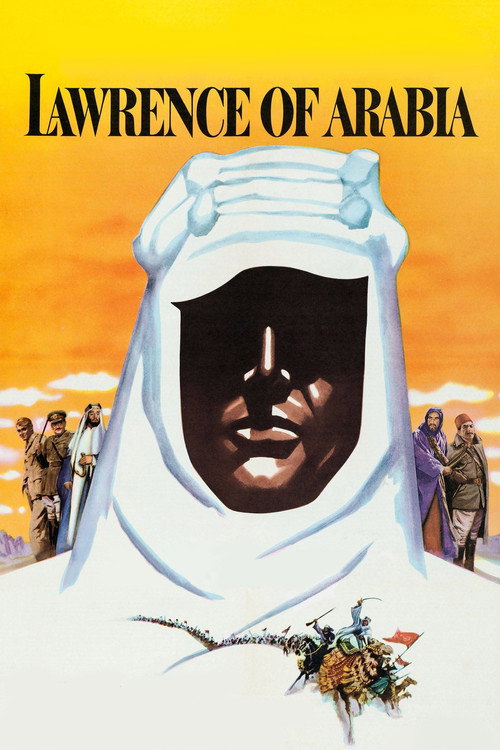
In 1916, a young British officer named T.E. Lawrence, played with magnetic intensity by Peter O'Toole, is sent to the Arabian desert to assess the situation of the Arab Revolt against the Ottoman Empire. What begins as a diplomatic mission becomes a personal odyssey, as Lawrence persuades the fragmented Arab tribes to unite under a common cause, leading them in a daring campaign of guerrilla warfare that would reshape the Middle East. David Lean's epic direction turns the desert into a vast, unforgiving character, captured in stunning 70mm by cinematographer Freddie Young. The film assembles an international cast, including Alec Guinness as Prince Feisal, Omar Sharif as the fierce Sherif Ali, and Anthony Quinn as the grizzled Auda abu Tayi, each delivering performances that have become film lore.
With a budget of $15 million, a staggering sum for its time, the production spanned years and continents, and the resulting spectacle was rewarded with $70 million at the box office, along with seven Academy Awards, including Best Picture. The shoot took the crew to Wadi Rum in Jordan, the Cabo de Gata in Spain, and Morocco, where they battled heat, sandstorms, and logistical nightmares. The score, composed by Maurice Jarre in just weeks after the original composer left, became one of the most recognizable in cinema history. "Lawrence of Arabia" remains a benchmark for historical epics, a film that balances grand spectacle with intimate character study, and its influence can be felt in every desert adventure that followed.
Stream
Rent
Prime Video
$3.99
Apple TV+
$3.99
Availability and pricing can change. Confirm on the provider's site before purchasing.
The film opens in 1935 with the death of T.E. Lawrence in a motorcycle accident in Dorset, England. A journalist's eulogy at his memorial service reflects on the man's mysterious life, and the story flashes back to 1916 Cairo. Lawrence is a misfit intelligence officer, arrogant and eccentric, who maps the desert for the British Army. When the Arab Revolt against the Ottoman Empire is faltering, civilian diplomat Mr. Dryden sends him to assess the situation, despite Lawrence's lack of military discipline.
Traveling to the Arabian desert, Lawrence meets Prince Feisal, leader of the Arab forces, who is wary of British intentions but desperate for support. During his journey, he encounters Sherif Ali, a proud tribal warrior who initially treats him with hostility. Lawrence's unconventional ideas, attacking the port of Aqaba by land rather than sea, seem mad, but he wins over Auda abu Tayi, a fierce chieftain, and leads a coalition of tribes across the Nefud Desert. The trek is brutal; one man, Gasim, is left behind, but Lawrence turns back to rescue him, earning respect. The surprise attack on Aqaba succeeds, and Lawrence becomes a legendary figure, adopting Arab dress and customs.
With Aqaba captured, Lawrence returns to Cairo, where General Allenby sees his value and sends him back to the desert to lead guerrilla raids on Turkish railways. Lawrence's fame grows, but so does his inner turmoil. He is captured by the Turks at Deraa, where he is tortured and sexually humiliated, an experience that shatters his confidence and leaves deep psychological scars. He returns to the fight, but his actions become increasingly ruthless. The film builds toward the Arab advance on Damascus, where Lawrence's dream of a unified Arab nation faces its ultimate test against the political machinations of the British and French, who have secret plans to divide the region. The story stops before the final outcome, leaving the question of whether one man can truly shape history hanging in the balance.
Fathom Events Trailer
Original Trailer
UK Re-Release Trailer
Critical Consensus
Lawrence of Arabia is universally regarded as one of the greatest films ever made, a sweeping epic that combines David Lean's masterful direction, Freddie Young's breathtaking cinematography, and Peter O'Toole's iconic performance. The film's nearly four-hour runtime is justified by its intimate character study and grand historical canvas, cementing its status as the definitive cinematic epic.
“David Lean's 'Lawrence of Arabia' is the greatest film epic ever made, a sweeping, romantic, and deeply human story that captures both the beauty and the tragedy of its subject.”
Roger Ebert
Chicago Sun-Times
“A magnificent, sprawling, and deeply felt film that transforms the desert into a character and Peter O'Toole into a legend.”
Bosley Crowther
The New York Times
“The film is a towering achievement of cinematic art, with David Lean's direction and Freddie Young's photography combining to create images that will endure for generations.”
Variety Staff
Variety
“Peter O'Toole delivers one of the most electrifying screen debuts in history, embodying Lawrence's charisma, arrogance, and ultimate tragedy with mesmerizing intensity.”
The Hollywood Reporter
The Hollywood Reporter
“A monumental work of cinema that remains as breathtaking today as it was in 1962, a film that redefined what an epic could be.”
Peter Bradshaw
The Guardian
Director
David Lean
Writers
Michael Wilson, Robert Bolt
Composer
Maurice Jarre
Cinematographer
Freddie Young
Producer
Sam Spiegel
Academy Awards (1963)
Best Picture: Won
Academy Awards (1963)
Best Director: Won
Academy Awards (1963)
Best Cinematography – Color: Won
Academy Awards (1963)
Best Art Direction – Color: Won
Academy Awards (1963)
Best Sound: Won
Academy Awards (1963)
Best Film Editing: Won
Academy Awards (1963)
Best Original Score: Won
Academy Awards (1963)
Best Actor: Nominated
Academy Awards (1963)
Best Supporting Actor: Nominated
Academy Awards (1963)
Best Adapted Screenplay: Nominated
BAFTA Awards (1963)
Best Film: Won
Golden Globe Awards (1963)
Best Motion Picture – Drama: Won
Join the community
fans discussing