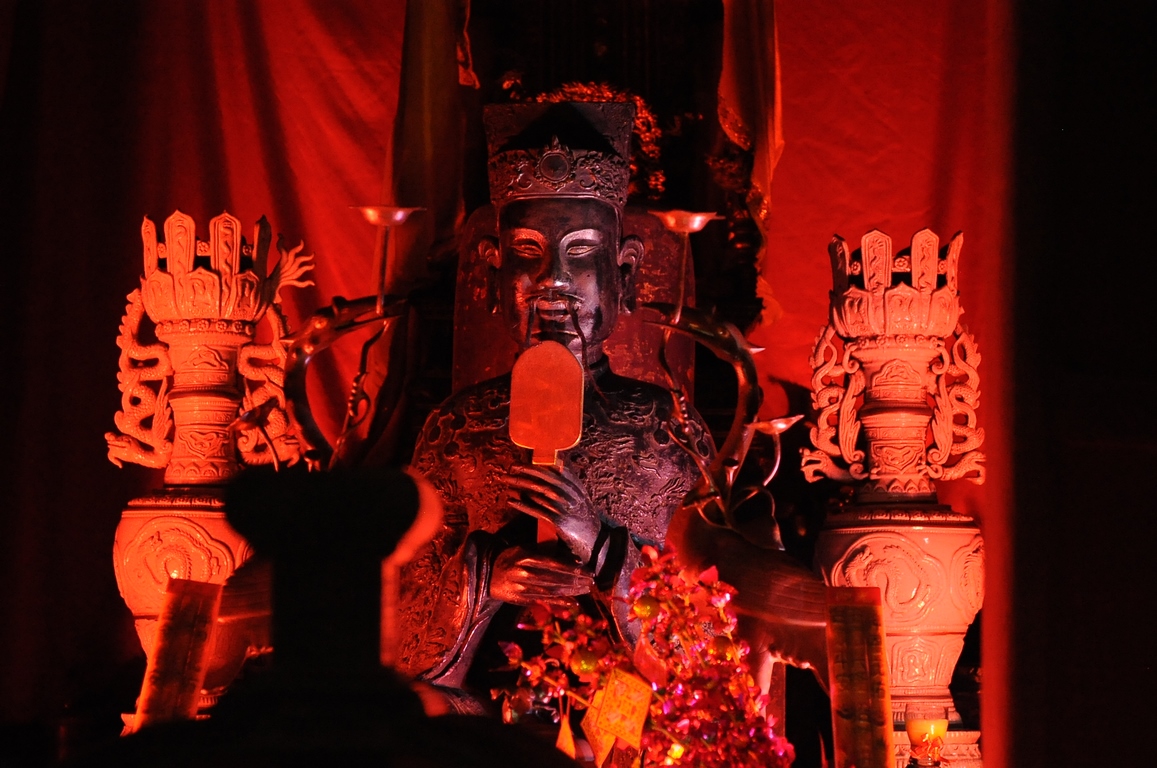
Kinh Dương Vương
 Vietnam
Legendary King and Founder of the Hồng Bàng Dynasty
Also known as: King of Kinh Dương, Water Ancestor King, Vua Thủy Tổ
Birthday
Birth Sign
Birthplace
Hunan
Age
Unknown
About
Kinh Dương Vương, whose name translates to King of Kinh Dương, was a foundational figure in ancient Vietnamese legend. Hailing from Hunan, he is credited in the 15th-century chronicle Đại Việt sử ký toàn thư with uniting disparate tribes into a single state, thereby establishing the Hồng Bàng dynasty. This unification marked him as the very first sovereign recognized by the Vietnamese people, a position of immense historical and cultural significance. His reign reportedly began in 2879 BCE over the land known as Xích Quỷ.
As the progenitor of the Vietnamese nation, Kinh Dương Vương remains a central figure in the country's cultural identity. He is venerated as the Water Ancestor King, with a popular shrine and presumed tomb in Bắc Ninh Province drawing pilgrims and festival-goers each year. His legacy endures through his son Lạc Long Quân and the foundational myths that trace the Vietnamese people's origins to his lineage.
Early Life & Background
According to the Đại Việt sử ký toàn thư, Kinh Dương Vương was born into a lineage that stretched back to the legendary Chinese ruler Shennong. He was the son of Đế Minh, also known as Emperor Ming, and the grandson of Đế Thừa, making him a third-generation descendant of Shennong. His birthplace is traditionally given as Hunan, a region that in mythological geography held significance as the domain of his father's rule.
In the era before his rise, the land that would become Vietnam was inhabited by various tribes with no unified political structure. Kinh Dương Vương emerged as a leader capable of bringing these groups together, a feat that would define his place in history. His traditional dates of life, from 2919 BCE to 2792 BCE, place him in deep antiquity, when the boundaries between history and myth were porous. His story, preserved through oral tradition and later chronicled, reflects the values and aspirations of the Vietnamese people as they sought to explain their origins.
Career Growth
Kinh Dương Vương's reign is traditionally dated to have begun in 2879 BCE, when he united the disparate tribes of the region into a single state. He named his kingdom Xích Quỷ, a territory that in legend covered a vast area of what is now southern China and northern Vietnam. This act of unification is considered the founding moment of the Hồng Bàng dynasty, which would rule for nearly two millennia.
His establishment of a centralized rule set a precedent for governance in the region. The Hồng Bàng dynasty, through his son Lạc Long Quân and subsequent generations, became the foundational dynasty of Vietnamese civilization. While historical records are scarce, his legacy as the first sovereign is universally acknowledged in Vietnamese historiography.
In modern times, Kinh Dương Vương is commemorated through festivals and shrines. The most notable is the annual festival in Bắc Ninh Province, which in 2026 marked the 4,905th anniversary of his birth and founding of the nation. This event, known as "Khai hội Kinh Dương Vương – Vua Thủy Tổ Việt Nam," was held over three days from March 4 to 6, 2026, underscoring his enduring importance as the symbolic father of the Vietnamese people.
Career Timeline
Public Image & Style
Kinh Dương Vương is perceived in Vietnamese culture as the ultimate founding father, a figure of wisdom and unity. His image is that of a wise and powerful king who brought order to chaos, a theme that resonates deeply in Vietnamese national identity.
He is often depicted in traditional art as a regal figure, sometimes with attributes of water and dragons, reflecting his title as the Water Ancestor King. The festival in Bắc Ninh, which draws thousands of visitors, reinforces his status as a living cultural symbol rather than a distant historical figure.
For many Vietnamese, Kinh Dương Vương represents the beginning of their nation's story, and his veneration is a way of honoring that heritage. His legacy is one of unity and strength, qualities that continue to inspire national pride.
Fame & Fandom (iFAMOUS Rankings)
Kinh Dương Vương stands as the foundational sovereign of Vietnam, a figure whose influence transcends modern celebrity metrics to anchor national identity. In August 2026, the iFANN Global Fame Engine evaluated this legendary monarch and confirmed he does not currently hold a placement in the published rankings or the Top 1,000 scope list. This absence reflects his status as an ancient deity rather than a contemporary entertainer competing for chart positions or viral attention. While he lacks a formal fanbase with organized campaigns, social media hashtags, or streaming parties, his cultural reach is measured by deep religious devotion and state-sponsored reverence. The Vietnamese people regard him as the Thủy Tổ, or Water Ancestor King, treating his legacy through ritual rather than fandom. Worship centers on the Lăng mộ Kinh Dương Vương in Thuận Thành district, where thousands gather annually to honor the progenitor who established the Hồng Bàng dynasty. His story, passed down through centuries, involves mythical unions and the birth of a hundred sons from a single egg, creating a narrative that defines the nation's origin. Unlike pop stars whose fame fluctuates with release cycles, Kinh Dương Vương maintains a static, enduring presence rooted in history and mythology. The annual Hùng Kings' Festival serves as the primary modern commemoration, drawing leaders and citizens alike to pay respects to the lineage he began over four millennia ago. Infrastructure projects near his mausoleum further signal ongoing community investment in preserving his memory. Though he holds no numerical rank in global fame databases, his impact remains immeasurable within the cultural sphere of Vietnam.
Interesting Facts and Legends
The title Kinh Dương Vương translates literally to King of Kinh Dương, yet no personal birth name has ever been recorded in historical chronicles. He is revered as the Water Ancestor King, a designation reflecting his mythical ties to water and creation. His son, Lạc Long Quân, plays a central role in the legend of the Hundred Eggs, which explains the origins of the Vietnamese people. This myth, alongside Kinh Dương Vương's own story, forms part of the national curriculum taught in Vietnamese schools. The shrine dedicated to him in An Lữ village holds the status of a national heritage site. Folklore recounts that his real name was Lộc Tục, grandson of Đế Thừa, and that he ruled for over 200 years before passing at age 260. A widely retold story describes his marriage to Thần Long, which produced one hundred eggs that hatched into the first generation of Vietnamese citizens. These narratives, though classified as folklore rather than verified history, have inspired countless works of art and literature throughout Vietnamese history.
Family & Personal Life
Kinh Dương Vương was the son of Đế Minh and the grandson of Đế Thừa, placing him in a lineage that traced back to the mythical Shennong. His wife, Thần Long, was the daughter of Động Đình Quân, a deity associated with the Động Đình Lake in Hunan. Their union was significant not only for its mythological connections but also because it produced Lạc Long Quân, who would become a central figure in Vietnamese creation myths.
Lạc Long Quân, often depicted as a dragon lord, married Âu Cơ, a fairy, and together they are said to have birthed the Vietnamese people. This family tree, from Shennong to Kinh Dương Vương to Lạc Long Quân, forms the mythological foundation of the Vietnamese nation.
Notable Connections
Kinh Dương Vương is associated with his father Đế Minh, his wife Thần Long, and his son Lạc Long Quân. He is also linked to the legendary ancestor Shennong, from whom he descended. In the broader context of Vietnamese mythology, he is connected to figures such as Âu Cơ, Thánh Gióng, Sơn Tinh, and Thủy Tinh, all of whom feature in the nation's foundational stories.
Relationships & Dating History
Kinh Dương Vương was married to Thần Long, the daughter of Động Đình Quân. Their marriage was a union of mythological significance, linking the royal lineage to the divine. Together they had a son, Lạc Long Quân, who became a central figure in Vietnamese creation myths. There are no records of other relationships, and his marriage to Thần Long is the only documented partnership in his life.
- MarriedThần LongDaughter of Động Đình Quân; mother of Lạc Long Quân.
Death & Aftermath
The legendary reign of Kinh Dương Vương concluded in 2792 BCE within the mythical territory of Xích Quỷ, marking the end of his rule over the united tribes. Traditional accounts describe this moment not as a biological cessation but as the passing of sovereignty to his son, Lạc Long Quân, who ascended to the throne without recorded conflict or legal dispute. Ancient chronicles do not specify a medical cause or a final illness; instead, they frame the event as a natural transition of power within the Hồng Bàng dynasty's foundational era. Reaction to his departure manifested through centuries of veneration rather than immediate mourning or public vigils.
The legacy of the Water Ancestor King became embedded in the cultural consciousness of Vietnam, transforming the end of his reign into the beginning of a dynastic lineage that would eventually culminate in the Hùng Kings. Temples dedicated to him, such as the shrine in Luy Lâu, Thuận Thành, and Phú Thọ, serve as enduring sites of worship where incense and flowers are offered to honor his role as the progenitor of the nation. These structures replaced any concept of a physical funeral, turning the memory of his death into a continuous ritual of gratitude. Posthumous honors have evolved into significant national commemorations that persist into the modern era.
In 2025, top leaders including Party General Secretary and State President Tô Lâm paid tribute at the Hùng Kings Temple in Phú Thọ province, acknowledging Kinh Dương Vương alongside other legendary ancestors. Infrastructure projects continue to bear his name, most notably the Kinh Dương Vương Bridge opened in Bắc Ninh on October 11, 2023, and highways in Ho Chi Minh City maintained as of 2025. His estate was never handled through legal heirs in a modern sense; instead, his lineage flowed directly through Lạc Long Quân, establishing a dynastic line that remains central to Vietnamese identity today.
Net Worth (Estate Value)
As a legendary figure from the 29th century BCE, Kinh Dương Vương had no material wealth in the modern sense. His legacy, however, is immeasurable in cultural terms. The shrine dedicated to him in Bắc Ninh Province attracts pilgrims and tourists, contributing to the local economy through tourism. The annual festival held in his honor generates revenue for the region and sustains traditional crafts and performances.
His story has also been commodified in souvenirs, books, and educational materials, adding to his cultural and economic footprint. While no monetary value can be assigned to a mythical king, his impact on Vietnamese identity is beyond measure.
Awards & Accolades
View 2 records, honours and achievementsKnown For
Founding the Hồng Bàng dynasty
2879 BCE · Founder and first king
Uniting tribes into the kingdom of Xích Quỷ
2879 BCE · Unifier
Keywords
Sources
Quick Facts
- Birthplace
- Hunan
- Gender
- Male
- Reign began
- 2879 BCE
- Kingdom
- Xích Quỷ
- Father
- Đế Minh
- Wife
- Thần Long
- Son
- Lạc Long Quân
Personal Details
- Spouse
- Thần Long
- Children
- Lạc Long Quân
Frequently Asked Questions
What is Kinh Dương Vương's real name?
When did Kinh Dương Vương live?
Who is Kinh Dương Vương's son?
What is Kinh Dương Vương known for?
Where is Kinh Dương Vương's temple?
Similar People
Join the community
fans discussing