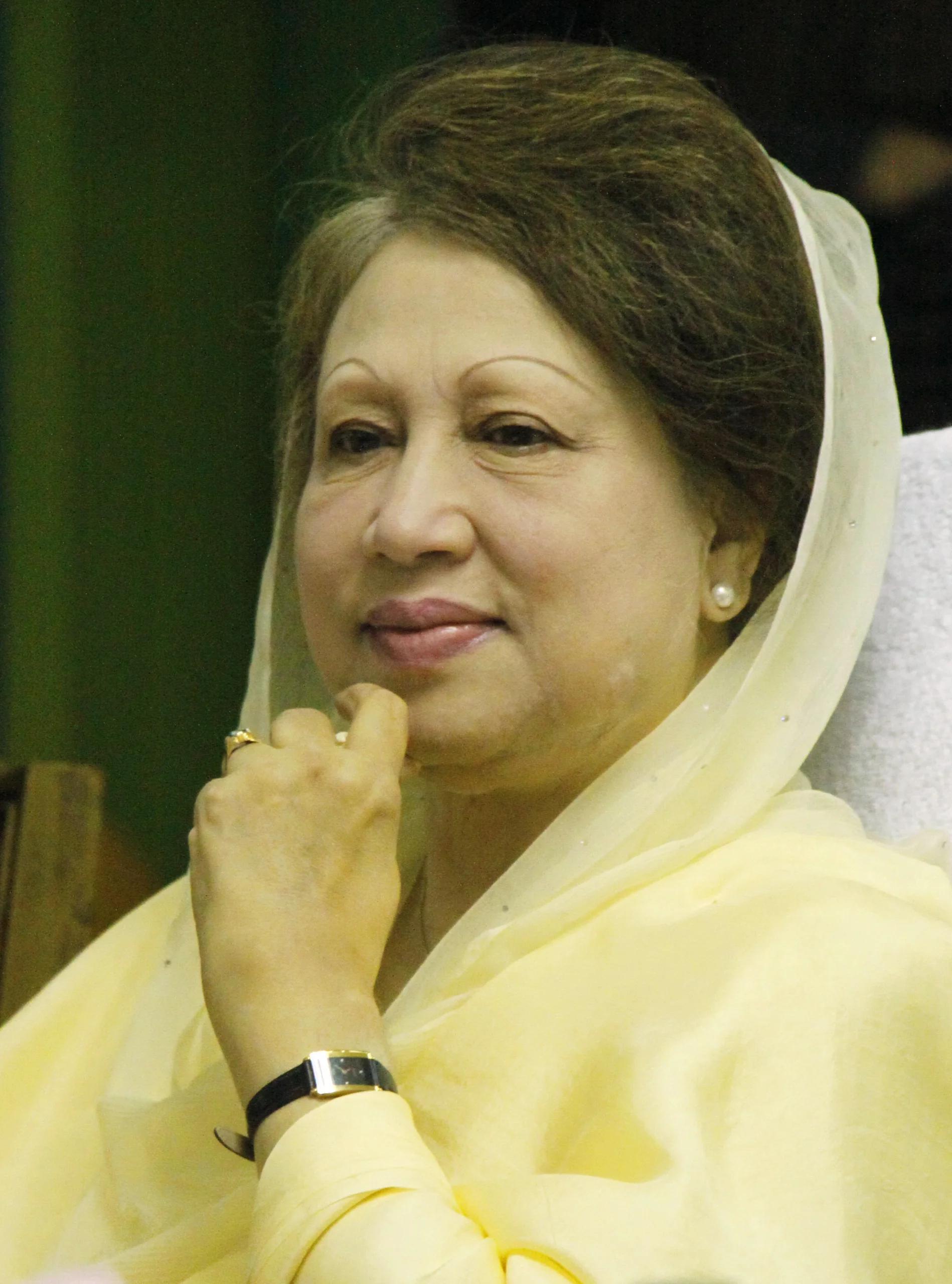
Khaleda Zia
 Bangladesh
Also known as: Begum Khaleda Zia, Khaleda Majumder, Khaleda Khanom, Begum Zia
Birthday
August 15, 1945
Birth Sign
Leo
Birthplace
Jalpaiguri, British India
Age
Died at 80
About
Begum Khaleda Zia was a Bangladeshi politician who served as the first female prime minister of Bangladesh, holding office from 1991 to 1996 and again from 2001 to 2006. She was the second woman to lead a Muslim-majority nation, following Pakistan's Benazir Bhutto. Zia chaired the Bangladesh Nationalist Party (BNP) from 1984 until her death in 2025, a tenure of 41 years.
Her political life began after the assassination of her husband, President Ziaur Rahman, in 1981. She became a leading figure in the pro-democracy movement against military rule in the 1980s, eventually ascending to the premiership. Known for her reserved and courteous demeanor, Zia was a formidable presence in Bangladeshi politics, often clashing with rival Sheikh Hasina.
In her final years, Zia faced imprisonment on corruption charges, but was released and acquitted in 2024 following the July Uprising. She passed away on December 30, 2025, and received a state funeral. Her legacy is marked by her role in restoring democracy and her enduring influence on the BNP.
Early Life & Background
Khaleda Khanam was born on August 15, 1945, in Jalpaiguri, then part of British India's Bengal province. She was the third of five children of Iskandar Majumder, a businessman from Shreepur village in present-day Feni District, and his wife Taiyaba. The family moved to Dinajpur after the 1947 partition, where her father had business interests in tea.
At age five, Khaleda began her education at St. Joseph's Convent in Dinajpur. She later attended Dinajpur Government Girls' High School, passing her matriculation in 1960. She enrolled at Surendranath College for intermediate studies, but her education was cut short when she married Ziaur Rahman in 1960, at around age 15. The couple moved to West Pakistan in 1965.
During the 1971 Liberation War, Khaleda was detained by the Pakistan army while her husband fought with the liberation forces. After independence, the family lived in a modest military residence in Dhaka Cantonment. Ziaur Rahman rose to become president in 1977, but was assassinated in 1981, setting the stage for Khaleda's entry into politics.
Career Growth
Following her husband's assassination, Khaleda Zia stepped into politics, assuming leadership of the BNP in 1984. She formed a seven-party alliance in 1983 to oppose General Hussain Muhammad Ershad's military dictatorship. Her activism led to seven detentions between 1983 and 1990. In 1986, she joined forces with Sheikh Hasina to challenge Ershad, and their movement forced his resignation in 1990.
The 1991 general election brought the BNP to power, and Zia became Bangladesh's first female prime minister. Her first term saw reforms in education, economy, and public administration. In 1996, she resigned to allow a caretaker government, but lost the subsequent election. She returned to power in October 2001, leading a four-party coalition with a two-thirds majority. Her second term saw economic growth, but ended amid political crisis and a military takeover in 2007.
Charged with corruption, Zia was sentenced to 17 years in prison in 2018. Following the July Uprising in 2024, she was released and acquitted of all charges. She remained BNP chairperson until her death on December 30, 2025.
Career Timeline
Public Image & Style
Khaleda Zia was perceived as a reserved and courteous leader, often described as humble and kind. Her aides noted that she never raised her voice. She was known for her traditional Bengali attire, typically wearing sarees, and her simple lifestyle. In the media, she was portrayed as an uncompromising leader who stood firm against military rule. Her supporters, known as BNP activists, revered her as a symbol of democracy. Her rivalry with Sheikh Hasina dominated Bangladeshi politics for decades, polarizing the nation. Despite her political battles, Zia maintained a dignified public image, rarely engaging in personal attacks.
Fame & Fandom
Khaleda Zia holds no current placement in the iFANN Global Top 1,000 or any scope-specific ranking list. The iFANN Global Fame Engine evaluated her profile in August 2026 and determined she remains unranked within the published tiers. Her absence from these charts reflects a legacy defined by statecraft rather than the continuous consumption metrics that drive modern celebrity rankings. While entertainment icons cycle through viral moments, Zia's influence was anchored in the rigid structures of Bangladeshi politics and the endurance of a decades-long political struggle. She commanded a massive, organized constituency known simply as BNP supporters or activists. This group operated not as a pop culture fandom but as a formidable political machine capable of mobilizing millions for strikes and rallies. Their loyalty was forged in the fires of military dictatorship and the shared narrative of her imprisonment. Rituals centered on her birthday observances and the collective mourning following her death in December 2025 transformed into acts of national solidarity. Supporters gathered in streets to demand justice, turning her personal legal battles into a public symbol of resistance. Unlike fanbases that chase chart positions, Zia's followers sought regime change and democratic restoration. Her death marked the end of an era, with mourners holding out their hands in a display of deep respect at her state funeral. The scale of her impact is measured in the shutdown of the nation's economy during protests and the sheer volume of people who attended her final rites. No formal name exists for this group; they are defined entirely by their political affiliation and their reverence for a leader who broke the glass ceiling for women in Bangladesh.
Interesting Facts and Legends
Khaleda Zia was an avid reader who spent hours daily in her private library. She maintained a dedicated rose garden at her residence, reflecting a passion for horticulture despite her high office. Known for her soft-spoken nature, she rarely granted interviews and preferred a simple lifestyle clad in traditional sarees. Her favorite meal was traditional Bengali fish curry, a culinary constant throughout her life. An honorary fellow of the Royal College of Physicians and Surgeons of Glasgow, she also patronized cultural institutions like the Bangladesh Shilpakala Academy. Beyond these personal habits, a powerful legend surrounds her tenure as Bangladesh's first female Prime Minister. Stories of her breaking patriarchal norms while restoring democracy after military rule form the core of her cultural identity. A widely retold chapter involves her long incarceration starting in 2018, where she faced a seventeen-year sentence before her release in 2024. Supporters framed this period as a martyrdom against political persecution, fueling massive street protests. The most definitive moment came with her passing on December 30, 2025, at age 80. Huge crowds gathered for her state funeral, creating a scene of extraordinary grief that cemented her status as a national icon. This final chapter transformed her from a polarizing politician into a universally mourned figure of historical significance.
Notable Quotes
“I never saw her raise her voice.”
“She was humble, kind and thoughtful.”
“Democracy is the only path to progress.”
Family & Personal Life
Khaleda Zia was the third of five children of Iskandar Majumder, a businessman, and Taiyaba Majumder. She married Ziaur Rahman in 1960, and they had two sons: Tarique Rahman, who later became a senior BNP leader, and Arafat Rahman Koko. The family lived at 6 Moinul Road in Dhaka Cantonment from 1978 to 1981. After her husband's assassination, Zia raised her sons while leading the BNP. Her son Tarique has been acting as the party's senior vice-chairman. Zia was known to be a devoted mother, often prioritizing her family despite her political duties.
Notable Connections
Khaleda Zia was married to Ziaur Rahman, the founder of BNP and former president of Bangladesh. Her principal political rival was Sheikh Hasina, leader of the Awami League, with whom she alternated power for decades. She opposed General Hussain Muhammad Ershad's military rule in the 1980s. Her sons, Tarique Rahman and Arafat Rahman Koko, were also involved in politics, with Tarique serving as a senior BNP leader.
Relationships & Dating History
Khaleda Zia married Ziaur Rahman in 1960, when she was about 15 years old. Ziaur Rahman was then a captain in the Pakistan Army. The couple had two sons, Tarique and Arafat. They remained married until his assassination on May 30, 1981. After his death, Khaleda did not remarry. She remained a widow for the rest of her life. Her relationship with Ziaur was supportive, and she often accompanied him during his presidency. Following his death, she dedicated herself to his political legacy. As of 2026, she is deceased, and her marital status at the time of death was widowed.
- MarriedZiaur Rahman1960 - 1981Married until his assassination in 1981.
Death & Aftermath
Died
December 30, 2025 (aged 80)
Death Place
Dhaka
Cause of Death
Prolonged illness reported
The final days of Begum Khaleda Zia unfolded in a Dhaka hospital where the former prime minister faced a prolonged illness before her passing. She died on December 30, 2025, at the age of 80, ending a political career that had spanned over four decades. Indian Prime Minister Narendra Modi expressed deep sadness upon learning of her death, calling her a significant figure who championed democracy in South Asia. Tributes poured in from across the political spectrum, with BNP leader Mirza Fakhrul Islam Alamgir paying homage to her grave alongside her husband's at Shaheed Minar during his oath-taking ceremony months later.
The public reaction reflected a nation mourning a matriarch whose life was defined by resilience and political struggle. Her funeral followed established protocols for state leaders, with family members and party loyalists gathering to bid farewell. Posthumous recognition included a five-day program announced by the Bangladesh Nationalist Party to mark its anniversary, featuring flag-hoisting ceremonies and tributes at the graves of both Ziaur Rahman and Khaleda Zia. Her legacy remained intertwined with the history of Bangladesh's democratic movement, remembered by many as a symbol of perseverance against military rule.
Net Worth (Estate Value)
$10 Million
iFANN Editorial Team estimate
Khaleda Zia's financial standing remained largely opaque throughout her career, as she prioritized politics over business ventures. Her income derived primarily from her political service and inherited family assets. Following her death in late 2025, her estate passed to her family, including her son Tarique Rahman. The holdings encompass properties across Bangladesh, notably the family residence in Dhaka. Per iFANN's editorial analysis, estimates of her net worth, which include inherited wealth and real estate value, stand at $10 Million as of 2026. This valuation accounts for her property portfolio and other investments. The estate continues to generate revenue through rental properties and various investment vehicles. No significant posthumous revenue streams have been reported since her passing.
Awards Won (4)
Khaleda Zia received several honors for her political contributions. In 2011, she was honored as a 'Fighter for Democracy' by the New Jersey State Senate. She was recognized as the first woman to be elected prime minister of Bangladesh and the second in the Muslim world. No major international awards were reported, but her legacy is celebrated in Bangladesh for her role in restoring democracy.
1991
2001
Known For
Prime Minister of Bangladesh
1991-1996, 2001-2006 · First female PM
Chairperson of BNP
1984-2025 · Leader
Keywords
Sources
Quick Facts
- Profession
- politician
- Born
- +1945-08-15
- Birthplace
- Jalpaiguri
- Died
- +2025-12-30
- Death Place
- Evercare Hospital Dhaka
- Gender
- Female
- Spouse
- Ziaur Rahman
- Birth Sign
- Leo
- Age at Death
- 80
Personal Details
- Full Name
- Khaleda Khanam
- Spouse
- Ziaur Rahman
- Children
- Tarique Rahman, Arafat Rahman Koko
- Education
- Surendranath College (attended)
Frequently Asked Questions
How old was Khaleda Zia when she died?
Was Khaleda Zia the first female prime minister of Bangladesh?
How many children did Khaleda Zia have?
What was the relationship between Khaleda Zia and Sheikh Hasina?
Why was Khaleda Zia imprisoned?
Social Media
Similar People
Join the community
fans discussing