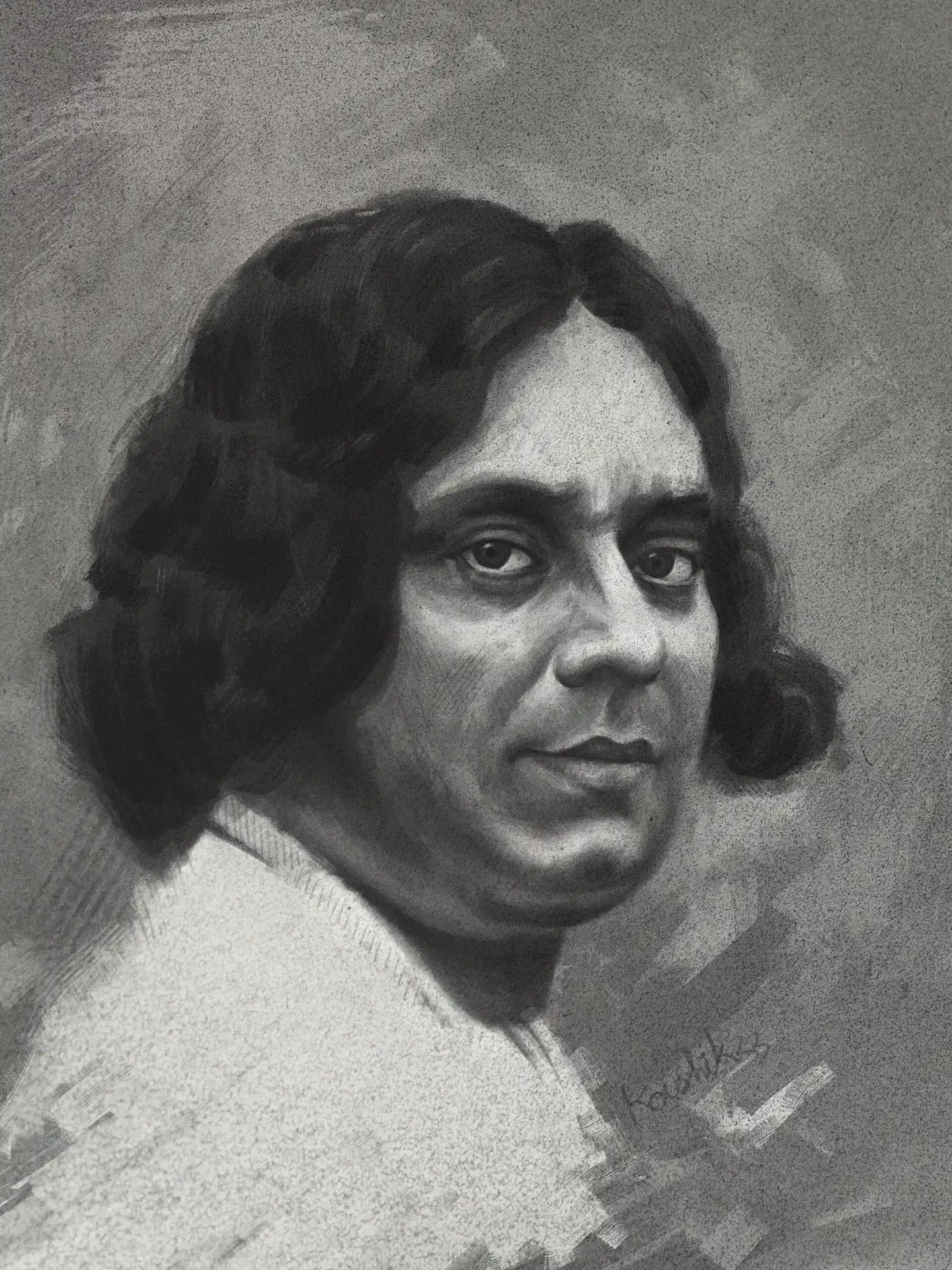
Kazi Nazrul Islam
 Bangladesh
poet•writer•musician•revolutionary
Also known as: Bidrohi Kobi, Dukhu Mia, Bulbul, National Poet of Bangladesh
Birthday
May 24, 1899
Birth Sign
Gemini
Birthplace
Churulia, Bengal Presidency, British India (now West Bengal, India)
Age
Died at 77
About
Kazi Nazrul Islam was a Bengali poet, writer, musician, and revolutionary, celebrated as the national poet of Bangladesh and one of the greatest figures in Bengali literature. His work, marked by fierce rebellion against oppression and a deep love for humanity, earned him the title 'Bidrohi Kobi' (Rebel Poet).
Nazrul's creative output was staggering: nearly 4,000 songs known as Nazrul Giti, numerous poems, novels, and essays that championed equality, justice, and communal harmony. His revolutionary poem 'Bidrohi' (The Rebel) remains a rallying cry for freedom, and his music, blending Islamic themes with Bengali folk traditions, reshaped the musical landscape of the region.
Despite his untimely illness in 1942, which silenced his voice, his legacy continued to grow. Honored with Bangladeshi citizenship in 1976, he passed away the same year, leaving behind a body of work that still inspires artists and activists across South Asia and beyond.
Early Life & Background
Born on May 24, 1899, in the village of Churulia in the Bardhaman district of Bengal Presidency, Kazi Nazrul Islam was the son of Kazi Faqeer Ahmed, an imam and caretaker of a local mosque and mausoleum, and Zahida Khatun. His childhood nickname, Dukhu Mia, meaning 'one with grief,' proved prophetic: his father died when Nazrul was only nine or ten, forcing the young boy to take on the role of muezzin at the mosque and caretaker of the mausoleum to support his family.
Nazrul's early education took place at a mosque-run maktab and later a dargah-run madrasa, where he delved into theology, Islamic philosophy, the Quran, and Hadith. But his interests stretched far beyond religious texts. He was drawn to folk theatre and joined a local troupe called Leṭor Dôl, where he wrote songs, poems, and plays. He also immersed himself in Bengali and Sanskrit literature, laying the groundwork for his future literary genius.
At seventeen, Nazrul enlisted in the British Indian Army, a decision that would shape his worldview. Posted in Karachi, he witnessed the harsh realities of colonial rule and the suffering of the common people. These experiences ignited his revolutionary spirit, which would soon find its voice in his writing.
Career Growth
After leaving the army in 1920, Nazrul moved to Calcutta, the cultural heart of Bengal, and threw himself into journalism. His first novel, 'Bandhan-hara' (The Unbound), was published that year, and he joined the Bengali Muslim Literary Society. But it was his poem 'Bidrohi' (The Rebel), published in 1922, that electrified the literary world. Its thunderous declaration, 'I am the rebel eternal, I raise my head beyond this world,' made him an instant icon of resistance.
That same year, he published his first collection of poems, 'Agniveena' (The Fiery Lute), and founded the journal 'Dhumketu' (The Comet), which became a platform for his revolutionary ideas. The British colonial authorities, wary of his influence, imprisoned him in 1923. Even from behind bars, he wrote prolifically, producing 'Rajbôndīr Jôbanbôndī' (Deposition of a Political Prisoner).
Throughout the 1920s and 1930s, Nazrul's creative energy flowed into music. He composed nearly 4,000 songs, collectively known as Nazrul Giti, which blended Islamic devotional themes with Bengali folk and classical traditions. His songs of love, devotion, and revolution became anthems for the masses. He also wrote short stories, essays, and plays, and his work with singer Abbasuddin Ahmed helped popularize his music across the region.
In 1942, at the height of his powers, Nazrul fell ill. A rare neurodegenerative disease, later diagnosed as Pick's disease, robbed him of his voice and memory. He spent the next three decades in silence, cared for by his family. In 1972, the newly independent Bangladesh invited him to live in Dhaka, where he was conferred citizenship in 1976. He died that same year, but his legacy as the 'Rebel Poet' and national poet of Bangladesh remains undimmed.
Career Timeline
Public Image & Style
Kazi Nazrul Islam is immortalized in Bengali culture as the 'Rebel Poet,' a fiery voice against injustice and oppression. His public image is one of defiance and compassion, equally comfortable with the sword of revolution and the lute of love. He is also fondly called the 'Bulbul' (nightingale) of Bengali music for his melodious compositions.
His poetry and songs are recited and sung at political gatherings, cultural events, and religious ceremonies alike. His fusion of Islamic devotional themes with Bengali folk traditions made him a unifying figure in a region often divided by religion. Fans and scholars alike admire his courage to challenge the British Raj and his unyielding commitment to humanism.
Today, his image adorns public spaces in Bangladesh, and his works are studied in schools and universities. His legacy is kept alive by countless artists who perform Nazrul Giti, ensuring that his voice continues to resonate with new generations.
Fame & Fandom
The reverence for Kazi Nazrul Islam transcends the typical boundaries of fandom, functioning instead as a living national constitution. His admirers are not a scattered group of enthusiasts but a unified constituency of students, intellectuals, and government bodies who treat his works as sacred state heritage rather than mere celebrity merchandise. This unique dynamic means his legacy is sustained through top-down institutionalization, such as the official designation of a 'Nazrul Year' in Bangladesh, alongside grassroots activism focused on preserving his ancestral home against modern threats. While there is no informal moniker like 'Swifties' or 'BTS Army' to identify his followers, their devotion manifests in solemn annual rituals where millions recite his poetry and sing his songs during the state-sponsored observances of May 24. Even in recent years, his spirit has been invoked as a guiding light for contemporary political movements, proving that his influence remains an active force in global discourse rather than a static historical footnote. This enduring power is quantified by his standing in the iFANN Global Fame Rankings, which track global attention across media coverage, search, and consumption signals worldwide. Through this lens, Kazi Nazrul Islam is recognized as the 7th most famous person from Bangladesh, a position he holds steady from the previous cycle.
Interesting Facts and Legends
Known affectionately as 'Dukhu Mia' or 'one with grief,' Nazrul's nickname foreshadowed the profound struggles he faced throughout his life. He was the first poet to successfully introduce Islamic themes into mainstream Bengali music, bridging a gap for conservative Muslim communities while championing communal harmony between Hindus and Muslims. His revolutionary poem 'Bidrohi' stands as one of the most powerful works in the language, often recited at political rallies to inspire defiance against oppression. A pioneer of the 'jatra' folk theatre, his early days with the Leṭor Dôl troupe deeply shaped his artistic sensibilities. Beyond these verified facts, a story fans still retell involves his arrest in November 1922 for sedition; the British authorities detained him for his fiery anti-colonial journalism, cementing his legend as a fearless revolutionary. Another enduring piece of lore describes his voice and pen as an 'Agni Veena' or Fire-Harp, a metaphorical instrument said to burn away darkness and injustice. In 2026, his legacy was further revitalized when cultural bodies linked his poetry to the spirit of the July uprising, framing his words as a beacon for modern resistance. Despite his passing, his birthday, May 24, remains a major national holiday celebrated as Nazrul Jayanti.
Family & Personal Life
Kazi Nazrul Islam was born into a devout Muslim family in Churulia. His father, Kazi Faqeer Ahmed, served as the imam of the local mosque and caretaker of the mausoleum of Pir Pukar. His mother, Zahida Khatun, was a homemaker. The family was large, and Nazrul had several siblings, though details remain sparse.
When his father died, Nazrul, still a child, took on the responsibility of supporting his mother and siblings, working as a muezzin and caring for the mausoleum. He also had an uncle, Bazle Karim, who was a folk singer and inspired Nazrul's early interest in folk opera.
In 1924, Nazrul married Promila Devi, a Hindu woman, in a union that defied religious boundaries and was celebrated as a symbol of communal harmony. The couple had several children, including sons Kazi Aniruddha, Kazi Sabyasachi, Kazi Anirban, and Kazi Arindam, and daughters Krishna Mohammad and others. Promila remained devoted to Nazrul, caring for him through his long illness until his death in 1976.
Notable Connections
Kazi Nazrul Islam's life was intertwined with several notable figures. His wife, Promila Devi, supported him through his illness and remained devoted until his death. His uncle, Bazle Karim, was a folk singer who introduced him to folk opera. Singer Abbasuddin Ahmed popularized Nazrul's songs across Bengal. Rabindranath Tagore influenced his early work, though Nazrul soon carved his own path, moving beyond Tagore's style to create a more revolutionary voice.
Relationships & Dating History
Kazi Nazrul Islam's most significant relationship was with Promila Devi, a Hindu woman he married in 1924. Their interfaith marriage was a bold statement in a time of communal tension, and it was celebrated as a symbol of unity. The couple had several children, and Promila remained a steadfast companion throughout Nazrul's life, especially during his long illness.
Before his marriage, there is little documented about Nazrul's romantic life. His early years were consumed by his education, military service, and literary pursuits. His marriage to Promila Devi was the defining relationship of his life, and they stayed together until his death in 1976. At the time of his death, he was married to Promila Devi.
- MarriedPromila Devi1924 - 1976Married in 1924; she remained devoted to him through his illness until his death in 1976.
Death & Aftermath
Died
August 29, 1976 (aged 77)
Death Place
Dhaka, Bangladesh
Cause of Death
Cerebral hemorrhage
The establishment of the Kazi Nazrul Islam Memorial at his former residence in Dhaka stands as a reflection of a life that concluded. This cultural center houses manuscripts and oversees the preservation of his legacy while the nation honors him with annual vigils and recitations. The final days were spent in deep cognitive impairment where he remained bedridden and unable to speak or write following a severe mental breakdown in 1942 that was compounded by family tragedies. On August 29, 1976, at the age of 77, he passed away from a cerebral hemorrhage resulting from long-term mental illness and physical deterioration, a cause established by attending physicians.
His death triggered profound national mourning across Bengal, with thousands lining the streets of Dhaka to attend a funeral procession marked by the singing of his revolutionary songs. Leaders from the Awami League and other political factions joined the mourners, reflecting his status as a unifying figure. In the decades since, his memory has been kept alive through the Kazi Nazrul University in Trishal, the Kazi Nazrul Islam Institute in Dhaka, and posthumous recognition including the Bangladesh Independence Day Award.
Net Worth (Estate Value)
$5 Million
iFANN Editorial Team estimate
Kazi Nazrul Islam's financial legacy is modest compared to modern celebrities, yet his estate continues to generate significant income through royalties from his songs, poems, and published works. His compositions, known as Nazrul Giti, remain staples in performances and recordings, while his books stay in print. Per iFANN's editorial analysis, the estate's value is estimated at around $5 million in 2026, driven by ongoing royalties from performances, recordings, and publications in Bangladesh and India. The Bangladesh government established the Nazrul Institute in Dhaka to preserve and promote his works, contributing to the estate's financial stability. Although Nazrul lived in relative poverty during his lifetime, his posthumous earnings have grown steadily over the decades. His works are widely utilized in films, television, and cultural events, generating consistent licensing fees. The estate is managed by his descendants, who have diligently worked to protect his intellectual property rights. Despite the passage of time, the demand for Nazrul's revolutionary poetry and soulful music remains strong, ensuring a lasting financial legacy.
Awards & Accolades
View 4 records, honours and achievementsKnown For
Bidrohi (The Rebel)
1922 · Poem
Agniveena (The Fiery Lute)
1922 · Poetry collection
Nazrul Giti
1920s-1930s · Musical compositions
Dhumketu (The Comet)
1922 · Journal
Bandhan-hara
1920 · Novel
Keywords
Sources
Quick Facts
- Profession
- poet, writer, musician, revolutionary
- Born
- May 24, 1899
- Birthplace
- Churulia, Bengal Presidency, British India
- Died
- August 29, 1976
- Death Place
- Dhaka, Bangladesh
- Gender
- Male
- Birth Sign
- Gemini
- Nationality
- British Indian (later Bangladeshi citizen)
- Spouse
- Promila Devi
- Children
- Several, including Kazi Aniruddha, Kazi Sabyasachi, Kazi Anirban, Kazi Arindam, Krishna Mohammad
Personal Details
- Full Name
- Kazi Nazrul Islam
- Spouse
- Promila Devi
- Children
- Kazi Aniruddha, Kazi Sabyasachi, Kazi Anirban, Kazi Arindam, Kazi M. Shamsul Islam, Kazi M. Motaharul Islam, Kazi M. Humayun Kabir, Kazi M. Nurul Islam, Krishna Mohammad, and others
- Education
- Studied at a mosque-run maktab and a dargah-run madrasa, where he learned theology, Islamic philosophy, the Quran, and Hadith.
Frequently Asked Questions
Who was Kazi Nazrul Islam?
What is Kazi Nazrul Islam famous for?
When and where was Kazi Nazrul Islam born?
What was Kazi Nazrul Islam's impact on Bengali culture?
When did Kazi Nazrul Islam die?
Similar People
Join the community
fans discussing