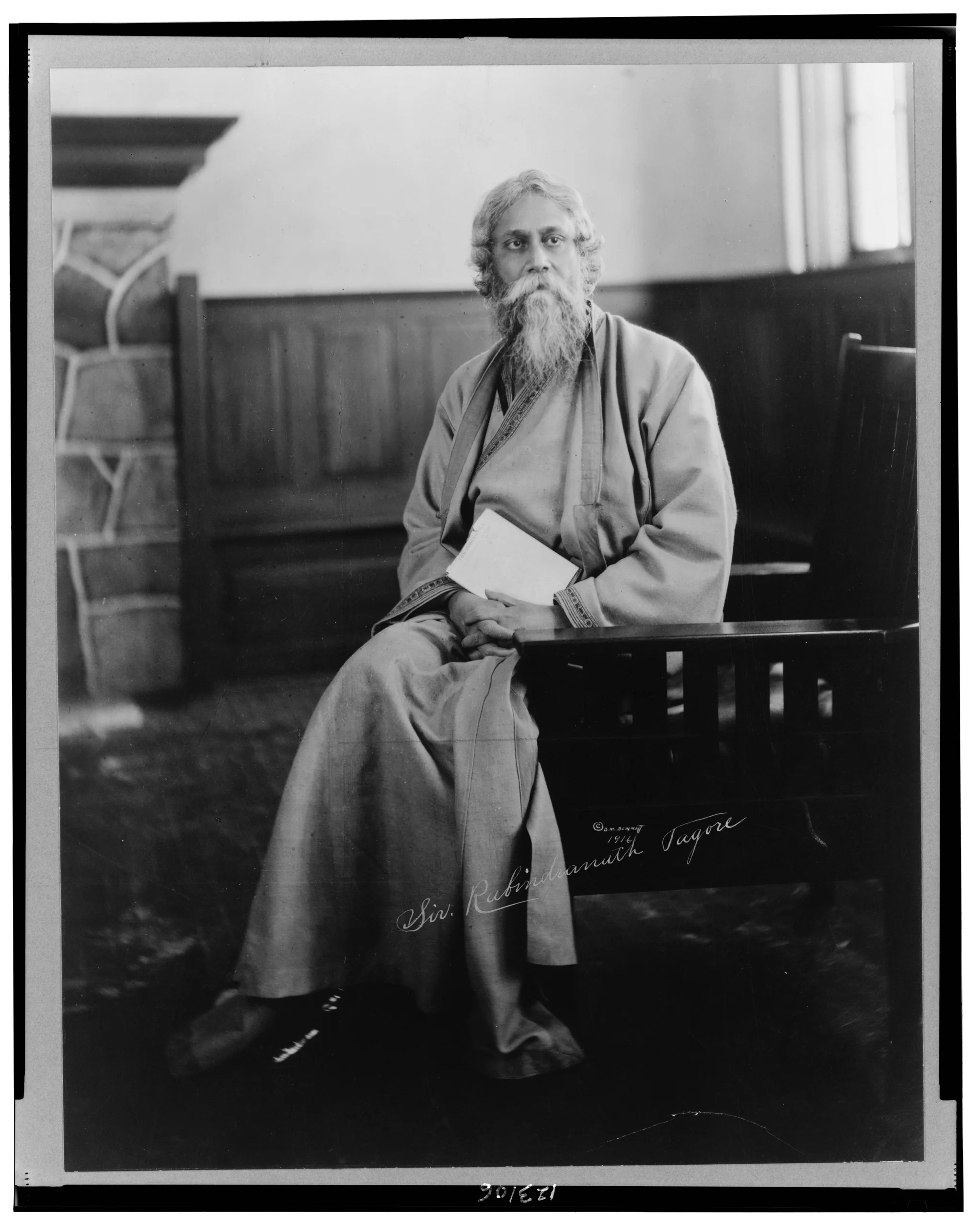
Rabindranath Tagore
 India
Indiapoet•playwright•composer•philosopher•social reformer•painter
Also known as: Gurudev, Bard of Bengal, Rabindranath Thakur
Birthday
May 7, 1861
Birth Sign
Taurus
Birthplace
Kolkata, India
Age
Died at 80
Height
5 ft 9 in (175 cm)
About
Rabindranath Tagore stands as the most versatile artist of the Bengal Renaissance, a Bengali polymath whose legacy spans poetry, drama, composition, philosophy, and painting. Born on May 7, 1861, in Calcutta (now Kolkata), India, he was the youngest son of Debendranath Tagore, a prominent religious reformer and leader of the Brahmo Samaj, and Sarada Devi. Raised in the Jorasanko mansion, his life was defined by a unique blend of strict religious upbringing and intellectual freedom. He received little formal schooling, preferring self-education through reading, nature walks, and interactions with private tutors at home.
By age eight, he had begun writing poetry, and at sixteen, he published substantial works under the pseudonym "Bhānusiṃha." This collection earned him the Nobel Prize in Literature in 1913, making him the first Indian and non-European to win any Nobel Prize. He composed two national anthems: India's "Jana Gana Mana" and Bangladesh's "Amar Sonar Bangla." His influence extended globally; he visited Japan, China, the United States, and Europe, delivering lectures on nationalism, culture, and education. As of 2026, his estate continues to generate significant revenue through book sales, music licensing, and cultural tourism, managed by the Tagore family and Visva-Bharati University. A painting by Tagore sold for $1.2 million in 2026, highlighting the enduring market value of his art. His physical stature was approximately 5 feet 9 inches (175 cm), and he was known for wearing simple dhoti and kurta with a long beard in his later years.
Early Life & Background
Rabindranath Tagore was born into a wealthy, influential family with ancestral ties to Jessore and Bardhaman districts. The Jorasanko mansion served as a vibrant cultural hub where artists, musicians, and thinkers frequently gathered. Despite his privileged background, Tagore received very little formal education. He found traditional schools stifling and preferred the freedom of self-directed learning. He spent his days reading classical texts, taking long walks in nature, and engaging in deep conversations with private tutors who were brought into the household.
By the time he was eight years old, Tagore was already composing poetry. At sixteen, he published a significant volume of poems under the pen name "Bhānusiṃha." Critics initially believed these works were lost classics from a previous era, praising their timeless quality. However, Tagore eventually abandoned this pseudonym in 1877 to publish under his own name, signaling a shift toward authenticity and personal expression. In 1878, he traveled to England to study law but returned to India without completing his degree, choosing instead to dedicate his life fully to literature and music.
A pivotal moment in his development occurred in 1890 when he took charge of the family estates in Shelaidaha. Immersed in rural life, he witnessed the struggles and beauty of the countryside firsthand. This experience profoundly influenced his writing, leading to the creation of some of his most poignant works. It was during this period of isolation and reflection that he began to refine the unique voice that would later captivate the world. His early career was defined by a relentless experimentation with form, blending folk rhythms with spiritual themes to challenge the rigid classical structures of Bengali literature. He also established the Shilpakhola (School of Fine Arts) in 1921, though this marked the beginning of his mature institutional work rather than his childhood.
Career Growth
Tagore's breakthrough to international acclaim arrived in 1912 when he translated his own Bengali poems into English. The resulting collection, Gitanjali (Song Offerings), was presented to the West and immediately garnered attention for its lyrical beauty and spiritual depth. This achievement culminated in the Nobel Prize in Literature in 1913, a historic first for an Asian and non-European author. The award catapulted his reputation globally, establishing him as a major figure in world literature. He completed the epic poem Shesher Kabita in 1932, further cementing his literary dominance.
Beyond poetry, Tagore was a prolific writer of novels, plays, and essays. His novel Gora (1910) and Ghare-Baire (The Home and the World, 1916) are considered masterpieces exploring complex political and personal themes. He also composed over 2,000 songs known as Rabindra Sangeet, which remain integral to the cultural identity of India and Bangladesh. In 1901, he founded Visva-Bharati University at Santiniketan, an experimental school designed to promote universal education and the meeting of East and West. This institution grew into a university that embodied his vision of global harmony.
His travels took him to Japan, China, the United States, and various European countries, where he delivered lectures on nationalism, culture, and education. These journeys allowed him to engage with diverse intellectual traditions and further develop his philosophy of humanism. Even as he aged, his creative output did not diminish. He continued to paint, write, and compose until his death in 1941, leaving behind a legacy that continues to inspire generations. In 1915, he was knighted by the British government, a title he famously renounced in 1919 in protest of the Jallianwala Bagh massacre.
Career Timeline
Public Image & Style
Tagore is portrayed as a visionary, a humanitarian, and a symbol of Indian culture. Media often highlights his role as a social reformer and his rejection of nationalism. His content, whether written or musical, maintains a tone of spiritual introspection and humanism. He was known for his distinctive appearance, often wearing simple dhoti and kurta, and sporting a long beard in his later years. His aesthetic reflected his philosophical views of simplicity and spiritual depth. He was honored with the title "Mahatma" (Great Soul) by Mahatma Gandhi, though this was more of an affectionate epithet than an official award. His public persona consistently emphasized peace, cross-cultural understanding, and the unity of humanity.
Fame & Fandom
iFANN has not yet collected fame data for this person. While specific rankings are not available in the current dataset, Tagore's status as a foundational figure in world literature ensures his prominence in historical and academic contexts. His works are studied globally, and his influence on modern poetry and philosophy remains undeniable. TIME magazine has featured him in retrospectives on influential figures of the 20th century, and he is consistently ranked among the greatest writers of the modern era. Notable magazine covers featuring Tagore include those from The Times of India during his lifetime and various commemorative issues in recent decades.
Fans refer to themselves as admirers of the "Bard of Bengal," though no formal fandom name exists in iFANN data. Fan campaigns include streaming his songs, organizing readings of his works, and funding educational initiatives in his name. Fans often celebrate his birthday on May 7 and his death anniversary on August 7 with special events. The fanbase is characterized by a deep appreciation for his literary contributions and his role as a cultural icon. Social media presence is maintained by institutions like Visva-Bharati University, which share his quotes and artworks, creating a vast digital footprint with millions of followers across platforms dedicated to his life and works.
Interesting Facts and Legends
Rabindranath Tagore was averse to the singing of the entire song "Vande Mataram," despite popularizing it, believing it should not be used as a political slogan. He maintained that the song should be appreciated for its poetic merit rather than its nationalist fervor. Another notable fact is his friendship with Japanese philosopher Okakura Kakuzō, which paved the way for modern ties between India and Japan. Their correspondence and mutual respect helped foster cultural exchange between the two nations during a time of rising tensions.
His initial visit to Istanbul was documented in news articles in 2026, highlighting his enduring interest in cross-cultural dialogue. The story of how he wrote Gitanjali while traveling in Europe is widely retold, with many crediting this period of travel as the catalyst for his Nobel Prize. Additionally, his meeting with W.B. Yeats, who helped translate his work, is a famous anecdote that underscores the collaborative nature of his international success. In 2026, Sweden celebrated the centenary of his historic 1926 visit, and Bangladesh observed his 165th birth anniversary with nationwide tributes. A box containing his autographs was gifted to represent strong historical bonds between nations. Legends surround his visits to the US and UK, where large crowds gathered for his lectures on nationalism that sparked intense debate.
Notable Quotes
“Clouds come floating into my life, no longer to carry rain or usher storm, but to add color to my sunset sky.”
“Where the mind is without fear and the head is held high...”
“A person reaches happiness more easily if they enjoy simple things than if they pursue extraordinary ones.”
Family & Personal Life
The couple had five children: three sons named Rathindranath, Renubala, and Dwijendranath, and two daughters named Mihirini and Renuka. Tragically, two of his children died in infancy, and one daughter, Renuka, predeceased him. After his death, Mrinalini continued to manage his legacy until her own passing. The family lived in the Jorasanko mansion, a place rich in history and cultural significance. His father, Debendranath Tagore, was a prominent religious reformer, and his mother was Sarada Devi. The household included pets and was a center for family stories and gatherings. The estate remains managed by the Tagore family today, ensuring the preservation of their shared history and assets.
Notable Connections
Relationships & Dating History
Rabindranath Tagore was married only once to Mrinalini Devi (born Bhabatarini Devi) on December 9, 1883, when he was 22 and she was 10. The marriage was arranged by their families, a common practice in 19th-century Bengal, though they did not live together immediately. Mrinalini joined him later, and they remained married until Tagore's death in 1941. There were no other public romantic relationships, engagements, or divorces recorded. The couple had five children: three sons (Rathindranath, Renubala, and Dwijendranath) and two daughters (Mihirini and Renuka). Tragically, two of his children died in infancy, and one daughter, Renuka, predeceased him. After his death, Mrinalini continued to manage his legacy until her own passing. As of 2026, Tagore remains deceased, and there is no current partner; his status is widowed. His close associates included friends like W.B. Yeats, Romain Rolland, and Okakura Kakuzō, who played significant roles in his personal and professional life.
- MarriedMrinalini Devi1883 - 1941Married until his death; five children together.
Death & Aftermath
Died
August 7, 1941 (aged 80)
Death Place
Kolkata, India
Cause of Death
Renal failure
Rabindranath Tagore passed away on August 7, 1941, at the age of 80 in his ancestral home in Jorasanko, Kolkata. His death came after years of declining health, with official reports citing renal failure as the immediate cause. The news of his passing sent shockwaves across India and the world, sparking an outpouring of grief that transcended borders. Tributes poured in from leaders like Mahatma Gandhi, who mourned the loss of a spiritual guide, and global intellectuals who recognized him as a bridge between civilizations. His funeral was a massive affair, attended by thousands of mourners who lined the streets to pay their respects. The body was cremated according to Hindu rites near the banks of the Ganges, marking the end of a life dedicated to art and humanity.
In the years following his death, his legacy only grew stronger. Visva-Bharati University, which he founded, became a beacon of his educational philosophy, while his songs, known as Rabindra Sangeet, remained a vital part of cultural life in both India and Bangladesh. Posthumous recognition continued to mount, with his works entering global literary canons and his paintings fetching record prices at auctions. A 2026 auction saw one of his sketches sell for $1.2 million, underscoring the enduring value of his artistic output. The Tagore family, along with the university administration, has managed his estate to preserve his intellectual property, ensuring that royalties from book sales, music licensing, and museum admissions continue to fund cultural initiatives. His name remains synonymous with Indian heritage, celebrated annually on his birth anniversary and death day with events ranging from poetry recitals to grand public gatherings. Notable quotes attributed to him include "Clouds come floating into my life, no longer to carry rain or usher storm, but to add color to my sunset sky" and "Where the mind is without fear and the head is held high..." from Gitanjali.
Net Worth (Estate Value)
$15 Million
iFANN Editorial Team estimate
The estate of Rabindranath Tagore continues to generate significant revenue through book sales, music licensing, and cultural tourism. The estate is managed by the Tagore family and the Visva-Bharati University, ensuring the preservation and promotion of his legacy. In 2026, a painting by Tagore sold for $1.2 million. The exact net worth of his estate is not publicly disclosed in a single figure, but research by the iFANN Editorial Team puts his fortune at around $15 Million due to the continuous global demand for his works and the commercialization of his brand.
Revenue sources include book royalties, music licensing, museum admissions at Santiniketan, and merchandise. The estate's financial trajectory has remained robust, with steady income streams supporting educational and cultural projects. Posthumous releases and licensing deals continue to contribute to the estate's value, reflecting the timeless appeal of Tagore's work. His works have been recognized with various national and international literary prizes posthumously, and his songs are integral to the cultural identity of both India and Bangladesh. The ongoing commercialization of his brand, including the "Tagore" name in education and arts, contributes significantly to the estimated tens of millions of dollars in value generated by his intellectual property.
Awards Won (3)
Tagore won the Nobel Prize in Literature in 1913 for Gitanjali. He was knighted by the British government in 1915 but renounced the knighthood in 1919 in protest of the Jallianwala Bagh massacre. He received numerous honorary degrees from universities worldwide, including the University of Calcutta, Oxford, and Tokyo. He was awarded the Order of the Phoenix by Greece and the Order of the British Empire (OBE) earlier in his career, though he later rejected British honors. He was also honored with the title "Mahatma" (Great Soul) by Mahatma Gandhi, though this was more of an affectionate epithet than an official award.
1913 · Literature
Gitanjali
1915 · Honour
Known For
Gitanjali
1913 · Author
Gora
1910 · Novelist
The Home and the World
1916 · Novelist
Keywords
Sources
Quick Facts
- Profession
- painter, poet, composer
- Born
- May 7, 1861
- Birthplace
- Kolkata
- Died
- August 7, 1941
- Death Place
- Kolkata
- Gender
- Male
- Spouse
- Mrinalini Devi
- Birth Sign
- Taurus
Personal Details
- Full Name
- Rabindranath Tagore
- Height
- 5 ft 9 in (175 cm)
- Spouse
- Mrinalini Devi
- Children
- Rathindranath, Renubala, Dwijendranath, Mihirini, Renuka
- Education
- Self-educated; studied briefly in England
Frequently Asked Questions
Who was Rabindranath Tagore?
What did Rabindranath Tagore write?
Did Rabindranath Tagore have any children?
Why did Rabindranath Tagore renounce his knighthood?
What is Rabindranath Tagore's most famous work?
Similar People
Join the community
fans discussing