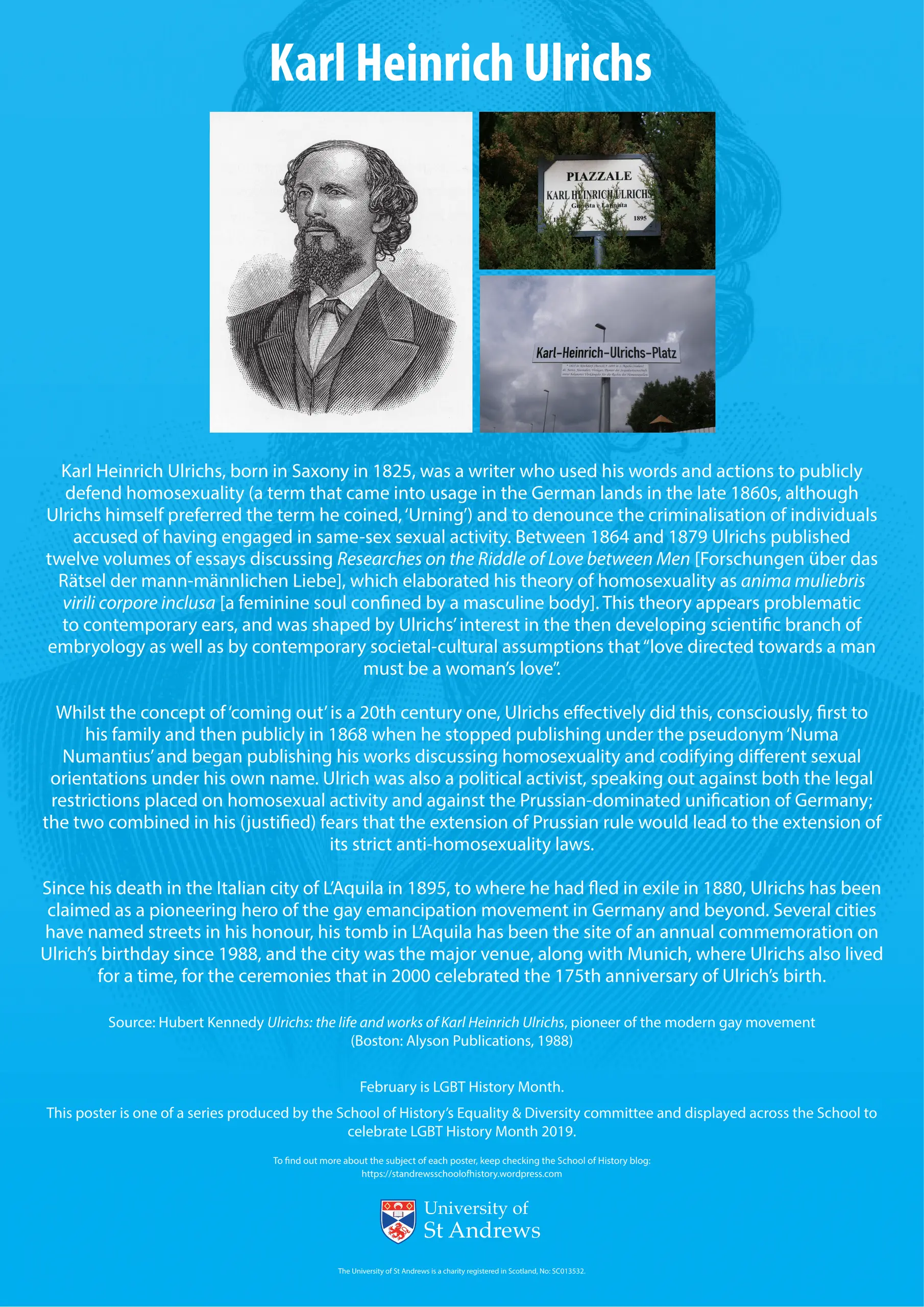
Karl Heinrich Ulrichs
lawyer•jurist•journalist•sexologist
Birthday
August 28, 1825
Birth Sign
Sagittarius
Birthplace
Aurich, Kingdom of Hanover
Age
Died at 69
About
Karl Heinrich Ulrichs was a German lawyer, jurist, journalist, and sexologist who lived from 1825 to 1895. He is universally recognized as the world's first openly gay man and the pioneer of the modern gay rights movement. Born in Aurich in the Kingdom of Hanover, Ulrichs dedicated his life to defending men attracted to other men against criminal laws that targeted them. Unlike many contemporaries who remained silent, he publicly identified himself as an "Urning," a term he coined, and argued that same-sex attraction was an innate, natural variation rather than a vice or crime. His legacy is defined by his transition from a conventional legal career to becoming the father of the modern gay rights movement through his pioneering work in sexology.
Ulrichs introduced groundbreaking terminology such as "Urning" for homosexuals and "Dioning" for heterosexuals, positing a theory of three sexes: male, female, and hermaphroditic. These concepts moved the conversation regarding same-sex desire from moral judgment to scientific inquiry, laying the theoretical groundwork for future fields of study. His advocacy directly influenced later figures like Magnus Hirschfeld, who founded the Scientific-Humanitarian Committee in 1897, building upon Ulrichs' earlier arguments. Today, he is honored in numerous academic studies, documentaries, and cultural projects, cementing his status as a foundational figure in queer history.
Early Life & Background
Karl Heinrich Ulrichs entered the world on August 28, 1825, in the town of Aurich, located in East Frisia within the Kingdom of Hanover. His father served as a civil servant, providing the family with a stable background that allowed Karl to pursue a rigorous education. From a young age, Ulrichs displayed an intense intellectual curiosity that set him apart from his peers, though he also experienced a deep sense of isolation due to his sexual orientation which he realized early in life. He enrolled at the University of Göttingen to study law, where he immersed himself in academic pursuits, before continuing his studies at the prestigious University of Berlin. These institutions shaped his understanding of jurisprudence and prepared him for a career in the legal system.
Ulrichs completed his studies and established a career as a legal adviser and jurist within the Hanoverian legal system. He worked in various capacities as a lawyer, maintaining a professional reputation before his personal life intersected with his public duties. However, his professional trajectory shifted dramatically in the mid-1860s. By 1867, it became apparent to his superiors that his sexual orientation aligned with the very people he was tasked with investigating under Paragraph 175 of the German penal code. This revelation led to his dismissal from his position as a legal adviser. While this loss of employment was devastating personally, it catalyzed a transition from a conventional legal career to one of public activism and writing. The dismissal marked the end of his attempt to live a discreet life and the beginning of his open defiance against the laws that criminalized his nature.
Career Growth
The year 1867 stands as the pivotal moment in Ulrichs' life and in LGBTQ+ history. On August 29, 1867, he addressed the Congress of German Jurists in Munich, delivering a speech that would become legendary. In this address, he became the first person in recorded history to publicly plead for the decriminalization of homosexuality and to admit his own identity before a public audience. He argued that homosexual acts were not crimes but natural occurrences, challenging the prevailing religious and legal views of the time. Following this breakthrough, Ulrichs embarked on a prolific writing career that spanned over a decade. Between 1864 and 1880, he published a series of twelve pamphlets collectively known as the Arus, or Forschungen über das Rätsel der mann-männlichen Liebe (Researches on the Riddle of Man-Manly Love).
These works introduced groundbreaking terminology such as "Urning" for homosexuals and "Dioning" for heterosexuals. He posited a theory of three sexes: male, female, and hermaphroditic, using the latter metaphorically to describe a third gender. His writings challenged the moral judgment of his era and laid the theoretical foundation for the field of sexology. Although his work was largely ignored or condemned by mainstream society during his lifetime, it gained traction among emerging circles of sexologists like Richard von Krafft-Ebing and Havelock Ellis. His advocacy directly influenced later figures like Magnus Hirschfeld, who founded the Scientific-Humanitarian Committee in 1897, building upon Ulrichs' earlier arguments. Despite facing significant social stigma and professional ostracization, Ulrichs continued to write and advocate until his death in Munich.
Career Timeline
Public Image & Style
Ulrichs presented himself as a serious intellectual and a man of science, rejecting the notion that his sexuality was a moral failing. He was known for his commitment to "Living Latin" and his rigorous legal arguments, championing the use of Latin as a universal language for scholarship. His public persona was defined by courage and conviction, as he risked his reputation and livelihood to speak openly about a taboo subject. Mainstream society viewed him with suspicion and hostility, labeling him a deviant, while emerging circles of scholars saw him as a pioneering thinker. His image today is that of a tragic hero who sacrificed his career and comfort to advance human rights. Specific physical attributes such as height or weight are not well-documented, but his intellectual demeanor remains a defining characteristic of his historical portrait.
Fame & Fandom (iFAMOUS Rankings)
iFANN has not yet collected fame data for this person. He does not appear on the September 2026 iFAMOUS Rankings flagship list. While Ulrichs lacks a modern fanbase with merchandise or social media following, he commands deep reverence within the LGBTQ+ community, academic circles, and historians of sexuality. He is often referred to as a legend or icon in these fields. Notable cultural mythology surrounds his 1867 speech, which is retold as the moment the "closet" was breached publicly for the first time. The story of his dismissal from his job and his subsequent rise as a writer serves as a central narrative in LGBTQ+ origin stories. In 2024, a short film titled Ulrichs 1867 was released, further cementing his place in cultural memory. In 2026, an exhibition examined new vocabulary that gave same-sex desire a place in art, likely referencing Ulrichs' linguistic contributions, underscoring his enduring influence on contemporary storytelling.
Interesting Facts and Legends
Ulrichs is often credited with coining the term "Urning" to describe men attracted to men, a word derived from the Greek goddess Aphrodite Urania. He also championed the use of "Living Latin" as a universal language for scholarship, a stance that distinguished him from many of his contemporaries. His 1867 speech at the Munich congress is frequently cited as the first public coming out in history, though he did not use the modern phrase "coming out" at the time. Ulrichs wrote extensively about the injustice of Paragraph 175 of the German penal code, calling for its repeal based on the principle of natural law. One of his most famous lines, often paraphrased, was: "I am a Urning... I am a man who loves men, and this is my nature." A statue dedicated to him stands at the Schwules Museum in Berlin, cementing his status as the father of the modern gay rights movement.
Notable Quotes
“I am a Urning... I am a man who loves men, and this is my nature.”
“The love between men is a natural phenomenon.”
“The love of men for men is not a sin, but a natural necessity.”
Family & Personal Life
Karl Heinrich Ulrichs was the son of a civil servant in Aurich, Kingdom of Hanover. Historical records indicate he never married and had no children. As a man living in the 19th century, he could not legally marry a partner, and societal pressures made open relationships impossible. While some sources suggest he may have had private romantic attachments, no specific names of partners or details of domestic arrangements are documented in credible historical archives. He remained single throughout his life, dedicating his existence to the cause of his community rather than personal family life. There is no evidence of a wife, husband, or long-term partner whose name has been preserved in historical texts. Consequently, all inquiries regarding his dating history, marriages, or offspring yield negative results; he is historically noted for his celibacy in the traditional sense, channeling his emotional energy entirely into his activism and writing.
Notable Connections
Relationships & Dating History
Karl Heinrich Ulrichs never married, and historical records indicate he did not have any children. As a man living in the 19th century, he could not legally marry a partner, and societal pressures made open relationships impossible. While some sources suggest he may have had private romantic attachments, no specific names of partners, dates of relationships, or details of domestic arrangements are documented in credible historical archives. He remained single throughout his life, dedicating his existence to the cause of his community rather than personal family life. There is no evidence of a wife, husband, or long-term partner whose name has been preserved in historical texts. Consequently, all inquiries regarding his dating history, marriages, or offspring yield negative results; he is historically noted for his celibacy in the traditional sense, channeling his emotional energy entirely into his activism and writing.
Death & Aftermath
Died
July 14, 1895 (aged 69)
Death Place
Munich, Bavaria
Cause of Death
Poor health
Karl Heinrich Ulrichs passed away on July 14, 1895, in Munich, Bavaria. He had been living in relative poverty and declining health during his final years after being dismissed from his legal career due to his sexual orientation. The exact cause of his death is not definitively recorded in major biographical summaries, though he was known to be in poor health in his final years. The mainstream press largely ignored his death or offered only muted coverage, reflecting the intense social stigma attached to homosexuality in late 19th-century Germany. His funeral was a private affair attended by close friends and colleagues rather than a public spectacle, and the exact location of his grave in Munich remains inconsistently documented in general biographical records.
Following his death, Ulrichs' legacy faded into obscurity for several decades, particularly during the Nazi regime which systematically persecuted homosexuals and destroyed much of the early gay rights literature he helped create. However, historians and activists began reclaiming his work in the post-World War II era. Decades later, he was formally recognized as a foundational figure when The New York Times published an "Overlooked No More" obituary in 2020. In 2021, outlets like Pink News commemorated his historic 1867 speech as the first public coming out. Today, his collected works remain essential reading in queer theory, and a statue dedicated to him stands at the Schwules Museum in Berlin, cementing his status as the father of the modern gay rights movement.
Net Worth (Estate Value)
$0
iFANN Editorial Team estimate
Karl Heinrich Ulrichs lived during the 19th century, a time when net worth was not a metric tracked for activists or writers in the modern sense. He worked as a lawyer and jurist but lost his position in 1867 due to his sexual orientation, which likely reduced his income significantly. He moved to Munich in his later years, where he lived in relative poverty but remained intellectually active. There are no records of substantial real estate holdings, business ventures, or investments that would contribute to a traditional net worth calculation. His financial legacy is measured not in currency but in the enduring value of his written works and the impact of his activism on the gay rights movement. The estate of Karl Heinrich Ulrichs holds no monetary value in the modern sense, as his assets were minimal and consumed by his lifestyle of advocacy.
Awards & Accolades
View 5 records, honours and achievementsKnown For
Arus Pamphlets
1864 · Author
Congress of German Jurists Speech
1867 · Speaker
Keywords
Sources
Quick Facts
- Profession
- jurist, writer, journalist
- Born
- August 28, 1825
- Birthplace
- Aurich, Kingdom of Hanover
- Died
- July 14, 1895
- Death Place
- Munich, Bavaria
- Gender
- Male
- Birth Sign
- Sagittarius
Personal Details
- Full Name
- Karl Heinrich Ulrichs
- Children
- Education
- University of Göttingen; University of Berlin
Frequently Asked Questions
What happened to Karl Heinrich Ulrichs?
What is Karl Heinrich Ulrichs known for?
Did Karl Heinrich Ulrichs have a wife or husband?
What caused Karl Heinrich Ulrichs' death?
Why is Karl Heinrich Ulrichs important today?
Similar People
Join the community
fans discussing