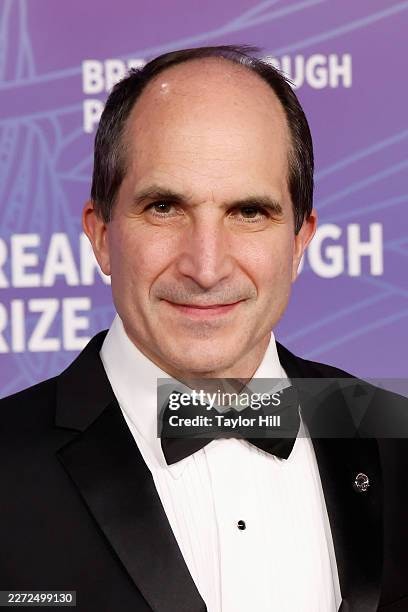
Juan Martín Maldacena
 Argentina
Birthday
September 10, 1968
Birth Sign
Virgo
Birthplace
Caballito, Buenos Aires, Argentina
Age
58 years old
Height
5 ft 8 in (173 cm)
About
Juan Martín Maldacena is an Argentine theoretical physicist who reshaped our understanding of the universe. As the Carl P. Feinberg Professor at the Institute for Advanced Study in Princeton, he stands among the most influential scientists in string theory and quantum gravity. His landmark 1997 paper introduced the AdS/CFT correspondence, a realization of the holographic principle that links gravity in a higher-dimensional space to quantum field theory on its boundary. This discovery, often called Maldacena's duality, has influenced black hole physics, quantum chromodynamics, condensed matter systems, and quantum information theory. His original paper has accumulated over 20,000 citations, making it one of the most cited physics papers of all time.
Maldacena's work continues to drive research into the deepest mysteries of space, time, and matter. He remains active at the IAS, exploring quantum gravity, entanglement, and the black hole information paradox. Though he maintains a low public profile, his ideas permeate modern theoretical physics and have earned him a reputation as a perennial Nobel Prize favorite.
Early Life & Background
Maldacena grew up in the Caballito neighborhood of Buenos Aires in a family without scientific background. His father worked in business and his mother was a homemaker. From an early age, he showed a strong aptitude for mathematics and physics, entering the University of Buenos Aires at just 17 to study physics. He earned his Licenciatura in 1991.
Seeking deeper challenges, he moved to the United States for graduate studies. At Princeton University, he completed his Ph.D. in 1996 under the supervision of Curtis Callan, writing a dissertation titled "Black Holes in String Theory." This work laid the foundation for his later revolutionary insights. He then spent a year as a postdoctoral researcher at Rutgers University, where he continued to develop his ideas on black holes and string theory.
In 1997, while still a postdoc, Maldacena published a paper that would change the course of theoretical physics. The paper, "The Large N Limit of Superconformal Field Theories and Supergravity," introduced the AdS/CFT correspondence. At 29 years old, he had proposed a duality that connected a theory of gravity in a five-dimensional anti-de Sitter space to a conformal field theory on its four-dimensional boundary. The work was initially met with skepticism by some journals but quickly became a cornerstone of modern physics.
Career Growth
After his breakthrough, Maldacena joined Harvard University as an associate professor in 1997, becoming a full professor by 2001. That same year, he moved to the Institute for Advanced Study in Princeton, where he was appointed Professor and later named the Carl P. Feinberg Professor. His AdS/CFT correspondence opened up new avenues in multiple fields. It provided a powerful tool for studying strongly coupled quantum field theories, leading to insights in quark-gluon plasma physics, superconductivity, and the behavior of black holes.
Maldacena's contributions have been recognized with a string of major awards. He received a MacArthur Fellowship in 2002, the Dirac Medal from ICTP in 2004, the Dannie Heineman Prize for Mathematical Physics in 2007, and the Fundamental Physics Prize in 2012. He also earned the Lorentz Medal in 2014, the Eddington Medal in 2015, the Pomeranchuk Prize in 2018, and a second Dirac Medal in 2021. In 2023, he was elected a Foreign Member of the Royal Society. His work continues to influence quantum gravity research, with recent papers exploring eternal black holes and the connection between entanglement and spacetime geometry.
Career Timeline
Public Image & Style
Maldacena's public image is that of a quiet, brilliant physicist who revolutionized our understanding of the universe while maintaining a modest demeanor. He is not a traditional celebrity but is revered in the physics community. Known for clear, intuitive explanations of complex concepts, he delivers technically rigorous presentations. Media portrayals describe him as "the quiet revolutionary of string theory." He has no active social media presence, communicating solely through academic publications and invited lectures. Physics enthusiasts and string theory followers study his papers intensively; the AdS/CFT correspondence is a required topic in most graduate-level string theory courses.
Fame & Fandom (iFAMOUS Rankings)
Juan Martín Maldacena stands as a quiet titan within the global scientific landscape, yet his footprint extends far beyond the lecture halls of Princeton. While he commands immense respect among theorists and mathematicians, iFANN's Global Fame Engine has evaluated this person, but they do not currently hold a placement in the published rankings (Global Top 1,000 or a Top-100 scope list). He remains unranked in the current edition of the world's most famous individuals, reflecting a fame profile that is deeply specialized rather than broadly ubiquitous. His influence operates through the gravity of ideas rather than the glare of celebrity culture. The community that reveres him consists of physicists, string theorists, and science enthusiasts who follow the evolution of quantum gravity. This audience does not form a traditional fanbase with a collective name; no organized group claims the title of 'Maldacena's Army,' nor do they engage in chart pushes or billboard campaigns. Instead, their devotion manifests in the citation of his work, the sold-out attendance at his talks in Salta and Buenos Aires, and the enduring academic discourse surrounding his theories. When Maldacena visits Argentina, media outlets frame these appearances as major cultural events, treating his discussions on space and time mysteries with the intensity usually reserved for pop icons. The 'legend' here is not one of emotional hysteria or fainting crowds, but of intellectual awe. The story told to newcomers is how his 1997 paper bridged the gap between gravity and quantum mechanics, a feat so profound it earned him comparisons to Einstein. This narrative of the 'New Argentine Einstein' travels freely through scientific circles, cementing his status as a living legend whose primary ritual is the solving of previously impossible problems.
Interesting Facts and Legends
Juan Martín Maldacena's 1997 paper was originally 27 pages long and initially faced rejection from several journals before emerging as a landmark achievement in physics. He speaks Spanish as his first language, having learned English only after moving to the United States for graduate school. Despite his towering fame, he has never written a popular science book, preferring to communicate complex ideas strictly through technical papers. His AdS/CFT paper has been cited over 20,000 times, surpassing the citation counts of many Nobel Prize-winning works. At just 29 years old, he was already recognized as a revolutionary figure in the field. He frequently collaborates with his wife, Marina Huerta, on various research projects. A central piece of modern physics lore surrounds his 1997 publication of the AdS/CFT correspondence, often called the 'Bridge' to an unknowable universe. This single conjecture is widely retold as the moment quantum gravity shifted from unsolvable mystery to calculable framework. In recent years, his return to Argentina has drawn full houses, such as a sold-out lecture in Salta in April 2025, where audiences flocked to hear him discuss the mysteries of black holes and spacetime. These events highlight his unique status as a national hero in science, revered for the sheer magnitude of his intellectual contributions rather than any performative flair.
Notable Quotes
“The AdS/CFT correspondence is a duality between a theory of gravity in a space and a quantum field theory on the boundary of that space.”
“String theory is a framework that attempts to unify all the forces of nature into a single, consistent theoretical framework.”
“The holographic principle suggests that our three-dimensional world might be a projection of information stored on a two-dimensional surface.”
“I think the most important thing is to follow your curiosity. Don't worry too much about what is fashionable or what will get you a job.”
“Black holes are the most fascinating objects in the universe because they bring together quantum mechanics and general relativity.”
Family & Personal Life
Maldacena is married to Marina Huerta, an Argentine theoretical physicist who works at the Institute for Advanced Study and the Universidad de Buenos Aires. They met through their shared scientific interests and have children together. The family resides in Princeton, New Jersey. Maldacena's parents were not scientists; his father worked in business and his mother was a homemaker. He has not publicly disclosed details about siblings.
Notable Connections
Maldacena's closest collaborators include his Ph.D. advisor Curtis Callan, frequent co-author Edward Witten, and colleague Leonard Susskind. He works regularly with his wife, physicist Marina Huerta, and has collaborated with Alexander Polyakov on AdS/CFT. At the Institute for Advanced Study, he interacts with Nobel laureate David Gross and many postdocs and students.
Relationships & Dating History
Maldacena's only known public relationship is with Marina Huerta, an Argentine theoretical physicist. They met through academic physics circles and married in the early 2000s. The couple collaborates on research, has children together, and resides in Princeton, New Jersey. Maldacena has no other documented dating history. As of 2026, he remains married to Huerta.
- MarriedMarina Huerta2002 - presentCurrentFellow Argentine theoretical physicist; they met through academic physics, collaborate on research, and have children together.
Salary, Net Worth In 2026
$5 Million
iFANN Editorial Team estimate
Per iFANN's editorial analysis, Juan Martín Maldacena's net worth is estimated at $5 Million as of 2026. His primary income stream stems from his tenure as the Carl P. Feinberg Professor at the Institute for Advanced Study, with an annual salary likely ranging between $250,000 and $400,000. Significant financial boosts have come from prestigious awards, including the Fundamental Physics Prize in 2012, which awarded $3 million split among laureates, granting him a share estimated between $500,000 and $1 million. The MacArthur Fellowship provided an additional $500,000 distributed over five years. Other accolades like the Dirac Medal, Lorentz Medal, and Eddington Medal carry smaller monetary prizes, typically ranging from $5,000 to $50,000 each. Invited lectures contribute modest speaking fees to his earnings. He likely owns a home in Princeton, New Jersey. Unlike many high-profile figures, he has not published a popular science book, meaning book royalties remain minimal.
Awards Won (9)
Maldacena has won numerous top scientific honors, including the MacArthur Fellowship, two Dirac Medals, the Fundamental Physics Prize, the Lorentz Medal, and the Eddington Medal. He was elected a Foreign Member of the Royal Society in 2023.
2023 · Election
2021 · Physics
AdS/CFT correspondence
Known For
AdS/CFT correspondence
1997 · Discoverer
Black Holes in String Theory
1996 · Author
Holographic principle
1997 · Contributor
Keywords
Quick Facts
- Profession
- physicist, theoretical physicist, university teacher
- Born
- +1968-09-10
- Birthplace
- Caballito
- Gender
- Male
- Birth Sign
- Virgo
Personal Details
- Full Name
- Juan Martín Maldacena
- Height
- 5 ft 8 in (173 cm)
- Spouse
- Marina Huerta
- Children
- Yes (number not publicly specified)
- Education
- University of Buenos Aires (Licenciatura, 1991); Princeton University (Ph.D., 1996)
Frequently Asked Questions
Did Juan Maldacena win the Nobel Prize?
Is Juan Maldacena married?
What is Juan Maldacena's net worth in 2026?
How old is Juan Maldacena?
What is the AdS/CFT correspondence?
Similar People

Join the community
fans discussing