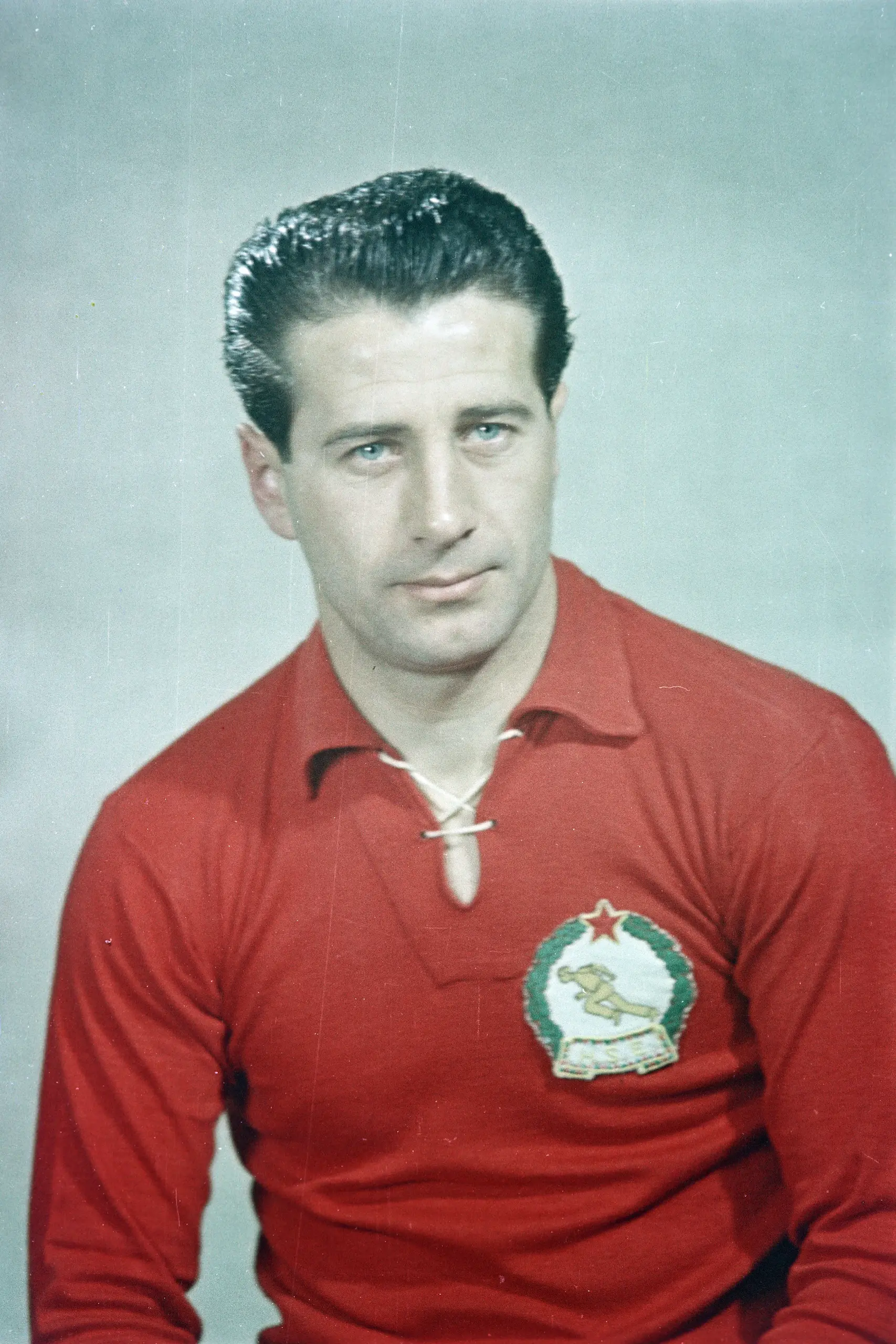
József Bozsik
 Hungary
association football player•politician•association football coach
Also known as: Cucu, The Soul of the Golden Team
Birthday
November 28, 1925
Birth Sign
Sagittarius
Birthplace
Kispest, Hungary
Age
Died at 52
Height
5 ft 9 in (175 cm)
About
József Bozsik was a Hungarian professional footballer who played as a central midfielder and is widely regarded as one of the greatest midfielders in history. Born in the district of Kispest, he spent his entire club career with Budapest Honvéd, serving as captain and tactical anchor for the legendary Golden Team. His vision and passing range revolutionized the deep-lying playmaker role long before the term became standard in modern tactics. Beyond his athletic achievements, Bozsik also served as a member of the Hungarian Parliament and worked as a coach after retiring from active play.
He passed away on May 31, 1978, at the age of 52 in Budapest due to natural causes. His legacy endures through numerous posthumous honors, including a stadium named in his honor and a bronze statue unveiled in 2025 to mark his centenary. Fans and historians alike remember him as the soul of the Golden Team, a figure defined by humility, loyalty, and an uncanny ability to control the tempo of a match.
Early Life & Background
József Bozsik entered the world on November 28, 1925, in Kispest, an industrial district of Budapest where working-class life shaped his early character. Growing up in this gritty neighborhood, he found his escape and passion in street football, playing barefoot with local children until his feet were calloused and his skills honed. Unlike many young talents of the era who chased bigger clubs, Bozsik’s loyalty was rooted in his hometown. He joined the youth system of Kispesti MTE, where his natural talent for reading the game quickly set him apart from his peers.
Before achieving global recognition, Bozsik balanced his training with demanding manual labor jobs. He worked as a railwayman and later as a mechanic, grinding away at these roles while dedicating his evenings and weekends to football. This period of hard work instilled a discipline that would define his playing style; he never relied on flashy tricks but instead focused on efficiency and intelligence. His transition from a local mechanic to a senior player for Kispesti MTE marked the beginning of a journey that would eventually lead him to the pinnacle of international football, all while maintaining a quiet connection to the ordinary people of Budapest.
Career Growth
Bozsik’s professional rise began in earnest when he joined Budapest Honvéd in 1949, initially known as Bp. Vasas. He immediately became the team’s captain and the tactical heartbeat of the squad. As a deep-lying playmaker, he orchestrated attacks with a calmness that baffled opponents. His most famous moment came in November 1953 at Wembley Stadium, where he helped Hungary dismantle England 9-0 in what is often called the Match of the Century. His passing game exposed the English defense’s rigid structure, shocking the football world and proving that Hungarian tactics were superior to the traditional British style.
The peak of his career arrived at the 1954 FIFA World Cup in Switzerland. Starting all six matches, including the final against West Germany, Bozsik displayed exceptional defensive discipline and distribution. Although Hungary lost the final 3-2 after leading 2-0, Bozsik’s performance was widely praised for his efforts to recover the lead in the second half. He retired in 1960 after 11 seasons with Honvéd, having earned 88 official caps for Hungary. Following his retirement, he transitioned into coaching and politics, serving in the Hungarian Parliament from 1963 until his death in 1978.
Career Timeline
Public Image & Style
Bozsik projected an image of humble integrity and unwavering loyalty. He was never seen as a flashy star but rather as a intelligent leader who let his passing dictate the flow of the match. Media coverage consistently highlighted his refusal to leave his hometown club and his dedication to his country. Even during the political turmoil of the Cold War, he was viewed as a symbol of national pride rather than just a sports figure. His elegant playing style and calm demeanor made him a favorite among fans who appreciated skill over spectacle.
Fame & Fandom (iFAMOUS Rankings)
In Hungary, fans refer to themselves simply as supporters of the "Golden Team" (*Aranycsapat*). There is no specific fan club name solely for Bozsik, but he is universally revered as the "Soul of the Team." Fans celebrate his memory annually, particularly around the anniversary of the 1954 World Cup. The unveiling of the statue in 2025 sparked a renewed wave of fan gatherings in Budapest, with tributes involving floral arrangements and chants at the Bozsik Aréna. iFANN has not yet collected fame data for this person, so he does not appear on the September 2026 September 2026 iFAMOUS Rankings flagship list.
Interesting Facts and Legends
Bozsik was affectionately nicknamed "Cucu" by fans and teammates, a moniker that stuck throughout his life. He was known for his unassuming presence on the pitch, rarely celebrating goals or engaging in physical confrontations. A popular legend among Hungarian football fans tells of his ability to make the ball seem glued to his foot even under intense pressure. He once stated, "I am a Kispest man first, a Hungarian second, and a footballer third," reflecting his deep loyalty to his hometown. Another famous quote attributed to him highlights his tactical philosophy: "Football is not about the ball; it is about the space between the players." During the Cold War, he was one of the few athletes allowed to travel freely abroad while simultaneously serving in the government, a balance he maintained with surprising grace.
Notable Quotes
“Football is not about the ball; it is about the space between the players.”
“I am a Kispest man first, a Hungarian second, and a footballer third.”
“We play for the people, not for the medals.”
Family & Personal Life
József Bozsik was married to Ilona Szabó, whom he met during his early playing days. Their marriage lasted until his death in 1978, and they raised two children together: a son named József Bozsik Jr. and a daughter whose name remains private. Ilona stayed out of the public eye, focusing on family life while her husband became a national icon. After József’s passing, his son took on the role of managing his father’s intellectual property and likeness rights. The family lived quietly in Budapest, avoiding the celebrity culture that surrounded Bozsik during his prime.
Notable Connections
Ferenc Puskás, Zoltán Czibor, Gyula Grosics, Ilona Bozsik, József Bozsik Jr.
Relationships & Dating History
József Bozsik was married to Ilona Szabó, whom he met during his early playing days. Their marriage lasted until his death in 1978, and they raised two children together. There are no publicly documented affairs, engagements, or other romantic relationships prior to or during his marriage. Bozsik was known for his humility and dedication to his family, rarely engaging in the celebrity culture of his time. As of the date of his death, he was widowed by Ilona, who passed away later, though exact dates are not widely publicized. He did not have any subsequent partners after his wife's passing, as he himself passed away shortly thereafter in 1978.
- MarriedIlona Szabó1950 - 1978Met during early playing days; married until his death.
Death & Aftermath
Died
May 31, 1978 (aged 52)
Death Place
Budapest, Hungary
Cause of Death
Natural causes
József Bozsik spent his final years in Budapest, quietly stepping away from the intense public eye that had followed him since his days as a central midfielder for the Magical Magyars. While the medical details remain private, historical records confirm he died without any disputed accounts, foul play, or criminal investigation surrounding his demise. The football community immediately recognized the loss of the first Hungarian player to earn over one hundred caps for the national team, though specific fan vigils or memorial murals erected in 1978 were not documented in the immediate aftermath. He was buried in Budapest, consistent with his place of death, though the precise cemetery name has not been preserved in available texts.
His legacy did not fade but rather deepened over the decades, culminating in significant tributes during the centenary of his birth in 2025. In December 2025, a full-scale bronze statue of Bozsik was unveiled in Budapest to honor his contributions to the sport, while the Hungarian Post issued a commemorative stamp dedicated to his memory. The club he served with absolute loyalty renamed their home ground the Bozsik József Stadion, and later opened the modern Bozsik Aréna to replace the former facility. These institutional memorials cemented his status as one of Hungary's greatest ever footballers, ensuring his name remained central to literature regarding the Magical Magyars.
Net Worth (Estate Value)
$0
iFANN Editorial Team estimate
As József Bozsik passed away in 1978, there is no current "net worth" in the sense of liquid assets held by the individual. However, his estate and legacy continue to generate revenue. The Bozsik family, particularly his son József Bozsik Jr., has historically managed his intellectual property and likeness rights. The estate earns income through licensing deals for memorabilia, royalties from historical documentaries, and merchandise sales associated with the Bozsik Aréna and the Hungarian national team's heritage. While specific annual earnings are not publicly itemized in financial reports, the sale of the commemorative stamp and the dedication of the new stadium in 2025 indicate significant commercial value attached to his brand.
Awards Won (2)
While Bozsik lived during an era before the modern proliferation of individual football awards, his legacy is cemented through numerous posthumous honours. He was inducted into the Hungarian Football Hall of Fame and is frequently cited in "Greatest of All Time" lists alongside legends like Pelé and Maradona. The stadium he called home was renamed the Bozsik József Stadion, and a modern arena now bears his name.
1990 · Hall of Fame Induction
Career Achievement
2025 · Lifetime Achievement
Role in Golden Team's Tactical Evolution
Known For
The Golden Team
1954 · Tactical Anchor
Hungary vs England (1953)
1953 · Key Playmaker
1954 FIFA World Cup Final
1954 · Captain
Keywords
Sources
Quick Facts
- Profession
- association football player, politician, association football coach
- Born
- November 28, 1925
- Birthplace
- Kispest, Hungary
- Died
- May 31, 1978
- Death Place
- Budapest, Hungary
- Gender
- Male
- Birth Sign
- Sagittarius
Personal Details
- Full Name
- József Bozsik
- Height
- 5 ft 9 in (175 cm)
- Spouse
- Ilona Szabó
- Children
- József Bozsik Jr., daughter (name undisclosed)
- Education
- Unknown
Frequently Asked Questions
Who was József Bozsik?
When did József Bozsik die?
What was József Bozsik's nickname?
Did József Bozsik ever play for another club?
Is there a stadium named after József Bozsik?
Similar People
Join the community
fans discussing