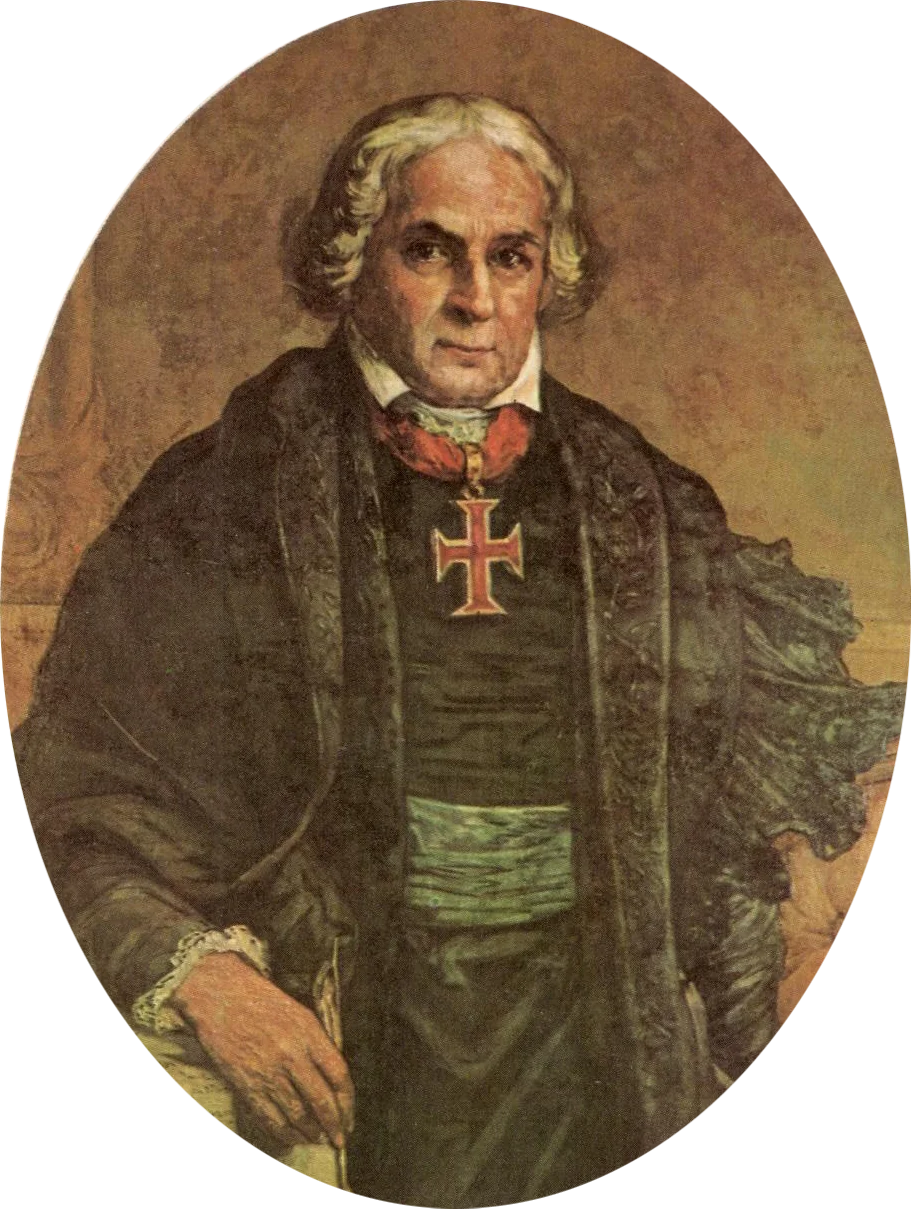
José Bonifácio de Andrada e Silva
 Brazil
Also known as: Patriarch of Independence, José Bonifácio
Birthday
June 13, 1763
Birth Sign
Gemini
Birthplace
Santos, São Paulo, Portuguese Empire (now Brazil)
Age
Died at 74
About
José Bonifácio de Andrada e Silva was a Brazilian statesman, naturalist, poet, and professor. Known to his countrymen as the "Patriarch of Independence," he was the leading intellectual force behind Brazil's separation from Portugal in 1822. He served as chief adviser to Emperor Pedro I and later as prime minister of the new empire. His vision extended beyond politics: he championed public education, advocated for the abolition of slavery, and proposed moving the capital to the underdeveloped interior, a plan realized over a century later with the founding of Brasília. As a scientist, he discovered four new minerals, including andradite, named in his honor. He died on April 6, 1838, at age 74, in Niterói, leaving a legacy that shaped Brazil's national identity.
Early Life & Background
Born in Santos in 1763 to a Portuguese colonel, Bonifácio grew up in a colonial outpost that would later become Brazil. He attended secondary school in São Paulo before entering the University of Coimbra in Portugal at age 20. There he earned a degree in philosophy in 1787 and a degree in law in 1788. In 1790, the Portuguese government commissioned him to conduct a scientific survey of several European countries, a ten-year project that took him to Paris and Saxony, where he studied mining, mineralogy, and chemistry. This work established his reputation as a natural scientist of note. He returned to Portugal in 1800 and was appointed general intendant of mines, later taking a professorship in geognosy at Coimbra. He also fought against the Napoleonic invasion from 1808 to 1810, rising to the rank of lieutenant colonel.
Career Growth
In 1819, after 36 years abroad, Bonifácio returned to Brazil and threw himself into politics. He quickly became the leading intellectual advocate for independence, serving as chief adviser to Prince Regent Dom Pedro. He headed the ministry formed in January 1822 and became prime minister after Pedro proclaimed Brazil's independence on September 7, 1822. His political career included terms as Secretary of State of Foreign Affairs and Imperial Affairs, and he served in the Chamber of Deputies for São Paulo and later Bahia. His 1821 document "Lembranças e Apontamentos do Governo Provisório de São Paulo" is considered a foundational text for the new nation. After political struggles, he was exiled to France but returned in 1829. Following Pedro's abdication in 1831, he served as tutor to the young Emperor Pedro II.
Career Timeline
Public Image & Style
Bonifácio is revered in Brazil as the "Patriarch of Independence." He is often depicted in historical art, such as the 1899 allegorical painting "The Founding of the Brazilian Fatherland," which shows him with the imperial flag and representatives of Brazil's three major ethnic groups. His public image is that of a multifaceted founding father: statesman, scientist, poet, and educator, whose ideas connected the Enlightenment to Brazil's independence process. He is described in a 1998 biography as "The Greatest Man in Brazilian History."
Fame & Fandom (iFAMOUS Rankings)
José Bonifácio de Andrada e Silva commands a legacy defined by civic reverence rather than modern fandom rituals. While he lacks a formal fanbase name or organized campaigns typical of contemporary icons, his status as the "Patriarch of Independence" ensures he remains a central figure in Brazilian national identity. His audience consists primarily of historians, students, and citizens who honor him through official state ceremonies and municipal commemorations rather than social media trends or viral chart pushes. In August 2026, the iFANN Global Fame Engine evaluated his standing and determined that he does not currently hold a placement in the published rankings, including the Global Top 1,000 or any Top-100 scope list. This absence from the charts reflects his position as a historical statesman whose influence is measured in institutional memory and academic study rather than current consumption signals or search volume. The evaluation confirms that while his name appears frequently in educational contexts and public monuments, it has not generated the sustained, mass-market engagement required for a ranked position in the global database. His presence is felt in the reopening of mineral galleries and the installation of statues, yet these events are driven by government bodies and cultural institutes rather than a dedicated fan organization. Consequently, no specific fandom name exists to describe his supporters, and no legendary crowd reactions or fan-driven initiatives have been recorded in the digital era. The scale of his fame remains anchored in the foundational history of Brazil, distinguishing him from living celebrities who rely on continuous media cycles to maintain their ranking.
Interesting Facts and Legends
José Bonifácio de Andrada e Silva discovered four new minerals, including andradite, which was named in his honor. He suggested creating a new capital in Brazil's interior, a vision realized with Brasília. His grandson, also named José Bonifácio, continued the abolitionist fight in the Senate until his death in 1886, and slavery ended in Brazil on May 13, 1888. Bonifácio fought against French troops led by Napoleon Bonaparte. A monument in Bryant Park, New York City, commemorates him alongside other notable figures from the Americas. Historical accounts describe his pivotal role in consolidating Brazil's independence from Portugal during his tenure as Minister of the Empire, a period often cited as the defining moment of his political career. Legends regarding his environmental foresight persist, noting that he anticipated debates on conservation and inclusion that remain relevant in modern Brazil. Recent controversies involving the cost and procurement of statues erected in his honor have sparked legal scrutiny, highlighting the enduring power of his image in public spaces. These institutional tributes serve as the primary method by which his legacy is maintained, ensuring his story remains part of the national narrative without the need for fan-driven promotion.
Notable Quotes
“The enlightened, the scholars knew what was best for the country.”
“Brazilian society would be built from the top down.”
Family & Personal Life
Notable Connections
Relationships & Dating History
Bonifácio's documented romantic history is limited to a single known relationship. He married Narcisa Emília O'Leary in 1790, and the marriage lasted until her death in 1829. The couple had three children together. No other romantic relationships are documented in the available historical sources. As a historical figure who died in 1838, there is no current relationship status to report.
- MarriedNarcisa Emília O'Leary1790 - 1829Married until her death.
Death & Aftermath
Died
April 6, 1838 (aged 74)
Death Place
Niterói, Rio de Janeiro
Cause of Death
Reported natural causes associated with advanced age
The passing of José Bonifácio de Andrada e Silva on April 6, 1838, sparked an immediate and profound shift in the Brazilian intellectual community, transforming years of political hostility into a wave of posthumous rehabilitation. Tributes poured in from former peers who recognized his foundational role in the nation's formation, marking a quiet but decisive move toward honoring the "Patriarch of Independence" after his death. This public reaction stood in stark contrast to the exile he endured since 1833, when Emperor Pedro I had stripped him of titles and property for viewing the statesman as a threat to imperial authority. Bonifácio died in Niterói, Rio de Janeiro, at the age of 74, having spent his final years living in deep poverty with his daughter Maria da Glória.
Historical records confirm his death occurred during this period of isolation but do not specify the exact address or provide an official medical statement regarding the cause. Accounts describe a state of extreme frailty and illness likely exacerbated by old age and the stress of persecution, leading to general descriptions of natural causes associated with advanced infirmity. His funeral was a modest affair held shortly after his death in the cemetery of Nossa Senhora do Rosário in Niterói, attended only by surviving family members and close associates loyal during his disgrace. The lack of a grand state ceremony reflected the precarious political climate of the moment, yet his reputation was quickly restored by subsequent governments.
Over time, his legacy expanded significantly; his name now adorns cities, universities, streets, and the mineral gallery at the University of Coimbra, while his writings were donated to the National Library of Brazil. His direct financial assets were minimal due to the confiscation of property, and his estate was handled quietly by descendants before his papers found their permanent home in national institutions.
Net Worth (Estate Value)
Awards Won (1)
José Bonifácio de Andrada e Silva was elected a member of the Royal Swedish Academy of Sciences in 1797 and was a member of the Lisbon Academy of Sciences.
1797 · Science
Scientific achievements
Known For
Patriarch of Independence
1822 · Leading advocate for Brazilian independence
Prime Minister of Brazil
1822 · First prime minister of the Empire of Brazil
Keywords
Sources
Quick Facts
- Profession
- statesman, naturalist, poet
- Born
- June 13, 1763
- Birthplace
- Santos, São Paulo, Portuguese Empire
- Died
- April 6, 1838
- Death Place
- Niterói, Rio de Janeiro, Empire of Brazil
- Gender
- Male
- Spouse
- Narcisa Emília O'Leary
- Children
- 3
- Education
- University of Coimbra
Personal Details
- Full Name
- José Bonifácio de Andrada e Silva
- Spouse
- Narcisa Emília O'Leary
- Children
- 3
- Education
- University of Coimbra (degrees in philosophy and law)
Frequently Asked Questions
Who was José Bonifácio de Andrada e Silva?
Why is José Bonifácio called the 'Patriarch of Independence'?
What minerals did José Bonifácio discover?
When did José Bonifácio die and where?
What was José Bonifácio's role in ending slavery in Brazil?
Similar People
Join the community
fans discussing