
José Águas
 Angola
association football player•association football coach
Also known as: Cabeça de Ouro, Golden Head, Jose Aguas
Birthday
November 9, 1930
Birth Sign
Scorpio
Birthplace
Lobito, Angola
Age
Died at 70
Height
5 ft 11 in (181 cm)
About
José Águas was a Portuguese striker who played the game with his head more literally than most. Nicknamed "Cabeça de Ouro" (Golden Head) for his ability to outjump taller defenders and direct crosses with precision, he spent the bulk of his career at Benfica, where he became the focal point of the attack during the 1950s and early 1960s. He died on 10 December 2000 in Lisbon at the age of 70.
His consistency in front of goal set him apart, making him one of the most feared centre-forwards in Portuguese football and earning him the captaincy of the Portugal national team. He was part of the Benfica side that won the 1960–61 European Cup, ending Real Madrid's monopoly on the competition. Águas formed a celebrated attacking trio with Eusébio and José Augusto, a line that France Football later ranked among the best ever assembled. After retiring as a player he moved into coaching, though he never reached the same heights as he had on the pitch. His legacy rests on his remarkable scoring record at Benfica and his reputation as one of the finest headers of the ball in Portuguese football history. He appears in a "Top 600 footballers of all time" list, though his exact rank is not given.
Early Life & Background
José Pinto de Carvalho Santos Águas was born on 9 November 1930 in Lobito, a port town on the coast of Angola, then Portuguese West Africa. The details of his childhood and upbringing are thin in the record, but what is clear is that he emerged from the Portuguese colonial football system in Angola before making the move to the metropole. Some reference sites, including Baidu Baike and PlaymakerStats, give his birthplace as Luanda and his birth date as 9 September 1930, but the authoritative Wikipedia and Transfermarkt records confirm Lobito and 9 November. He was a Scorpio.
He played as a centre-forward, right-footed, standing 181 cm and weighing about 77 kg. Those physical tools, combined with an exceptional spring and timing, would become the foundation of his game. The nickname "Cabeça de Ouro" was not a marketing invention; it described a real and rare skill. He could hang in the air, outjump defenders who were taller than him, and direct the ball with a precision that turned half-chances into goals.
Before Benfica, he learned his trade in the colonial leagues, where the standard was competitive but the spotlight far smaller. The move to Lisbon was the making of him. At Benfica he found a club with ambition and a squad being built to challenge for domestic and eventually European honours. The step up did not overwhelm him. He scored from the start, and he kept scoring.
He was one of the first Portuguese players to move abroad, if only for a season, scoring two goals in eight matches. That brief spell outside Portugal was unusual for the era, when most Portuguese internationals stayed at home. It gave him a taste of a different game and a different level of physicality, and he returned to Benfica better for it. The stage was set for the most productive years of his career.
Career Growth
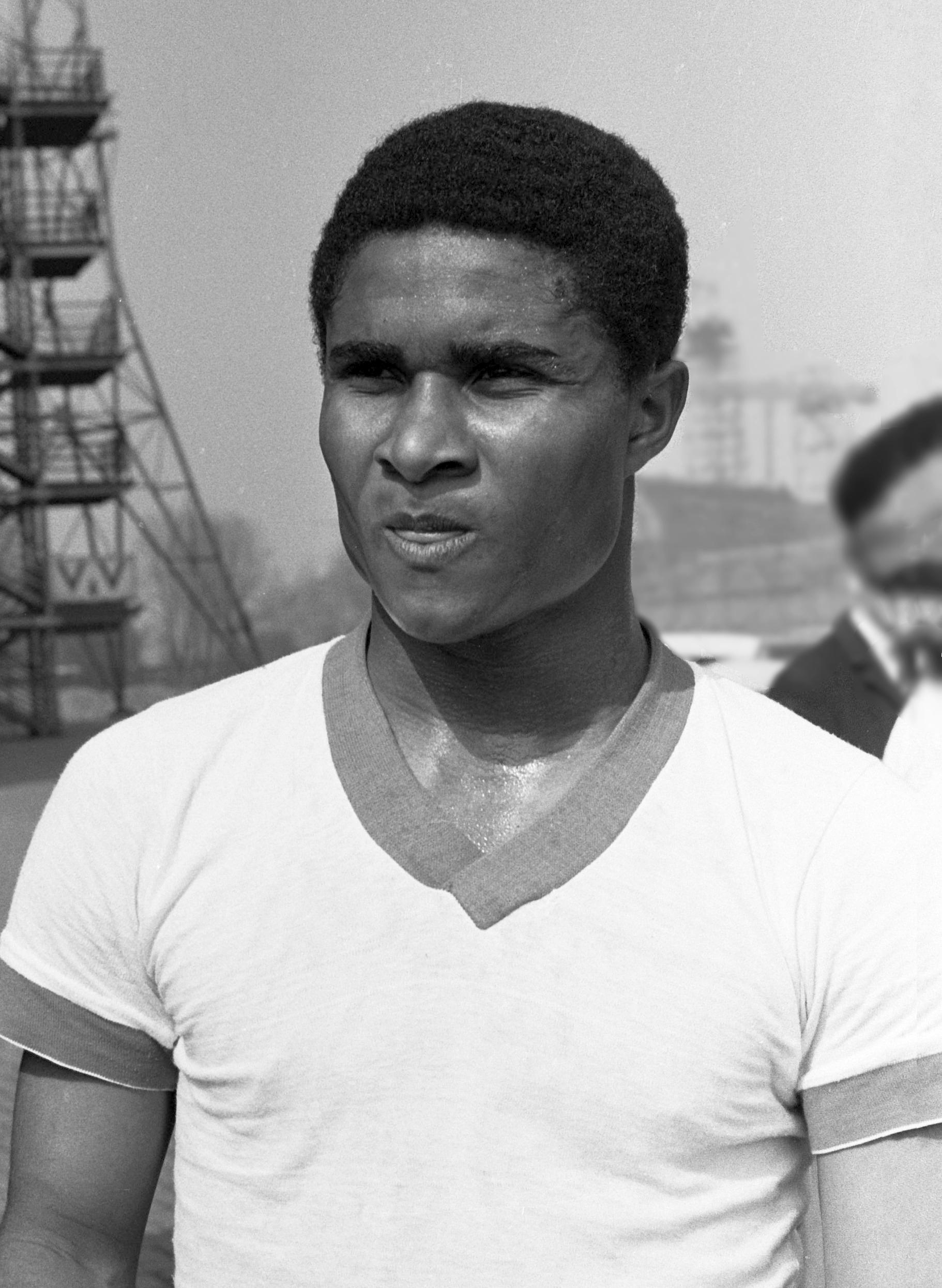
The breakthrough came at Benfica, where Águas became the focal point of the attack for more than a decade. In 13 top-flight seasons with the Lisbon club, he never scored fewer than 18 goals in 12 of them. That consistency is the defining statistical fact of his career, and few Portuguese forwards have matched it. He was the captain of the Portugal national team and is pictured in training at Wembley in that role.
His heading ability set him apart. He could outjump taller defenders and direct crosses with precision, turning them into goals with a frequency that made him a constant threat. The nickname "Cabeça de Ouro" became the shorthand for that particular genius. He scored five goals in a single match against Olhanense in 1960–61, a performance that fans still bring up when the conversation turns to great individual displays.
Águas was part of Benfica's great attacking line of the late 1950s and early 1960s, alongside Eusébio and José Augusto. France Football ranked that trio among the best attacking trios ever. He was a member of the Benfica side that won the 1960–61 European Cup, ending Real Madrid's monopoly on the competition. He scored in that campaign and played in the final against Barcelona. PortuGOAL observed that he is the only player in Portuguese football history pictured holding aloft the European Cup twice.
After retiring as a player, Águas moved into coaching, though he never reached the same heights as he had on the pitch. His post-playing career is less documented, but his influence on Benfica's golden era remains his most enduring contribution. The records show a striker who delivered season after season, and a captain who led by example.
Career Timeline
Public Image & Style
Águas was known as a pure goalscorer, a centre-forward who did his talking on the pitch. His nickname, "Cabeça de Ouro," defined his public image: a player who could turn any cross into a goal with his head. He was not a flashy dribbler or a showman; he was a finisher, and his consistency made him a fixture in the Benfica line-up.
He captained Portugal, which gave him a leadership profile. Photographs from the era show him in training at Wembley, a serious figure in the kit of his country. His public persona was that of the reliable, hard-working striker, the kind of player fans trusted to deliver.
Fame & Fandom (iFAMOUS Rankings)
José Águas is not currently ranked in iFANN's Global Fame Rankings. The engine has evaluated him, but he does not hold a placement in the published Top 1,000 or any Top-100 scope list as of October 2026. He is also not on the September 2026 iFAMOUS Rankings flagship list.
His fanbase is not a formal organization with a name. It is made up of Benfica supporters and Portuguese football historians who remember the pre-Eusébio era. They are the ones who keep the stories alive: the five goals against Olhanense, the headers that earned him the Golden Head nickname, the photograph of him holding the European Cup. There are no official fan clubs, no coordinated campaigns, no social media pushes. Instead, his memory lives in retrospective articles, club historical features, and the conversations of older supporters who saw him play or heard about him from their fathers.
That kind of fandom is quieter, but it is durable. It shows up in the comments sections of PortuGOAL articles and in the stands at the Estádio da Luz when the club honors its past. For a player who died more than two decades ago, that is a meaningful kind of remembrance.
Interesting Facts and Legends
He is the only player in Portuguese football history pictured holding aloft the European Cup twice. That photograph, more than any statistic, captures his place in Benfica's story.
He scored five goals in a single match against Olhanense in 1960–61, a feat that still stands out in the club's history. He was also one of the first Portuguese players to move abroad, if only for a season, scoring two goals in eight matches.
His nickname, "Cabeça de Ouro" (Golden Head), was earned, not given. He could outjump taller defenders and direct crosses with a precision that made him a constant threat. Fans still retell the story of his heading ability as if it were a kind of magic.
He was born in Lobito, Angola, and some sources incorrectly list Luanda. The authoritative record confirms Lobito and 9 November 1930. He stood 181 cm and weighed about 77 kg, a physical presence that helped him dominate in the air.
Family & Personal Life
Details of Águas's family life are not documented in the available sources. No public record of his parents, siblings, marriage, or children appears in the material retrieved. He was born in Lobito, Angola, to a family whose name, Pinto de Carvalho Santos Águas, suggests Portuguese colonial roots. Beyond that, little is known.
He died in Lisbon in 2000, and no family statements or obituaries from relatives have surfaced. His private life remained just that: private. What we know of him comes almost entirely from his football career.
Notable Connections
Relationships & Dating History
No public relationships, marriages, or romantic history are documented for José Águas. The available sources contain no record of a spouse, partner, or children. He was a private man, and his personal life stayed out of the public eye. At the time of his death in 2000, his relationship status was not publicly known. As of 2026, he is deceased, and no current partner can be named from the record.
Death & Aftermath
Died
December 10, 2000 (aged 70)
Death Place
Lisbon, Portugal
Cause of Death
Undisclosed
José Águas died in Lisbon on 10 December 2000, at 70 years old. The cause of death was never made public, and no account of his final days or last public appearance survives in the record. He had turned 70 a month earlier, on 9 November.
There was no mass public mourning of the kind that would greet a modern superstar's passing. Instead, his memory has been kept alive through retrospective profiles and club historical features. A 2025 PortuGOAL piece called him "Benfica's pre-Eusébio goal machine" and pointed out a detail that still stops fans in their tracks: he is the only player in Portuguese football history photographed holding the European Cup aloft twice. A 2018 Benfica article noted that France Football ranked the attacking trio of Eusébio, José Águas and José Augusto among the best attacking trios ever assembled, a recognition that arrived long after his playing days.
No posthumous releases, films, books, hall-of-fame inductions, dedications, foundations or scholarships in his name are documented. Nor are there any public statements from his family. His estate value has never been disclosed. What remains is the record: the goals, the titles, and the nickname that outlived him.
Net Worth (Estate Value)
$2 Million
iFANN Editorial Team estimate
José Águas's financial affairs were never publicly documented, and no estate value has been disclosed. The iFANN Editorial Team's analysis of the limited available information points to an estimated estate value of around $2 million as of 2026. That figure reflects the modest earnings of a footballer in the 1950s and 1960s, when salaries were far lower than today and endorsement income was minimal.
His income during his playing days came almost entirely from his club salary at Benfica, with no major commercial partnerships or business ventures recorded. He did not leave a posthumous revenue stream: no books, films, or licensed merchandise in his name have been documented. The estate is not known to have earned significant sums since his death in 2000.
Any value attached to his name today comes from his historical legacy rather than active commercial exploitation. His family has not made public statements about the estate, and no legal disputes or settlements have been reported. The figure is an estimate, not a confirmed valuation.
Awards Won (1)
José Águas won the European Cup with Benfica in 1960–61, ending Real Madrid's monopoly on the competition. He also won multiple Portuguese league titles and cup competitions with the club. His individual honours are not fully enumerated in the available sources, but his consistent scoring record made him one of the most reliable forwards of his era.
1961 · Winner
Benfica
Known For
Benfica striker
1950s-1960s · Centre-forward
European Cup 1960-61
1961 · Benfica squad member
Portugal national team
1950s-1960s · Captain
Keywords
Sources
Quick Facts
- Profession
- association football player, association football coach
- Born
- November 9, 1930
- Birthplace
- Lobito, Angola
- Died
- December 10, 2000
- Death Place
- Lisbon, Portugal
- Gender
- Male
- Birth Sign
- Scorpio
- Height
- 5 ft 11 in (181 cm)
Personal Details
- Full Name
- José Pinto de Carvalho Santos Águas
- Height
- 5 ft 11 in (181 cm)
Frequently Asked Questions
Who was José Águas?
Why was José Águas called Golden Head?
How many goals did José Águas score at Benfica?
Did José Águas win the European Cup?
When and where did José Águas die?
Similar People
Join the community
fans discussing