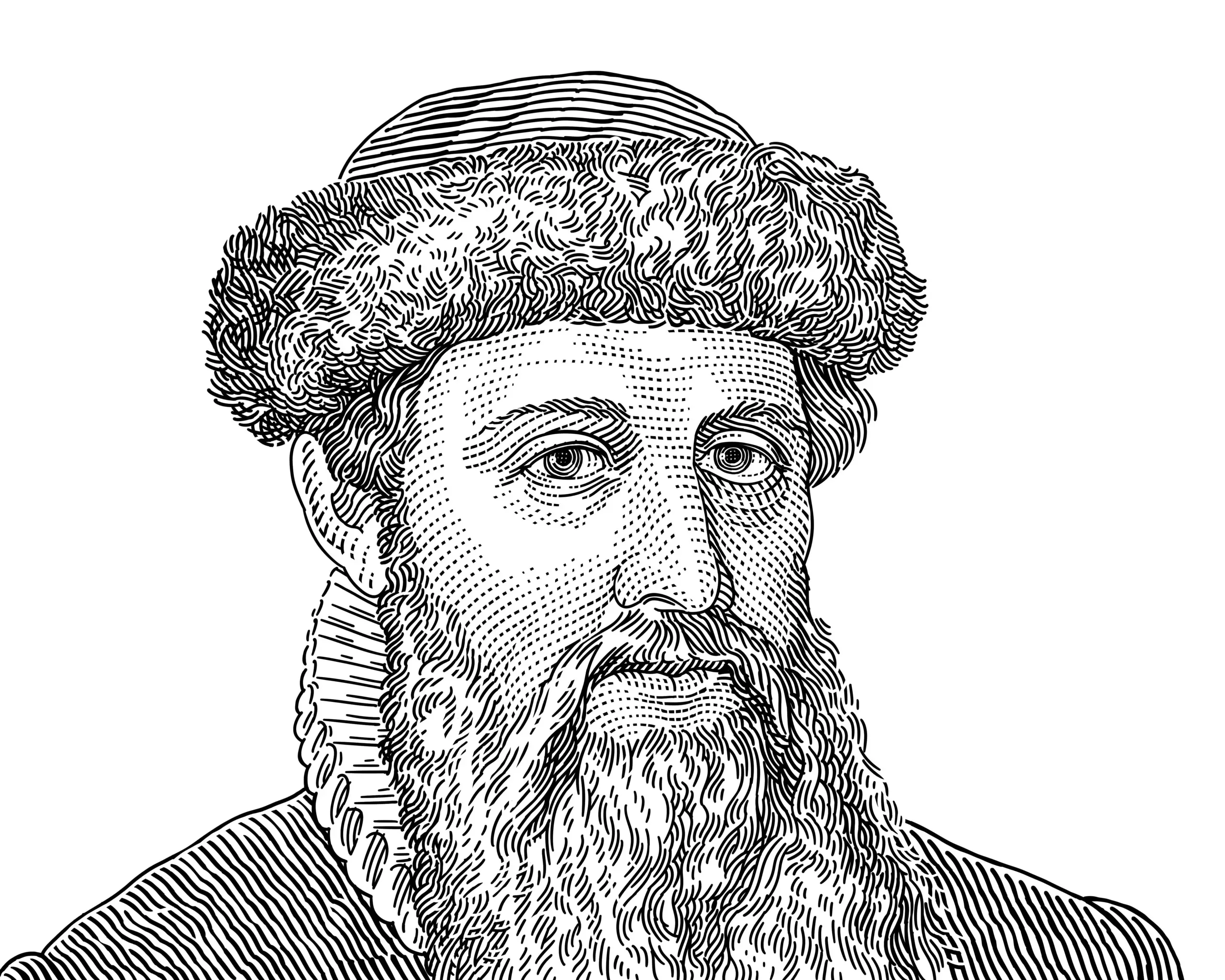
Johannes Gutenberg
 Germany
Also known as: Johannes Gensfleisch, Johannes Gensfleisch zur Laden, Johann Gutenberg
Birthday
c. 1400
Birth Sign
Unknown
Birthplace
Mainz, Germany
Age
Died at 68
About
Johannes Gutenberg was a German goldsmith and inventor who developed the movable-type printing press in Europe around 1440. His creation fundamentally altered the course of human history by enabling the rapid mass production of books and documents. This innovation sparked the Information Revolution, fueling the Renaissance, the Reformation, and the Scientific Revolution across the continent.
Although he faced financial ruin and legal battles during his lifetime, his legacy endured through the spread of his technology. The Gutenberg Bible, completed around 1455, remains a masterpiece of early printing and stands as one of the most valuable books in existence today. Modern historians consistently rank him among the most influential figures in human civilization alongside giants like Newton and Einstein.
Early Life & Background
Born into a wealthy patrician family in Mainz, Johannes was originally named Johannes Gensfleisch zur Laden. He adopted the surname Gutenberg from his mother's family estate later in life. While exact birth dates vary between 1393 and 1406, scholars generally place his birth around 1400. His father, Friele Gensfleisch, was a merchant who held a seat on the city council, providing Johannes with access to the upper-class social circle of Mainz.
Unlike many of his contemporaries, Gutenberg never attended a university. Instead, he trained as a goldsmith, a trade that demanded extreme precision and a deep understanding of metal alloys. This background proved essential for his future work. Around 1430, political unrest in Mainz prompted him to move to Strasbourg, where he began experimenting with mirror-making. He formed a partnership to polish glass discs using a lead alloy abrasive technique, but the venture ended in litigation after his partner died unexpectedly. These years of legal disputes and mechanical experimentation in Strasbourg laid the groundwork for his eventual breakthrough.
Career Growth
Gutenberg returned to Mainz around 1448 and secured funding from Johann Fust, a wealthy moneylender. By 1450, he had constructed a wooden screw press adapted from agricultural wine presses and developed a new oil-based ink suitable for metal type. His three-part system, movable type made of a lead-tin-antimony alloy, the specialized ink, and the press itself, allowed for the efficient production of text.
The project culminated in the completion of the Gutenberg Bible (also known as the 42-line Bible) in 1455. This massive undertaking produced over 180 copies, though the process was fraught with difficulty. In 1455, Fust sued Gutenberg for defaulting on a loan. The court ruled in Fust's favor, transferring ownership of the workshop and the unfinished Bibles to Fust and his son-in-law Peter Schöffer. Despite losing his business, the impact of his invention was immediate. Within decades, printing presses had spread to over 200 cities in Europe, democratizing knowledge and reshaping society forever.
Career Timeline
Public Image & Style
Media portrayals depict Gutenberg as a humble craftsman whose technical ingenuity changed the world. He is often framed as a tragic hero who suffered financial betrayal yet achieved a triumph that outlasted his own struggles. His image is synonymous with innovation, enlightenment, and the democratization of information. Historical narratives emphasize his perseverance against debt and the volatility of partnerships, casting him as a solitary genius who unlocked the potential of the written word.
Fame & Fandom
iFANN has not yet collected fame data for this person. While there is no formal fandom ranking in the modern sense, Gutenberg commands a dedicated following among historians, librarians, bibliophiles, and educators. Fan-like activities include high visitor numbers at the Gutenberg Museum in Mainz, annual scholarly conferences dedicated to his work, and educational campaigns where schools organize events to teach about the printing press. Digital enthusiasts also participate in crowdsourcing projects to transcribe and digitize early printed texts, keeping his legacy alive in the digital age.
Interesting Facts and Legends
His original name was Johannes Gensfleisch zur Laden, not Gutenberg. He took the latter name from his mother's estate. Before inventing the press, he attempted to sell polished glass mirrors to pilgrims in Strasbourg, a scheme that involved grinding glass with a lead alloy. The Gutenberg Bible is so beautifully crafted that many copies were hand-illuminated by artists after printing, making them nearly indistinguishable from handwritten manuscripts. A popular legend claims he discovered movable type by watching children play with clay blocks or seeing coins being struck, though these stories are unverified folklore. When Mainz was sacked in 1462, he fled the city carrying his press and type, inadvertently spreading the technology to other European cities.
Family & Personal Life
Gutenberg married Else Wirtz, the daughter of a wealthy citizen of Mainz, around 1437. The couple had one son named Friedrich, born approximately in 1439. Little is known about Else's death or what happened to Friedrich after Gutenberg's passing. Some historical accounts suggest Friedrich may have inherited his father's debts or continued working in the printing industry. Gutenberg left no personal letters or diaries, leaving his intimate family life largely a mystery to modern researchers.
Notable Connections
Relationships & Dating History
Historical records from the 15th century do not document casual relationships or public dating histories for Johannes Gutenberg. The only confirmed romantic union was his marriage to Else Wirtz, which likely took place around 1437. The marriage appears to have been arranged for social and economic stability within the Mainz patriciate. They had one son, Friedrich, born around 1439. There is no evidence of other partners, divorces, or engagements. Gutenberg died in 1468, and while it is possible his wife predeceased him, historical accounts confirm he was a widower or deceased while married at the time of his death.
- MarriedElse Wirtz1437 - 1468Had one son together; marriage lasted until his death.
Death & Aftermath
Died
February 3, 1468 (aged 68)
Death Place
Mainz, Rhineland-Palatinate, Germany
Cause of Death
Unknown
Johannes Gutenberg died on February 3, 1468, in Mainz, Germany, at approximately seventy years of age. Historical accounts do not detail his final days or specific circumstances surrounding his passing, as such biographical details were rarely recorded with specificity for individuals outside major political figures during that era. While Gutenberg faced significant legal disputes regarding debts and partnerships earlier in his life, these battles concluded long before his mortality and were unrelated to his passing.
Public reaction to his death was muted by modern standards, as news traveled slowly and print culture remained in its infancy. Tributes from peers and institutions were likely private or limited to local guilds and church officials in Mainz. His funeral was a private affair held shortly after his death, where he was interred in the Franciscan Church in Mainz at a family grave prepared by his father's side. The service included only his family and close associates, and his tombstone was lost over time, though the site remains historically significant.
Posthumously, Johannes Gutenberg has received extensive recognition including the naming of Johannes Gutenberg University Mainz in 1946 and the annual Johannisnacht Festival in Mainz which celebrates his memory. In 2021, Google honored him with a Doodle, and various books, documentaries, and films have been produced about his life, including a biography released in 2025. A musical titled "Gutenberg! The Musical!" opened in Kihei in January 2026. His legacy is largely retrospective, celebrated centuries later rather than at the time of his passing, while the specific distribution of his assets remains unknown to history.
Net Worth (Estate Value)
$0
iFANN Editorial Team estimate
As a historical figure who passed away in 1468, Johannes Gutenberg has no current net worth in the traditional sense. His estate value is measured in cultural capital and intellectual property managed by institutions like the Gutenberg Museum in Mainz. Posthumous revenue streams include museum admissions, licensing of reproductions, scholarly publications, and merchandise. Individual copies of the Gutenberg Bible are valued at millions of dollars at auction, sometimes exceeding $10 million, though these assets belong to private collectors rather than an estate. The economic activity generated by his invention over five centuries is estimated to be in the trillions, though this cannot be attributed to a personal fortune.
Awards & Accolades
View 9 records, honours and achievementsKnown For
Gutenberg Bible
1455 · Inventor/Printer
Movable-Type Printing Press
1440 · Inventor
Keywords
Sources
Quick Facts
- Profession
- inventor, typographer, engraver
- Born
- c. 1400
- Birthplace
- Mainz
- Died
- February 3, 1468
- Death Place
- Mainz
- Gender
- Male
Personal Details
- Full Name
- Johannes Gensfleisch zur Laden zum Gutenberg
- Spouse
- Else Wirtz
- Children
- Friedrich Gutenberg
- Education
- Goldsmith apprenticeship; no university records
Frequently Asked Questions
Who was Johannes Gutenberg?
When was Johannes Gutenberg born and when did he die?
What was Johannes Gutenberg's biggest invention?
Did Johannes Gutenberg invent the printing press?
How much is the Gutenberg Bible worth today?
Similar People
Join the community
fans discussing