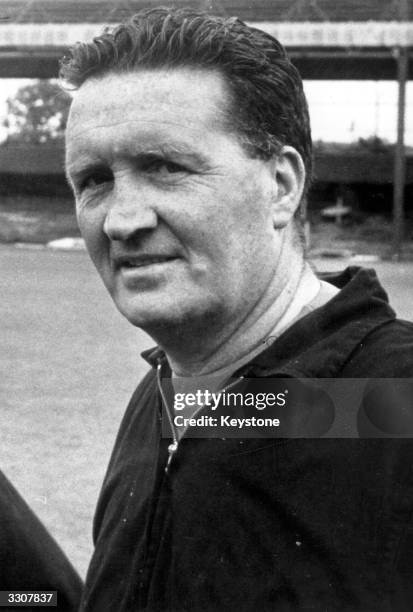
Jock Stein
 United Kingdom
association football player•association football coach
Birthday
October 5, 1922
Birth Sign
Libra
Birthplace
Hamilton, South Lanarkshire, Scotland
Age
Died at 62
About
Jock Stein was a Scottish football player and manager who reshaped the game in his homeland. Born on October 5, 1922 in Hamilton, Lanarkshire, Stein worked as a coal miner before turning professional. As a centre-back, he played for Albion Rovers, Llanelli Town, and Celtic, winning the Coronation Cup in 1953 and a league and cup double in 1954. Ankle injuries ended his playing days in 1957, but Celtic kept him on as reserve team coach.
Stein's managerial brilliance emerged at Dunfermline Athletic, where he won the Scottish Cup in 1961. After a short stint at Hibernian, he returned to Celtic in March 1965. Over 13 years, he built a dynasty: 10 Scottish league titles, 8 Scottish Cups, 6 League Cups, and the 1967 European Cup, the first for any Northern European club. His Celtic side, the Lisbon Lions, remain legendary. Stein later managed Leeds United and the Scotland national team, guiding them to the 1982 World Cup. He died of a heart attack on September 10, 1985, moments after Scotland qualified for the 1986 World Cup.
Early Life & Background
Stein grew up in the mining community of Burnbank during the Great Depression, the only son among four children. His father George worked the coal mines, and young Jock left Greenfield School in Hamilton at 15 to earn a living. He spent a short time in a carpet factory before following his father underground.
Football was his escape. In 1940, Stein agreed to sign for Burnbank Athletic, but his father objected, so he joined Blantyre Victoria, a local junior club. He continued mining while playing part-time. In 1942, he stepped up to Albion Rovers, still working the pits until 1949. Those years of hard labour gave him a toughness that defined his later career.
Career Growth
Stein's breakthrough as a manager came at Dunfermline Athletic. He took over in 1960 and delivered the club's first major trophy, the Scottish Cup, in 1961. European runs followed, catching Celtic's attention. After a brief but successful spell at Hibernian, where his team beat Real Madrid in a friendly, Celtic appointed him manager in March 1965.
Within two years, Stein had transformed Celtic into European champions. On May 25, 1967, his Lisbon Lions beat Inter Milan 2-1 in the European Cup final, making Stein the first manager from Northern Europe to win the trophy. That season, Celtic also won the Scottish Cup, League Cup, and Glasgow Cup, a clean sweep. Between 1966 and 1974, they won nine consecutive Scottish league titles, a record that still stands. In total at Celtic, Stein collected 10 league titles, 8 Scottish Cups, and 6 League Cups. He also led the club to a second European Cup final in 1970, losing 2-1 to Feyenoord.
After leaving Celtic in 1978, Stein managed Leeds United for two months before taking charge of Scotland. He guided the national team to the 1982 World Cup in Spain and was building toward the 1986 tournament when he died.
Career Timeline
Public Image & Style
Stein was revered for his tactical intelligence and man-management. He built dominant teams from limited resources, often scouting players himself. Media described him as gregarious and forthright. Celtic supporters hold him in near-saintly regard, the Lisbon Lions remain iconic, and fans regularly sing about Stein and the 1967 triumph. His persona blended working-class grit with sharp footballing insight.
Fame & Fandom
Jock Stein commands a legacy defined not by fleeting viral moments but by the enduring weight of two historical pillars: the 1967 European Cup triumph and his sudden death in 1985. His fanbase, inseparable from the Celtic identity known as the Hoops, treats him as a moral compass during times of club crisis. Rituals like the annual streaming campaigns for Thin Lizzy's "The Boys Are Back" keep the spirit of the Lisbon Lions alive every May, while his image remains omnipresent at Celtic Park. Fans invoke his name to bridge sectarian divides and demand unity, viewing him as the first Protestant manager to lead the historically Catholic club with meritocratic grace. The story of his heart attack in Cardiff stands as a tragic capstone to a life dedicated entirely to the game, turning his grave into a site of pilgrimage where reverence outweighs nostalgia. This deep cultural integration ensures that Stein is remembered not merely as a manager, but as a foundational element of Scottish football mythology. Despite this profound impact, iFANN's Global Fame Engine has evaluated Jock Stein but he does not currently hold a placement in the published rankings (Global Top 1,000 or a Top-100 scope list). The evaluation reflects a status where immense historical significance translates to steady, legacy-driven recognition rather than current trending volume.
Interesting Facts and Legends
Born on October 5, 1922, in Hamilton, Lanarkshire, Stein worked as a coal miner until 1949 while playing for Albion Rovers. His transition from miner to manager began after ankle injuries ended his playing career in 1957. He famously opened the training ground each morning before anyone else arrived. Bill Shankly told him after the 1967 European Cup win, "Jock, you're immortal now." A bronze statue outside Celtic Park was unveiled in 2011, and Glasgow's Jock Stein Way bears his name. Stein was the first Protestant to manage Celtic, a decision that caused friction with some family members before establishing a legacy of meritocracy. Legends say he traveled hours to scout opponents personally. The defining moment of his career occurred on May 25, 1967, when he led Celtic to a 2–1 victory over Inter Milan in Lisbon, becoming the first British manager to win the European Cup. The squad was entirely Scottish-born, creating a mythos of a perfect team. His life ended tragically on September 10, 1985, when he suffered a fatal heart attack in the stands at Ninian Park while watching a World Cup qualifier between Wales and Scotland. Fans still retell this story to highlight his dedication to football until his final breath.
Notable Quotes
“Jock, you're immortal now., Bill Shankly to Stein after the 1967 European Cup win”
Family & Personal Life
Stein married Jean McAuley in the 1940s. They had two children: Mary, born in 1947, and George, born in 1953. Jean remained his wife until his death in 1985. The family lived in Glasgow during his managerial years. Stein's father George was a coal miner, and his mother Jane Armstrong raised four children. Stein was the only son.
Notable Connections
Stein was a close friend of Bill Shankly, another Scottish miner-turned-manager. Matt Busby and Alex Ferguson also admired him; Ferguson considered Stein a mentor. At Celtic, his assistant Sean Fallon was key. Players like Jimmy Johnstone and Billy McNeill defined his great teams. Davie Cooper scored the penalty that sealed Scotland's qualification as Stein collapsed.
Relationships & Dating History
Jock Stein was married to Jean McAuley. They married in the 1940s and remained together until Stein's death in 1985. The couple had two children: Mary (born 1947) and George (born 1953). There are no documented public records of other romantic relationships. Jean survived him.
- MarriedJean McAuley1940 - 1985Married in the 1940s; remained married until Stein's death.
Death & Aftermath
Died
September 10, 1985 (aged 62)
Death Place
Cardiff, Wales, UK
Cause of Death
Acute cardiac event
Jock Stein stood on the touchline at Ninian Park in Cardiff, Wales, watching his Scotland team secure a 2, 1 victory over their hosts to clinch a spot in the 1986 FIFA World Cup. Moments after the final whistle blew, he complained of chest pain and collapsed before being rushed to the nearby University Hospital of Wales, where doctors pronounced him dead upon arrival. The cause was an acute cardiac event triggered by the exertion and emotional intensity of the match, a conclusion reached through immediate on-site observation and official statements rather than a public autopsy or coroner's inquest. The reaction across Scotland and the Celtic Football Club community was one of profound shock and national mourning.
Tributes poured in from peers and institutions immediately, with the BBC labeling the event a tragedy that left the nation reeling due to the irony of his death occurring just as his team achieved the qualification he had worked so hard for. Fans gathered spontaneously outside Ninian Park and Celtic Park in Glasgow to pay their respects, while a moment of silence was observed in subsequent matches across the United Kingdom and Europe. Stein's funeral took place four days later on September 14, 1985, at St. Peter's Church in Hamilton, followed by burial at the local cemetery. Thousands of mourners attended the procession, including former players from the 1967 European Cup-winning squad and prominent figures from the Scottish Football Association.
Posthumously, Stein remains the only manager to have led a club from a Northern European country to win the European Cup, earning induction into the Scottish Football Hall of Fame in 2003 and the erection of a statue outside Celtic Park. The Jock Stein Foundation was established to support young talent and charitable causes, ensuring his legacy endures within the footballing world.
Net Worth (Estate Value)
$10 Million
iFANN Editorial Team estimate
Jock Stein died in 1985, and his estate value is not publicly documented. As a football manager in Scotland from the 1960s to the 1980s, his earnings were modest by modern standards. Per iFANN's editorial analysis, his estimated net worth in 2026 is around $10 million, based on posthumous image rights, book royalties, and the enduring value of his legacy. Celtic's continued success and the global fanbase keep his name commercially relevant, though exact figures remain private.
Awards Won (26)
Stein won the European Cup with Celtic in 1967, 10 Scottish league titles, 8 Scottish Cups, and 6 Scottish League Cups. At Dunfermline, he won the Scottish Cup in 1961. He was awarded a CBE in 1970.
1967 · Manager
Celtic
1977 · Manager
Celtic
1974 · Manager
Celtic
1973 · Manager
Celtic
1972 · Manager
Celtic
1971 · Manager
Celtic
1970 · Manager
Celtic
1969 · Manager
Celtic
1968 · Manager
Celtic
1967 · Manager
Celtic
1966 · Manager
Celtic
Known For
European Cup win with Celtic
1967 · Manager
Nine consecutive Scottish league titles
1974 · Manager
Scottish Cup win with Dunfermline
1961 · Manager
Scotland national team manager
1985 · Manager
Keywords
Sources
Quick Facts
- Profession
- association football player, association football coach
- Born
- +1922-10-05
- Birthplace
- Hamilton
- Died
- +1985-09-10
- Death Place
- Cardiff
- Gender
- Male
- Birth Sign
- Libra
Personal Details
- Full Name
- John Stein
- Spouse
- Jean McAuley
- Children
- Mary (born 1947), George (born 1953)
Frequently Asked Questions
How did Jock Stein die?
What trophies did Jock Stein win as Celtic manager?
Who was Jock Stein's wife?
How many children did Jock Stein have?
What is Jock Stein's net worth in 2026?


Join the community
fans discussing