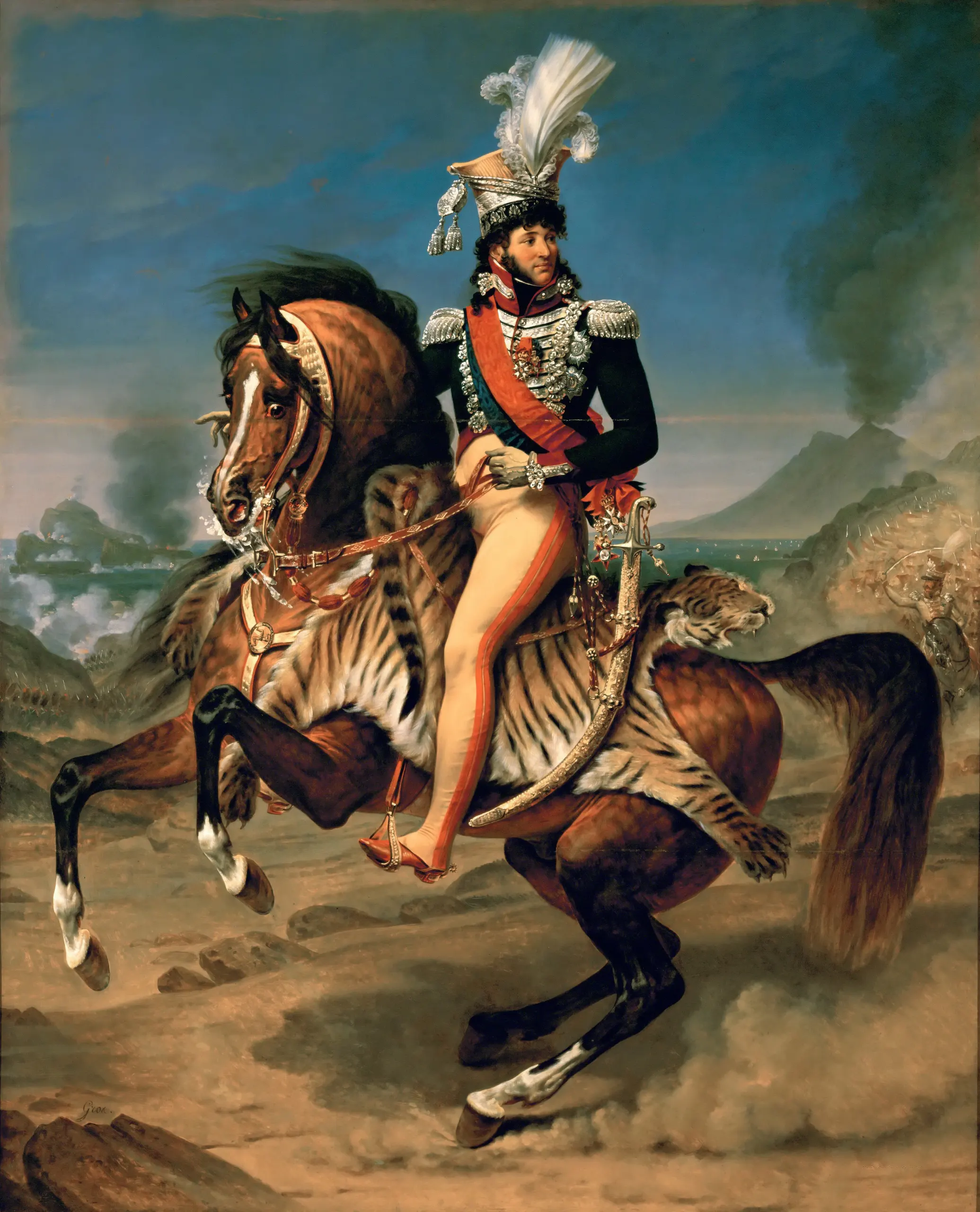
Joachim Murat
 France
military officer•statesman•King of Naples
Also known as: Joachim-Napoleon, The First Horseman of Europe, The Dandy King
Birthday
March 25, 1767
Birth Sign
Sagittarius
Birthplace
Labastide-Fortunière (now Labastide-Murat), Lot, France
Age
Died at 48
Height
5 ft 11 in (180 cm)
About
Joachim Murat was a French Army officer and statesman who rose from a modest background to become King of Naples. Born on March 25, 1767, in Labastide-Fortunière, he initially attended a seminary before enlisting in the 10th Dragoon Regiment in 1787. His military career accelerated during the French Revolutionary Wars when he distinguished himself as a cavalry commander under Napoleon Bonaparte. He played a decisive role in the insurrection of 13 Vendémiaire in 1795, seizing cannons to suppress royalist rebels in Paris, which earned him immediate promotion and a position as Napoleon's aide-de-camp.
Murat became one of the most celebrated cavalry leaders in history, earning the title "First Horseman of Europe." He served as Marshal of the Empire and Grand Duke of Berg before being installed as King of Naples in 1808. His reign was marked by attempts to modernize the Neapolitan state and support the arts, though it was often strained by financial instability and reliance on French troops. During the Hundred Days in 1815, he declared war on Austria to reclaim his throne but was defeated at the Battle of Tolentino.
Following his capture, Murat was tried for treason and executed by firing squad in Pizzo on October 13, 1815, at the age of 48. His life ended dramatically, yet his legacy endured as a symbol of the volatile ambition and military brilliance of the Napoleonic era. He is remembered not only for his tactical genius but also for his flamboyant style and tragic fall from power.
Early Life & Background
Joachim Murat was born into a humble family in the small town of Labastide-Fortunière in southwestern France. His father, Jean-Baptiste Murat, worked as an innkeeper, and his mother was Anne Loubières. As a young man, Murat initially pursued a religious vocation and attended a seminary, but he found the discipline stifling and left without completing his studies. The outbreak of the French Revolution in 1789 provided the catalyst for a different path. Instead of remaining in the clergy, he enlisted in the 10th Dragoon Regiment in 1787 at the age of twenty, though his early years in the army were marked by periods of desertion and re-enlistment before he found stability.
Before his rise to prominence, Murat worked as a stable boy and groom, developing an exceptional skill with horses that would define his future reputation. Historical accounts describe him as charismatic, flamboyant, and impulsive even in his youth. He possessed a natural talent for horsemanship and a daring spirit that set him apart from his peers. His pivotal moment arrived during the French Revolutionary Wars when he demonstrated bravery and tactical acumen. In 1795, during the insurrection of 13 Vendémiaire, Murat played a decisive role by seizing cannons and using them to suppress royalist rebels in Paris. This act of boldness caught the eye of Napoleon Bonaparte, leading to his immediate promotion to General of Brigade and his appointment as Napoleon's aide-de-camp.
The transition from a stable boy to a general was rapid and unprecedented. Murat's ability to command cavalry charges and his loyalty to Napoleon solidified his position within the revolutionary hierarchy. By the time he married Caroline Bonaparte in 1800, he had already established himself as a key figure in the Napoleonic machine. His early life experiences, particularly his time with horses and his exposure to the chaos of the revolution, shaped the aggressive and charismatic leader who would later rule Naples.
Career Growth
Joachim Murat's military career reached its zenith during the Napoleonic Wars, where he became renowned for his mastery of cavalry warfare. After his success at 13 Vendémiaire in 1795, he accompanied Napoleon to Italy and Egypt, leading successful cavalry charges against Austrian forces. He distinguished himself at the Battle of Aboukir in 1799 and played a critical role in the Coup of 18 Brumaire, helping Napoleon seize power. For this service, he was promoted to General of Division. In 1804, Napoleon created him one of the original eighteen Marshals of the Empire.
Murat commanded the cavalry at major battles including Marengo, Hohenlinden, Ulm, Austerlitz, Jena, and Eylau. At Austerlitz and Eylau, his massive cavalry charges turned the tide of battle, earning him the moniker "First Horseman of Europe." In 1806, following victories at Ulm and Austerlitz, he was appointed Grand Duke of Berg and Cleves. His political ambitions grew alongside his military successes, and in 1808, Napoleon made him King of Naples, where he reigned as Joachim-Napoleon until 1815.
As King of Naples, Murat attempted to reform the Neapolitan state, modernize its administration, and support the arts. However, his rule was often characterized by financial instability and heavy reliance on French troops. During the invasion of Russia and the German campaigns, he served as Commander-in-Chief of the Grande Armée's cavalry. After the disastrous defeat at Leipzig in 1813, he began negotiating separately with the Austrians to save his own throne, effectively abandoning Napoleon. In 1815, during the Hundred Days, he declared war on Austria to regain full control of Italy but was defeated at the Battle of Tolentino. His attempt to reclaim his kingdom ended with his capture and execution in Pizzo.
Career Timeline
Public Image & Style
Joachim Murat is portrayed in history as a brilliant but flawed military genius. He is remembered as a man of immense courage and charisma, yet also as a figure driven by vanity and ambition. The media and historians often contrast his "dandy" lifestyle with the grim realities of war, painting him as a tragic figure whose fall was as dramatic as his rise. His flamboyant dress and love of luxury earned him the nickname "Dandy King," setting him apart from the more austere styles of his contemporaries. Murat's public image is that of a dashing cavalry officer who charged repeatedly into enemy lines, often risking his life for glory. His betrayal of Napoleon in 1813 and subsequent attempt to reclaim his throne added layers of complexity to his legacy, portraying him as a man torn between loyalty and self-preservation.
Fame & Fandom (iFAMOUS Rankings)
Joachim Murat currently holds no placement in the published Global Top 1,000 or any Top-100 scope list within the iFANN rankings. The historical figure remains a subject of serious study rather than a participant in contemporary popularity metrics. While the name persists in cultural memory through Napoleonic historiography and reenactment circles, there is no formal fandom name documented for either the Marshal of France or his living descendant, Prince Joachim Murat. The audience engaging with his legacy consists primarily of historians, military enthusiasts, and royal watchers who follow family affairs without organized campaigns or specific rituals. No fan-funded projects, birthday billboards, or viral internet lore exist to define a modern community around him. His public profile, particularly regarding the living prince, is confined to royalist circles and business reports rather than pop culture stardom. The absence of a named fanbase reflects the nature of his existence as a figure from over two centuries ago, where interaction is limited to academic discourse and heritage preservation. Any attempt to assign a modern fandom structure would be anachronistic, as the engagement with his life story relies on established historical narratives rather than the dynamic, participatory culture seen with current celebrities. The lack of a digital footprint in terms of fan organization underscores that his fame is rooted in the past, sustained by museums, textbooks, and the occasional rediscovery of lost artifacts like the Canova busts.
Interesting Facts and Legends
Joachim Murat was known as the "Dandy King" due to his love of luxury, fine clothes, and elaborate uniforms with gold embroidery. He spent lavishly on his court in Naples, often leading to financial crises. Despite his royal status, he remained proud of his humble origins as the son of an innkeeper and frequently referenced his time as a stable boy in anecdotes. He was described as the "First Horseman of Europe," a title reflecting his dominance in cavalry warfare. At the Battle of Eylau in 1807, he led a charge that nearly resulted in the capture of the Russian Emperor Alexander I, showcasing his reckless bravery. The portrait bust by Antonio Canova, commissioned around 1813, was lost for decades and only resurfaced in 2017, confirming its existence and enhancing Murat's artistic legacy. His final days are steeped in legend, with the story of him walking calmly to the firing squad becoming a recurring motif in art and literature.
Notable Quotes
“I am the First Horseman of Europe.”
“If I am not king, I am nothing.”
“I have done everything for my country and my family.”
Family & Personal Life
Joachim Murat was the son of Jean-Baptiste Murat, an innkeeper, and Anne Loubières. He was born in Labastide-Fortunière, a small town in the Lot department of southwestern France. His upbringing was modest, and he initially attended a seminary before leaving to pursue a military career. Murat's personal life was dominated by his marriage to Caroline Bonaparte, Napoleon's youngest sister. They were married in a civil ceremony on February 21, 1800. Their relationship was politically strategic but also deeply passionate and volatile. They had five children together: Charlotte, Lucien, Napoléon, Zénaïde, and Julie. Caroline was a powerful influence on Murat's court and policies in Naples. She attempted to intervene to save him from execution but was unsuccessful. The family lived in various palaces across Europe, including the Royal Palace of Naples, but their lives were constantly disrupted by the wars and political upheavals of the era.
Notable Connections
Napoleon Bonaparte, Caroline Bonaparte, Louis-Alexandre Berthier, Michel Ney, Antonio Canova, Prince Joachim Murat (8th).
Relationships & Dating History
Joachim Murat's personal life was defined by his marriage to Caroline Bonaparte, the youngest sister of Napoleon Bonaparte. They met through Napoleon's circle and were married in a civil ceremony on February 21, 1800. Their relationship was politically strategic, uniting the Bonaparte dynasty with a rising military star, but it was also deeply passionate and volatile. Caroline was a powerful influence on Murat's court and policies in Naples, often acting as a mediator between her husband and brother. The couple had five children together: Charlotte, Lucien, Napoléon, Zénaïde, and Julie. Caroline attempted to intervene to save Murat from execution after his capture in 1815 but was unsuccessful. There are no widely documented public romantic relationships prior to his marriage to Caroline. While he was known for his charm and flirtatious nature, historical accounts focus almost exclusively on his union with Caroline as his primary and defining relationship. He remained married to Caroline until his death on October 13, 1815.
- MarriedCaroline Bonaparte1800 - 1815Married in 1800; she was Napoleon's sister. Had five children together. She tried to save him from execution but failed.
Death & Aftermath
Died
October 13, 1815 (aged 48)
Death Place
Pizzo, Calabria, Italy
Cause of Death
Execution by firing squad
Joachim Murat died on the morning of October 13, 1815, in Pizzo, a coastal town in the province of Calabria. Following his defeat at the Battle of Tolentino, he fled to Corsica and then attempted to land near Pizzo with a small group of loyalists hoping to spark a royalist uprising against the restored Bourbon monarchy. Local authorities loyal to King Ferdinand IV arrested him immediately. He was subjected to a summary military trial by a council of war that found him guilty of treason and rebellion. Despite desperate pleas for mercy from Murat himself and intervention attempts by his wife, Queen Caroline Bonaparte, the tribunal ordered an immediate execution.
At dawn, he was taken to the Aragonese Castle in Pizzo and shot by a firing squad. His death shocked Europe, creating a sharp divide between the conservative celebration of removing a usurper and the mourning of Murat as a martyr among Napoleonic veterans and liberal sympathizers. The event fueled the romanticization of the Napoleonic era, cementing his legend as a tragic hero in French and Italian folklore. Memorials were erected in Pizzo and elsewhere, including a famous bust by Antonio Canova that resurfaced in 2017.
His body was initially buried in the churchyard of Piedigrotta in Pizzo. Due to political volatility in the region, his remains were exhumed in 1816 and transferred to Paris. Family members secured permission for the transfer, and he was interred in Section 4 of Père Lachaise Cemetery. Posthumously, Murat has been the subject of numerous artistic works and academic studies, with his legacy preserved through museums and historical discourse rather than active family estates.
Net Worth (Estate Value)
$0
iFANN Editorial Team estimate
As a deceased historical figure from the early 19th century, Joachim Murat does not possess a modern net worth in the traditional sense. Upon his execution in 1815, his estate was dissolved, and his properties were confiscated by the Bourbon restoration. There is no active estate managing revenue from the 18th-century King today. Any value associated with his name is purely cultural or related to the management of his descendants' legacy. His descendant, Joachim Louis Napoléon de Murat, 8th Prince Murat (born 1944), is a business leader and head of the House of Murat. Recent reports highlight his involvement in reviving SMEs in France, but specific net worth figures for the prince are not publicly disclosed in credible financial outlets. Posthumous revenues are limited to the sale of reproductions of art, such as the Canova bust, and tourism in Pizzo, which generate revenue for local municipalities rather than the Murat family directly. The iFANN Editorial Team notes that while the Murat family retains historical prestige, no quantifiable fortune exists for the historical figure himself.
Awards Won (4)
Joachim Murat received numerous titles and honours throughout his career. He was created a Marshal of the Empire in 1804, one of the original eighteen marshals. He served as Grand Duke of Berg and Cleves from 1806 to 1808 and was appointed King of Naples in 1808. He also held the honorary title of Admiral of France. For his services in Italy, he received the Order of the Iron Crown. His legacy is further honored by the commissioning of a famous bust by Antonio Canova around 1813, which is now considered a masterpiece of neoclassical sculpture.
1804 · Military Honour
Service to the French Empire
1806 · Title
Political Appointment
Known For
King of Naples
1808 · Monarch
Marshal of the Empire
1804 · Military Commander
Battle of Austerlitz
1805 · Cavalry Leader
Keywords
Sources
Quick Facts
- Profession
- politician, military officer, military personnel
- Born
- March 25, 1767
- Birthplace
- Labastide-Murat
- Died
- October 13, 1815
- Death Place
- Pizzo
- Gender
- Male
- Spouse
- Caroline Bonaparte
- Birth Sign
- Sagittarius
Personal Details
- Full Name
- Joachim Murat
- Height
- 5 ft 11 in (180 cm)
- Spouse
- Caroline Bonaparte
- Children
- Charlotte Murat, Lucien Murat, Napoléon Joseph Charles Paul Murat, Zénaïde Bonaparte Murat, Julie Bonaparte Murat
- Education
- Seminary (briefly); self-taught military tactics
Frequently Asked Questions
Who was Joachim Murat?
How did Joachim Murat die?
What was Joachim Murat's relationship with Napoleon?
Did Joachim Murat have children?
Where is Joachim Murat buried?
Similar People
Join the community
fans discussing