Jesse Lauriston Livermore
 United States
Also known as: The Boy Plunger, The Great Bear of Wall Street, Larry Livingston
Birthday
July 26, 1877
Birth Sign
Sagittarius
Birthplace
Shrewsbury, Massachusetts, USA
Age
Died at 63
About
Jesse Lauriston Livermore was an American stock trader and speculator who became the most famous market operator of the early 20th century. Born in Shrewsbury, Massachusetts, he pioneered technical analysis and momentum trading during an era when financial reporting was sparse and manipulation was common. His life story defined a generation of traders, marked by immense wealth accumulation followed by devastating losses and a tragic end.
Often called the "Boy Plunger" or the "Great Bear of Wall Street," Livermore built his fortune by short-selling stocks before major crashes. He made headlines for predicting the 1906 San Francisco earthquake impact and the 1929 Great Depression, amassing an estimated $100 million in a single week at the height of his career. Despite his genius for spotting market trends, he struggled to maintain his wealth due to emotional trading and poor judgment later in life.
His legacy rests primarily on Reminiscences of a Stock Operator, a 1923 book by Edwin Lefèvre that immortalized Livermore's methods and struggles. The text remains a foundational guide for traders today. By the time he died at age 63, Livermore had lost most of his fortune and faced liabilities exceeding his assets, leading to a suicide that underscored the psychological toll of his profession.
Early Life & Background
Jesse Lauriston Livermore grew up in a farming community in Shrewsbury, Massachusetts, where his family faced financial instability. He attended school only until the age of 14, leaving home early to support himself rather than pursuing higher education. In 1891, at just 14 years old, he moved to Boston and took a job as a quotation board boy at the brokerage firm Paine Webber. His daily task involved manually copying ticker tape numbers onto a large board, a job that required intense concentration and speed.
It was during these long hours watching the ticker tape that Livermore developed a unique aptitude for spotting patterns in stock price movements. He began keeping a notebook of prices and realized that stocks moved in predictable cycles based on supply and demand rather than company fundamentals alone. To practice his theories without risking capital, he started placing bets with local bookmakers on the direction of tickers in the office. These small wagers allowed him to test his hypotheses and eventually amass a small fortune before entering the actual market.
By 1893, he had saved approximately $1,000 from these side bets. This capital gave him the confidence to enter the trading pit at a New York brokerage. His first significant trade involved shorting Colorado fuel stocks, which netted him a profit of roughly $1,000 in a single day. This immediate success led to him being given a line of credit, allowing him to trade larger sums and marking the transition from a curious observer to a serious market participant.
Career Growth
Livermore's career is defined by his ability to identify major market trends and capitalize on them, particularly through short-selling. In 1901, he made his first million dollars by correctly predicting a rise in the steel industry, specifically buying into United States Steel. This established him as a formidable force on Wall Street. During the panic following the 1906 San Francisco earthquake, he identified that the city's reconstruction would require massive amounts of lumber and materials. He shorted stocks of companies that would suffer while buying those that would benefit, reportedly clearing over $1 million in a few days.
His most famous early triumph occurred during the 1907 Panic. As the market crashed due to a liquidity crisis, Livermore shorted the entire market, making an estimated $1 million in a matter of weeks. His actions were so influential that J.P. Morgan famously called upon him to help stabilize the market, though Livermore's methods were controversial among the establishment. He recovered from a bankruptcy in 1915 and made another fortune by shorting the market during World War I volatility in 1916.
Livermore's legendary feat occurred in October 1929. Anticipating the crash, he shorted the market heavily. On Black Thursday and Black Tuesday, he made an estimated $100 million, becoming the richest man in the world at that moment. He famously wrote a letter to his broker advising him to sell everything, but when the broker hesitated, Livermore executed the trades himself. Despite this success, he struggled to maintain his wealth in the mid-1930s due to poor judgment and emotional trading, ultimately failing to rebuild his fortune before his death.
Career Timeline
Public Image & Style
Livermore is remembered as the solitary, brooding trader who saw the future in charts. Media portrayals often depict him as a tragic hero, a genius who was destroyed by his own demons. His image is that of a man who mastered the markets but could not master his emotions. The tone surrounding his legacy is serious, cautionary, and inspirational, serving as a reminder of the dangers of leverage and emotional decision-making in high-stakes environments. He is frequently cited as the ultimate example of both what can be achieved and what can be lost in the world of speculation.
Fame & Fandom (iFAMOUS Rankings)
iFANN has not yet collected fame data for this person. While historical rankings place him among the greatest traders of all time, there is no current published ranking in the iFANN Global Fame Rankings as of October 2026. The fanbase for Livermore consists of traders, investors, and students of financial history who study his strategies. This community is highly organized within online trading forums and educational channels, where they discuss his rules and analyze his trades.
Fans often reference his "rules of trading" in chart discussions and cite his quotes as guiding principles. There are no formal charity drives or organized campaigns associated with his name, but fans frequently donate to mental health organizations in his memory, acknowledging his struggle with depression. His voice lives on through quotes in trading books and videos, keeping his legacy alive for new generations of market participants.
Interesting Facts and Legends
Livermore earned the nickname "Boy Plunger" because he started working at a young age and plunged into the market with reckless abandon. His first trading floor was actually a wall of ticker tape machines, and he claimed he could predict market moves just by watching the rhythm of the machine's paper tape before ever placing a real trade. The note he left at the scene of his death, reading "I am tired of fighting," has become one of the most famous quotes in financial history, symbolizing the psychological toll of speculation.
The book Reminiscences of a Stock Operator was written by Edwin Lefèvre, who never met Livermore personally but interviewed him extensively. The narrative blends Livermore's life with other traders' experiences, making it semi-fictionalized yet deeply rooted in reality. A modern connection to his lineage emerged in 2025 when reports surfaced that adult film actress Brandi Love is his great-granddaughter, sparking renewed interest in his family tree. Traders often reference his rule that the market is a device for transferring money from the impatient to the patient.
Notable Quotes
“The market is a device for transferring money from the impatient to the patient.”
“It was never my thinking that made the big money for me. It was always my sitting.”
“I am tired of fighting.”
“There is nothing new in Wall Street. What happens in the present has happened before and will happen again.”
Family & Personal Life
Jesse Livermore was married three times throughout his life. His first marriage ended in divorce around 1906, with little public information available about the partner or any children from that union. His second marriage to Margaretta "Maggie" Livermore lasted from approximately 1907 until their high-profile divorce in 1933. They had two children together: a son named Jesse Jr. and a daughter named Margaret. The divorce proceedings were messy, involving financial disputes and estrangement linked to his recklessness.
Shortly after divorcing Maggie, he married Dorothy Livermore in 1933. There is little public information about their relationship dynamics or whether they had children together. She survived him and was his sole surviving spouse at the time of his death. Following his passing, his estate was settled, and any remaining assets were distributed to heirs or used to pay debts. His personal life was often tumultuous, mirroring the volatility of his trading career.
Notable Connections
Relationships & Dating History
Jesse Livermore was married three times, with his personal life often mirroring the volatility of his trading career. His first marriage, which began around 1900, ended in divorce circa 1906. Details about this union are scarce, and no children are widely documented from this period. The divorce likely stemmed from the stress of his early trading highs and lows and his increasing absences.
His second marriage to Margaretta "Maggie" Livermore lasted from approximately 1907 until their high-profile divorce in 1933. This was his longest and most publicized marriage, producing two children: a son named Jesse Jr. and a daughter named Margaret. The marriage ended amidst financial recklessness and alleged infidelity, leading to a messy divorce with financial disputes and estrangement. Following this split, Livermore lived a more solitary life.
He married Dorothy Livermore in 1933, shortly after his divorce from Maggie. There is little public information about their relationship dynamics or whether they had children together. She survived him and was his sole surviving spouse at the time of his death in 1940. As of the latest historical data, his status remains Widowed, with his relationships ending with his passing.
- DivorcedUnknown1900 - 1906First marriage details are scarce; divorced due to stress and absences.
- DivorcedMargaretta "Maggie" Livermore1907 - 1933Longest marriage; two children (Jesse Jr. and Margaret); ended in messy divorce.
- WidowedDorothy Livermore1933 - 1940Married shortly after second divorce; she survived him.
Death & Aftermath
Died
November 28, 1940 (aged 63)
Death Place
New York City, New York, USA
Cause of Death
Suicide by gunshot
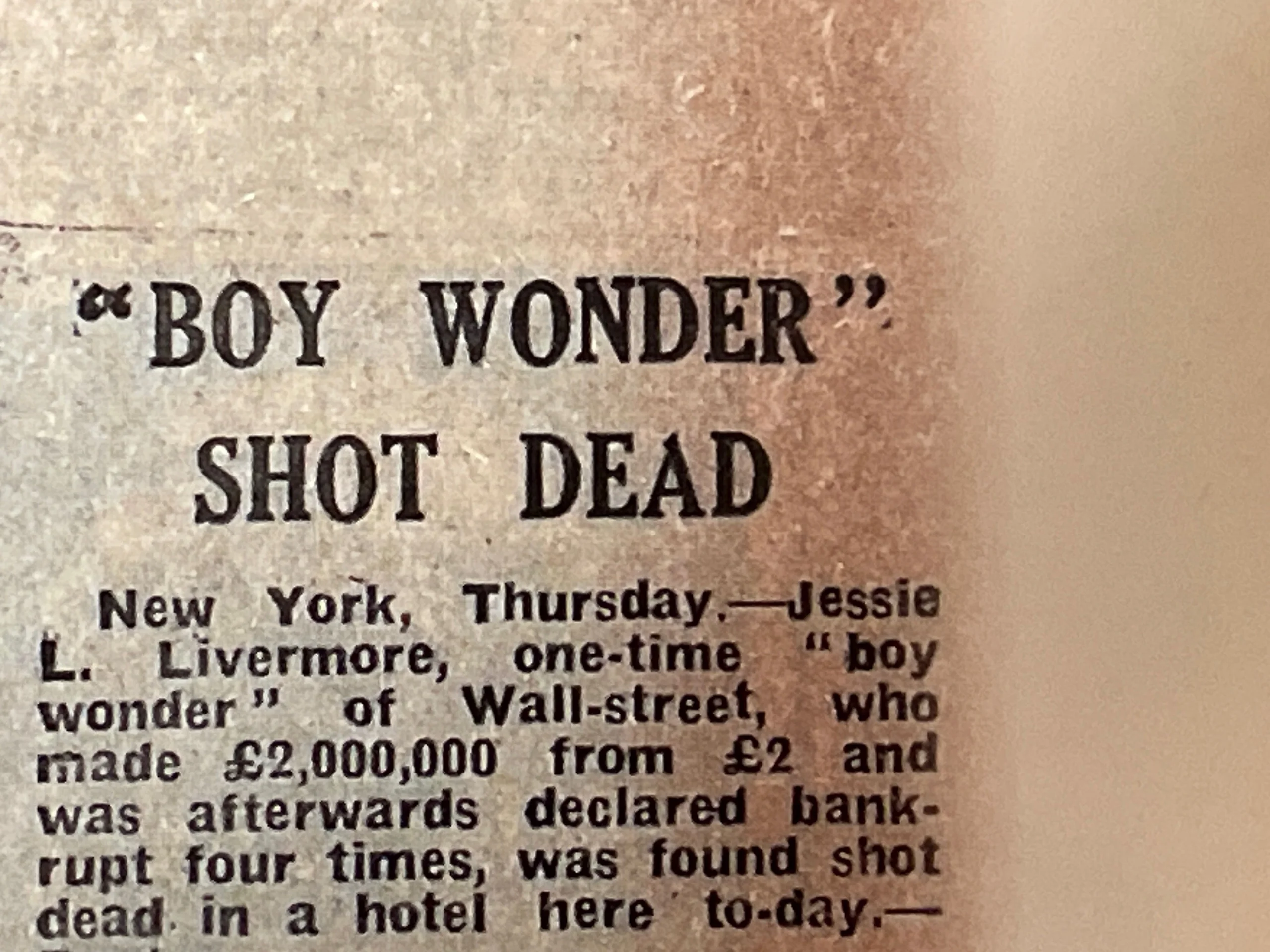
New York City police confirmed on November 29, 1940, that Jesse Lauriston Livermore had ended his life following the discovery of his body in room 40 of the Hotel Pennsylvania penthouse suite. The investigation concluded swiftly due to the presence of a .38 caliber revolver and a suicide note beside him that read, "I am tired of fighting." Livermore died at age 63 after a period of severe isolation and despair, having recently lost significant funds attempting to recover from previous trading failures. Financial publications offered somber tributes acknowledging his legendary status as the man who predicted the Panic of 1907 and the Great Depression. A funeral service was held two days later at noon on December 1, 1940, at the Campbell Funeral Church on Madison Avenue and Eighty-first Street.
Approximately one hundred relatives and friends attended the private gathering before he was buried at Sleepy Hollow Cemetery in Sleepy Hollow, New York. His estate was liquidated privately to settle debts, leaving insufficient assets for a significant inheritance while the administration focused solely on obligations rather than legal contests regarding the death itself. The most enduring impact remained the publication of Edwin Lefèvre's 1923 classic Reminiscences of a Stock Operator, which served as the primary inspiration for his life story and kept his trading philosophy alive in the global financial community.
Net Worth (Estate Value)
$0
iFANN Editorial Team estimate
Jesse Lauriston Livermore died insolvent in 1940, with liabilities exceeding his assets. At the time of his death, his individual net worth was effectively zero or negative, as he had lost much of his fortune in the mid-1930s. There is no active estate managing his wealth today, as the estate was settled shortly after his passing in December 1940. Any remaining assets were distributed to heirs or used to pay debts.
The value of his legacy exists primarily through the intellectual property of his life story. The royalties from Reminiscences of a Stock Operator continue to generate revenue, but this belongs to the publisher and the author's estate, not Livermore's direct heirs. The iFANN Editorial Team estimates his net worth at $0, reflecting the fact that he died with no remaining personal wealth. His cultural value is immense, but financially, he left no estate to speak of.
Awards & Accolades
View 7 records, honours and achievementsKnown For
Reminiscences of a Stock Operator
1923 · Subject of the book
1929 Stock Market Crash
1929 · Short seller
1907 Panic
1907 · Market stabilizer
Keywords
Sources
Quick Facts
- Profession
- financier, trader
- Born
- July 26, 1877
- Birthplace
- Shrewsbury, Massachusetts
- Died
- November 28, 1940
- Death Place
- New York City
- Gender
- Male
- Birth Sign
- Sagittarius
Personal Details
- Full Name
- Jesse Lauriston Livermore
- Spouse
- Dorothy Livermore
- Children
- Jesse Jr., Margaret
- Education
- Public school until age 14
Frequently Asked Questions
How did Jesse Livermore die?
What is Jesse Livermore best known for?
Was Jesse Livermore really rich?
Who is Jesse Livermore related to today?
Is Jesse Livermore still active in trading?
Similar People


Join the community
fans discussing