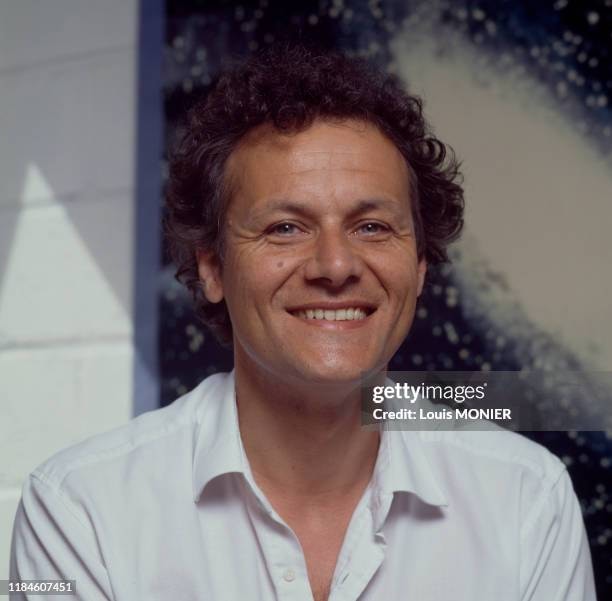
Jean-Pierre Luminet
 France
astrophysicist•writer•poet•artist
Birthday
June 3, 1951
Birth Sign
Gemini
Birthplace
Cavaillon, France
Age
75 years old
About
Jean-Pierre Luminet is a French astrophysicist, writer, poet, and visual artist. He is best known for his pioneering 1979 simulation of a black hole's appearance, his work on cosmic topology, and his prolific science communication. As of 2026, he is emeritus research director at CNRS and a visiting scientist at the Centre de Physique Théorique in Marseilles. He has authored 28 books, including science works, historical novels, and poetry collections, translated into multiple languages. Luminet received the UNESCO Kalinga Prize for Popularization of Science in 2021 and the Georges Lemaître Prize in 1999. The asteroid 5523 Luminet is named after him.
Early Life & Background
Jean-Pierre Luminet grew up in Cavaillon, a small town near Avignon in southeastern France. His early life balanced a strong aptitude for mathematics with a passion for creative expression. He pursued advanced studies in physics and astrophysics at the Université de Provence, followed by doctoral work at the Paris Observatory. His doctoral research focused on black hole physics and cosmology, leading to a landmark paper in 1979 titled "Image of a spherical black hole with thin accretion disk" in Astronomy & Astrophysics. This work, done with manual calculations and physical modeling, was one of the first realistic simulations of a black hole's visual appearance, predating the Event Horizon Telescope image by four decades. Before his breakthrough, Luminet also developed interests in poetry and the arts, which would later define his multifaceted career.
Career Growth
After his 1979 paper, Luminet became a leading figure in French cosmology. In the 1990s, he proposed that the universe might have a finite, multiply-connected topology, such as a dodecahedron or torus, challenging the conventional infinite flat model. He received the Georges Lemaître Prize in 1999 for contributions to cosmology. His prolific science communication includes 15 science books, 7 historical novels, and 6 poetry collections, with translations into Chinese, Korean, and German. Notable titles include Le destin de l'univers (2003) and Les trous noirs (2008). In November 2021, he was awarded the UNESCO Kalinga Prize for Popularization of Science. He also serves on the editorial board of Inference: The International Review of Science. Luminet continues his research as emeritus director at CNRS and remains active in writing and art.
Career Timeline
Public Image & Style
Luminet is often described as a "poet of the cosmos" for his elegant, poetic writing style that makes complex astrophysics accessible. French media portray him as a national treasure in science communication, frequently interviewing him on radio and television. His public persona is that of a Renaissance man, equally at home in the laboratory, the writer's study, and the artist's studio. His books and lectures are characterized by clarity, poetic language, and a philosophical approach, connecting cosmology to literature and art. He has no significant social media presence, communicating primarily through books, conferences, and interviews.
Fame & Fandom (iFAMOUS Rankings)
Jean-Pierre Luminet commands a distinguished presence within the global scientific community, where his name resonates with students, astronomers, and science enthusiasts worldwide. His influence stems from decades of bridging complex astrophysics with public imagination rather than mass-market celebrity status. According to the August 2026 evaluation by iFANN, Jean-Pierre Luminet is currently not ranked in the Global Top 1,000 or any specific scope list. The system has evaluated his profile but notes that he does not hold a placement in the published rankings at this time. Consequently, no ordinal position can be assigned to his current global fame metrics. While his work on black hole visualization and cosmic topology has achieved legendary status among physicists, the general public does not organize around him as a pop-culture icon. There is no documented fandom name for his supporters; his audience consists primarily of readers of his books, viewers of his documentaries, and members of the scientific community who follow his research. Unlike entertainers who cultivate dedicated fan clubs with specific monikers, Luminet's followers engage through his academic output and media appearances. The lack of a formal fanbase reflects his career trajectory as a civil servant and researcher rather than an entertainer seeking viral attention. His legacy is built on intellectual contribution rather than the rituals of fandom culture.
Interesting Facts and Legends
Jean-Pierre Luminet's 1979 simulation of a black hole remains a marvel of pre-digital ingenuity, executed manually with physical calculations before computer graphics could render such images. He once collaborated with composer Gérard Grisey, a founder of spectral music, to fuse astrophysics with musical composition. As a leading proponent of the Poincaré dodecahedral space hypothesis, he continues to shape theories regarding the universe's shape. His six poetry collections uniquely blend scientific language with poetic form. The asteroid 5523 Luminet, discovered in 1991, bears his name in honor of his contributions. One of the few French scientists to receive the UNESCO Kalinga Prize, he joins past winners like Carl Sagan and David Attenborough. A widely retold story in his biography involves the 1978 creation of the first simulated image of a black hole. Because computing power was limited at the time, Luminet drew the resulting image by hand using pen and ink, creating a striking visual representation of light bending around the event horizon. This moment is frequently referenced as when humanity first artistically saw a black hole before the Event Horizon Telescope captured real images decades later. His authorship of the seminal book Black Holes further established his reputation as a communicator who made complex subjects accessible without a mathematical background.
Notable Quotes
“Science and poetry are not opposites. They are two ways of approaching the same mystery: the universe and our place in it.”
“Forty years ago, I drew what I thought a black hole would look like. When I saw the Event Horizon Telescope image, I felt a profound emotion.”
“Perhaps the universe is not infinite. It may be finite but unbounded, like a sphere. This is not science fiction; it is a testable hypothesis.”
“Science communication is not a secondary activity. It is a duty for those who have been privileged to understand the universe a little better.”
Family & Personal Life
Jean-Pierre Luminet keeps his family life private. Public sources do not reveal the names of his spouse or children, nor details about his parents or siblings. He is known to have been married, but no further information is available. His focus remains on his scientific and artistic work.
Notable Connections
Luminet collaborated with composer Gérard Grisey on music-science fusion projects. He co-authored papers and books on cosmic topology with cosmologist Jean-Philippe Uzan. Other frequent collaborators include astrophysicists Marc Lachièze-Rey and Roland Lehoucq, and mathematician Alain Connes.
Relationships & Dating History
Public information about Jean-Pierre Luminet's romantic relationships is extremely limited. He has been married, but the name of his spouse, the year of marriage, and any details are not publicly available in English-language sources. He may have children, but this is unconfirmed. As of 2026, his relationship status is unknown, as he maintains a private personal life separate from his public persona.
- MarriedNo public details available about his spouse or marriage.
Salary, Net Worth In 2026
$1.5 Million
iFANN Editorial Team estimate
Jean-Pierre Luminet's net worth is not publicly documented through traditional corporate filings. Per iFANN's editorial analysis, his wealth is estimated at $1.5 Million as of 2026. Primary income sources include his CNRS salary, which typically ranges from €50,000 to €90,000 per year for senior directors, alongside book royalties from 28 published titles. Additional revenue streams come from proceeds of art sales featuring his engravings and sculptures, as well as speaking fees. The UNESCO Kalinga Prize included a monetary award of approximately $20,000 to $50,000. He has no known major endorsement deals, business ventures, or publicly documented real estate holdings.
Awards Won (5)
Luminet has won several prestigious awards. He received the Georges Lemaître Prize in 1999 for cosmology. In 2021, he was awarded the UNESCO Kalinga Prize for Popularization of Science. He has also won prizes from the French Academy of Sciences (Prix Jean Perrin, Prix Paul Doistau-Émile Blutet) and literary prizes from the Académie Française.
2021 · Science Communication
Lifetime achievement
1999 · Cosmology
Contributions to cosmology
Known For
Black hole visualization (1979 paper)
1979 · Author
Cosmic topology (finite universe hypothesis)
1990 · Proponent
Science communication (28 books, Kalinga Prize)
2021 · Author
Keywords
Quick Facts
- Profession
- astrophysicist, writer, poet, artist
- Born
- June 3, 1951
- Birthplace
- Cavaillon, France
- Gender
- Male
- Birth Sign
- Gemini
Personal Details
- Full Name
- Jean-Pierre Luminet
- Education
- Université de Provence (Aix-Marseille University); Paris Observatory
Frequently Asked Questions
What is Jean-Pierre Luminet known for?
Is Jean-Pierre Luminet married?
What is Jean-Pierre Luminet's net worth?
How old is Jean-Pierre Luminet?
What is the Kalinga Prize that Jean-Pierre Luminet won?
Join the community
fans discussing