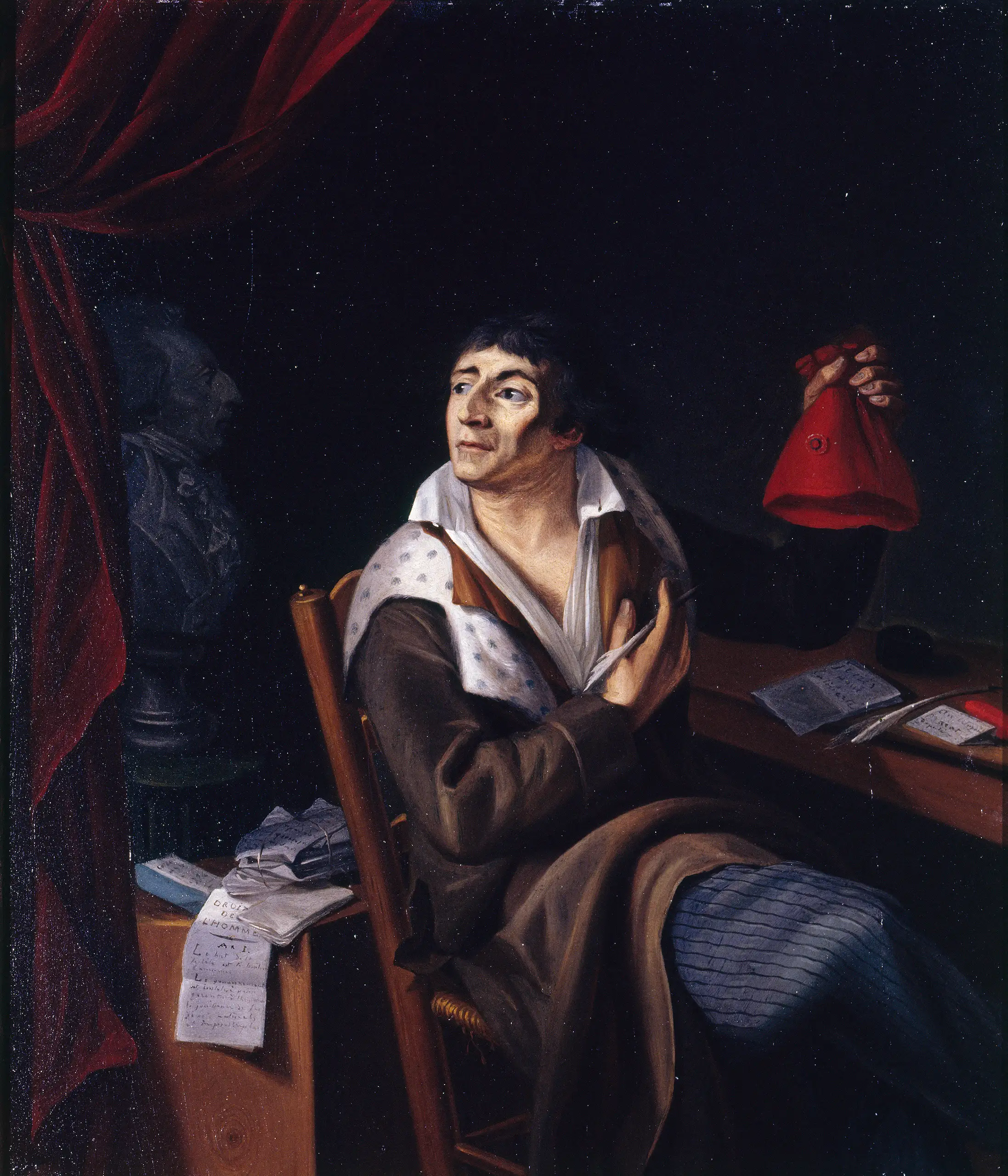
Jean-Paul Marat
 France
political theorist•physician•scientist•journalist
Also known as: Jean Paul Marat
Birthday
May 24, 1743
Birth Sign
Sagittarius
Birthplace
Boudry, Neuchâtel (now Switzerland)
Age
Died at 50
About
Jean-Paul Marat was a French political theorist, physician, and scientist who became one of the most radical voices of the French Revolution. Born in Boudry, Switzerland, on 24 May 1743, he trained as a doctor and practiced medicine in London before returning to France. In the 1780s, he turned his attention to politics, publishing pamphlets and newspapers that championed the working-class sans-culottes. His most famous creation was the periodical L'Ami du peuple (The Friend of the People), which earned him a loyal following among radicals and made him an unofficial link to the Jacobin faction that rose to power in June 1793. Marat's journalism was fierce and unyielding. He attacked the new leaders and institutions of the revolution with equal intensity, demanding swift action against counter-revolutionaries. His influence was so great that some historians attribute the September Massacres of 1792 to his incendiary writings, though others argue the violence grew out of the chaotic circumstances of the time rather than any single person's will. Despite the controversy, Marat remained a champion of the poor and a vocal critic of the wealthy elite. His life ended abruptly on 13 July 1793, when Charlotte Corday, a Girondin sympathizer, stabbed him while he bathed to soothe a chronic skin condition. Corday was executed four days later. In death, Marat became a martyr for the Montagnards and the sans-culottes. Jacques-Louis David, a fellow revolutionary and friend, immortalized him in the painting The Death of Marat, which remains one of the most famous images of the Revolution. Marat was just 50 years old.
Early Life & Background
Born Jean-Paul Mara in Boudry, a small town in the Principality of Neuchâtel, Marat faced a childhood marked by frequent movement. His father, Pierre Mara, worked as a clerk for the local lord, requiring the family to relocate between Boudry and La Chaux-de-Fonds. These moves interrupted formal schooling, leaving his mother, Marie Sarrasin, to provide his initial education. Despite these disruptions, young Jean-Paul showed a keen intellect, particularly in mathematics and physics. He attended a local school in La Chaux-de-Fonds where his aptitude for science began to stand out among his peers. At age 22, in 1765, Marat traveled to Edinburgh, Scotland, to pursue medical studies under the renowned anatomist John Hunter. This move marked a significant shift in his life, taking him from a modest Swiss upbringing to the intellectual hubs of Britain. While in Edinburgh, he also lectured at the University of Edinburgh and immersed himself in the scientific community. He published several works during this period, including Essai sur le feu in 1770 and Recherches physiques sur la lumière in 1780. These publications earned him recognition as a serious scientist and led to his election as a member of the Royal Society of Medicine in London in 1773. Despite his academic achievements, Marat struggled to find a stable position in the medical profession. He practiced in London but faced financial difficulties and resistance from the established medical community due to his unconventional theories. By 1775, he returned to France, settling in Paris. Although he continued to publish scientific papers, he found himself marginalized within the French medical establishment. It was during this period of professional frustration that he began to write political pamphlets, laying the groundwork for his future role as a revolutionary voice. His early career was defined by a struggle for acceptance that would eventually fuel his radical political activism.
Career Growth
Marat's political career exploded with the outbreak of the French Revolution in 1789. In September of that year, he founded L'Ami du peuple (The Friend of the People), a weekly newspaper that quickly became the voice of the radical left. The paper was characterized by its fierce attacks on the monarchy, the aristocracy, and moderate revolutionaries, whom he accused of betraying the cause of the people. Marat's writing was direct, emotional, and often inflammatory, calling for immediate action against counter-revolutionaries. By 1792, Marat had become one of the most powerful figures in the revolutionary movement. His influence was so great that historians have debated whether his writings directly incited the September Massacres of 1792, during which thousands of prisoners were killed. Despite the controversy, Marat remained a beloved figure among the sans-culottes, who saw him as their true defender. His ability to articulate the grievances of the poor and the working class gave him a unique platform that no other revolutionary leader possessed. In June 1793, Marat was elected to the National Convention, representing the Montagnard faction. However, his time in office was short-lived, as he was already suffering from a severe skin condition that required him to spend much of his day in a medicinal bath. This physical ailment only added to his image as a suffering martyr for the people. His assassination by Charlotte Corday in July 1793 cut his political career short but cemented his legacy as a central figure in the Revolution.
Career Timeline
Public Image & Style
Marat's public persona was that of a rugged, uncompromising defender of the poor. He cultivated an image of asceticism and suffering, often appearing in his bathrobe and surrounded by his medicinal tubs to emphasize his physical sacrifices for the revolution. His writing style was blunt and aggressive, designed to provoke anger and action rather than polite debate. Media perception of him shifted dramatically over time; initially viewed as a hero by the sans-culottes, he became a controversial figure after the fall of the Jacobins. Today, he is seen as a complex figure whose radicalism and advocacy for the poor continue to resonate in discussions of populism and political violence.
Fame & Fandom (iFAMOUS Rankings)
While Jean-Paul Marat lacks a modern fanbase with organized clubs or formal names, his legacy has evolved into a rich cultural mythology that functions much like the lore of a contemporary fandom. The story of his assassination remains the central pillar of this enduring narrative, with the image of him slumped in his medicinal bath serving as an iconic symbol of revolutionary sacrifice. This visual legend, immortalized by Jacques-Louis David's painting The Death of Marat, continues to define how audiences engage with his life, transforming a historical figure into a touchstone for debates on terror and power. In academic circles and political commentary, his influence is palpable, with scholars and analysts revisiting his radicalism and the dynamics of his death as relevant case studies for modern populism.
In August 2026, the iFANN Global Fame Engine evaluated Jean-Paul Marat and determined that he currently holds no placement in the published rankings, including the Global Top 1,000 or any Top-100 scope list. This status reflects his position as a historical subject rather than a current celebrity competing in real-time fame metrics. While he does not appear in the current numerical hierarchy, his presence in global discourse regarding political violence and the role of the press ensures his name remains instantly recognizable to those studying Western history.
The fanbase has no formal name, which aligns with the reality that his supporters were political allies known as sans-culottes rather than fans engaging in pop culture rituals. There are no recorded fan campaigns, birthday billboards, or inside jokes associated with his life, as the concept of a fanbase is anachronistic for an eighteenth-century revolutionary. Yet, the intensity of the stories retold about him, from his skin condition necessitating time in a bathtub to the dramatic intervention of Charlotte Corday, demonstrates a deep, sustained engagement with his life that rivals the devotion found in modern fandoms.
Interesting Facts and Legends
Marat suffered from a severe skin condition, likely dermatitis herpetiformis or psoriasis, which caused him excruciating pain and required him to bathe in medicinal water for hours each day. This physical reality is often romanticized in art, but it was a source of constant agony for him. The painting The Death of Marat by Jacques-Louis David was commissioned by the National Convention just days after his death, transforming a gruesome murder scene into a sacred image of sacrifice. Marat's name is frequently associated with the phrase "friend of the people," which became a rallying cry for the sans-culottes. Historical accounts suggest that his last words were "Je meurs" (I am dying) as he slumped in his bath. The incident involving his assassination has been retold countless times in literature and film, becoming a cultural touchstone for discussions on political violence.
Notable Quotes
“Liberty or death!”
“Je meurs." (I am dying.)”
“The friend of the people must be feared by the tyrants.”
Family & Personal Life
Jean-Paul Marat married Simone Évrard, a seamstress from Geneva, in 1784. The couple had no children together. Simone was a devoted supporter of Marat's political work and accompanied him throughout his life. She managed his household and cared for him during his illness, acting as a crucial partner in his daily struggles. Their marriage was described as a partnership based on mutual respect and shared ideals, though it was not without its challenges due to Marat's demanding schedule and health issues. There are no documented romantic relationships outside of his marriage to Simone Évrard. Marat was known for his intense dedication to his cause, and his personal life was largely overshadowed by his political activities.
Notable Connections
Simone Évrard (wife), Charlotte Corday (assassin), Jacques-Louis David (artist), Maximilien Robespierre (ally), Georges Danton (rival).
Relationships & Dating History
Jean-Paul Marat married Simone Évrard, a seamstress from Geneva, in 1784. The couple had no children together. Simone was a devoted supporter of Marat's political work and accompanied him throughout his life. She managed his household and cared for him during his illness. Their marriage was described as a partnership based on mutual respect and shared ideals, though it was not without its challenges due to Marat's demanding schedule and health issues. There are no documented romantic relationships outside of his marriage to Simone Évrard. Marat was known for his intense dedication to his cause, and his personal life was largely overshadowed by his political activities. Simone survived him, and they remained married until his death in 1793.
- MarriedSimone Évrard1784 - 1793Married until his death; she cared for him during his illness.
Death & Aftermath
Died
July 13, 1793 (aged 50)
Death Place
Paris, France
Cause of Death
Fatal stabbing wound to the chest
On the evening of July 13, 1793, Jean-Paul Marat sat in his medicinal bath at his residence on Rue des Cordeliers in Paris, managing the severe skin condition that had kept him bedridden for weeks. Charlotte Corday entered the apartment claiming to deliver evidence of a Girondin plot and stabbed him once in the left pectoral region before he could react. He reportedly whispered Je meurs as he collapsed, passing away shortly after around 10:00 PM. Local authorities conducted an immediate inquest, leading to a rapid trial three days later where Corday admitted to the act but claimed it was necessary to save the Republic; she was found guilty of regicide and executed by guillotine on July 17.
The reaction to his death transformed him instantly into the primary martyr of the Revolution, with crowds gathering outside his home to view his body displayed in the tub. A grand funeral procession occurred on July 15 attended by thousands of sans-culottes and revolutionary leaders like Robespierre, who eulogized him as the incorruptible friend of the people. During the ceremony, his heart was reportedly removed and placed in a vase to symbolize his undying devotion, while commemorative prints and medallions depicting the event flooded the market. The most famous visual tribute was Jacques-Louis David's painting The Death of Marat, commissioned just days after the murder.
Marat was interred in the Panthéon on September 15, 1793, in a ceremony intended to canonize him as a secular saint of the Revolution. This honor proved short-lived, as his remains were exhumed from the Panthéon on October 10, 1794, following the Thermidorian Reaction and reburied in a common grave at the Cemetery of Sainte-Catherine.
Net Worth (Estate Value)
$0
iFANN Editorial Team estimate
As a historical figure from the 18th century, Jean-Paul Marat did not accumulate wealth in the modern sense. His estate was modest, and he died without significant assets. Posthumous revenues from his works and the sale of commemorative items have generated income for publishers and museums, but these do not constitute a net worth in the contemporary sense. The iFANN Editorial Team estimates his estate value at $0, reflecting the lack of personal fortune typical of revolutionary figures of his era.
Awards & Accolades
View 2 records, honours and achievementsKnown For
L'Ami du peuple
1789 · Founder and Editor
The Death of Marat
1793 · Subject
Keywords
Sources
Quick Facts
- Profession
- politician, journalist, physician
- Born
- May 24, 1743
- Birthplace
- Boudry
- Died
- July 13, 1793
- Death Place
- Paris
- Gender
- Male
- Spouse
- Simone Évrard
- Birth Sign
- Sagittarius
Personal Details
- Full Name
- Jean-Paul Mara
- Spouse
- Simone Évrard
- Children
- Education
- Taught by mother; school in La Chaux-de-Fonds; University of Edinburgh (medicine); University of Paris
Frequently Asked Questions
Who was Jean-Paul Marat?
How did Jean-Paul Marat die?
What was Jean-Paul Marat's main contribution to the French Revolution?
Why is Jean-Paul Marat still remembered today?
What is the significance of the painting The Death of Marat?
Similar People
Join the community
fans discussing