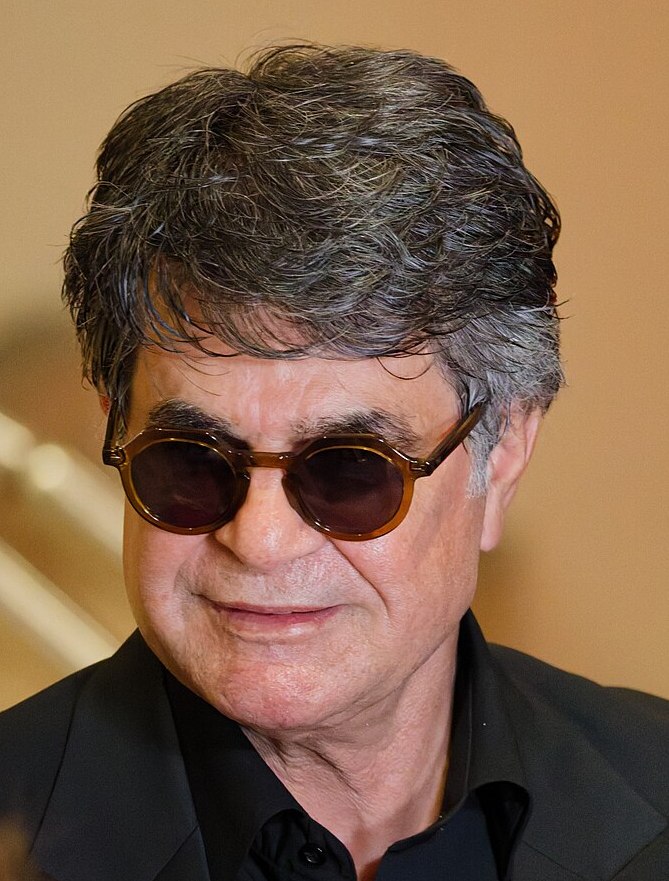
Jafar Panahi
 Iran
Iranfilm director•film producer•film editor
Birthday
+1960-07-11
Birth Sign
Cancer
Birthplace
Mianeh
Age
66 years old
About
Jafar Panahi, born on July 11, 1960, in Mianeh, Iran, is one of the most significant figures in contemporary world cinema. As a filmmaker, producer, and editor, he has become a leading voice of the Iranian New Wave, a movement that emerged after the 1979 Revolution. His films, deeply rooted in neorealism, focus on the lives of women, children, and the marginalized, offering a sharp critique of Iran's social, political, and gender structures. Panahi's work has earned him international acclaim, placing him among an elite group of directors who have won top prizes at Cannes, Berlin, and Venice. His 1995 debut feature, The White Balloon, won the Caméra d'Or at Cannes, and he later took the Golden Lion for The Circle (2000), the Golden Bear for Taxi (2015), and the Palme d'Or for It Was Just an Accident (2025). He is also a two-time Golden Globe nominee and an Academy Award nominee, and in 2012, he received the Sakharov Prize for Freedom of Thought. Panahi's career has been shadowed by relentless conflict with Iranian authorities. Starting with The Circle, which addresses the plight of women in Iran, his films have often been banned or censored at home. In 2010, he was sentenced to six years in prison and a 20-year ban on filmmaking, charged with "propaganda against the Islamic Republic." Undeterred, Panahi continued to make films clandestinely, producing works like This Is Not a Film (2011), Closed Curtain (2013), Taxi (2015), and No Bears (2022). These films often reflect, in a metacinematic way, on his own restrictions as an artist under state surveillance. His legal battles are ongoing, with new sentences, including a one-year prison term for propaganda activities, but he has never stopped creating. Beyond his filmmaking, Panahi has been a symbol of artistic resistance. His work has inspired audiences and filmmakers worldwide, and his inclusion in Time 100 for 2026 underscores his global impact. Through his defiance and dedication, Panahi has transformed personal limitations into powerful art, proving that creativity can flourish even under the most oppressive conditions.
Fame & Fandom
Jafar Panahi's standing in global cinema is now measurable in the iFANN Global Fame Rankings, where he holds the 21st most famous person from Iran, a placement that has held steady from the previous cycle. It's a ranking that tracks attention across media coverage, search, and consumption signals worldwide, and for Panahi, that attention is inseparable from his defiance: a filmmaker who has turned house arrest into a film set and a prison sentence into a moral stance. His audience, though, has never coalesced into a formal fandom, there's no official name, no fan club, no organized community. Instead, his supporters are cinephiles, festival-goers, and human-rights advocates, drawn to his neorealist portraits of women, children, and the marginalized. They show up in solidarity campaigns, like the global outcry after his 2025 sentencing, but those are institutional gestures, not fan-driven projects. Panahi's engagement with his audience is his art itself: films smuggled out in flash drives, shot on cellphones, premiering at Cannes while he remains under ban. That's the bond, not merchandise or meet-and-greets, but the shared act of witnessing a filmmaker who refuses to stop.
Interesting Facts and Legends
Panahi's legend is built on defiance. After his 2010 arrest and 20-year filmmaking ban, he secretly made This Is Not a Film (2011) in his Tehran apartment, smuggling the footage to Cannes, a story fans still retell, often with the detail that the flash drive was hidden inside a cake. His 2015 Taxi, shot from a moving vehicle, won the Golden Bear at Berlin, a direct rebuke to the ban. In 2026, he attended the Oscars, then voluntarily returned to Iran to face a one-year prison sentence, saying, "If I'm not there, I'm not a whole." The New Yorker profiled him as "Jafar Panahi Steps Out of the Shadows," and TIME named him one of its 100 Most Influential People. His son, Panah Panahi, has noted the contrast: unlike his father, he has "not had much trouble coming to the Cannes Film Festival from Iran."
Awards & Accolades
Keywords
Quick Facts
- Profession
- film director, film producer, film editor
- Born
- +1960-07-11
- Birthplace
- Mianeh
- Gender
- Male
- Birth Sign
- Cancer
Join the community
fans discussing