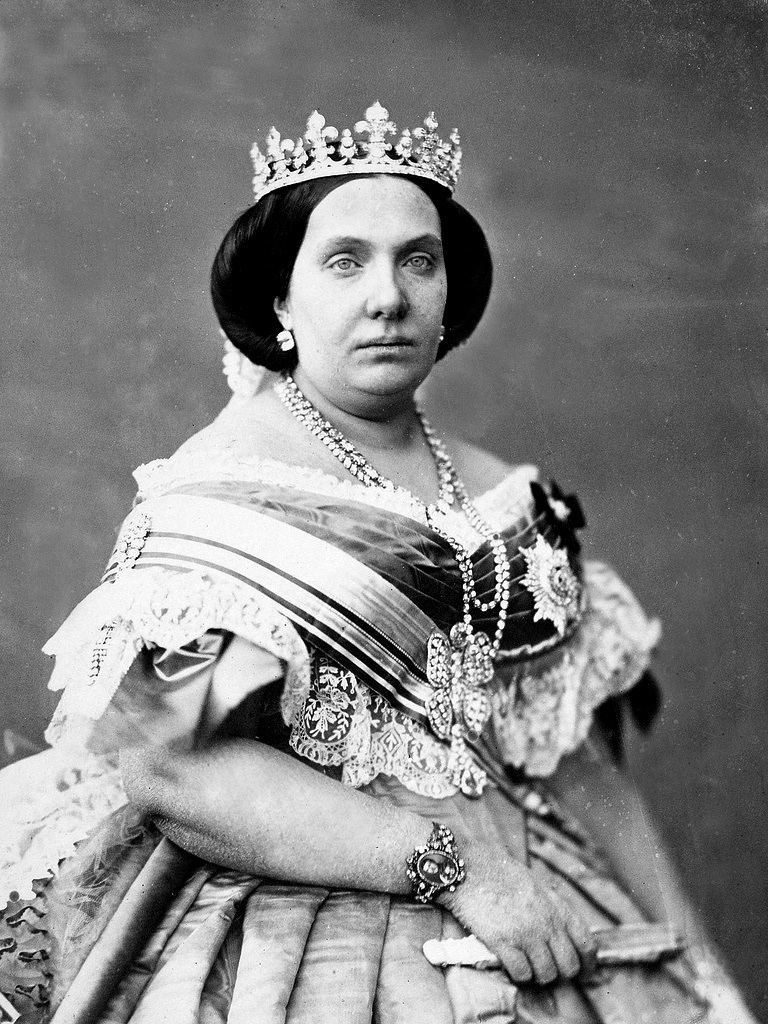
Isabella II
 Spain
SpainBirthday
+1830-10-10
Birth Sign
Libra
Birthplace
Madrid
Age
Died at 73
About
Isabella II, born María Isabel Luisa de Borbón y Borbón-Dos Sicilias on 10 October 1830 in Madrid, was the only queen regnant in the history of unified Spain. Her father, King Ferdinand VII, issued the Pragmatic Sanction to override Salic Law and secure her succession, as he had no sons. When she was just under three years old, her father died, and she ascended the throne in 1833. Her uncle, Infante Carlos, refused to recognize a female sovereign, sparking the Carlist Wars and a dynastic conflict that would shape Spanish politics for decades. During her minority, her mother Maria Christina served as regent, and Spain shifted from an absolute monarchy to a constitutional one, adopting the Royal Statute of 1834 and the Constitution of 1837. Isabella was declared of age in 1843 at the age of thirteen, and she began her personal rule.
Fame & Fandom
The dust of the palace corridors in Madrid still holds the weight of a reign that began with a child's crown and ended with a forced exile. Isabella II remains a figure of historical gravity, recognized globally as the 66th most famous person in Spain, a standing she has held steady through shifting political tides. This placement within the iFANN Global Fame Rankings reflects her enduring presence in the collective memory of a nation that watched her ascend at age three and lose her throne decades later. Her story is not one of fleeting viral fame but of deep-rooted dynastic drama that shaped a country. While modern audiences might expect a bustling community of devotees, the reality for this deposed monarch is starkly different. There is no formal fandom name attached to her legacy, nor are there organized campaigns or digital rituals celebrating her life. The audience for her history is strictly academic, comprised of historians and students rather than fans who create wikis or stream content. She exists in the public consciousness as a singular anomaly, the only queen regnant in unified Spanish history, rather than as a celebrity with a cult following. The rankings capture her status as a pivotal historical actor, a woman whose personal tragedies became national crises. Even without a fanbase to amplify her image, her name carries the heavy burden of a failed monarchy, making her fame less about adoration and more about the cautionary tale of power lost.
Interesting Facts and Legends
Isabella II ascended the throne in 1833 before her third birthday, triggered by her father King Ferdinand VII's Pragmatic Sanction which overrode traditional Salic Law to allow female succession. Her uncle, Infante Carlos, rejected this move immediately, sparking the Carlist Wars that would plague Spanish politics for generations. Throughout her thirty-five-year reign, she faced constant instability, eventually becoming so unpopular that the Glorious Revolution of 1868 forced her into exile. Unlike modern icons who suffer from adulation turning to outrage, her unpopularity was rooted in genuine political failure and military mismanagement. Historical accounts describe her as disliked across the country long before her final departure. Despite the turmoil, she bore twelve children, including four daughters whose lives have since become subjects of intense historical analysis. A specific artifact often cited in royal circles is her Mellerio Diamond Star Tiara, an item noted during her death anniversary commemorations. This piece of jewelry serves as a tangible link to her heritage, surviving the chaos of her deposition. Her legacy remains defined by these structural shifts in Spanish governance rather than any viral folklore or crowd-driven legends.
Death & Aftermath
Died
+1904-04-09 (aged 73)
Death Place
Paris, France
Cause of Death
Unknown
Isabella II, Queen of Spain from 1833 until her deposition in 1868, died on April 9, 1904, in Paris, France. Historical records confirm that she passed away in exile following her overthrow during the Glorious Revolution of 1868. She was 73 years old at the time of her death. While standard biographical sources consistently list her death date and location, they do not provide a detailed official medical report or autopsy results regarding the specific pathology that ended her life.
Public reaction to her death did not include fan vigils or memorial events, reflecting her status as a historical figure rather than a contemporary celebrity whose death sparked immediate mass media events. Tributes from peers and institutions are not detailed in the search results, though her legacy is acknowledged in historical analyses of the Spanish transition from absolutism to constitutional monarchy. The handling of her estate is also not described in the provided text.
The only confirmed facts regarding her death are the date, the location in Paris, and her age at the time. Later news items dated in 2026 regarding other monarchs do not apply to Isabella II, who died in 1904.
Awards & Accolades
Keywords
Quick Facts
- Profession
- ruler
- Born
- +1830-10-10
- Birthplace
- Madrid
- Died
- +1904-04-09
- Death Place
- Paris
- Gender
- Female
- Spouse
- Francisco de Asís, Duke of Cádiz
- Birth Sign
- Libra
Personal Details
- Spouse
- Francisco de Asís, Duke of Cádiz
Join the community
fans discussing