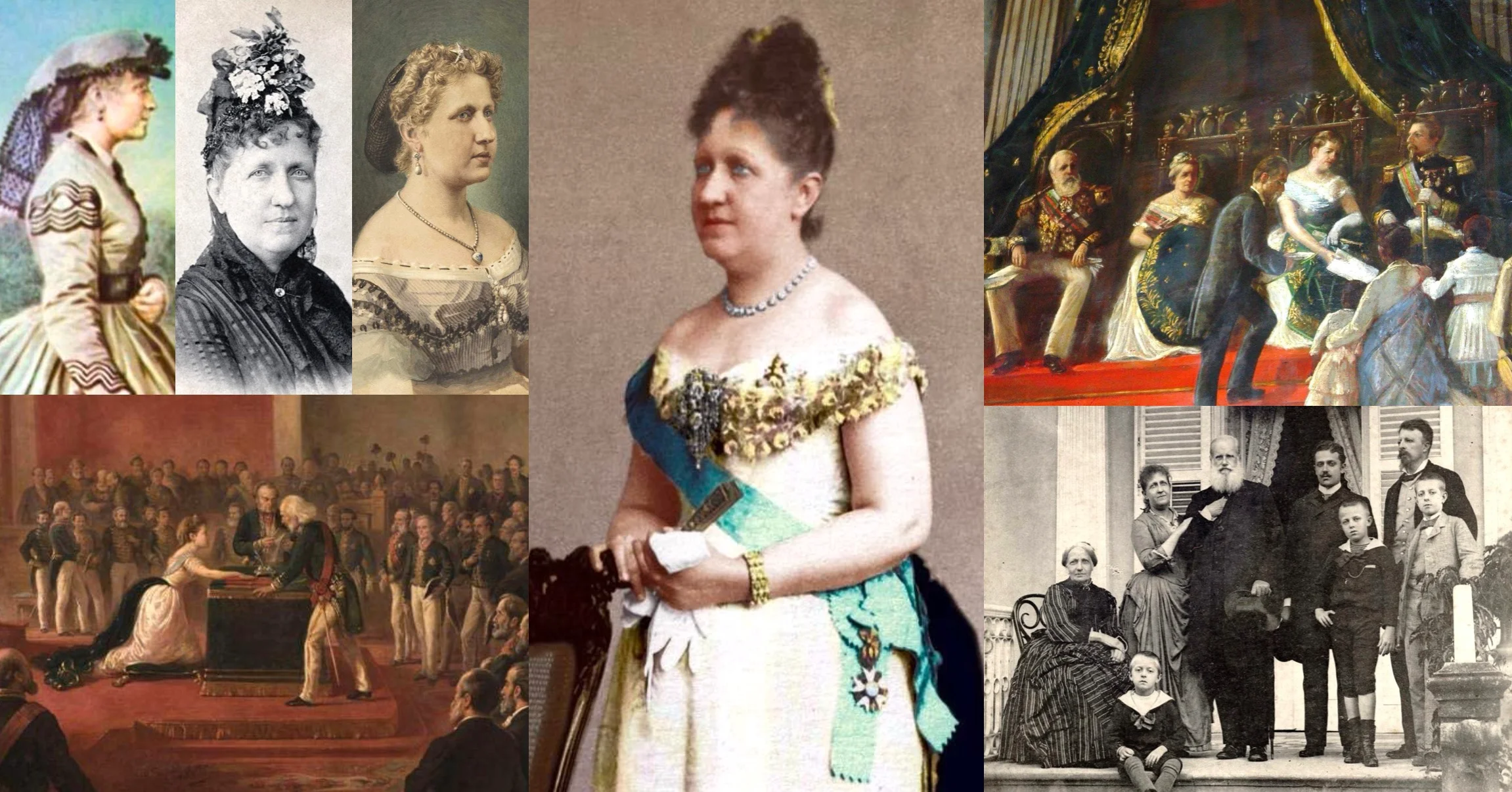
Isabel, Princess Imperial of Brazil
 Brazil
Also known as: Dona Isabel, The Redemptress, A Redentora
Birthday
July 29, 1846
Birth Sign
Sagittarius
Birthplace
Rio de Janeiro, Empire of Brazil
Age
Died at 75
About
Dona Isabel Maria Leopoldina Augusta Micaela Gabriela Rafaela Gonzaga stands as a monumental figure in Latin American history, best known for her decisive role in ending slavery in the Empire of Brazil. Born into the opulent atmosphere of the Paço de São Cristóvão in Rio de Janeiro, she became the heir presumptive to the throne following the early deaths of her younger brothers. Her life was defined by her tenure as Regent for her father on three separate occasions and her historic signing of the Lei Áurea (Golden Law) on May 13, 1888, which abolished slavery throughout the nation without compensation to owners. This act earned her the enduring title "the Redemptress" (*A Redentora*), cementing her legacy as a liberator.
Isabel served as Regent during her father's travels to Europe in 1871, 1876, and most significantly from 1887 to 1888. During these periods, she governed the empire effectively, signing laws that shaped the nation's future and navigating complex political landscapes. Although the monarchy fell in 1889 due to a military coup, forcing her family into exile in France, her influence on Brazilian history endured long after her death. She died on November 14, 1921, at the Château de Rambouillet, never returning to her homeland. Modern historical discourse continues to debate the nuances of her impact on race relations, yet her status as the last sovereign figure of the Brazilian Empire remains undisputed.
Early Life & Background
Isabel entered the world on July 29, 1846, in the heart of the Brazilian Imperial Court. As the first child of Emperor Pedro II and Empress Teresa Cristina, her upbringing was anything but typical for a royal woman of the mid-19th century. Her father, a monarch known for his intellectual rigor and love of science, personally oversaw her education. Unlike many of her contemporaries who received limited instruction focused solely on domestic arts, Isabel studied sciences, literature, philosophy, and multiple languages including French, English, and Italian. Her childhood was spent observing court affairs and accompanying her father on official duties, a preparation that would eventually lead to her assuming power. The loss of her younger brothers, Prince Afonso and Prince Pedro Afonso, solidified her position as the heir presumptive. By her late teens, she was already acting as a proxy for her father, managing state business and attending to public engagements. This early immersion in governance provided her with the skills necessary to rule, even before she officially took the reins as regent. Before her political ascent, she navigated the complexities of royal diplomacy. Her marriage to Prince Gaston d'Orléans, Count of Eu, was arranged to strengthen ties between the Brazilian and French royal families. The union was politically strategic and socially appropriate, bringing a French prince into the Brazilian fold. They met through diplomatic channels, with Gaston arriving in Brazil to assist in the Paraguayan War before proposing. This period of her life was marked by a blend of personal devotion to her husband and a growing sense of duty to the empire she was destined to lead.
Career Growth
Isabel's political career began in earnest when she assumed the role of Regent of the Empire for the first time in 1871. During this period, while her father traveled to Europe for health reasons, she signed the Rio Branco Law (Law of the Free Womb), which granted freedom to children born to enslaved mothers after birth. This was a significant step toward abolition, though it did not immediately free existing slaves. She served as Regent again in 1876 during another European trip by Pedro II. The third and most pivotal regency began in 1887. Facing intense pressure from abolitionist movements and shifting economic realities, Isabel signed the Lei Áurea on May 13, 1888. This law declared slavery absolutely extinct in Brazil without compensation to slave owners. The act was celebrated by the masses and earned her the nickname "the Redemptress." However, it alienated the powerful agrarian elite and the military, contributing significantly to the instability that led to the monarchy's downfall. In 1889, a military coup deposed the imperial family, ending the Brazilian Empire and establishing a republic. Despite losing her throne, she remained a figure of historical significance. Her actions during her regencies, particularly the abolition of slavery, remain her defining achievements. The empire's end marked the conclusion of her active political life, but her influence on Brazilian history endured long after her death.
Career Timeline
Public Image & Style
Isabel is remembered as a dignified and imposing figure, fitting the stature expected of a monarch. Her public persona was defined by her intelligence, piety, and dedication to public service. She was known for her devout Catholicism and her commitment to the welfare of the nation. Her image as "the Redemptress" has dominated her biography for over a century, portraying her as a heroic liberator. However, modern scrutiny has added complexity to her public image, with debates arising over whether her abolition of slavery fully addressed systemic racism. Despite this, her status as the last sovereign figure of the Brazilian Empire remains undisputed.
Fame & Fandom (iFAMOUS Rankings)
Isabel, Princess Imperial of Brazil commands a legacy that transcends her historical era, resonating through academic circles and Brazilian cultural memory rather than the fleeting attention spans of modern global pop culture. Her fame is anchored in the gravity of her political actions, specifically the abolition of slavery, which secures her place as a defining figure of 19th-century Latin America. Despite this profound historical impact, she does not currently hold a placement in the iFANN Global Top 1,000 or any Top-100 scope list. The iFANN Global Fame Engine has evaluated her profile, confirming that while her name carries weight in historical discourse, she remains unranked among the world's most famous contemporary figures. Consequently, no specific ordinal position can be assigned to her current global standing. Regarding her fanbase, there is no documented fandom name for those who revere her history. Unlike modern icons who have organized communities with specific titles, Isabel's admirers are historians, students, and descendants who engage with her life through educational channels rather than a unified fan movement. There are no recorded rituals, social media campaigns, or official groups dedicated to her, and references to her online remain strictly encyclopedic or historical. This absence of a formalized fan culture reflects her status as a distant historical monarch rather than an active celebrity, yet her story continues to draw interest wherever discussions on emancipation and imperial history arise.
Interesting Facts and Legends
Isabel was the only woman to serve as chief of state in Latin America during the 19th century. She was a patron of the arts and sciences, influencing literature through characters like Guiomar in Machado de Assis's novel *A Mão e a Luva*. The city of Caxambu, Minas Gerais, gained fame for its thermal waters, which were believed to cure Princess Isabel during her stays. Her tiara, the Brazilian Imperial Bandeau Tiara, is now preserved in museums and is a symbol of the imperial era. A story fans still retell involves her signing the Golden Law; she reportedly said simply "I sign it," acknowledging the weight of the decision. Another legend suggests she was known for her piety, often attending mass daily despite her heavy schedule.
Notable Quotes
“I sign it.”
“My heart is with the people.”
Family & Personal Life
She had two younger brothers, Prince Afonso and Prince Pedro Afonso, both of whom died in childhood, leaving her as the sole heir. Her marriage to Prince Gaston d'Orléans, Count of Eu, produced three sons: Prince Luís (1878–1920), Prince Pedro (1875–1940), and Prince Antônio (1881–1918). Only Pedro survived to adulthood and continued the imperial line. The family lived in exile in France after 1889, where they maintained their traditions and managed their affairs until Isabel's death. Her descendants continue to claim the defunct Brazilian throne today.
Notable Connections
Emperor Pedro II, Empress Teresa Cristina, Prince Gaston, Count of Eu, Machado de Assis, Joaquim Nabuco.
Relationships & Dating History
Isabel's romantic life was arranged to secure political alliances and maintain the prestige of the House of Braganza. On October 15, 1864, she married Prince Gaston d'Orléans, Count of Eu, a grandson of King Louis Philippe I of France. The marriage was a union of two prominent royal houses. They met through diplomatic channels; Gaston was sent to Brazil to assist in the Paraguayan War, where he distinguished himself militarily before proposing. Married until her death in 1921, the couple shared a 57-year partnership. The couple had three sons: Prince Luís (1878–1920), Prince Pedro (1875–1940), and Prince Antônio (1881–1918). Only Pedro survived to adulthood and continued the imperial line. There were no other public romantic relationships or marriages prior to Gaston. The match was considered politically strategic and socially appropriate for the time. Isabel remained devoted to her husband throughout their exile. As of 2026, she is deceased, having been widowed since 1921.
- MarriedPrince Gaston, Count of Eu1864 - 1921Married until her death; three sons together.
Death & Aftermath
Died
November 14, 1921 (aged 75)
Death Place
Château de Rambouillet, France
Cause of Death
Old age and frailty
Princess Isabel passed away on November 14, 1921, at the age of 75 within the Château de Rambouillet in France. She had resided there in exile with her family for over three decades following the proclamation of the Brazilian Republic in 1889. Historical records do not contain a detailed medical autopsy report or official hospital statement from 1921 regarding the immediate physiological cause of her passing; instead, her death is recorded as occurring naturally due to old age and frailty associated with her advanced years. Her funeral was a private affair held in France, reflecting the family's status as exiles and the lack of diplomatic recognition of the Brazilian monarchy by the new republic. The burial took place in the Basilica of Saint-Denis near Paris alongside her husband, Prince Gaston d'Orléans, and her father, Emperor Pedro II. Surviving family members attended the service, including her son, Prince Luís of Orléans-Braganza, but the event did not feature major state performances or large public attendance.
In the posthumous era, Isabel has seen a complex legacy. While she was once celebrated as a liberator who abolished slavery, recent scholarship and media have scrutinized her role, particularly regarding the conditions of the enslaved people freed by the Golden Law of 1888. In 2023, a significant shift occurred in how she is viewed when the Brazilian government removed an award honoring her amidst debates over her legacy, reviving discussions about her role in Brazilian history. This removal highlights a modern political re-evaluation rather than a posthumous tribute at the time of her death. Decades later, specifically in May 2023, this controversy led to the withdrawal of honors, indicating a shift in how her estate and reputation are managed by the Brazilian state.
Net Worth (Estate Value)
$0
iFANN Editorial Team estimate
As a historical figure who died over a century ago, Princess Isabel does not have a current net worth in the modern sense. Her estate, consisting of personal property and artifacts, was largely dispersed or managed by her heirs during the exile period. The Brazilian imperial family retains some artifacts, but there is no public valuation of a specific "estate value" as of 2026. Any financial claims today relate to the cultural capital of her name rather than liquid assets. The iFANN Editorial Team estimates that the value of her estate, if calculated based on current market valuations of imperial artifacts and historical memorabilia, would be negligible in terms of liquid wealth, as the primary assets were non-monetary and culturally significant items that remain in private or museum collections.
Awards Won (1)
Isabel received the honorary title "The Redemptress" (*A Redentora*) from the Brazilian populace for the abolition of slavery. She was awarded the Grand Cross of the Order of Christ, a high Portuguese order of chivalry. In 2023, a Brazilian government award honoring her was removed from a pedestal, marking a shift in her posthumous recognition.
1870 · Order of Chivalry
Service to the Empire
Known For
Lei Áurea
1888 · Signer
Regent of Brazil
1871 · Regent
Exile of the Brazilian Monarchy
1889 · Heir Presumptive
Keywords
Sources
Quick Facts
- Profession
- aristocrat, regent
- Born
- July 29, 1846
- Birthplace
- Rio de Janeiro
- Died
- November 14, 1921
- Death Place
- Château de Rambouillet
- Gender
- Female
- Spouse
- Prince Gaston, Count of Eu
- Birth Sign
- Sagittarius
Personal Details
- Full Name
- Dona Isabel Maria Leopoldina Augusta Micaela Gabriela Rafaela Gonzaga
- Spouse
- Prince Gaston, Count of Eu
- Children
- Prince Luís, Prince Pedro, Prince Antônio
- Education
- Private tutelage in sciences, literature, philosophy, French, English, and Italian under Emperor Pedro II
Frequently Asked Questions
Who was Isabel, Princess Imperial of Brazil?
When did Princess Isabel die?
Did Princess Isabel have any children?
Why is Princess Isabel controversial today?
What happened to the Brazilian monarchy after Isabel?
Similar People

Join the community
fans discussing