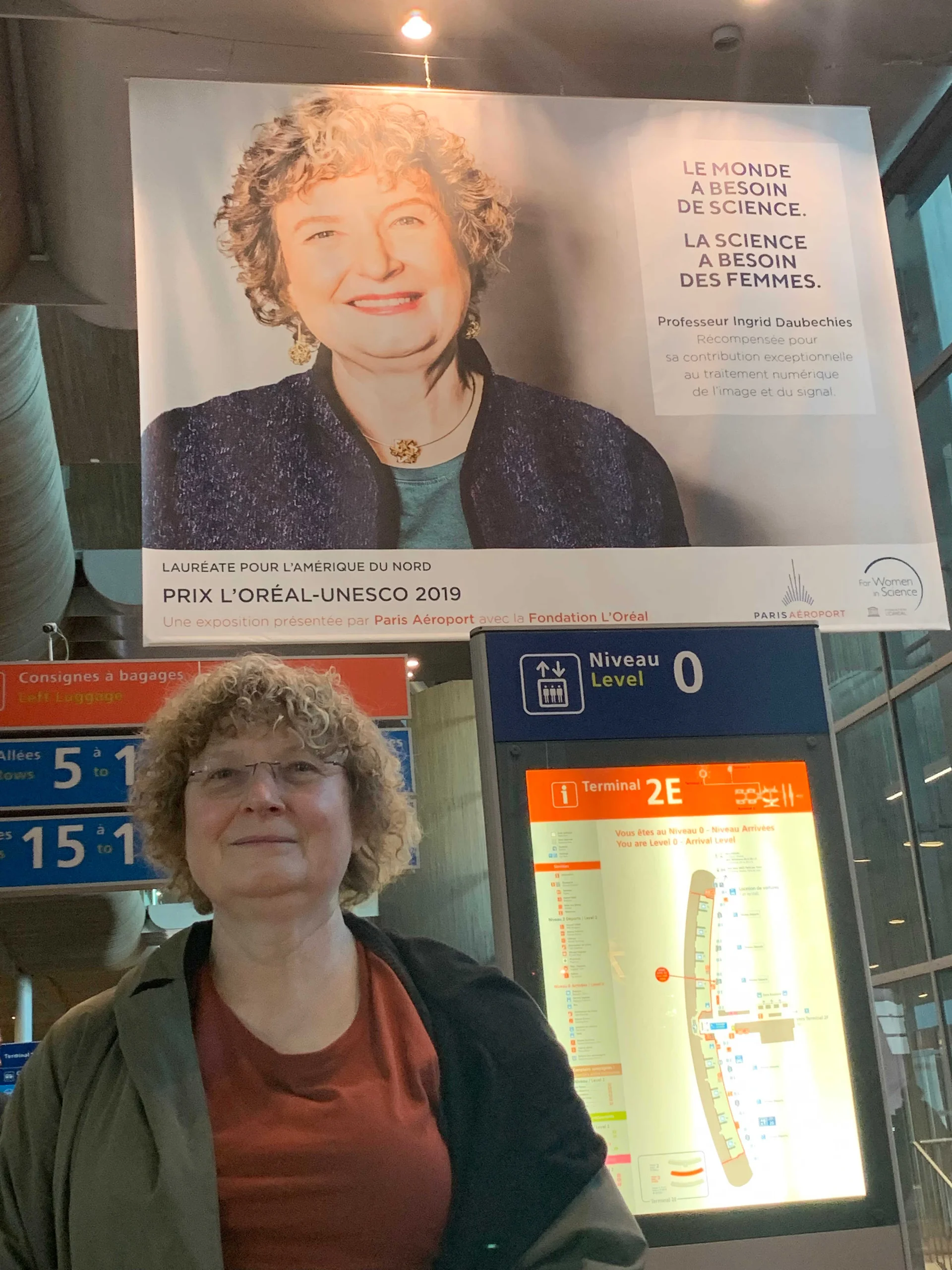
Ingrid Daubechies
 Belgium
mathematician•physicist•university teacher
Also known as: Baroness Ingrid Daubechies
Birthday
August 17, 1954
Birth Sign
Leo
Birthplace
Houthalen-Helchteren, Belgium
Age
72 years old
About
Ingrid Daubechies is a Belgian-American physicist and mathematician, widely celebrated as the architect of modern wavelet theory. Her discovery of the Daubechies wavelets in 1988 laid the mathematical groundwork for JPEG 2000, a compression standard that touches nearly every digital image you see today. She holds the title of James B. Duke Distinguished Professor Emerita at Duke University, where her research has pushed into areas as varied as medical imaging, audio processing, and even the authentication of paintings by Rembrandt and Van Gogh.
Daubechies has collected an extraordinary array of honors, including a MacArthur Fellowship in 1992, membership in the National Academy of Engineering and the National Academy of Sciences, and the presidency of the International Mathematical Union from 2011 to 2014. In January 2025, she received the National Medal of Science, the highest scientific honor in the United States. Her work has earned her the nickname "The Godmother of the Digital Image" from The New York Times, a fitting tribute to a woman whose mathematics quietly powers the modern electronic world.
Beyond her research, Daubechies is a passionate advocate for diversity in mathematics, serving on the board of Enhancing Diversity in Graduate Education (EDGE) to support women entering the field. Her blend of deep theory and practical application has made her a towering figure in applied mathematics, and her legacy continues to shape how we process images and understand the world.
Early Life & Background
Ingrid Daubechies was born on August 17, 1954, in Houthalen-Helchteren, a small coal-mining town in the Limburg region of Belgium. Her father was a mining engineer, and growing up in that industrial landscape gave her an early appreciation for how structures hold together, a curiosity that would later inform her mathematical work. She excelled in school, showing a natural aptitude for science and mathematics, though she initially leaned toward physics.
Daubechies studied at the Vrije Universiteit Brussel (Free University of Brussels), where she earned her bachelor's degree and then a Ph.D. in physics in 1980. Her doctoral work focused on quantum mechanics, but she soon became fascinated by the mathematical tools used to process signals. After completing her degree, she held positions at the University of Antwerp and the University of Louvain, where she began to explore the problems of data compression and reconstruction that would define her career.
In 1986, she made the move to the United States, joining Princeton University as a faculty member. It was there, surrounded by some of the brightest minds in mathematics, that she began the work that would lead to her breakthrough: the creation of a new class of wavelets that could decompose signals with unprecedented efficiency. The transition from Belgium to Princeton marked the start of her most influential period, but the seeds of her revolutionary ideas were planted in those early years of grappling with the fundamental questions of how information can be represented.
Career Growth
Daubechies' breakthrough came in 1988 when she published her seminal paper introducing what are now known as Daubechies wavelets. These orthogonal wavelets with compact support allowed for efficient signal decomposition and quickly became the industry standard for data compression. The technology was integrated into the JPEG 2000 standard in the early 2000s, transforming digital photography, medical imaging, and satellite transmission. Prior to this, image compression relied heavily on the Discrete Cosine Transform (DCT), which often introduced visible artifacts; her wavelets provided a multi-resolution analysis that represented images more efficiently, leading to higher quality at lower bitrates.
Her move to Duke University in 1993 marked the beginning of a long and productive tenure, where she eventually became the James B. Duke Distinguished Professor. In 1992, she was awarded a MacArthur Fellowship, recognizing her potential for significant contributions to society. Her work on wavelets extended beyond compression into art history; she used mathematical techniques to analyze brushstrokes and authenticate works by Old Masters, proving the versatility of her theoretical framework. The technology also underpins MP3 audio compression and NASA's image processing from the Hubble Space Telescope.
In 2011, Daubechies made history as the first woman president of the International Mathematical Union, a role she held until 2014. That same year, she was elected to the Academia Europaea. In 2019, the Flatiron Institute named its auditorium in her honor, and she received the L'Oréal-UNESCO For Women in Science Award. In 2021, The New York Times Magazine featured her on its cover with the headline "The Godmother of the Digital Image." Her most recent honor came in January 2025, when she received the National Medal of Science from President Biden, specifically for her development of wavelets in signal processing. She also received an honorary doctorate from Amherst College in 2024.
Career Timeline
Public Image & Style
Ingrid Daubechies is often portrayed in the media as a quiet revolutionary, a mathematician whose work has quietly transformed the digital world. The New York Times gave her the nickname "The Godmother of the Digital Image," a moniker that captures her foundational role in the technology behind JPEG 2000. She is known for her humility and approachability, often taking time to mentor young researchers and advocate for diversity in STEM fields. Her public image is that of a brilliant but approachable scholar, someone who can explain complex mathematical concepts with clarity and warmth. She is a role model for women in mathematics, and her election as the first female president of the International Mathematical Union was a historic milestone that resonated far beyond the academic community. She was featured in Marie Claire in March 2019, discussing her L'Oréal-UNESCO award and advocacy.
Fame & Fandom (iFAMOUS Rankings)
Ingrid Daubechies has cultivated a unique presence where academic reverence replaces the frenetic energy of pop culture fandom. Unlike entertainment icons who command armies of followers with specific names and organized campaigns, her audience is a dispersed community of mathematicians, engineers, and art historians united by intellectual admiration rather than parasocial devotion. There is no documented fanbase name, nor are there fan-funded billboards or social media movements dedicated to her daily life; her relationship with the public remains one of quiet inspiration within the STEM fields. This lack of traditional celebrity infrastructure does not diminish her stature but highlights the distinct nature of her legacy as a foundational figure in digital technology. Regarding her standing in the global consciousness, iFANN has conducted a comprehensive evaluation of her profile. As of August 2026, Ingrid Daubechies is currently unranked in the Global Top 1,000 list, meaning she does not hold a placement in the published rankings at this time. The iFANN Global Fame Engine has assessed her data thoroughly, yet she falls outside the scope of the current top-tier fame metrics. While she commands immense respect in specialized circles, her visibility has not translated into the broad consumer signals required for a numerical rank on the global charts. Her fame is deep rather than wide, rooted in the invisible architecture of JPEG 2000 and the integrity of modern signal processing rather than mass-market consumption.
Interesting Facts and Legends
Born in a coal-mining town where her father worked as a mining engineer, Ingrid Daubechies developed an early aptitude for structural analysis that would later define her career. She is celebrated for applying wavelet transforms to detect art forgeries, meticulously analyzing the layering of paint in masterpieces to distinguish authentic works from counterfeits. Her status as one of only five women to win mathematics' biggest prizes in nearly 90 years places her in an elite historical tier alongside luminaries like Maryam Mirzakhani and Claire Voisin. A devoted advocate for women in STEM, her work with the EDGE program has helped countless women enter graduate studies in mathematics. Her favorite mathematical object is reportedly the wavelet, which she describes as a "little wave" capable of building bridges between abstract theory and practical application. The cultural mythology surrounding her includes the widely recognized title "The Godmother of the Digital Image," bestowed by the New York Times Magazine for her foundational role in image compression. A pivotal moment in her legend occurred when the Flatiron Institute named its auditorium after her in June 2019, cementing her influence on the field. Most recently, she was awarded the National Medal of Science in January 2025, the highest honor in U.S. science, recognizing her lifetime of contributions to signal processing without the chaos of street-level celebrity.
Notable Quotes
“Wavelets are like little waves that can be used to build bridges between theory and application.”
“Mathematics is not just about numbers; it is about patterns and structures that help us understand the world.”
“I have always been fascinated by the way mathematics can be used to solve real-world problems, from compressing images to authenticating art.”
“We need more women in mathematics, not just for fairness, but because diverse perspectives lead to better science.”
Family & Personal Life
Ingrid Daubechies is married to Robert Calderbank, a distinguished mathematician and electrical engineer who has held professorships at Duke University and Princeton University. The couple met during their time in academia, likely while both were active in the mathematical community in the United States. Their partnership is characterized by a shared dedication to mathematics and science education. The couple has not publicly disclosed details regarding children, and specific information about offspring is not widely documented in public biographical summaries. Daubechies' parents were from a working-class background in Belgium, and her father's profession as a mining engineer was an early influence on her scientific curiosity.
Notable Connections
Ingrid Daubechies is associated with several prominent figures in mathematics and science. Her husband, Robert Calderbank, is a fellow mathematician and electrical engineer. She is also mentioned alongside other top female mathematicians like Maryam Mirzakhani and Claire Voisin in discussions of the most influential women in the field. At Duke University, she has collaborated with colleagues in the Department of Mathematics and the Center for Applied Mathematics. Her work has been supported by the Simons Foundation, and she has been honored by organizations such as the L'Oréal-UNESCO For Women in Science program.
Relationships & Dating History
Ingrid Daubechies has been married to Robert Calderbank, a distinguished mathematician and electrical engineer, for most of her adult life. The couple met during their time in academia, likely while both were active in the mathematical community in the United States. They share a deep commitment to mathematics and science education. There are no public records of prior marriages, engagements, or high-profile romantic relationships preceding her marriage to Calderbank. As of 2026, she remains married to Robert Calderbank. The couple has not publicly disclosed details regarding children, though some sources suggest they may have raised a family, but specific information is not widely documented.
- MarriedRobert CalderbankCurrentMet during their academic careers; both are mathematicians and engineers.
Salary, Net Worth In 2026
$5 Million
iFANN Editorial Team estimate
As of 2026, Ingrid Daubechies's net worth is estimated to be around $5 Million per iFANN's editorial analysis. Her wealth primarily stems from her distinguished academic career at Duke University, where she held the James B. Duke Distinguished Professorship. Beyond her salary, she has secured numerous research grants from prestigious institutions such as the National Science Foundation and the Simons Foundation. Intellectual property royalties from her wavelet patents contribute to her income, though the exact amounts remain undisclosed. Unlike celebrities whose earnings rely on endorsements, her financial success is driven by academic funding and institutional support. Her net worth has grown steadily over the years, reflecting her status as one of the most respected mathematicians in the world. No estate value or posthumous earnings apply as she is alive.
Awards Won (3)
Ingrid Daubechies has received numerous prestigious awards throughout her career. She was awarded the MacArthur Fellowship in 1992, the National Medal of Science in 2025, and the L'Oréal-UNESCO For Women in Science Award in 2019. She is a member of the National Academy of Engineering, the National Academy of Sciences, and the American Academy of Arts and Sciences. She has also received honorary degrees from several institutions, including Amherst College.
2025 · Science
Development of wavelets in signal processing
2019 · Science
For her contributions to mathematics
Known For
Daubechies wavelets
1988 · Inventor
JPEG 2000 standard
2000 · Contributor
International Mathematical Union President
2011 · President
Keywords
Sources
Quick Facts
- Profession
- mathematician, physicist, university teacher
- Born
- August 17, 1954
- Birthplace
- Houthalen-Helchteren, Belgium
- Gender
- Female
- Spouse
- Robert Calderbank
- Birth Sign
- Leo
- Education
- Ph.D. in Physics, Vrije Universiteit Brussel, 1980
- Awards
- National Medal of Science (2025), MacArthur Fellowship (1992)
Personal Details
- Full Name
- Ingrid Daubechies
- Spouse
- Robert Calderbank
- Education
- Ph.D. in Physics, Vrije Universiteit Brussel, 1980
Frequently Asked Questions
Who is Ingrid Daubechies?
What is Ingrid Daubechies' husband's name?
Did Ingrid Daubechies win the National Medal of Science?
Is Ingrid Daubechies still alive?
How did Ingrid Daubechies contribute to JPEG 2000?
Social Media
Similar People
Join the community
fans discussing