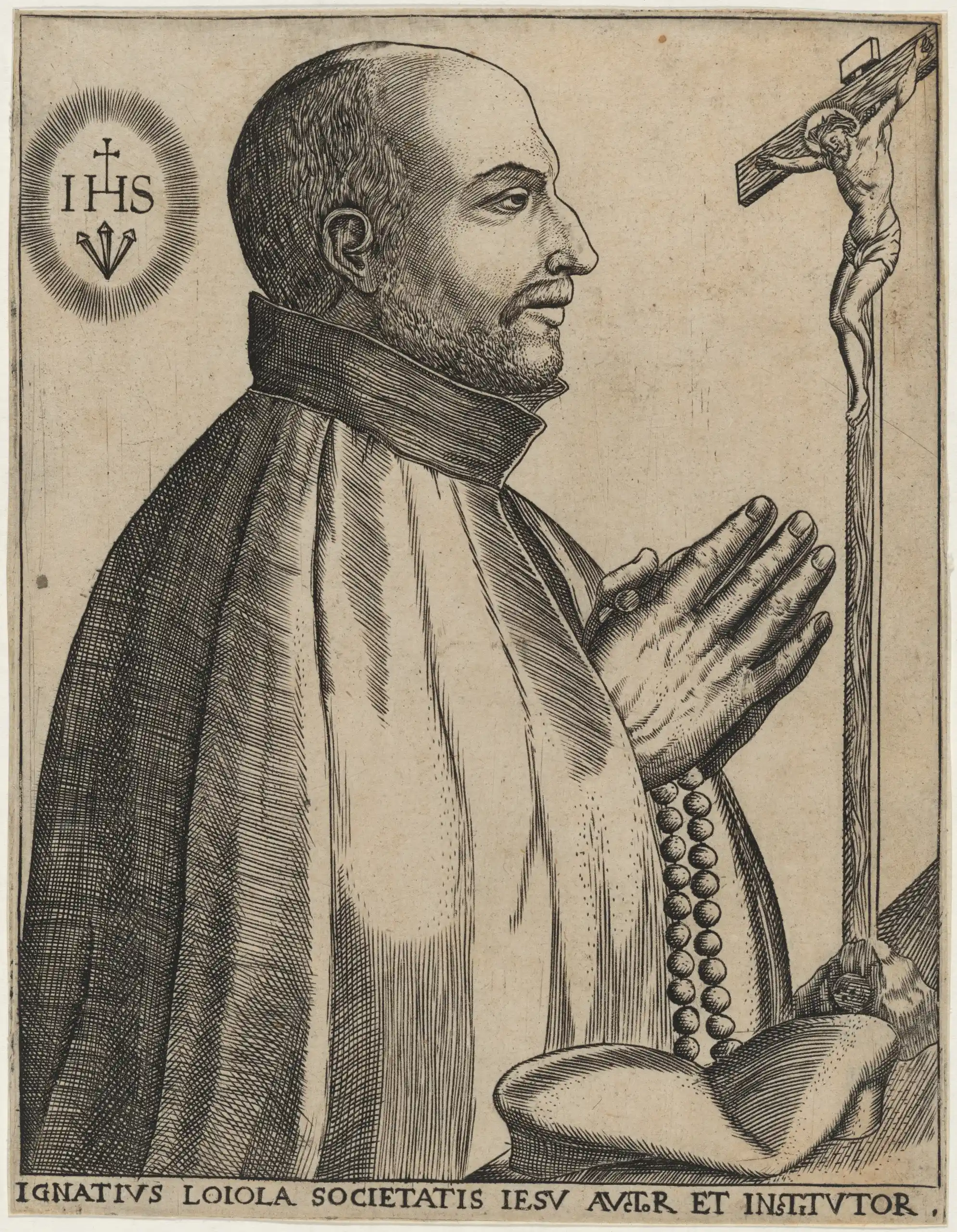
Ignatius of Loyola
 Spain
SpainLatin Catholic priest•soldier•founder of the Society of Jesus
Also known as: Saint Ignatius of Loyola, Saint Ignatius, Ignatius Loyola, Ignatius of Nepeya, Iñigo López de Oñaz y Loyola
Birthday
October 23, 1491
Birth Sign
Sagittarius
Birthplace
Oratory of the Holy House of Loyola, Basque Country, Kingdom of Navarre
Age
Died at 64
About
Ignatius of Loyola stands as a towering figure in Catholic history, renowned for founding the Society of Jesus, commonly known as the Jesuits, in 1540. Born Íñigo López de Oñaz y Loyola around October 23, 1491, in the Basque Country, he transformed from a soldier aspiring to military glory into one of the most influential spiritual leaders of the modern era. His legacy is defined by his unique approach to spiritual development, articulated in his seminal work Spiritual Exercises, which remains a cornerstone of Christian meditation and discernment today. He was beatified in 1609 and canonized as Saint Ignatius of Loyola on March 12, 1622, later declared a Doctor of the Church in 1922 for his profound contributions to theology.
The scale of his influence extends far beyond his lifetime, with the order he founded operating over one hundred universities worldwide, including prestigious institutions like Georgetown University and Loyola University Chicago. These institutions serve as living testaments to his vision of education and social justice. As the first Superior General of the Jesuits, he established an organizational structure that became central to the Counter-Reformation, guiding the Catholic Church through a period of significant change. His feast day is observed annually on July 31, marking the date of his death in 1556 at the age of 64. He is widely recognized as the patron saint of soldiers, the Basque provinces, and all spiritual retreats, embodying the archetype of the "soldier of Christ" who traded worldly ambition for divine service.
Early Life & Background
Íñigo López de Oñaz y Loyola entered the world around October 23, 1491, at the Oratory of the Holy House of Loyola in the village of Loyola within the Basque Country of Navarre. As the youngest of thirteen children in a family of minor nobility, his early years were steeped in martial ambition rather than religious devotion. His birth name, Íñigo, was a distinctly Basque name, but it was later changed to Ignatius, likely after St. Ignatius of Antioch or as a mark of humility following his conversion. Before his spiritual transformation, he served as a page to the Duke of Najera starting around 1509 and later as a courtier and soldier for the Castilian government, aspiring to military glory and chivalric romance. By 1517, he had been appointed steward of the royal household at the fortress of Pamplona, fully immersed in the life of a knight.
The defining moment of his life occurred on May 20, 1521, during the Siege of Pamplona. While defending the castle against French forces, a cannonball struck his left leg, shattering it and damaging his right leg. The injury required extensive surgery, leaving him with a permanently shortened leg and a limp for the rest of his life. During his grueling recovery at the family estate of Loyola, his father forbade him from reading books of chivalry, which had previously fueled his ambitions. Instead, he was given only two texts: The Life of Christ by Ludolph of Saxony and a collection of saints' lives.
Immersed in these readings, Ignatius underwent a profound psychological and spiritual crisis. He began to compare the fleeting glory of earthly knighthood with the eternal rewards of serving God. This period marked the transition from Íñigo the soldier to Ignatius the mystic. Following his discharge from the hospital in late 1522, he spent approximately a year living as a hermit in a cave near Manresa, Spain. There, he engaged in intense fasting, prayer, and self-mortification, experiencing vivid mystical visions where he reportedly heard voices and saw divine light. It was during this isolation that he began to formulate the core principles of what would become The Spiritual Exercises.
Career Growth
Ignatius's career shifted entirely from the military to theology and religious leadership. After his conversion, he traveled to Manresa, then to Montserrat, and finally to Barcelona before sailing to Jerusalem in 1523. When denied entry to the Holy Sepulchre due to restrictions on non-Catholics, he remained in Europe to study. He attended the University of Alcalá and later the University of Paris (Sorbonne) between 1528 and 1535, where he studied philosophy and theology alongside six companions, including Francis Xavier.
In 1534, while still a student in Paris, Ignatius and his six companions met at the chapel of Saint Denis on Montmartre. They took vows of poverty and chastity and promised to travel to Jerusalem; if they could not reach there, they pledged their obedience to the Pope. In 1537, they were ordained priests in Venice. They traveled to Rome, where they offered their services to Pope Paul III. Impressed by their dedication, the Pope authorized them to preach and hear confessions throughout Italy.
On September 27, 1540, Pope Paul III issued the bull Regimini militantis Ecclesiae, officially approving the Society of Jesus (the Jesuits). Ignatius was elected the first Superior General of the order, a position he held until his death in 1556. Under his leadership, the Jesuits expanded rapidly across Europe and into Asia, Africa, and the Americas, becoming a central force in the Counter-Reformation. His greatest professional achievement was the establishment of the Spiritual Exercises (published in 1548) and the creation of an educational network that remains one of the largest in the world today. He dictated his autobiography in 1553 to provide a record of his experiences for future generations.
Career Timeline
Public Image & Style
Ignatius is portrayed as the archetype of the "soldier of Christ." His image is typically depicted in a black cassock (Jesuit habit), often holding a book (The Spiritual Exercises) or a cross. Media portrayals emphasize his transformation from arrogance to humility, his intellectual rigor, and his organizational genius. His tone is one of discipline, obedience, and contemplative action. Unlike modern celebrities, he does not appear on secular magazine covers like *TIME* or *Rolling Stone*, but his image is ubiquitous in religious publications such as *America* (Jesuit magazine) and liturgical calendars. Recent cultural references in 2026 have even compared his narrative arc to fictional characters like Spider-Man, highlighting themes of redemption and responsibility. His public persona is defined by the nickname "The Black Pope," referring to the immense power wielded by the Jesuit General, a title earned through his strategic leadership and unwavering loyalty to the papacy.
Fame & Fandom
The devotion surrounding Ignatius of Loyola lacks a modern fandom name, as his followers identify instead as Jesuits or adherents to Ignatian Spirituality rather than fans in the contemporary entertainment sense. His legacy is maintained through liturgical observance and institutional education rather than viral campaigns or chart-topping media pushes. The primary ritual of this community occurs annually on July 31st for the Feast of St. Ignatius, marking the date of his death in 1556 with special masses and reflections. While he does not have a fanbase that organizes charity drives or streams content to boost visibility, his influence remains vast through the Society of Jesus, which operates over one hundred universities worldwide. Within the iFANN Global Fame Rankings, Ignatius of Loyola holds significant standing despite his historical status. He is currently the 75th most famous person in Spain, a position holding steady from the previous cycle. In terms of origin, he ranks as the 67th most famous person from Spain, also maintaining his placement. His influence within his specific domain is particularly pronounced, placing him at the 11th most famous person in Religious Leaders. These metrics reflect a sustained reverence that transcends time, anchoring his memory firmly in the collective consciousness of the Spanish-speaking world and the broader religious community. Social media accounts for Jesuit organizations collectively hold millions of followers, sharing content related to his teachings, though he has no personal profile.
Interesting Facts and Legends
Ignatius of Loyola began life as Íñigo López de Oñaz y Loyola, a Basque name that he later Latinized to Ignatius, possibly to honor St. Ignatius of Antioch or to distance himself from his past identity. A verified story from his life involves the Wound at Pamplona, where a cannonball struck him while defending the castle against the French forces; this event serves as the origin point for his conversion from a vain soldier to a humble saint. Following his conversion, he spent about a year in a cave near Manresa, experiencing intense mystical visions and writing what would become The Spiritual Exercises. This text established the method of discernment of spirits, a core tenet of his teachings. Along with six companions, he vowed poverty and chastity at Montmartre in Paris in 1534, eventually founding the Society of Jesus with the motto Ad Maiorem Dei Gloriam. He died on July 31, 1556, leaving behind a legacy defined by education and social justice rather than celebrity culture. Notably, he wrote The Spiritual Exercises in Spanish, though it was quickly translated into Latin and other European languages. He is frequently cited in lists of "Greatest Christians" and "Most Influential Figures in History" by encyclopedias. In 2026, a podcast adaptation of his autobiography was released to commemorate his life, and various schools named after him held athletic events and art shows.
Notable Quotes
“Take care to keep your eyes fixed on the goal you have set for yourself, and do not let anything distract you from it.”
“To love and be loved is the greatest thing in the world.”
“Seek and find God in all things.”
Family & Personal Life
Ignatius of Loyola was born into a large family as the youngest of thirteen children in a lineage of minor nobility in the Basque Country. His parents were Juan de Loyola and Marina Sánchez de Ona. Despite his noble birth, he chose a path of voluntary poverty, renouncing his family's wealth and status upon his conversion. He never married and had no children, dedicating his entire existence to his faith and the organization of the Society of Jesus. His relationship with his siblings is largely undocumented in terms of close personal interaction, as his focus shifted entirely to his religious vocation after 1521. He maintained no domestic household, living instead in communal settings with his fellow Jesuits. His physical appearance included a tall stature relative to his time, though he was noted for his permanent limp caused by his war wound. He often wore simple, rough clothing reflecting his ascetic lifestyle, rejecting the fine garments associated with his former noble standing.
Notable Connections
Relationships & Dating History
As a Catholic priest and founder of a religious order requiring vows of celibacy, Ignatius of Loyola did not have a romantic dating history, marriages, or children. His personal life was dedicated entirely to his faith and the organization of the Society of Jesus. He maintained close spiritual brotherhoods with his companions, particularly Francis Xavier, Peter Faber, and Diego Laynez, but these were platonic, spiritual partnerships. He is widely recognized as having no spouse or romantic partners, as his vow of chastity was a foundational requirement of his vocation. His relationships were characterized by deep camaraderie and shared mission rather than familial or romantic bonds. He viewed his companions as brothers in arms for the spiritual battle, prioritizing their collective growth over individual attachments. This lack of personal entanglements allowed him to dedicate every aspect of his life to the expansion of the Jesuit order.
Death & Aftermath
Died
July 31, 1556 (aged 64)
Death Place
Rome, Italy
Cause of Death
Severe dysentery and general frailty
The first Superior General of the Society of Jesus died on July 31, 1556, in Rome after a life defined by rigorous discipline and spiritual innovation. Ignatius of Loyola succumbed to severe dysentery compounded by the physical toll of his earlier military injuries and advanced age, dying at approximately sixty-five years old. Contemporary accounts describe a peaceful passing marked by prayer, with his companions administering last rites as he breathed his last. He had been bedridden for some time and was unable to return to his native Spain for his final days. Tributes flowed immediately from peers who viewed him as their spiritual father, establishing an annual liturgical commemoration that evolved into his feast day. His remains were initially interred in the church of Santa Maria della Strada before being transferred to the Basilica of the Gesù in 1561, where they remain a major site of pilgrimage today. The Society of Jesus managed his estate and legacy, ensuring the continuity of his work through educational institutions and foundations bearing his name. His most enduring contribution remains The Spiritual Exercises, a manual of meditations widely used globally, while his influence is recognized through his status as a Doctor of the Church and patron of soldiers. The rapid canonization process following his death underscores the immediate impact of his life and work on the Catholic Church.
Net Worth (Estate Value)
$0
iFANN Editorial Team estimate
As a historical religious figure who died in 1556, Ignatius of Loyola had no personal net worth in the modern sense. He lived in voluntary poverty, owning nothing personally. At his death, his personal estate consisted of his manuscripts (including The Spiritual Exercises) and his writings. These intellectual property rights are now managed by the Society of Jesus. The "estate" value is effectively infinite in terms of institutional wealth generated by the Jesuits. The Society of Jesus manages billions of dollars in assets globally, including real estate, endowments, and educational institutions. However, this wealth belongs to the corporation (the Society), not the individual's heirs, as per his vows. No specific dollar figure can be attributed to Ignatius himself, but the global network bearing his name generates significant revenue through tuition, donations, and endowments. The financial success of the order he founded stands as a testament to his organizational acumen, surpassing any material wealth he could have accumulated as a soldier.
Awards Won (3)
While modern awards like Oscars or Grammys did not exist in the 16th century, Ignatius received the highest honours available in his time and posthumously. He was beatified by Pope Paul V on July 27, 1609, and canonized as a Saint by Pope Gregory XV on March 12, 1622, along with Saints Teresa of Ávila, Francis Xavier, and Philip Neri. Declared a Doctor of the Church by Pope Pius XI in 1922 for his contributions to theology and spirituality, he is named patron saint of the Basque provinces, the Society of Jesus, soldiers, and all spiritual retreats since 1922.
1609 · Religious Honor
Society of Jesus
1622 · Saint
Society of Jesus
Known For
The Spiritual Exercises
1548 · Author
Society of Jesus
1540 · Founder
Keywords
Sources
Quick Facts
- Profession
- Latin Catholic priest, soldier, founder of Catholic religious community
- Born
- October 23, 1491
- Birthplace
- Oratory of the Holy House of Loyola
- Died
- July 31, 1556
- Death Place
- Camere di San Ignazio
- Gender
- Male
- Birth Sign
- Sagittarius
Personal Details
- Full Name
- Íñigo López de Oñaz y Loyola
- Children
- Education
- University of Alcalá; University of Paris (Sorbonne)
Frequently Asked Questions
Who was Ignatius of Loyola?
How did Ignatius of Loyola die?
What is the Spiritual Exercises?
When was Ignatius of Loyola canonized?
Did Ignatius of Loyola ever marry?
Similar People
Join the community
fans discussing