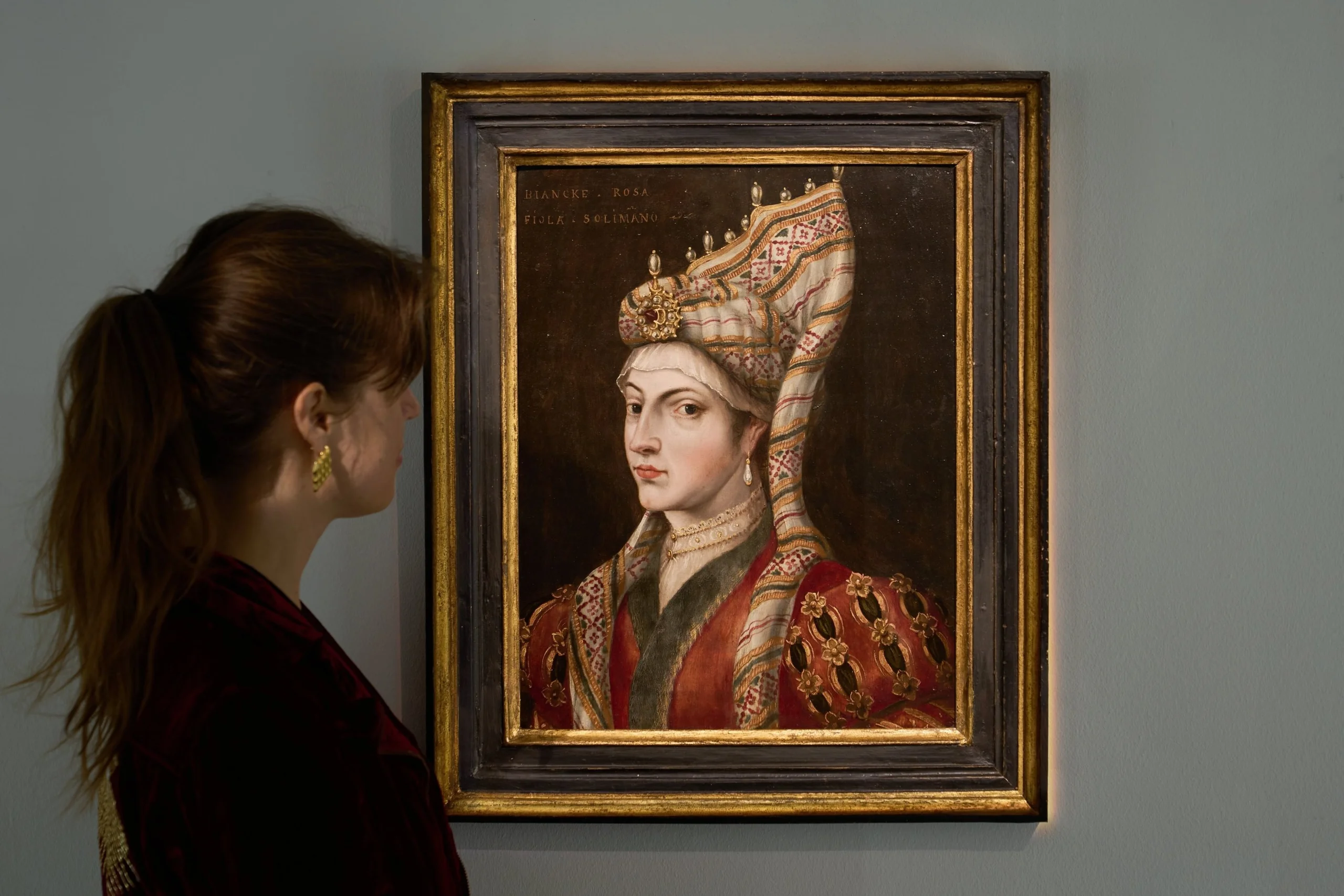
Hürrem Sultan
Haseki Sultan•patron of the arts•diplomat
Also known as: Roxelana, Hürrem, Roxolana
Birthday
c. 1505
Birth Sign
Aries
Birthplace
Ruthenia (modern-day Ukraine)
Age
Died at 53
About
Hürrem Sultan, born around 1505 in Ruthenia and known in the West as Roxelana, was the chief consort and legal wife of Ottoman Sultan Suleiman the Magnificent. Born into an Orthodox Christian family, likely named Anastasia Lisowska, she entered the imperial harem as a captured slave before rising to become the first Haseki Sultan of the Ottoman Empire. Her marriage to Suleiman shattered centuries of tradition that prohibited sultans from marrying their concubines, fundamentally altering the role of women in the Ottoman court and initiating the era known as the "Sultanate of Women." She bore Suleiman six children, four of whom survived infancy, including her successor Selim II.
During her lifetime, Hürrem wielded power rarely seen by women of her time. While Suleiman led military campaigns across Europe and the Middle East, she managed state affairs from the capital. Her surviving correspondence with foreign leaders like Sigismund II Augustus of Poland reveals a diplomatic strategy that blended personal warmth with sharp political acumen. She used her influence to secure favorable treaties and protect the interests of her native Ruthenia. Beyond politics, she left a lasting physical legacy through major public works, including the Haseki Sultan Complex and the Hürrem Sultan Hamam, which still stand in Istanbul today. She died on April 15, 1558, leaving behind a dynasty and a legacy of female empowerment that lasted for decades.
Early Life & Background
Hürrem's origins lie in the town of Rohatyn, located in Ruthenia within the Polish-Lithuanian Commonwealth, around the year 1505. Historical evidence suggests she was born into an Orthodox Christian family of Ukrainian or Rusyn descent. Her father is identified in some sources as Dimitri Lisowski, a local priest or minor nobleman, while her mother was named Anna. As a child, she lived a relatively ordinary life near the Carpathian Mountains, receiving basic education that included literacy, religious instruction, and domestic skills typical for a woman of her station.
The trajectory of her life changed drastically around 1519 when she was approximately fourteen years old. During a Crimean Tatar raid on her village, she was captured along with many others. She was sold into slavery and transported along the extensive slave trade routes through Crimea and across the Black Sea. Her journey eventually brought her to Constantinople, the capital of the Ottoman Empire. There, she was purchased by the eunuchs of the Imperial Palace and entered the Topkapı Palace harem.
Upon entering the harem, she was given the name Hürrem, which translates to "the cheerful one" or "the joyful one." This name reflected her lively personality, which stood in stark contrast to the somber and rigid atmosphere of the palace. In the early years of her confinement, she distinguished herself not only through her beauty but also through her intelligence and wit. Unlike other concubines who might have remained in the background, Hürrem quickly caught the attention of Prince Süleyman, who would become Sultan in 1520. Their initial bond formed during these formative years in the harem laid the groundwork for a relationship that would reshape the history of the Ottoman Empire.
Career Growth
Hürrem's ascent to power began in earnest after Süleyman became Sultan in 1520. She defied established protocol by bearing him six children: Mehmed, Abdullah, Selim (later Selim II), Bayezid, Cihangir, and Mihrimah. Traditionally, concubines were expected to be separated from their sons once they reached maturity to prevent factional strife, but Hürrem's influence allowed her to keep her children close. This defiance marked the beginning of her profound impact on the court.
The pivotal moment in her career occurred in the late 1520s and early 1530s when she successfully lobbied for her marriage to Suleiman. Traditional law dictated that a sultan could only marry foreign princesses to maintain diplomatic alliances, but Hürrem argued that his love for her and the stability of the empire required a union with his chosen partner. In 1534, following the death of Mahidevran Sultan's son Mehmed, Suleiman married Hürrem, making her the first legal wife of an Ottoman sultan. This event created the position of Haseki Sultan, granting her the status of a queen consort and allowing her to live outside the harem walls in the newly built Haseki Sultan Suite.
As Haseki, Hürrem managed state affairs while Suleiman was away on campaign. She acted as a diplomat, sending letters and gifts to foreign leaders, including Sigismund II Augustus of Poland and Shah Tahmasp I of Persia. Her correspondence revealed a strategic partnership where she advised on diplomatic matters and warned of potential uprisings. Her influence extended to the construction of major public works, including the Haseki Sultan Complex and the Hürrem Sultan Hamam, which served as hospitals, soup kitchens, and baths for the public. Her career culminated in her death in 1558, having transformed the role of women in the Ottoman court and setting a precedent for female influence that lasted for decades.
Career Timeline
Public Image & Style
Hürrem Sultan is remembered as a pioneering figure in women's history, known for her intelligence, resilience, and political acumen. She challenged patriarchal constraints and redefined the role of women in the Ottoman court. Her public image is one of strength and determination, often portrayed as a symbol of female empowerment. She was known for her distinctive style, blending traditional Ottoman fashion with her unique personality. Her correspondence with foreign leaders revealed a sophisticated mind capable of navigating complex diplomatic relations. Despite the controversies surrounding her rise to power, she is widely respected for her contributions to public welfare and her enduring legacy in Ottoman history.
Fame & Fandom (iFAMOUS Rankings)
iFANN has not yet collected fame data for this person. As of September 2026, she does not appear in the Global Fame Rankings because the engine has not yet gathered sufficient modern digital signals for this historical figure. Her fame is rooted in historical significance rather than contemporary celebrity metrics.
Despite the lack of formal ranking data, Hürrem Sultan enjoys a dedicated global fandom, particularly among fans of the Turkish historical drama Magnificent Century. The fanbase, often referred to simply as followers of the series, is highly organized and engages in social media discussions, charity drives, and streaming campaigns inspired by her life. Fans celebrate her as a symbol of female empowerment, intelligence, and resilience against patriarchal constraints. Inside jokes and rituals among fans often revolve around her famous wit, her loyalty to Suleiman, and her ability to navigate the treacherous politics of the Ottoman court. The series' popularity has sparked renewed interest in her story, leading to academic discussions and cultural events dedicated to her legacy.
Interesting Facts and Legends
Hürrem's name means "cheerful" or "joyful," a fitting moniker given her lively personality that contrasted sharply with the somber atmosphere of the palace. She was known for her distinctive appearance, described in historical accounts as having strawberry blonde hair, pale skin, and a curvy build, which made her stand out in the predominantly dark-haired Ottoman court. One of her most notable achievements was her ability to navigate complex political landscapes while raising five sons, challenging the old custom that limited each concubine to one male heir. She sent embroidered gifts to the Shah of Persia, which were instrumental in negotiating peace treaties. Her historic bathhouse, the Hürrem Sultan Hamam, continues to operate today and recently transitioned to geothermal power in 2025. A rare 17th-century Venetian School portrait of her was sold at Christie's in London in October 2021 for $173,000. In July 2026, a city in Ukraine unveiled a monument, street, and museum center dedicated to her, celebrating her origins and historical impact.
Notable Quotes
“I am your humble servant, yet I am also the wife of the Sultan.”
“I will not be a shadow; I will be the light.”
Family & Personal Life
Hürrem was born to Dimitri Lisowski, a local priest or minor nobleman, and his wife Anna in Ruthenia. She had siblings, though their names are not well-documented in historical records. Upon entering the Ottoman court, her immediate family was far away, yet she maintained strong ties to her native Ruthenia. She had six children with Suleiman the Magnificent: Mehmed, Abdullah, Selim II, Bayezid, Cihangir, and Mihrimah. Of these, Selim II succeeded his father as sultan, and Mihrimah became a powerful figure in her own right. Hürrem's influence extended to her grandchildren, ensuring that every subsequent Ottoman ruler descended from her line. Her legacy lives on through her descendants and the architectural monuments she commissioned.
Notable Connections
Relationships & Dating History
Hürrem Sultan had one documented romantic relationship, which evolved into a marriage: Suleiman the Magnificent. They met when she was a young slave in the Topkapı Palace and he was the reigning Sultan. Their relationship was deeply intimate and enduring, characterized by surviving love letters that reveal a bond rarely seen in royal history. They had six children together: Mehmed (died young), Abdullah (died young), Selim II (successor), Bayezid (executed), Cihangir (died young), and Mihrimah (lived to adulthood). The couple remained together until Hürrem's death in 1558. Following her death, Suleiman never remarried, breaking the tradition of Ottoman sultans taking new wives after the death of their primary consort. He joined her in death eight years later in 1566.
- MarriedSuleiman the Magnificent1534 - 1558Legal wife and chief consort; mother of six children.
Death & Aftermath
Died
April 15, 1558 (aged 53)
Death Place
Topkapı Palace, Constantinople
Cause of Death
Unknown illness
Hürrem Sultan died on April 15, 1558, at the age of approximately 53 within the confines of the Topkapı Palace in Constantinople. Historical records do not confirm a single definitive cause of death, though contemporary accounts suggest she succumbed to a sudden and severe illness. While rumors of poisoning circulated among courtiers and foreign diplomats due to her immense political power, no autopsy or official investigation ever substantiated these claims. Her passing left a void that the empire struggled to fill immediately.
Sultan Suleiman was reportedly devastated by the loss of his wife and confidante. He never remarried, a significant break from Ottoman tradition where sultans typically took new consorts after the death of their primary partner. Instead, he mourned her for the remainder of his life, joining her in death eight years later in 1566. The emotional toll of losing Hürrem is often cited as a turning point in Suleiman's later years, marked by increased isolation and a shift in his military campaigns.
Her funeral was a grand affair befitting her status as the first legal wife of an Ottoman sultan. She was interred in a magnificent mausoleum (türbe) adjacent to the Süleymaniye Mosque, a location she had commissioned herself. This placement was unprecedented; prior to her, sultans were rarely buried directly next to their wives unless the women held exceptional status. The mausoleum remains one of the most visited historical sites in Istanbul today.
Following her death, the political landscape of the Ottoman Empire shifted significantly. Her son Selim II ascended to the throne, ensuring that every subsequent Ottoman ruler descended from her line. Her daughter Mihrimah continued to wield considerable influence, managing vast charitable foundations and acting as a key advisor to her brother. The era known as the "Sultanate of Women" began in earnest, with female relatives of the sultan holding unprecedented power over state affairs and public works for decades to come. Her legacy endures through the architectural marvels she funded, including the Haseki Sultan Complex and the famous bathhouse in Istanbul, which continues to operate as a cultural landmark.
Net Worth (Estate Value)
$0
iFANN Editorial Team estimate
As a historical figure who passed away in 1558, Hürrem Sultan does not have a net worth in the modern financial sense. Her wealth was tied to the vast resources of the Ottoman Empire and her personal patronage of public works. During her lifetime, she controlled significant funds for charitable foundations (waqf), including hospitals, schools, and baths. Her estate included land grants and income from various properties. Today, her legacy is measured not in currency but in the enduring impact of her architectural projects, such as the Haseki Sultan Complex and the Hürrem Sultan Hamam, which continue to serve the public. The value of her historical artifacts, such as the 17th-century portrait sold at Christie's in 2021 for $173,000, reflects her cultural significance rather than personal wealth.
Awards & Accolades
View 5 records, honours and achievementsKnown For
Magnificent Century
2011 · Subject of historical drama
Ottoman Empire History
1505-1558 · Haseki Sultan
Keywords
Sources
Quick Facts
- Profession
- Haseki Sultan, patron of the arts, diplomat
- Born
- c. 1505
- Birthplace
- Ruthenia (modern-day Ukraine)
- Died
- April 15, 1558
- Death Place
- Topkapı Palace, Constantinople
- Gender
- Female
- Spouse
- Suleiman the Magnificent
Personal Details
- Full Name
- Anastasia Lisowska (likely)
- Spouse
- Suleiman the Magnificent
- Children
- Mehmed · Abdullah · Selim II · Bayezid · Cihangir · Mihrimah
- Education
- Basic literacy and domestic skills; Imperial Harem training
Filmography
1
Total
0
Film
1
TV
Frequently Asked Questions
What was Hürrem Sultan's real name?
Did Hürrem Sultan die naturally or was she poisoned?
How many children did Hürrem Sultan have?
Was Hürrem Sultan the first legal wife of an Ottoman Sultan?
Where is Hürrem Sultan buried?
Similar People
Join the community
fans discussing