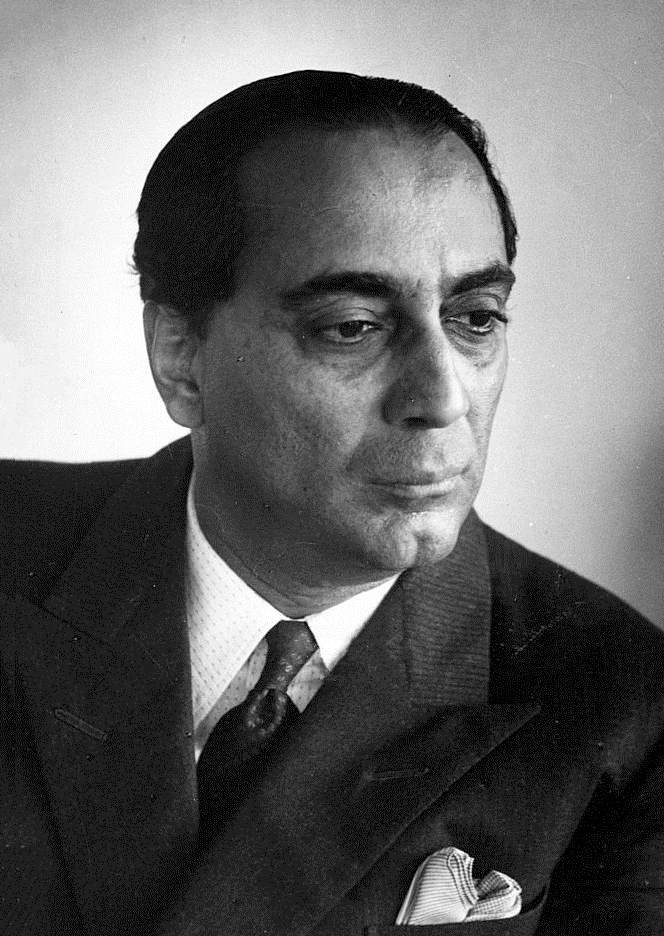
Homi Jehangir Bhabha
 India
IndiaBirthday
October 30, 1909
Birth Sign
Scorpio
Birthplace
Mumbai, India
Age
Died at 56
Height
5 ft 8 in (173 cm)
About
Homi Jehangir Bhabha was an Indian nuclear theoretical physicist who is widely credited as the father of the Indian nuclear programme. He was the founding director and professor of physics at the Tata Institute of Fundamental Research (TIFR) and the founding director of the Atomic Energy Establishment, Trombay (AEET), later renamed the Bhabha Atomic Research Centre (BARC) in his honor. Bhabha served as the first chairman of the Indian Atomic Energy Commission and secretary of the Department of Atomic Energy. He also played a pivotal role in the birth of the Indian space programme by supporting early space science projects through the AEC. A Fellow of the Royal Society, Bhabha was awarded the Adams Prize in 1942 and the Padma Bhushan in 1954. He was nominated for the Nobel Prize in Physics five times. Bhabha died in the crash of Air India Flight 101 in 1966 at the age of 56.
Early Life & Background
Born into a wealthy Parsi family in Bombay, Bhabha attended the Cathedral and John Connon School. His father wanted him to become an engineer, so in 1927 he went to Cambridge University to study mechanical engineering at Gonville and Caius College. After earning a first-class degree in 1930, he wrote to his father explaining his passion for physics. His father agreed on the condition he first become a competent engineer. Bhabha then completed a first-class degree in mathematics in 1932. He began research in theoretical physics at the Cavendish Laboratory under Ralph H. Fowler. In 1934 he published his first paper on cosmic radiation, winning the Senior Studentship of the Royal Commission for the Exhibition of 1851. He used this fellowship to work with Wolfgang Pauli in Zurich and Niels Bohr in Copenhagen.
Career Growth
In 1935 Bhabha published his paper deriving the cross-section for electron-positron scattering, now known as Bhabha scattering. He earned his doctorate from Cambridge in 1937. Returning to India for a vacation in 1939, the outbreak of World War II prevented his return to England. He joined the Indian Institute of Science in Bangalore under Sir C. V. Raman. In 1941 he was elected a Fellow of the Royal Society, the youngest Indian to receive that honor. In 1944 he wrote a letter to the Sir Dorabji Tata Trust advocating for a dedicated body to develop atomic energy, which led to the founding of TIFR in 1945. In 1948 he became the first chairman of the Indian Atomic Energy Commission. In 1954 he established the Atomic Energy Establishment, Trombay, and was awarded the Padma Bhushan. He oversaw the construction of India's first nuclear reactors, Apsara and CIRUS, and the commissioning of the plutonium reprocessing facility at Trombay. He also championed the Indian space program, securing funding for ISRO through the Department of Atomic Energy.
Career Timeline
Public Image & Style
Bhabha is remembered as a visionary, a patriot, and a brilliant scientist. His signature style was that of a sophisticated gentleman, often seen in a well-tailored suit and tie. His speeches and writings were formal, clear, and persuasive. In India, he is revered as the father of the Indian nuclear programme. His birth anniversary is marked as National Energy Day, and his legacy is celebrated at TIFR and BARC. Fans and admirers often share his quotes on social media and visit the institutions he founded.
Fame & Fandom
Homi Jehangir Bhabha commands a unique form of reverence that transcends the typical celebrity worship found in pop culture. His following is not defined by social media trends or merchandise, but by the deep institutional loyalty of the scientific community and the Indian public who view him as the architect of their nation's energy independence. The alumni of TIFR and staff at BARC act as his dedicated guardians, keeping his three-stage nuclear program alive through decades of political and technological change. Tributes manifest as serious academic discourse rather than fan campaigns, with his birthday and death anniversary serving as solemn days of reflection within the scientific establishment. While there is no formal fandom name documented for this global icon, the collective respect he garners from students and researchers worldwide functions as a powerful, organized network of admiration. Despite his immense historical impact, iFANN has evaluated Homi Jehangir Bhabha but currently finds that he does not hold a placement in the published Global Top 1,000 rankings or any Top-100 scope list. This absence reflects the nature of his fame, which is rooted in national legacy and specialized achievement rather than mass-market consumption metrics.
Interesting Facts and Legends
Beyond his scientific brilliance, Bhabha was a man of diverse talents who often sketched portraits of his colleagues and personally supervised the landscaping of the TIFR campus as a passionate botanist. He famously held a private pilot license before tragically piloting Air India Flight 101 during its fatal crash into Mont Blanc in 1966. A close friend of sitarist Ravi Shankar and an admirer of Western opera, he never accepted a salary for his roles as director of TIFR or chairman of the AEC, donating all funds back to the institutes. One widely retold legend centers on his strategic foresight; the story goes that he convinced J.R.D. Tata to fund a new institute dedicated to fundamental research, bypassing colonial structures to build what is now a hub for Nobel-caliber work. Another enduring narrative involves his famous aphorism, "No power is as costly as no power," which remains a rallying cry for energy security in modern India. These stories are not mere folklore but verified milestones that define the country's scientific identity.
Notable Quotes
“The development of atomic energy should be entrusted to a very small and high-powered body composed of people with a broad vision and completely disinterested in the matter.”
“There is no place for dogma in science. The scientist is free, and must be free to ask any question, to doubt any assertion, to seek for any evidence, to correct any errors.”
“For the full flowering of our genius, we must have in our country an atmosphere of intellectual freedom, and a deep respect for the life of the mind.”
Family & Personal Life
Bhabha was born to Jehangir Hormusji Bhabha, a well-known barrister, and Meheren, daughter of textile magnate Sir Dinshaw Maneckji Petit. He was the nephew of Sir Dorabji Tata. He had a younger brother, Jamshed. Bhabha never married and had no children. His family home, Mehrangir in Mumbai, was bequeathed to the National Centre for the Performing Arts.
Notable Connections
Bhabha worked closely with Prime Minister Jawaharlal Nehru, who was his patron in building India's scientific infrastructure. He mentored Vikram Sarabhai, the founder of the Indian space program. He collaborated with Nobel laureate Sir C. V. Raman in Bangalore and with physicists Niels Bohr and Wolfgang Pauli in Europe. His uncle, Sir Dorabji Tata, funded the establishment of TIFR.
Relationships & Dating History
Homi J. Bhabha never married and had no known romantic relationships. He was a lifelong bachelor, intensely dedicated to his scientific work and nation-building. His closest personal relationships were with his mother, Meheren, and his younger brother, Jamshed. As of 2026, he is deceased and was never married.
Death & Aftermath
Died
January 24, 1966 (aged 56)
Death Place
Mont Blanc, French Alps, France
Cause of Death
Trauma from aircraft crash
Homi Jehangir Bhabha was traveling from Geneva to Mumbai when Swissair Flight 108 crashed into the glacier-covered slopes of Mont Blanc in the French Alps shortly after takeoff on January 24, 1966. The physicist, who had been scheduled to present a paper on nuclear energy policy at an International Atomic Energy Agency meeting in Vienna, was among the 117 people killed in the high-altitude impact that occurred around 1:30 PM local time. An official inquiry conducted by Swiss and French authorities attributed the tragedy to navigation errors in poor weather conditions, ruling the cause as trauma from the mid-air explosion without citing any conspiracy theories or foul play.
Tributes poured in immediately from the scientific community, with the Royal Society publishing a memorial praising him as an outstanding scientist and imaginative administrator whose loss was felt globally. In India, the government declared a period of mourning, and Prime Minister Lal Bahadur Shastri joined President Sarvepalli Radhakrishnan and thousands of mourners at the Mani Bhavan Crematorium in Mumbai for his funeral service two days later. The nation marked the occasion with moments of silence while research programs he established continued their work, and institutions like the Atomic Energy Establishment in Trombay were renamed the Bhabha Atomic Research Centre in his honor later that year.
Net Worth (Estate Value)
Unknown
iFANN Editorial Team estimate
As of 2026, the personal financial standing of Homi Jehangir Bhabha is not a matter of public record or modern calculation. iFANN's editorial research traces his economic reality to a life of deliberate simplicity and institutional devotion rather than personal accumulation. Born into wealth, he inherited property but consistently rejected the trappings of personal fortune throughout his career. He never accepted a salary for his leadership roles as director of TIFR or chairman of the Atomic Energy Commission, donating all such funds back to the institutes he founded. His estate remained modest, centered on his family home, Mehrangir, which was bequeathed to the National Centre for the Performing Arts after his passing in 1966. There are no significant posthumous earnings generated by his persona, as his legacy remains entirely held within the government-funded institutions he established.
Awards Won (2)
Bhabha won the Adams Prize in 1942 from Cambridge University for his work on cosmic radiation and theoretical physics. He was awarded the Padma Bhushan, India's third-highest civilian award, in 1954.
1954 · Civilian Award
Science and Engineering
1942 · Academic
Cosmic radiation and theoretical physics
Known For
Indian nuclear programme
1945 · Founder
Tata Institute of Fundamental Research
1945 · Founding Director
Bhabha Atomic Research Centre
1954 · Founding Director
Bhabha scattering
1935 · Discoverer
Keywords
Quick Facts
- Profession
- nuclear physicist
- Born
- +1909-10-30
- Birthplace
- Mumbai
- Died
- +1966-01-24
- Death Place
- Bossons Glacier
- Gender
- Male
- Birth Sign
- Scorpio
Personal Details
- Full Name
- Homi Jehangir Bhabha
- Height
- 5 ft 8 in (173 cm)
- Education
- Gonville and Caius College, Cambridge (BA, PhD)
Frequently Asked Questions
How did Homi J. Bhabha die?
Who is known as the father of the Indian nuclear program?
Did Homi J. Bhabha have a wife or children?
What is Bhabha scattering?
What is the Bhabha Atomic Research Centre (BARC)?
Similar People
Join the community
fans discussing