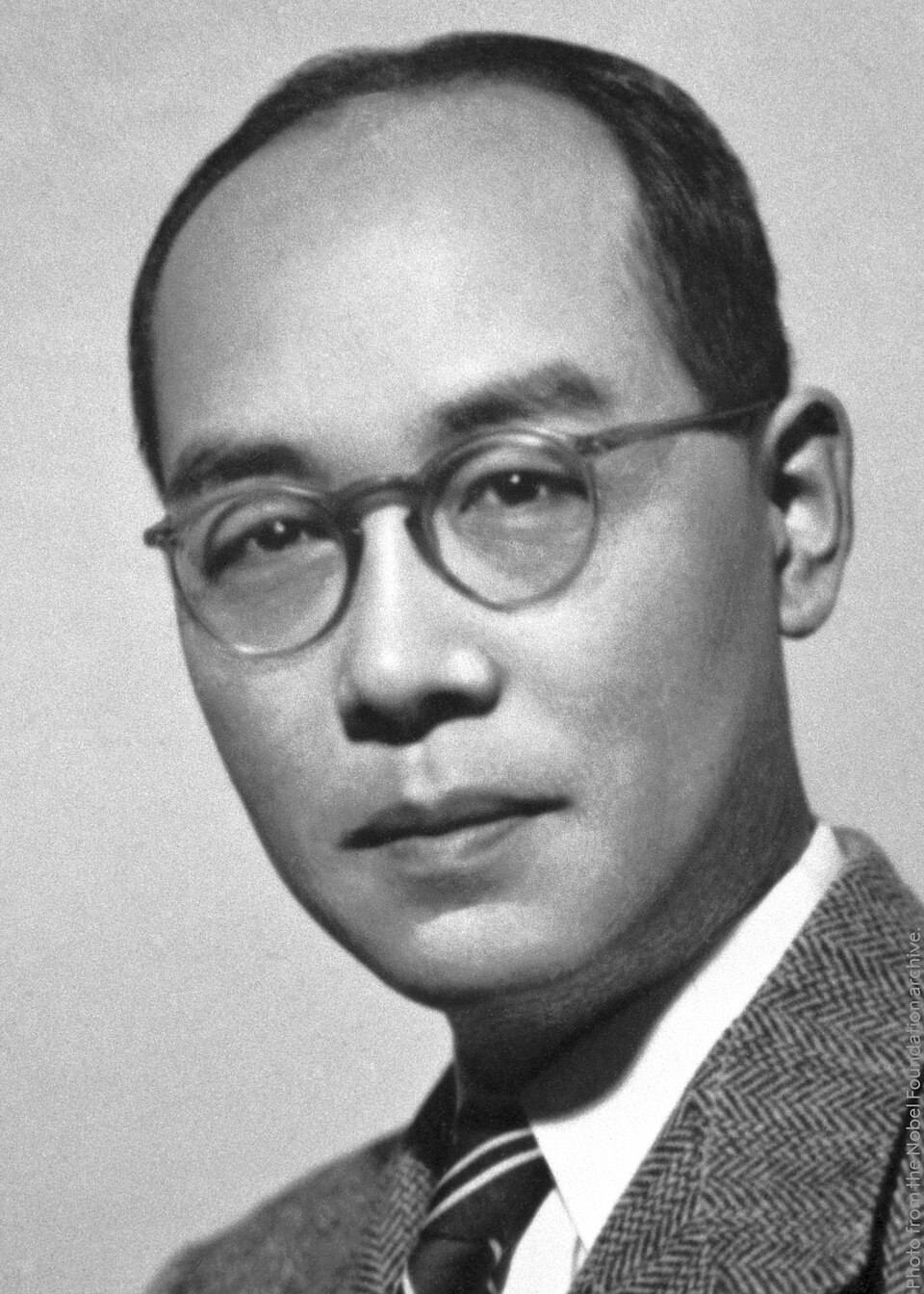
Hideki Yukawa
 Japan
Japanphysicist•theoretical physicist
Also known as: Hideki Ogawa
Birthday
January 23, 1907
Birth Sign
Aquarius
Birthplace
Azabu, Tokyo, Japan
Age
Died at 74
Height
5 ft 6 in (168 cm)
About
Hideki Yukawa was a Japanese theoretical physicist who made one of the most important breakthroughs in 20th-century physics. In 1935, he predicted the existence of a new subatomic particle, the meson, to explain how the atomic nucleus holds together. This work earned him the Nobel Prize in Physics in 1949, making him the first Japanese person to win a Nobel Prize.
Yukawa's meson theory laid the foundation for the modern understanding of the strong nuclear force, a fundamental interaction that binds protons and neutrons in the nucleus. His prediction was confirmed experimentally in 1947 with the discovery of the pion. Today, his legacy lives on through the Yukawa Institute for Theoretical Physics at Kyoto University, a leading center for theoretical research.
A soft-spoken and deeply philosophical man, Yukawa was also a public intellectual who signed the Russell-Einstein Manifesto in 1955, calling for nuclear disarmament. He is celebrated in Japan as a national hero and a symbol of scientific excellence. He was the first Japanese Nobel laureate in any category, and his work remains a cornerstone of the Standard Model of particle physics. The 90th anniversary of his meson theory was commemorated in 2025 with academic conferences. He continues to be honored through stamps, medals, and the Yukawa Institute, which remains active in research.
Early Life & Background
Hideki Yukawa was born Hideki Ogawa on January 23, 1907, in Azabu, Tokyo, the fifth of seven children. He grew up in Kyoto, where his father taught geology at Kyoto Imperial University. As a child, he read Confucian and Taoist texts, developing a philosophical outlook. In middle school, his father considered sending him to technical college, doubting his abilities, but the school principal praised his mathematical talent and offered to adopt him to keep him on an academic path.
Yukawa entered the Third High School in 1923, where he was strongly attracted to physics. He entered Kyoto Imperial University in 1926 and graduated in just three years with a master's degree. He was drawn to theoretical physics after a teacher marked a creative math proof as wrong, and he abandoned experimental physics because he could not master glassblowing. After graduating, he stayed on as an unpaid assistant for three years, conducting research with little support.
Career Growth
In 1932, Yukawa was appointed as a physics lecturer at Kyoto University. He moved to Osaka University in 1933, where he published his meson theory in 1935. The paper proposed that protons and neutrons exchange a new particle, the meson, to create the strong nuclear force. At first, the idea received little attention, but it gained traction after the muon was discovered in 1936. He completed his Ph.D. in 1938 and became a professor at Kyoto University in 1939. The pi meson, or pion, was finally discovered in 1947 by Cecil Powell's team, confirming his prediction. In 1949, he won the Nobel Prize in Physics and joined Columbia University as a professor. He returned to Japan in 1953 and established a major school of theoretical physics at Kyoto University. He remained active in research and advocacy until his death in 1981.
Career Timeline
Public Image & Style
Yukawa was known as a shy, soft-spoken scientist who often appeared in photographs at blackboards filled with equations. He dressed in suits or traditional Japanese attire and was portrayed in the media as a humble pioneer. In Japan, he is revered as a national hero and the father of Japanese theoretical physics. His image appears on stamps and commemorative medals. The Yukawa Institute for Theoretical Physics at Kyoto University serves as a living memorial. His signature on the Russell-Einstein Manifesto reinforces his image as a scientist with a conscience. He was featured on the cover of TIME Magazine on November 7, 1949, the first Japanese person to appear on that cover. UNESCO participated in the 100th anniversary of his birth in 2007, striking a medal with his portrait.
Fame & Fandom
Hideki Yukawa's public legacy is that of a revered national scientific figure, not a celebrity with a conventional fanbase. There is no formal fandom name, no organized fan clubs, and no documented grassroots fan campaigns. Instead, his memory is preserved through institutional honors: the Yukawa Institute for Theoretical Physics at Kyoto University, the Hideki Yukawa Chair in Theoretical Physics, and the renovation of his Kyoto residence by architect Tadao Ando. His Nobel Prize in 1949, the first for a Japanese citizen, made him a symbol of postwar Japanese achievement, and his advocacy for peace and disarmament further cemented his status as a moral leader. However, his fame is of a quiet, intellectual kind, celebrated in academic circles and national commemorations rather than through fan culture.
As of August 2026, iFANN's Global Fame Engine has evaluated Hideki Yukawa but he does not currently hold a placement in the published rankings, whether the Global Top 1,000 or any Top-100 scope list. His fame, while historically significant, does not translate into the contemporary global rankings that measure ongoing public engagement.
Interesting Facts and Legends
Hideki Yukawa's original surname was Ogawa; he adopted the name Yukawa upon marrying in 1932. His classmate from elementary school through university, Sin-itiro Tomonaga, also won a Nobel Prize in Physics in 1965. Yukawa chose physics over mathematics after a high school teacher marked his creative proof incorrect, and he could not pursue experimental physics due to his failure to master glassblowing. His father initially considered him less gifted than his brothers and wanted him to attend technical college. In 1955, he signed the Russell-Einstein Manifesto alongside Einstein and Russell. He received numerous honors, including the Order of Culture, the Lomonosov Gold Medal, the Imperial Prize of the Japan Academy, and the Decoration of the Sacred Treasure. He was a member of the Japan Academy, a Foreign Member of the Royal Society, and a Foreign Associate of the National Academy of Sciences, and held honorary doctorates from the University of Paris and the University of Moscow.
A legendary moment in his legacy came in 2007 with the discovery of a cache of his unpublished manuscripts, dubbed "Yukawa's gold mine," which provided unprecedented insight into his thought processes. His deep attachment to Kyoto, despite his international career, is a recurring theme in his mythology, as is his time at the Institute for Advanced Study in Princeton, where he interacted with Albert Einstein. A 2025 article from the American Institute of Physics highlighted his interest in baseball, adding a humanizing touch to his image.
Notable Quotes
“The theory of nuclear forces was my first love, and it was the subject of my first published paper.”
“We have to learn to think in a new way. We have to learn to ask ourselves, not what steps can be taken to give military victory to whatever group we prefer, for there no longer are such steps.”
“I was attracted to the study of nature because it seemed to me that the laws of nature are beautiful and simple.”
“The creative process in science is very similar to that in art. Both require imagination and intuition.”
Family & Personal Life
Hideki Yukawa was the fifth of seven children born to Takuji Ogawa, a geology professor, and Koyuki Ogawa. Three of his brothers also became university professors. He married Sumi Yukawa in 1932, adopting her surname as part of the Japanese custom of mukoyoshi. They had two sons, Haruki and Takaaki. The family lived in Kyoto, where Yukawa worked at Kyoto University. His household was academic and traditional, with a strong emphasis on education and philosophical reflection. Both parents came from scholarly families of the samurai tradition. The family moved to Kyoto in 1908 when his father became a professor there.
Notable Connections
Hideki Yukawa's closest associate was Sin-itiro Tomonaga, his classmate from elementary school through university, who also won a Nobel Prize in Physics in 1965. His professors Yoshio Nishina and K. Tamaki encouraged his theoretical work. Experimental physicist Cecil Powell confirmed Yukawa's meson prediction in 1947. Yukawa also interacted with Albert Einstein and Richard Feynman during his time at Princeton and Columbia.
Relationships & Dating History
Hideki Yukawa married Sumi Yukawa in 1932 in a traditional Japanese arrangement. As part of the marriage, he was adopted into her family and changed his surname from Ogawa to Yukawa. Sumi was the daughter of the Yukawa family. They had two sons, Haruki and Takaaki. The marriage was stable and private, focused on family and his scientific work. Yukawa remained married to Sumi until his death in 1981. There are no documented reports of any other romantic relationships. As of 2026, he is deceased, and his marriage ended with his passing.
- MarriedSumi Yukawa1932 - 1981Married in 1932; Yukawa adopted her surname upon marriage. They had two sons together.
Death & Aftermath
Died
September 8, 1981 (aged 74)
Death Place
Kyoto, Japan
Cause of Death
Unknown
Hideki Yukawa died on September 8, 1981, in Kyoto, Japan. The available records confirm the date and location of his passing but do not provide specific details regarding the official cause of death or any subsequent medical investigation. His final days were marked by no unusual events or public disputes, and his death was treated as a natural event without legal controversy. Tributes from the scientific community honored him as a pioneer in meson theory and quantum mechanics, focusing primarily on his enduring contributions to the understanding of the strong nuclear force. While the specific date and nature of his funeral or memorial service remain undocumented, his legacy continued through academic institutions.
Notable posthumous developments include the renovation of his former residence in Sakyo Ward, Kyoto, which served as his home for over two decades and was converted into a public multi-purpose facility by May 26, 2024. The academic community further recognized his stature with the establishment of the Hideki Yukawa Chair in Theoretical Physics, most recently awarded to Mayuko Yamashita in April 2026. The handling of his estate by the family is not detailed in the source material, though the primary documented legacy remains his status as Japan's first Nobel laureate in physics.
Net Worth (Estate Value)
$2 Million
iFANN Editorial Team estimate
As a deceased Nobel laureate and university professor, Hideki Yukawa's estate value is estimated at $2 million, according to iFANN's editorial analysis. His lifetime earnings came primarily from academic salaries at Kyoto University and Columbia University, plus the Nobel Prize monetary award of approximately $30,000 in 1949 (equivalent to about $350,000 today). The estate generates revenue through royalties from his published works and scientific papers, as well as licensing of his name and image for educational materials and commemorative items such as stamps and medals. The Yukawa family manages the estate. The Yukawa Institute for Theoretical Physics at Kyoto University is a separate institutional entity that continues his academic legacy but does not generate personal income for the estate. Specific dollar figures for his estate are not publicly documented, but his papers receive thousands of citations annually on Google Scholar.
Awards Won (4)
Hideki Yukawa won the Nobel Prize in Physics in 1949 for predicting the existence of mesons. He also received Japan's Order of Culture, the Lomonosov Gold Medal from the USSR Academy of Sciences, and the Imperial Prize of the Japan Academy. These honors recognize his foundational contributions to particle physics.
1949 · Physics
Prediction of the existence of mesons
1949 · Cultural Honor
Contributions to physics
Known For
Meson theory (prediction of the pion)
1935 · Theoretical physicist
Keywords
Sources
Quick Facts
- Profession
- physicist, theoretical physicist
- Born
- 1907-01-23
- Birthplace
- Azabu, Tokyo, Japan
- Died
- 1981-09-08
- Death Place
- Kyoto, Japan
- Gender
- Male
- Spouse
- Sumi Yukawa
- Birth Sign
- Aquarius
Personal Details
- Full Name
- Hideki Ogawa
- Height
- 5 ft 6 in (168 cm)
- Spouse
- Sumi Yukawa
- Children
- Haruki Yukawa, Takaaki Yukawa
- Education
- Kyoto Imperial University (Master's, 1929); Osaka University (Ph.D., 1938)
Frequently Asked Questions
How did Hideki Yukawa predict the meson?
What did Hideki Yukawa win the Nobel Prize for?
Was Hideki Yukawa married?
What is Hideki Yukawa's net worth?
How old was Hideki Yukawa when he died?
Similar People
Join the community
fans discussing