About
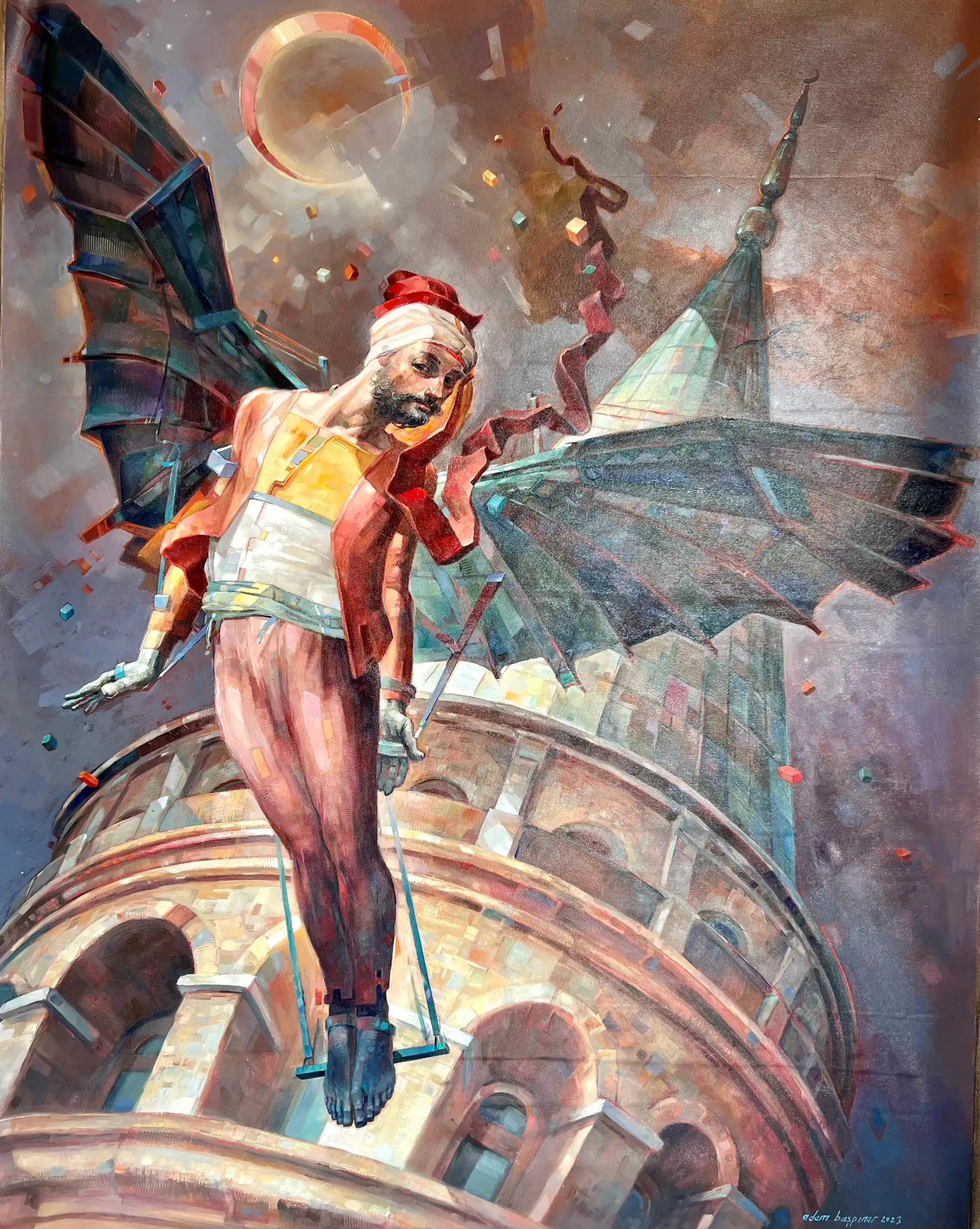
Hezârfen Ahmed Çelebi was a 17th-century Ottoman polymath from Constantinople who achieved the earliest documented unpowered human flight. Born around 1609, he worked as a physicist, chemist, physician, and musician during the reign of Sultan Murad IV. His life ended in 1640 after being exiled to Algiers, leaving behind a legacy defined by a daring glide across the Bosphorus.
While he authored works on chemistry and composed poetry, history remembers him primarily for his aviation experiments. Using wings constructed from wood and silk, he launched himself from the Galata Tower and glided to Üsküdar, covering roughly three kilometers without mechanical assistance. This feat predates the Wright brothers by over two centuries and remains a unique milestone in the history of human flight.
Early Life & Background
Hezârfen Ahmed Çelebi arrived in Constantinople around 1609, entering an era where scientific inquiry and artistic expression were deeply intertwined within the Ottoman court. His early years were spent cultivating a diverse range of skills that would later define his career. He received rigorous education in the classical sciences of the time, mastering mathematics, astronomy, and natural philosophy alongside medicine and chemistry. Unlike many contemporaries who specialized in a single field, he developed expertise in physics and music, becoming particularly noted for his knowledge of Andalusi traditions.
His formative years involved deep study of aerodynamics and the mechanics of flight, interests that set him apart from other scholars of the seventeenth century. Before his breakthrough, he worked as a physician and chemist, establishing a reputation for intellectual versatility. The epithet "Hezârfen" likely reflected this breadth of talent, suggesting a man with "a thousand ears" or vast knowledge. These early years of research and practice laid the groundwork for his ambitious attempt at human flight, driven by a curiosity that pushed beyond the accepted boundaries of his time.
Career Growth
The defining moment of Hezârfen's career occurred in 1638 when he executed a sustained, unpowered flight. Constructing wings from wood and silk based on his own designs, he launched from the Galata Tower on the European side of the Bosphorus. He successfully glided across the water to Üsküdar on the Asian side, a distance estimated between 2.8 and 3 kilometers that took approximately 15 minutes to complete. This achievement stands as one of the earliest verified attempts at human aviation, occurring more than 200 years before the Wright brothers.
Following this success, he reportedly received honors from Sultan Murad IV, though historical records vary regarding the extent of these rewards. Beyond aviation, he continued to contribute to science through writings on chemistry and medicine while composing poetry. However, his career faced significant political challenges shortly after the flight. Fears that his experiments could be used for military espionage or concerns about challenging social norms led to his fall from favor. He was eventually exiled by the Sultan, ending his active period of innovation and public service within the Ottoman Empire.
Career Timeline
Public Image & Style
Hezârfen Ahmed Çelebi is remembered as a serious, contemplative scientist driven by an intense curiosity to push the boundaries of human capability. His public image combines the intellect of a scholar with the courage of an explorer, embodying the spirit of the Ottoman Golden Age. In modern Turkey, he is celebrated as a national hero and a symbol of ingenuity, often depicted in traditional Ottoman attire such as a kaftan and turban. His legacy transcends mere historical fact, evolving into a cultural icon representing the triumph of human will against natural limitations.
Fame & Fandom
iFANN has not yet collected fame data for this person. As a historical figure from the 17th century, he does not appear in current global fame rankings or contemporary search interest metrics. His recognition is confined to historical and cultural spheres rather than modern celebrity networks.
While there is no formal fandom name documented in iFANN data, Hezârfen enjoys a devoted following among aviation enthusiasts, historians, and the general public in Turkey. His story is frequently taught in schools as a testament to human innovation and courage. Fan culture surrounding him includes educational programs, museum exhibits, and annual commemorations of his flight. Recent efforts to recreate his flight using modern technology have further fueled interest, keeping his memory alive through documentaries, books, and digital media projects that celebrate his pioneering spirit.
Interesting Facts and Legends
Hezârfen Ahmed Çelebi possessed a rare combination of talents that included not only physics and medicine but also music. He was known to play the oud and compose music, adding a cultural dimension to his scientific pursuits that was uncommon for scholars of his era. The term "Hezârfen" itself is believed to be an epithet given to him by peers, meaning "one who has a thousand ears" or "a man of many talents," reflecting his diverse expertise.
A lesser-known aspect of his life involves the preservation of his story. While no direct quotes from him survive, his actions are recorded in the *Seyahatnâme* (Book of Travels) by the famous traveler Evliyâ Çelebi, who had no relation to him. Modern recreations of his flight have been attempted, including a notable BASE jump from the Galata Tower in 2017 that drew global attention to his legacy.
Family & Personal Life
As a figure from the 17th century, detailed records regarding Hezârfen Ahmed Çelebi's family are virtually non-existent. No primary sources document parents, siblings, marriages, or children. Biographies of scholars from this era typically focused on professional achievements rather than domestic lives, leaving his personal relationships largely unknown to modern historians. There are no credible accounts of a spouse or descendants, and any speculation about his family structure remains purely fictional based on later dramatizations.
Notable Connections
Relationships & Dating History
Historical records from the 17th century provide no information regarding the romantic life of Hezârfen Ahmed Çelebi. No primary sources document marriages, engagements, or specific partners, which is typical for scholars of that era whose biographies focused on professional achievements. The absence of such records means that his relationship status remains unknown beyond his role as a scholar and aviator. Any claims about a wife or children are unsupported by historical evidence and likely stem from modern fictional interpretations.
Death & Aftermath
Died
1640 (aged 31)
Death Place
Algiers
Cause of Death
Illness following exile
Following his daring flight across the Bosphorus in 1638, Hezârfen Ahmed Çelebi entered a period of decline marked by political intrigue and eventual exile. Historical records derived from Evliyâ Çelebi's Seyahatname place his death in 1640 at the age of approximately thirty-one, though no specific day or month is preserved in the surviving texts. The circumstances surrounding his final days remain obscure, with accounts suggesting he succumbed to illness following his removal from the Ottoman court rather than through any verified forensic event or official medical ruling. The immediate aftermath of his passing was devoid of modern tributes or public vigils, as the concepts of mass mourning and memorial services did not function in 17th-century Ottoman society. Contemporary reaction was limited to the small circle of scholars who recorded his life in literary works, most notably the inclusion of his story in the Seyahatname written between 1640 and 1655.
Any immediate handling of his estate followed customary inheritance laws, yet specific details regarding asset distribution have been lost to history. Centuries later, Hezârfen Ahmed Çelebi emerged as a national icon in Turkey, celebrated as the first man to achieve unpowered human flight. His legacy has been commemorated through the naming of streets, parks, and educational institutions, alongside appearances in cultural productions such as the television series Muhteşem Yüzyıl Kösem . Modern recognition extends to scientific honors and even contemporary commercial ventures bearing his name, reflecting an enduring status that transformed a historical figure of uncertain fate into a symbol of aviation innovation.
Net Worth (Estate Value)
$0
iFANN Editorial Team estimate
As a historical figure who lived in the 17th century, Hezârfen Ahmed Çelebi did not accumulate personal wealth in the modern sense. There are no records of estates, bank accounts, or financial assets that survived to the present day. The concept of net worth does not apply to individuals from this era whose economic status was tied to patronage and scholarly stipends rather than commercial ventures.
Any financial value associated with his name today exists solely in the realm of cultural heritage and intellectual property rights managed by institutions. Museums, historical societies, and cultural organizations in Turkey utilize his legacy for educational purposes and tourism, generating revenue through exhibits and commemorative events. However, these earnings belong to the institutions preserving his memory rather than to any estate or descendants, as no direct heirs have been identified.
Awards & Accolades
View 3 records, honours and achievementsKnown For
First Unpowered Human Flight
1638 · Aviator
Keywords
Sources
Quick Facts
- Profession
- physicist, chemist, inventor, poet
- Born
- 1609
- Birthplace
- Constantinople (Istanbul)
- Died
- 1640
- Death Place
- Algiers
- Gender
- Male
- Birth Sign
- Capricorn
Personal Details
- Full Name
- Ahmed Çelebi
- Children
- Education
- Classical Ottoman sciences including mathematics and astronomy
Frequently Asked Questions
Who was Hezârfen Ahmed Çelebi?
When did Hezârfen Ahmed Çelebi die?
Did Hezârfen Ahmed Çelebi really fly?
What happened to Hezârfen Ahmed Çelebi after his flight?
Is Hezârfen Ahmed Çelebi considered the first person to fly?
Similar People
Join the community
fans discussing