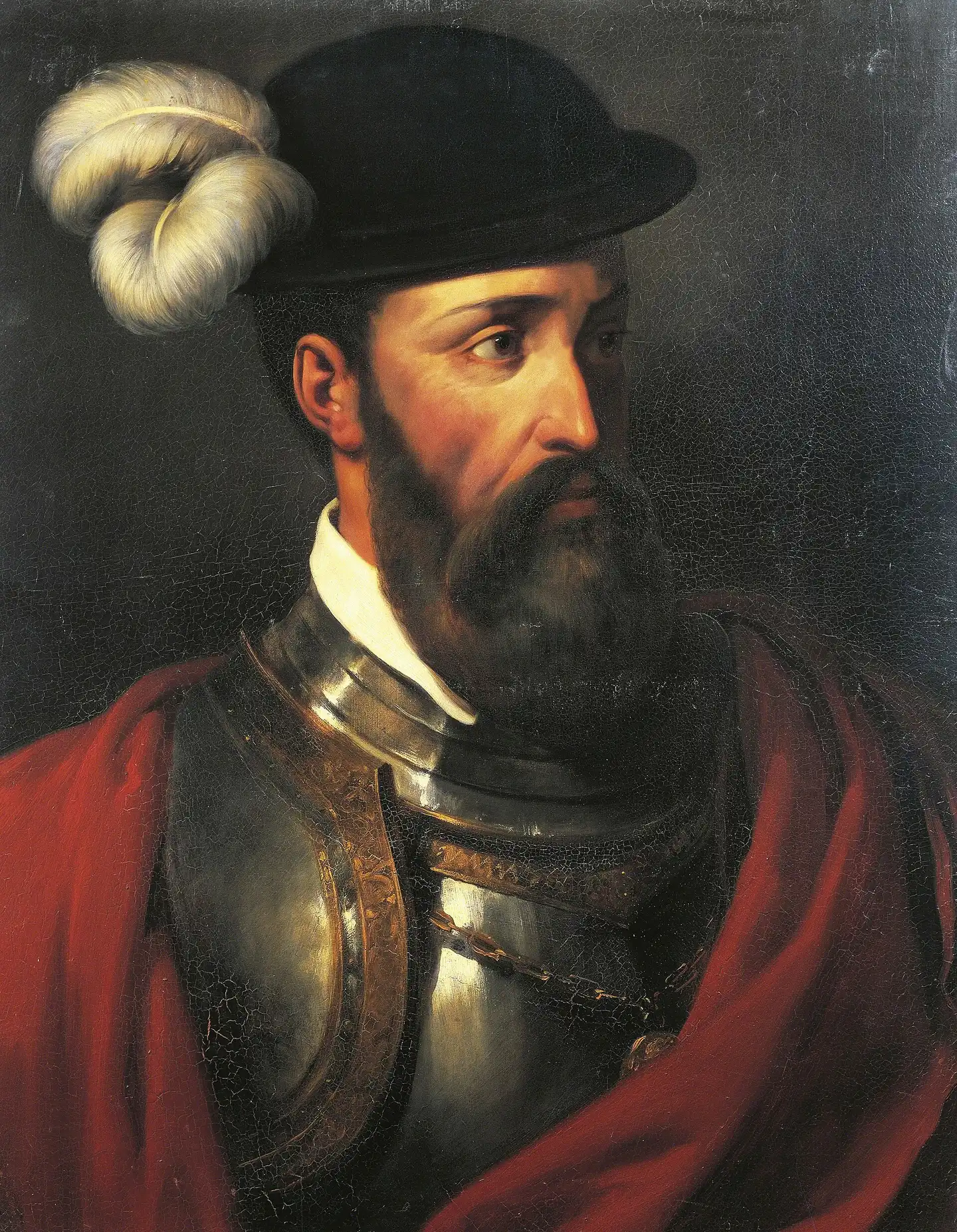
Francisco Pizarro
 Spain
Spainconquistador•explorer•discoverer
Also known as: Francisco Pizarro y González, El Swineherd
Birthday
March 16, 1478
Birth Sign
Pisces
Birthplace
Trujillo, Spain
Age
Died at 63
About
Francisco Pizarro stands as one of the most consequential figures in world history, defined by his role as the Spanish conquistador who led the expedition that conquered the Inca Empire. Born around 1478 in Trujillo, Extremadura, Spain, he rose from humble origins to become the Governor and Captain General of New Castile. His legacy is marked by the founding of Lima in 1535, which became the capital of the Viceroyalty of Peru and cemented Spanish dominance in South America for centuries. Despite being illiterate and signing documents with a simple cross, Pizarro possessed a sharp strategic mind that allowed him to exploit internal civil wars within the Inca state. His achievements include the capture of Emperor Atahualpa at Cajamarca and the establishment of the Audiencia of Lima, the highest judicial body in the region. Today, his name remains synonymous with the Age of Discovery, immortalized in monuments like the Francisco Pizarro Solar Power Plant in Spain and statues in Peru that continue to spark intense historical debate regarding colonialism and indigenous rights.
Early Life & Background
Francisco Pizarro was born in Trujillo, a town in the province of Extremadura, Spain, around 1478. Historical accounts describe his parents as Gonzalo Pizarro Rodríguez de Aguilar, a soldier of modest means, and Francisca González, a peasant woman. Some sources suggest he was the illegitimate son of a pig farmer, a detail that contributed to his early nickname "the swineherd" among contemporaries. He spent his childhood tending pigs on his family's estate, an occupation that provided little opportunity for formal schooling. Pizarro never learned to read or write fluently, a fact that distinguished him from many of his noble counterparts in the Spanish court. In his late teens, likely around 1502, Pizarro left Trujillo seeking fortune in the New World. His journey began when he sailed to the Caribbean, joining the expedition of Alonso de Ojeda in 1509. He participated in the colonization efforts in Colombia and Panama, serving under Vasco Núñez de Balboa. A pivotal moment occurred in 1513 when he accompanied Balboa on the expedition that led to the first European sighting of the Pacific Ocean from the American continent. This experience solidified his desire to explore further south toward the wealthy Inca Empire. Pizarro played a crucial role in the founding of Panama City in 1519, eventually serving as its mayor. This administrative position gave him valuable political clout and experience in managing settlements. However, his ambitions extended beyond the Isthmus of Panama. He spent the next decade planning expeditions to the south, facing two unsuccessful attempts to conquer Peru before finally securing royal permission from King Charles I of Spain in 1529. By this time, he had gathered enough support and resources to launch his final campaign, setting the stage for the conquest of the Inca Empire.
Career Growth
Pizarro's career reached its zenith with the conquest of the Inca Empire, a feat achieved through a combination of military strategy, exploitation of internal civil war, and superior technology. After two unsuccessful attempts to conquer Peru, he secured royal permission from King Charles I of Spain in 1529 to lead a final campaign, receiving the titles of Governor, Captain General, and Adelantado of New Castile. In December 1531, he arrived in Peru with 180 men and 27 horses. On November 16, 1532, at the Battle of Cajamarca, Pizarro executed one of history's most audacious ambushes. With fewer than 200 men against thousands of Inca warriors, he captured the Sapa Inca Atahualpa alive. Despite receiving a massive ransom of gold and silver to fill Atahualpa's room twice over, Pizarro had the emperor executed on August 29, 1533, after a sham trial. By late 1533, Pizarro marched into the Inca capital of Cuzco, effectively completing the conquest of the empire. In 1535, he founded the city of Lima, which he designated as the capital of the Viceroyalty of Peru, cementing Spanish control over the region. He established the Audiencia of Lima, the highest judicial body in the area, and oversaw the distribution of land grants to his followers. His leadership transformed the political landscape of South America, though it came at a tremendous cost to the indigenous population. Pizarro remained the dominant figure in the region until his death in 1541, leaving behind a legacy of both achievement and controversy.
Career Timeline
Public Image & Style
Francisco Pizarro's public image is complex and polarized. To some, he is a heroic figure who brought civilization and Christianity to the New World, while to others, he is a brutal conqueror responsible for the genocide of the Inca people. Media portrayals of him vary depending on the cultural context; in Spain, he is often celebrated as a national hero, while in Peru, he is frequently depicted as a symbol of colonial oppression. His content's tone and format in historical texts are generally objective, focusing on the facts of his conquests and the impact of his actions on the indigenous populations. He was granted significant honors by the Spanish Crown, including knighthood and the right to bear a coat of arms featuring a llama, a condor, and the words "El Sol" (The Sun), symbolizing his conquest of the land of the Incas. Although he refused the title of Marquess of the Conquest initially, preferring the practical governorship, his status was undeniably elevated. Modern media continues to grapple with his legacy, particularly following the restoration of his statue in Lima in January 2025, which reignited debates over whether he should be remembered as a hero or a villain. His name now appears on a massive photovoltaic plant in Extremadura, Spain, marking him as a namesake for modern renewable energy infrastructure, blending historical memory with contemporary environmental progress.
Fame & Fandom
Francisco Pizarro holds no current placement in the iFANN Global Top 1,000 rankings. The iFANN Global Fame Engine evaluated his standing but found he does not occupy a published position on any scope list or top-tier chart. This absence of a numeric rank reflects his status as a figure from five centuries ago rather than a contemporary subject of daily media consumption. While modern celebrities vie for algorithmic visibility, Pizarro exists outside the churn of current fame cycles, measured instead by historical permanence. No formal fandom name documents the collective identity surrounding him. There is no moniker like 'Pizzaholics' or 'Team Pizarro' to describe supporters, nor do organized groups engage in birthday campaigns, subway ad drives, or fan-funded projects for his legacy. History enthusiasts study his life, but they do not form an active community with shared rituals or social media followings akin to modern pop culture movements. The only tangible echoes of public engagement involve infrastructure and monuments; a massive photovoltaic plant in Spain bears his name, and a statue reinstalled in Lima in January 2025 sparked political debate rather than fan celebration. His presence remains that of a studied historical entity rather than a beloved celebrity with a devoted tribe. In historical rankings, he is consistently cited as one of the most influential figures in world history, often appearing at number one for the conquest of the Inca Empire in lists of key figures in Latin American history.
Interesting Facts and Legends
Francisco Pizarro emerged from humble beginnings as the son of pig farmers in Trujillo, Spain, before rising to become a pivotal figure in the Spanish conquest of the Americas. He served as mayor of Panama City and joined Vasco Núñez de Balboa's expedition, which resulted in the first European sighting of the Pacific Ocean from the American continent. A legendary moment in his story occurred on November 16, 1532, when he ambushed the Inca Emperor Atahualpa at the plaza of Cajamarca with fewer than 200 men. Despite facing thousands of warriors, Pizarro captured the emperor alive using surprise tactics involving cavalry and steel armor, holding him hostage for a massive ransom of gold and silver before executing him. Another iconic chapter unfolded on June 26, 1541, when Pizarro met his violent end during a rebellion in Lima. Attacked by conspirators led by Diego de Almagro II, he fought fiercely despite being outnumbered and wounded, reportedly killing several attackers before falling in his own palace. Modern legends also include the controversy surrounding a statue of Pizarro restored to central Lima in January 2025, which reignited debates over his legacy as either a conqueror or a symbol of colonial oppression. Physical attributes of Pizarro are not well-documented in terms of precise height, but contemporary descriptions portray him as a man of average build, perhaps slightly stocky, with a rugged appearance typical of soldiers of his era. He was known for his courage and determination rather than physical stature. Interesting trivia includes his illiteracy, which made him an unusual figure among the Spanish nobility, and his role in the founding of multiple cities in South America, including San Miguel de Piura and Cuzco, in addition to Lima.
Notable Quotes
“I die as a knight.”
“I have found a kingdom of gold and silver.”
Family & Personal Life
Historical records regarding Francisco Pizarro's romantic life are sparse and do not follow the modern chronology of public dating history. He did have documented children, though the details of their mothers' identities and the nature of those unions vary in historical accounts. He fathered several illegitimate children with indigenous women during his campaigns. The most notable was his son, Gonzalo Pizarro, born to a noblewoman named Inés Huaylas Yupanqui (also known as Doña Inés), who was a daughter of the Inca Emperor Huayna Capac. This relationship was politically significant, blending Pizarro's lineage with the Inca nobility. Another son, Juan Pizarro, was also born to an indigenous woman, though her name is less frequently recorded in primary sources. There is no evidence of a formal marriage; Pizarro remained unmarried throughout his life, a common practice among many conquistadors who sought to avoid the legal restrictions of Spanish marriage laws while securing alliances through concubinage. His brothers Hernando Pizarro, Juan Pizarro, and Gonzalo Pizarro all played significant roles in the conquest alongside him. These siblings were instrumental in the administration of the newly conquered territories, with Hernando often acting as Pizarro's representative in Spain to secure royal favor and resolve disputes. The family dynamic was deeply intertwined with the political struggles of the era, as the brothers navigated complex power dynamics within the Spanish colonial hierarchy.
Notable Connections
Hernando Pizarro, Juan Pizarro, Gonzalo Pizarro, Diego de Almagro, Atahualpa, Vasco Núñez de Balboa, King Charles I of Spain
Relationships & Dating History
Regarding personal life and relationships, historical records regarding Francisco Pizarro's romantic life are sparse and do not follow the modern chronology of public dating history. He did have documented children, though the details of their mothers' identities and the nature of those unions vary in historical accounts. He fathered several illegitimate children with indigenous women during his campaigns. The most notable was his son, Gonzalo Pizarro, born to a noblewoman named Inés Huaylas Yupanqui (also known as Doña Inés), who was a daughter of the Inca Emperor Huayna Capac. This relationship was politically significant, blending Pizarro's lineage with the Inca nobility. Another son, Juan Pizarro, was also born to an indigenous woman, though her name is less frequently recorded in primary sources. There is no evidence of a formal marriage; Pizarro remained unmarried throughout his life, a common practice among many conquistadors who sought to avoid the legal restrictions of Spanish marriage laws while securing alliances through concubinage. Consequently, there is no "dating history" in the modern sense, no engagements, divorces, or widowed status, as he died unmarried in 1541. His legacy includes these children, particularly Gonzalo, who later led a rebellion against the Spanish crown following his father's death. He also worked closely with Diego de Almagro, his former partner, and later fell out with Almagro's son, Diego de Almagro II, leading to the conspiracy that ended his life. Other key figures in his personal network included the Inca Emperor Atahualpa and his brother Huáscar, whose civil war Pizarro exploited to his advantage.
Death & Aftermath
Died
June 26, 1541 (aged 63)
Death Place
Lima, Peru
Cause of Death
Assassination by sword wounds
The morning sun rose over Lima on June 26, 1541, illuminating the dining room of Francisco Pizarro's palace where he sat to eat breakfast. A group of conspirators led by Juan de Rada and his illegitimate son Gonzalo Pizarro burst into the room, intent on ending the governor's rule. Pizarro fought back with surprising ferocity, killing several attackers before being overwhelmed by the sheer number of swords striking him. He reportedly shouted that he died as a knight before succumbing to fatal wounds in his neck and chest, leaving his body exposed briefly until loyalists buried him hastily at the Convent of San Francisco to prevent desecration. The assassination triggered immediate political chaos rather than mourning, sparking a period known as the War of the Conquistadors as rival factions vied for control of Peru. Royal authorities from the Spanish Crown swiftly moved to restore order, hunting down the perpetrators who had fled the city. A trial conducted by the Royal Audiencia of Lima resulted in the execution of the primary instigators; Gonzalo Pizarro was beheaded on April 9, 1548, convicted of treason and parricide. Public reaction remained divided between those who celebrated the end of harsh rule and the colonial administration which viewed the regicide as a dangerous breach of social order. While tributes were limited to clergy eulogies and official proclamations acknowledging the loss of an empire builder, the long-term memory of Pizarro oscillated between reverence and condemnation. His statue in central Lima faced removal in 2003 due to controversies surrounding the genocide of indigenous peoples, only to be reinstalled in January 2025 following restoration efforts that reignited historical debates. His last words, "I die as a knight," remain a defining moment in historical literature, reflecting his belief in his own honor despite the treachery he faced.
Net Worth (Estate Value)
$0
iFANN Editorial Team estimate
Francisco Pizarro's net worth is not applicable in the modern currency sense, but his wealth accumulation was astronomical for his time. Upon capturing Atahualpa, he received a ransom of gold and silver estimated to be worth millions of dollars in today's value. The exact amount varies by source, but estimates suggest the ransom filled a room measuring 22 feet by 17 feet twice with gold and a second room half that size with silver. Modern historians estimate this treasure to be equivalent to hundreds of millions of US dollars. Pizarro's personal share of this wealth allowed him to live in luxury in Lima, though much of it was lost to disputes among the conquistadors and the eventual distribution to the Spanish Crown. His estate included vast land grants and the right to collect taxes from the newly conquered territories. Since his death, his estate has not generated revenue in the modern sense, but his name continues to generate economic value through tourism, historical sites, and the naming of businesses, such as the solar plant mentioned earlier. The ransom itself was a pivotal event that temporarily enriched the Spanish treasury and individual conquistadors, fueling further exploration and colonization efforts across the Americas.
Awards & Accolades
View 9 records, honours and achievementsKnown For
Conquest of the Inca Empire
1532 · Leader
Founding of Lima
1535 · Founder
Keywords
Sources
Quick Facts
- Profession
- conquistador, explorer, discoverer
- Born
- March 16, 1478
- Birthplace
- Trujillo, Spain
- Died
- June 26, 1541
- Death Place
- Lima, Peru
- Gender
- Male
- Birth Sign
- Pisces
Personal Details
- Full Name
- Francisco Pizarro González
- Children
- Gonzalo Pizarro · Juan Pizarro · Francisco Pizarro
- Education
- None recorded
Frequently Asked Questions
Who was Francisco Pizarro?
When was Francisco Pizarro born?
How did Francisco Pizarro die?
What is Francisco Pizarro famous for?
Did Francisco Pizarro have children?
Similar People
Join the community
fans discussing