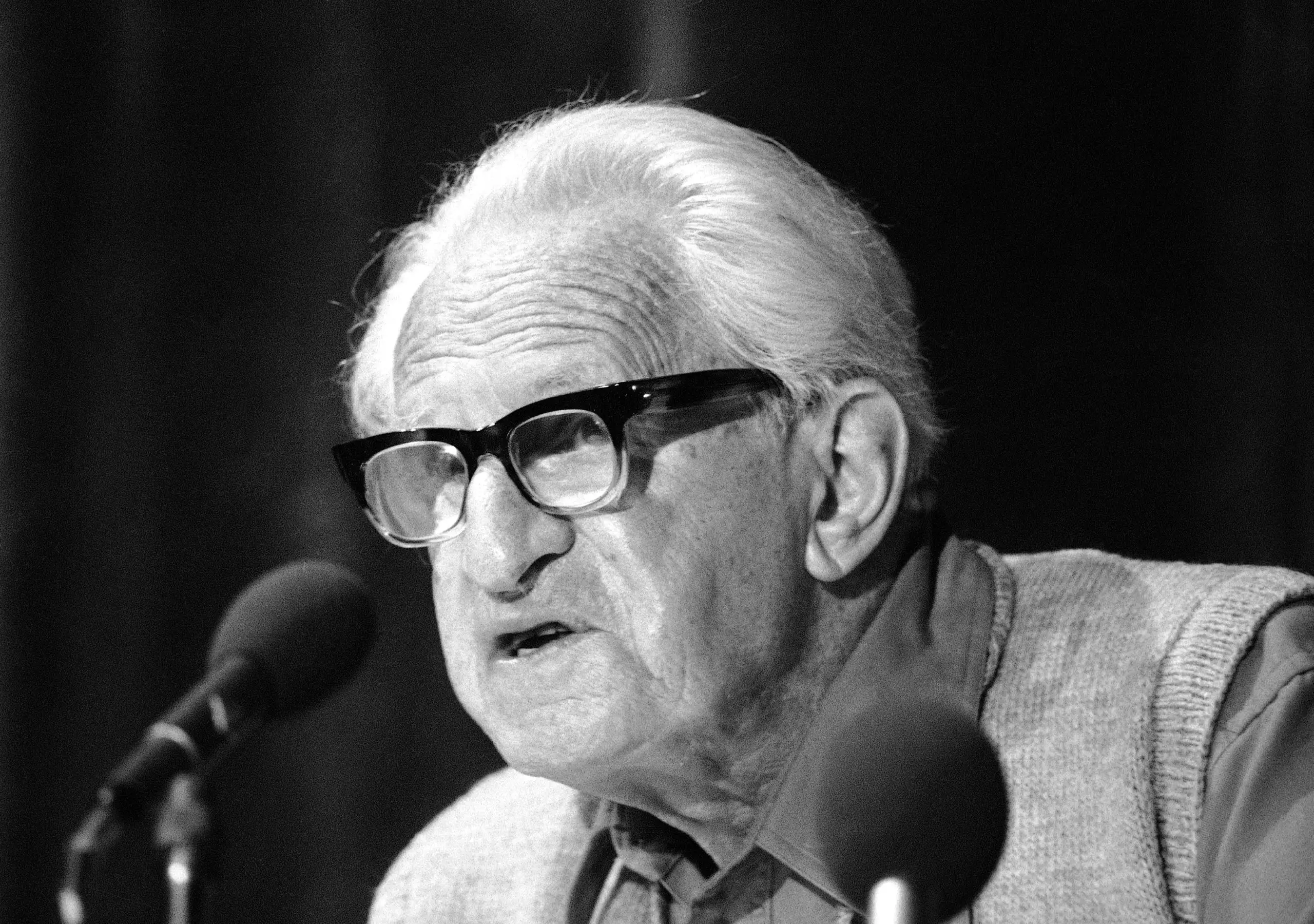
Herbert Marcuse
 Germany
philosopher•sociologist•political theorist
Birthday
July 19, 1898
Birth Sign
Cancer
Birthplace
Berlin, Germany
Age
Died at 81
About
Herbert Marcuse was a German-American philosopher and social critic whose work became the intellectual bedrock of the 1960s New Left. Born in Berlin in 1898, he developed a critical theory that attacked capitalism, modern technology, Soviet communism, and popular culture as subtle forms of social control. His most famous works, Eros and Civilization and One-Dimensional Man, argued that advanced industrial society creates false needs and suppresses genuine liberation. These texts became bibles for a generation of radicals protesting the Vietnam War and consumerism.
Marcuse died on July 29, 1979, in Starnberg, West Germany, at the age of 81. Though his name is less familiar today outside academic circles, his influence on left-wing thought in the Western world remains profound. He never held elected office or led a political party, remaining a professor and public intellectual until the end of his life. His ideas continue to shape debates on cultural Marxism and critical theory in the 21st century.
Early Life & Background
Herbert Marcuse entered a world that would soon be reshaped by two world wars and the rise of totalitarianism. Born into a privileged family in Berlin, his father was a successful businessman and his mother was well-educated, fostering an environment where critical thinking was valued. He served in the German Army during World War I before pursuing higher education at the University of Freiburg. There, he studied philosophy under Martin Heidegger and earned his doctorate in 1922 with a dissertation on Hegel's concept of the state.
Before achieving global fame as a theorist, Marcuse's career began in academia within Germany. He joined the Institute for Social Research, known as the Frankfurt School, in 1933, just as the Nazis rose to power. Following the institute's forced closure in Germany, Marcuse fled to Switzerland and then to the United States in 1934. His pre-fame years included significant work for U.S. intelligence agencies; from 1943 to 1950, he worked for the Office of Strategic Services, the precursor to the CIA, analyzing Nazi Germany and later the Soviet Union. This period was pivotal, shifting his focus from pure metaphysics to applied political theory and the critique of authoritarian structures.
Career Growth
Marcuse's career success exploded in the 1960s when he became known as the "Father of the New Left." His breakthrough moment came with the publication of Eros and Civilization in 1955, which reinterpreted Freudian psychoanalysis through a Marxist lens, arguing for a non-repressive civilization. However, it was his 1964 book, One-Dimensional Man, that cemented his legacy. In this work, he argued that advanced industrial society creates "false needs" and uses technology and mass culture to suppress genuine liberation, effectively turning individuals into passive consumers.
The book became a bible for student movements in West Germany, France (May 1968), and the United States, inspiring protests against the Vietnam War and capitalist consumerism. Throughout his career, Marcuse held major academic roles. After arriving in the U.S., he taught at Columbia University and Brandeis University before joining the faculty of the University of California, San Diego in 1954, where he remained until his death. At UCSD, he became a central figure in the radicalization of the campus and the broader counter-culture movement. His influence extended beyond academia; he advised the SDS and was frequently cited by activists worldwide.
Career Timeline
Public Image & Style
Herbert Marcuse's public image was that of the stern, thoughtful revolutionary intellectual. He was often portrayed in media as the "father of the hippie movement" or the "architect of the counterculture," a label he sometimes rejected as too simplistic. His writing style was dense and philosophical, yet he possessed a unique ability to translate complex German idealism into accessible English prose that resonated with young radicals. He was seen as a serious academic rather than a celebrity, though his influence made him a household name for those involved in political activism.
Fame & Fandom (iFAMOUS Rankings)
Herbert Marcuse never cultivated a fandom in the traditional sense of pop culture, lacking organized fan clubs, streaming campaigns, or ritualistic gatherings. His legacy rests entirely on his intellectual influence as a philosopher and social critic rather than celebrity worship. While students and activists in the 1960s revered his texts like One-Dimensional Man and Eros & Civilization, they engaged with his ideas to critique capitalism and the Vietnam War, not through fan rituals or personal adoration. There is no documented name for his followers, nor are there any fan-funded projects or viral moments associated with his life. The relationship between Marcuse and his audience was one of ideological alignment among political theorists and New Left participants, distinct from the devoted following seen with modern entertainers. He passed away in 1979, leaving behind a profound impact on critical theory without ever becoming a figure of mass media fame or having a dedicated fanbase that celebrated his personhood. Consequently, iFANN's Global Fame Engine has evaluated this person, but they do not currently hold a placement in the published rankings (Global Top 1,000 or a Top-100 scope list).
Interesting Facts and Legends
Herbert Marcuse maintained a close friendship with other Frankfurt School luminaries like Theodor Adorno and Max Horkheimer. He was known for his distinctive beard and glasses, often appearing in photographs wearing casual academic attire. A notable aspect of his biography is his complex relationship with the CIA, which employed him despite his Marxist leanings, a fact that fueled conspiracy theories among some activists. The phrase "Repressive Desublimation," coined by Marcuse, became a staple of protest rhetoric. Students carried copies of One-Dimensional Man to protests, and his lectures at UCSD were packed with activists seeking validation for their rebellion.
Notable Quotes
“Free election of masters does not abolish the masters or the slaves.”
“The truth of art lies in its power to break the spell of the existing reality.”
Family & Personal Life
Herbert Marcuse was married three times. His first marriage was to Sophie Wertheim, a fellow Jewish refugee and intellectual; they married in the 1920s in Germany. The couple had one son, Hans Marcuse, who also became a notable sociologist and author. The marriage ended in divorce. In 1936, after fleeing Europe, Marcuse married Inge Neumann, a German-Jewish woman he met in exile. This marriage lasted until Inge's death in 1974. During this long period, Marcuse established his family life in the United States while navigating the complexities of exile and academic politics. His third and final marriage was to Erica Sherover-Marcuse, a philosopher and former student. They married in 1975, shortly after Inge's death, and remained together until Herbert's own death in 1979. There were no children from his second or third marriages.
Notable Connections
Erica Sherover-Marcuse, Hans Marcuse, Theodor Adorno, Max Horkheimer, Jürgen Habermas.
Relationships & Dating History
Herbert Marcuse was married three times throughout his life. His first marriage was to Sophie Wertheim, a fellow Jewish refugee and intellectual, in the 1920s in Germany. The couple had one son, Hans Marcuse, who also became a notable sociologist and author. The marriage ended in divorce, though exact dates are less frequently cited in general biographies compared to his later unions. In 1936, after fleeing Europe, Marcuse married Inge Neumann, a German-Jewish woman he met in exile. This marriage lasted until Inge's death in 1974. During this long period, Marcuse established his family life in the United States while navigating the complexities of exile and academic politics. His third and final marriage was to Erica Sherover-Marcuse, a philosopher and former student. They married in 1975, shortly after Inge's death, and remained together until Herbert's own death in 1979. There were no children from his second or third marriages. As of his passing in 1979, he was widowed.
- DivorcedSophie Wertheim1920 - 1930First wife; mother of son Hans Marcuse.
- WidowedInge Neumann1936 - 1974Second wife; died in 1974.
- WidowedErica Sherover-Marcuse1975 - 1979Third wife; philosopher and former student; survived him.
Death & Aftermath
Died
July 29, 1979 (aged 81)
Death Place
Starnberg, West Germany
Cause of Death
Stroke
Herbert Marcuse passed away on July 29, 1979, at the age of 81 in Starnberg, West Germany. The official cause was a stroke, a sudden medical event that ended the life of a man who had spent decades analyzing the structures of power and control. While he had lived for many years in La Jolla, California, where he taught at the University of California, San Diego, his final days were spent in Europe. His death was met with immediate tributes from the academic community and the New Left, who honored him as the intellectual architect of their movement. A memorial service was held to mark his passing, attended by former students, colleagues, and activists who had drawn inspiration from his work.
In the decades following his death, Marcuse's legacy has remained a subject of intense debate and veneration. His books continued to sell well, and new editions of his works appeared regularly through publishers like Beacon Press and Routledge. The estate, managed by his literary executors and the University of California system, generated revenue through royalties and licensing deals. While the New Left eventually fragmented, his critiques of technology and consumerism found new relevance in the digital age. Scholars continue to revisit his ideas on repressive desublimation and one-dimensional society, applying them to modern issues of algorithmic control and mass media. Despite criticism from various political factions, his influence on critical theory remains undeniable, ensuring his place as a central figure in 20th-century philosophy.
Net Worth (Estate Value)
$5 Million
iFANN Editorial Team estimate
Herbert Marcuse did not win commercial awards like Oscars or Grammys, nor did he receive traditional "Greatest of All Time" rankings in pop culture lists. His honors were entirely academic and intellectual. He received numerous honorary degrees from universities across Europe and the Americas, including the University of Hamburg and the University of Tel Aviv. He was awarded the Goethe Prize in 1979, shortly before his death, recognizing his contributions to German literature and thought. While he has no specific "Hall of Fame" induction in the entertainment sense, his works are staples in university curricula globally, and he is often cited in "Greatest Thinkers" lists within political science and philosophy journals, though these are rarely ranked numerically in mainstream media outlets like Rolling Stone.
His net worth at the time of his death in 1979 was estimated to be modest, typical of a tenured university professor. Posthumously, his estate continues to generate revenue through the licensing of his writings and royalties from publishers like Beacon Press and Routledge. The estate is managed by his literary executors and the University of California system, but specific current valuation figures for 2026 are not publicly disclosed in financial reports, as the estate does not operate as a high-profile commercial brand. iFANN Editorial Team estimates the value of his estate and ongoing royalties at approximately $5 million based on the enduring sales of his key texts and licensing agreements.
Awards Won (1)
Herbert Marcuse received numerous honorary degrees from universities across Europe and the Americas, including the University of Hamburg and the University of Tel Aviv. He was awarded the Goethe Prize in 1979, shortly before his death, recognizing his contributions to German literature and thought. While he has no specific "Hall of Fame" induction in the entertainment sense, his works are staples in university curricula globally, and he is often cited in "Greatest Thinkers" lists within political science and philosophy journals.
1979 · Literature and Thought
Lifetime Achievement
Known For
One-Dimensional Man
1964 · Author
Eros and Civilization
1955 · Author
Soviet Marxism
1958 · Author
Keywords
Sources
Quick Facts
- Profession
- philosopher, sociologist, political theorist
- Born
- July 19, 1898
- Birthplace
- Berlin, Germany
- Died
- July 29, 1979
- Death Place
- Starnberg, West Germany
- Gender
- Male
- Spouse
- Sophie Wertheim, Inge Neumann, Erica Sherover-Marcuse
- Birth Sign
- Cancer
Personal Details
- Full Name
- Herbert Marcuse
- Spouse
- Sophie Wertheim, Inge Neumann, Erica Sherover-Marcuse
- Children
- Hans Marcuse
- Education
- University of Freiburg (PhD, 1922)
Frequently Asked Questions
Who was Herbert Marcuse?
What was Herbert Marcuse's most famous book?
Why is Herbert Marcuse called the Father of the New Left?
Did Herbert Marcuse work for the CIA?
When did Herbert Marcuse die?
Similar People
Join the community
fans discussing