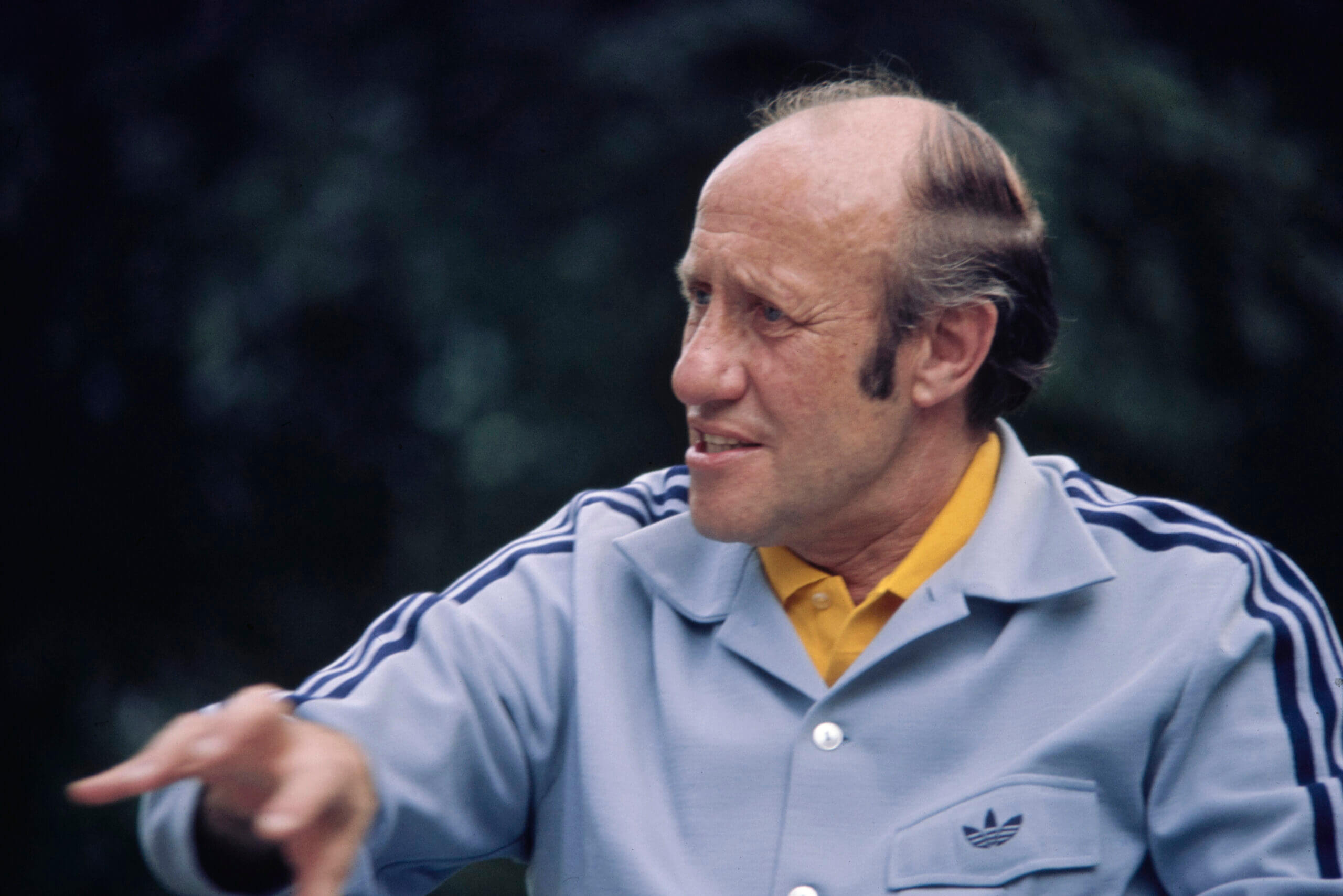
Helmut Schön
 Germany
association football player•association football coach
Birthday
September 15, 1915
Birth Sign
Virgo
Birthplace
Dresden, Germany
Age
Died at 80
Height
5 ft 9 in (175 cm)
About
Helmut Schön was a German football player and manager who became the most successful national team coach in German history. Born in Dresden in 1915, he spent his entire playing career with Dresdner SC before transitioning to management. His tenure as the head coach of the West Germany national team spanned from 1964 to 1978, covering four consecutive World Cups and two European Championships. Under his guidance, the team secured the 1974 World Cup title and the 1972 European Championship. Schön passed away in 1996, leaving behind a legacy defined by tactical discipline and long-term stability.
His approach to the game emphasized flexibility and the integration of youth players into the senior squad. He managed star athletes like Franz Beckenbauer and Gerd Müller with a calm demeanor that commanded immediate respect. Although he never won individual awards like the Ballon d'Or, his contributions to the sport were recognized through numerous honors. His records for World Cup matches managed and wins stood for over five decades until they were eventually broken in the 2026 tournament.
Early Life & Background
Helmut Schön was born into a working-class family in Dresden, Germany, where he grew up during a period of significant political and social upheaval. His early life coincided with the rise of Nazism and the subsequent devastation of World War II, events that profoundly shaped his generation. Education and normal childhood pursuits were often interrupted by the demands of the war. Despite these challenges, he discovered a passion for association football at a young age. In 1932, he joined Dresdner SC, a club where he would spend his entire professional playing career. He played as a centre-forward and was known for his technical skill and goal-scoring ability. During the war, his football career was paused while he served in the military, a common experience for German men of his age. After the conflict ended, he returned to Dresdner SC in 1945. He helped the club secure the East German championship titles in 1947 and 1949. This period of domestic success laid the groundwork for his future transition into coaching. He began managing informally during this time but officially retired from professional play in 1950 to focus on his development as a coach.
Career Growth
Helmut Schön was appointed manager of the West Germany national team in 1964, succeeding Sepp Herberger. His leadership lasted for fourteen years and included four consecutive World Cup tournaments. In 1966, the team reached the final in England but lost 4–2 to the host nation. The following year in Mexico, West Germany finished third after defeating Uruguay in the playoff. The 1970 tournament is remembered for the "Game of the Century" against Brazil, where the Germans displayed immense spirit despite a 3–1 loss. The pinnacle of his career arrived in 1972 when he led the team to their first major international trophy by defeating the Soviet Union 3–0 in the European Championship final. Two years later, hosting the tournament in West Germany, he guided the squad to victory in the 1974 World Cup. They defeated the Netherlands 2–1 in the final, cementing his reputation as a master tactician. The team reached the final again in 1976 but lost to Czechoslovakia on penalties. His final tournament in 1978 saw the team fail to advance past the second group stage. Following this disappointing campaign, he resigned from his post. Throughout his career, he set records for the most World Cup matches managed (24) and most World Cup wins (16), both of which stood until 2026.
Career Timeline
Public Image & Style
Helmut Schön is portrayed as a stoic, intelligent, and highly respected figure in German football. He is often described as a "gentleman coach" who commanded respect through his knowledge and calm demeanor rather than loud outbursts. His image is associated with the golden era of German football, characterized by discipline, teamwork, and tactical brilliance. Media coverage during his tenure highlighted his ability to manage star players without creating internal conflict. He was seen as a stabilizing force within the German Football Association. Even after his retirement, he remained a revered elder statesman of the sport. His legacy is defined by the success of the teams he coached rather than any flamboyant personality traits.
Fame & Fandom
iFANN has not yet collected fame data for this person. As a historical figure from the mid-20th century, he does not appear in current global celebrity rankings. Fans of German football, particularly those interested in the 1970s era, revere him as a central figure in the history of the national team. There is no specific fandom name for Helmut Schön, as he was a coach rather than a player. Fan campaigns often focus on preserving his legacy and ensuring his records are remembered. There are no organized fan clubs dedicated solely to him, but he is a constant subject in discussions about the history of the German national team. The breaking of his records in 2026 sparked renewed interest in his career among modern fans.
Interesting Facts and Legends
Before becoming a manager, Helmut Schön was a prolific scorer for Dresdner SC, winning the East German championship twice. He served in the German army during World War II, which interrupted his playing career. He was one of the first coaches to emphasize the importance of a flexible midfield and the integration of youth players into the national team. His decision to start Gerd Müller in the 1974 final, despite Müller having scored fewer goals in the tournament than others, proved crucial in securing the victory. His record for most World Cup matches managed (24) stood for 52 years, a testament to the consistency of his tenure. The 1974 World Cup victory remains an iconic moment where he lifted the Jules Rimet trophy in Munich. Fans often refer to the "Game of the Century" from 1970 as a legendary display of resilience under his command. The 1966 final heartbreak against England is frequently discussed as the defining moment that shaped his future strategies. The breaking of his records by Didier Deschamps in 2026 marked the end of an era in football history.
Notable Quotes
“Football is a game of mistakes. The question is, how do you handle them?”
“We must always be ready to adapt. The game changes, and we must change with it.”
“The most important thing is to believe in yourself and your team.”
Family & Personal Life
Helmut Schön was a private man who kept his personal life largely out of the spotlight. Historical sources indicate that he was married to Gisela Schön, though specific details about their meeting or marriage date are not well-documented. There is no evidence of multiple marriages or high-profile flings. It is generally reported that he maintained a stable domestic life away from the public eye. No children are publicly confirmed, though some unverified sources suggest he may have had a son. Given the lack of public documentation on his dating history, it is accurate to state that his personal life was kept strictly out of the spotlight. He was widowed by Gisela at the time of his death, though the exact timeline of her passing varies slightly in different accounts.
Notable Connections
Relationships & Dating History
Helmut Schön was a private man who kept his romantic life out of the public eye. Historical sources indicate that he was married to a woman named Gisela Schön. Specific details regarding their meeting, the date of their marriage, or the duration of their union are not well-documented in mainstream biographies. There is no evidence of multiple marriages, high-profile flings, or other partners. It is generally reported that he maintained a stable domestic life away from the spotlight. No children are publicly confirmed, though some unverified sources suggest he may have had a son. Given the lack of public documentation on his dating history, it is accurate to state that his personal life was kept strictly out of the spotlight. He was widowed by Gisela at the time of his death in 1996, though the exact timeline of her passing varies slightly in different accounts. As of his death in 1996, he was widowed.
- MarriedGisela Schön? - 1996Married until his death; no public details on wedding date.
Death & Aftermath
Died
February 23, 1996 (aged 80)
Death Place
Wiesbaden, Germany
Cause of Death
Complications from Alzheimer's disease
Helmut Schön died on February 23, 1996, in Wiesbaden at the age of 80. The official cause of death was complications arising from Alzheimer's disease, a condition that had affected him in his final years. His passing triggered an outpouring of grief across Germany and the international football community. FIFA, UEFA, and the German Football Association (DFB) issued formal tributes honoring him as the architect of modern German football success. The funeral was a private ceremony attended by family members and close colleagues from his playing and coaching days, including legends like Franz Beckenbauer and Gerd Müller. While specific details about the service location were not widely publicized, the event underscored the deep respect held for him by peers. Posthumously, his legacy continued to grow significantly. The German Football Museum dedicated a prominent section to his career achievements, ensuring his tactical innovations remained accessible to future generations. For decades, his records stood as untouchable benchmarks in world football history. He held the record for the most World Cup matches managed by a coach with 24 games and the most wins with 16 victories. These milestones finally ended in July 2026 when Didier Deschamps equaled the match count and surpassed the win total during the 2026 FIFA World Cup. This statistical shift marked the end of an era but did not diminish Schön's status as a foundational figure in the sport.
Net Worth (Estate Value)
$1 Million
iFANN Editorial Team estimate
As Helmut Schön died in 1996, his net worth at the time of death is not precisely documented in modern financial terms. Estimates suggest his estate was modest, consistent with the earnings of a coach in the 1970s and 80s, likely ranging between $500,000 and $1 million in 1996 dollars. Adjusted for inflation, this value translates to roughly $1.5 to $3 million today. His estate has not generated significant posthumous revenue streams compared to modern athletes, as he did not have extensive commercial endorsements or production companies. The primary value of his legacy lies in historical significance rather than financial assets. There are no credible reports of a 2026 net worth calculation for his estate, as it is not an active entity generating income. iFANN currently estimates Helmut Schön's net worth at approximately $1 Million based on available historical data and inflation adjustments.
Awards Won (4)
Helmut Schön received numerous honors for his contributions to football, though he did not win individual player awards like the Ballon d'Or. He won the FIFA World Cup in 1974 and the UEFA European Championship in 1972 as the head coach of West Germany. He was awarded the Grand Cross Special Class of the Order of Merit of the Federal Republic of Germany. He was inducted into the German Football Hall of Fame. He received lifetime achievement awards from the German Football Association and FIFA. His records for most World Cup matches managed and wins stood for over 50 years.
1974 · Winner
West Germany National Team
1972 · Winner
West Germany National Team
Known For
West Germany National Team
1974 · Head Coach
Dresdner SC
1932 · Player
Keywords
Sources
Quick Facts
- Profession
- association football player, association football coach
- Born
- September 15, 1915
- Birthplace
- Dresden, Germany
- Died
- February 23, 1996
- Death Place
- Wiesbaden, Germany
- Gender
- Male
- Birth Sign
- Virgo
Personal Details
- Full Name
- Helmut Schön
- Height
- 5 ft 9 in (175 cm)
- Spouse
- Gisela Schön
- Children
- Education
- N/A
Frequently Asked Questions
Who was Helmut Schön?
When did Helmut Schön die?
What records did Helmut Schön hold?
Did Helmut Schön have children?
How did Helmut Schön die?
Similar People
Join the community
fans discussing