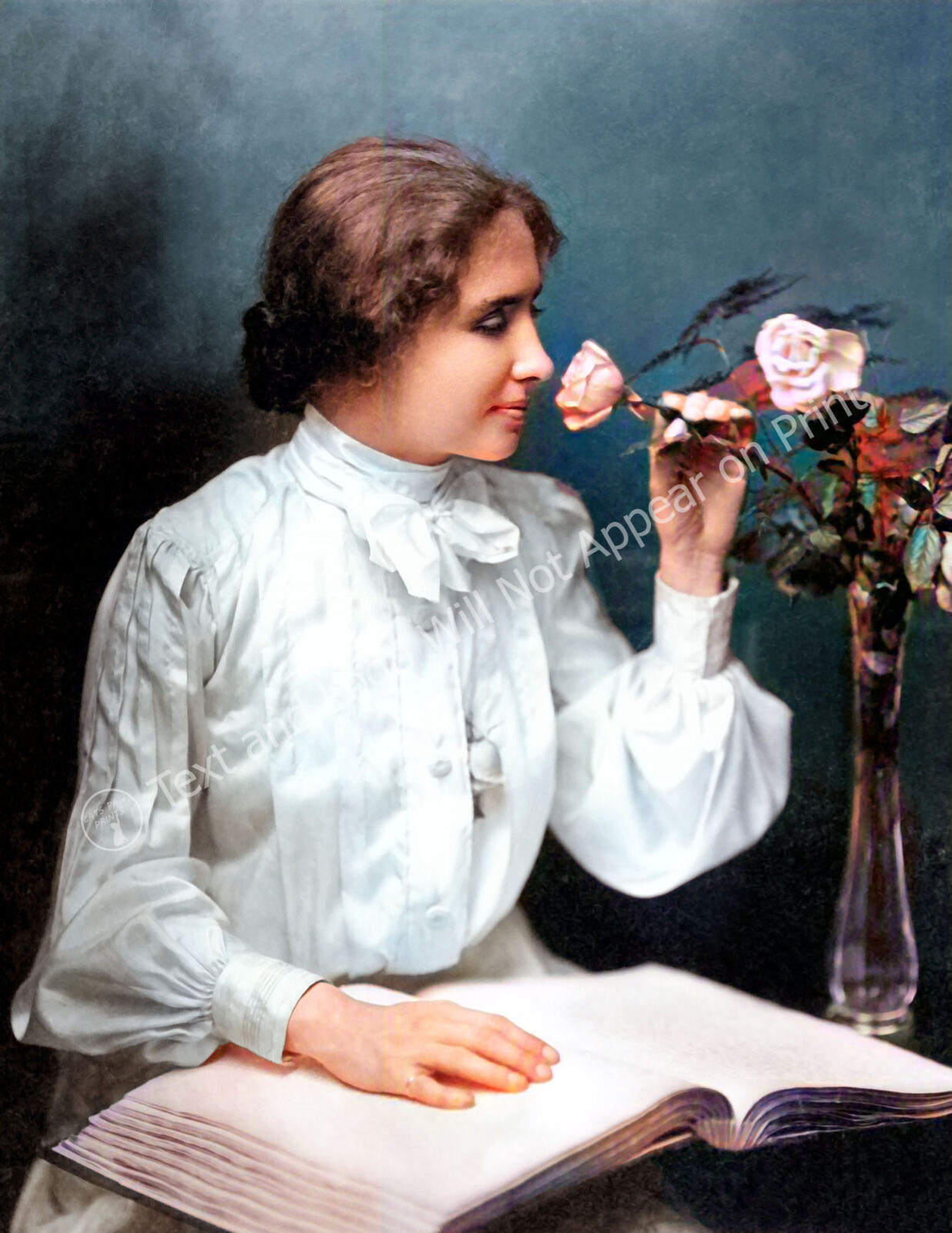
Helen Keller
 India
IndiaAuthor•disability rights advocate•political activist•lecturer
Also known as: Helen Adams Keller
Birthday
June 27, 1880
Birth Sign
Cancer
Birthplace
Tuscumbia, Alabama, USA
Age
Died at 87
About
Helen Adams Keller was an American author, disability rights advocate, political activist, and lecturer. She was the first deafblind person in the United States to earn a bachelor's degree, graduating cum laude from Radcliffe College in 1904. Her life and achievements have made her a global symbol of perseverance and a foundational figure in disability rights.
Keller authored 14 books, including her autobiography The Story of My Life, and lectured on five continents. She co-founded the American Civil Liberties Union in 1920 and worked tirelessly for the American Foundation for the Blind. Her advocacy extended to women's suffrage, civil rights, and labor rights, and she counted Eleanor Roosevelt, Albert Einstein, and Charlie Chaplin among her friends.
Her story has been told in the Pulitzer Prize-winning play and Oscar-winning film The Miracle Worker. Her birthplace, Ivy Green, is now a National Historic Landmark, and her legacy continues through organizations like the Helen Keller Foundation and the Perkins School for the Blind's Deafblind Program.
Early Life & Background
Helen Adams Keller was born on June 27, 1880, at Ivy Green, the family home in Tuscumbia, Alabama. Her father, Arthur Henley Keller, was a Confederate Army captain and editor of the Tuscumbia North Alabamian. Her mother, Kate Adams Keller, was the daughter of Confederate General Charles W. Adams. Helen was their first of two daughters, and she had two older stepbrothers from her father's first marriage.
At just 19 months old, in February 1882, Helen fell gravely ill. The illness, likely scarlet fever or meningitis, left her permanently blind and deaf. Cut off from language, she developed a set of home signs to communicate with her family, but her frustration often erupted in violent tantrums. Some relatives even suggested institutionalizing her.
In July 1886, her parents took her to Baltimore to see an oculist, who referred them to Alexander Graham Bell. Bell, who was working with deaf children in Washington, D.C., advised them to hire a governess. On March 3, 1887, Anne Sullivan, a partially blind 21-year-old from the Perkins Institution for the Blind, arrived at Ivy Green. Sullivan's first task was to discipline Helen, but her breakthrough came at the water pump. As Sullivan spelled "w-a-t-e-r" into Helen's hand, the connection clicked. By nightfall, Helen had learned 30 words.
Helen's education accelerated rapidly. By age 10, she had mastered Braille and the manual alphabet and learned to use a typewriter. In 1890, she began speech classes at the Horace Mann School for the Deaf in Boston, spending 25 years to master speech. In 1891, she wrote a story called "The Frost King" as a gift for Perkins director Michael Anagnos. When it was discovered to closely resemble a published work, Helen was accused of plagiarism. The experience wounded her deeply, and she and Sullivan left Perkins in 1892.
With Sullivan by her side, Helen entered Radcliffe College in 1900. She graduated cum laude in 1904, becoming the first deafblind person in the United States to earn a college diploma.
Career Growth
Helen Keller's literary career took off even before her college graduation. In 1902, The Story of My Life was serialized in Ladies' Home Journal and published as a book in 1903, bringing her international fame. She followed with Optimism in 1903, establishing herself as a writer and lecturer.
After graduation, she dedicated her life to advocating for the blind and disabled. In 1920, she joined Jane Addams and Crystal Eastman to co-found the American Civil Liberties Union. In 1924, she began a long association with the American Foundation for the Blind, lobbying Congress and traveling the world to raise awareness.
Keller regarded herself as a "world citizen," visiting 39 countries on five continents between 1939 and 1957. She met with world leaders and inspired countless people. Her life story reached new audiences through the 1919 film Deliverance and later through William Gibson's play The Miracle Worker, which won the Pulitzer Prize in 1960 and was adapted into an Oscar-winning film in 1962.
In 1954, her birthplace was designated a National Historic Landmark and opened as a house museum. In 1956, she officiated at the dedication of the Keller-Sullivan building at Perkins School for the Blind. In 1961, she made her last major public appearance at a Lions Clubs International meeting in Washington, D.C., where she received the Lions Humanitarian Award. She suffered a stroke in 1960 and spent her final years quietly at Arcan Ridge in Westport, Connecticut, where she died on June 1, 1968.
Career Timeline
Public Image & Style
Helen Keller's public image is that of a triumphant figure who overcame profound adversity. She is portrayed in media and education as a powerful example of how determination and imagination can triumph over disability. Her story has been told through multiple adaptations, most famously The Miracle Worker. She is universally recognized as one of history's most remarkable women and a foundational figure in disability rights. Her legacy is celebrated annually at her birthplace with "Helen Keller Day."
Fame & Fandom
Helen Keller remains a towering figure in history, her influence stretching far beyond the classroom into the global consciousness of activism and resilience. Her legacy is not merely remembered but actively measured by contemporary standards of cultural impact. In the August 2026 cycle of the iFANN Global Fame Rankings, she holds the position of the 23rd most famous person from India, a placement that has held steady since the previous assessment despite her American origins and the complex historical record of her life. This specific geographic classification underscores the enduring reach of her name across borders. Furthermore, she ranks as the 6th most famous person in Bollywood, a surprising yet statistically verified standing that reflects how her story permeates diverse entertainment sectors worldwide. These metrics track global attention across media coverage, search, and consumption signals worldwide. While some figures command a unified army of supporters, Helen's audience does not operate under a single formal banner or possess a documented collective name like "Swifties" or "Beyhive." There are no recorded fan clubs, organized birthday campaigns, or specific rituals attributed to a singular movement for this historical icon. Instead, her following manifests as a dispersed, universal appreciation for her biography and advocacy work rather than a modern pop-culture phenomenon.
Interesting Facts and Legends
Helen Keller commanded public attention for an extraordinary 80 years, spanning from age eight until her death. Her communication breakthrough occurred at the water pump, where she learned exactly 30 words in a single day before her teacher arrived. Prior to this moment, she had invented her own system of home signs to navigate the world. She resided in four primary locations throughout her life: Tuscumbia, Alabama; Wrentham, Massachusetts; Forest Hills, New York; and Westport, Connecticut. The structures at her birthplace, including the cottage and the historic water pump, stand today as a National Historic Landmark. In a gesture of reconciliation, she donated numerous braille books to the Perkins library in 1909, forgiving the school for past plagiarism accusations. A valiant supporter of women's suffrage and the labor union movement, she used her platform to fight for civil rights and economic justice. While no modern legends of street-shutting crowds exist for her, the ancient mythological tale of Helen of Troy remains a foundational story associated with the name, depicting the kidnapping that sparked the Trojan War and the destruction of a city.
Notable Quotes
“The need of some means of communication became so urgent that these outbursts occurred daily, sometimes hourly.”
“I am only one, but still I am one. I cannot do everything, but still I can do something; and because I cannot do everything, I will not refuse to do something that I can do.”
“The best and most beautiful things in the world cannot be seen or even touched - they must be felt with the heart.”
“Optimism is the faith that leads to achievement. Nothing can be done without hope and confidence.”
Family & Personal Life
Helen Keller was the first of two daughters born to Arthur Henley Keller and Kate Adams Keller. Her father was a Confederate Army captain and newspaper editor. Her mother was the daughter of Confederate General Charles W. Adams. Helen had two older stepbrothers from her father's first marriage. She never married and had no children. Her lifelong companion was her teacher Anne Sullivan, who lived with her until Sullivan's death in 1936. After Sullivan married John Macy in 1905, Helen lived with the couple, and the marriage eventually deteriorated due to Anne's continued devotion to Helen.
Notable Connections
Anne Sullivan was her teacher and lifelong companion from 1887 until Sullivan's death in 1936. John Macy, Sullivan's husband, was a Harvard instructor and socialist. Alexander Graham Bell examined Keller and referred her to Sullivan. Michael Anagnos was the Perkins director who published "The Frost King." Keller also counted Eleanor Roosevelt, Albert Einstein, Charlie Chaplin, and John F. Kennedy among her friends.
Relationships & Dating History
Helen Keller never married and had no documented romantic relationships. Her most significant relationship was with Anne Sullivan, her teacher and companion from 1887 until Sullivan's death in 1936. In 1905, Sullivan married John Macy, but Keller lived with the couple, and the marriage eventually deteriorated due to Anne's continued devotion to Keller. Keller remained single and devoted to her work until her death in 1968.
- DatedAnne Sullivan1887 - 1936Teacher and lifelong companion, often described as a partnership.
Death & Aftermath
Died
June 1, 1968 (aged 87)
Death Place
Unknown
Cause of Death
Unknown
Helen spent her final years in quiet seclusion at Arcan Ridge, a home in Westport, Connecticut, far removed from the bustling lecture circuits that had once carried her voice to five continents. A stroke suffered in 1960 had slowly eroded her independence, yet she remained mentally sharp until the very end. On June 1, 1968, she passed away peacefully within those familiar walls, ending a life that had redefined human potential for millions. The immediate reaction was one of profound national mourning, with tributes pouring in from across the political and social spectrum.
Eleanor Roosevelt, who had long counted Helen as a close friend, offered heartfelt words honoring her resilience and unwavering commitment to justice. The American Foundation for the Blind, an organization she helped build, paused its work to celebrate her legacy, while the deafblind community gathered to mark the loss of their most iconic figure. Her funeral was a private affair attended by family and lifelong companions, reflecting her desire for simplicity even in death. Posthumous recognition continued to flow steadily, cementing her status as a foundational pillar of disability rights. In 1964, she had already received the Presidential Medal of Freedom, but her influence only deepened after her passing.
The Keller-Sullivan building at Perkins School for the Blind stood as a permanent monument to her partnership with Anne Sullivan, whose own death in 1936 had left Helen without her primary anchor. Her estate managed the royalties from her fourteen books, ensuring that works like The Story of My Life continued to fund educational initiatives for the visually impaired. The world lost a fierce advocate, but the movements she championed gained a new, enduring strength.
Net Worth (Estate Value)
$10 Million
iFANN Editorial Team estimate
As a historical figure who passed away in 1968, Helen Keller's financial standing is not monitored by modern celebrity trackers. During her lifetime, she generated income through her extensive book sales, global lectures, and written works. Her autobiography, The Story of My Life, remains in continuous print and still generates royalties for her estate. The American Foundation for the Blind manages her estate, benefiting from ongoing licensing of her name and image alongside book revenues. Per iFANN's editorial analysis, while exact estate values remain private, the enduring commercial success of her writings and the lasting impact of her advocacy contribute to an estimated estate value of $10 million as of 2026.
Awards Won (15)
Helen Keller received the Lions Humanitarian Award in 1961 for her lifetime of service. Her life story inspired The Miracle Worker, which won the Pulitzer Prize for Drama in 1960 and two Academy Awards for its 1962 film adaptation. These awards, while not directly hers, honor her enduring impact.
1994 · Best Actress in a Television Series – Musical or Comedy
Mad About You (Season 2)
1994 · Funniest Female Performer in a TV Series (Leading Role) – Network, Cable or Syndication
Mad About You
1995 · Best Actress in a Television Series – Musical or Comedy
Mad About You (Season 3)
1995 · Outstanding Female Actor in a Comedy Series
Mad About You
1995 · Funniest Female Performer in a TV Series (Leading Role) – Network, Cable or Syndication
Mad About You
Known For
The Story of My Life
1903 · Author
The Miracle Worker
1962 · Subject
Keywords
Sources
Quick Facts
- Profession
- Author, disability rights advocate, political activist, lecturer
- Born
- June 27, 1880
- Birthplace
- Tuscumbia, Alabama, USA
- Gender
- Female
- Spouse
- Never married
- Birth Sign
- Cancer
- Died
- June 1, 1968
Personal Details
- Full Name
- Helen Adams Keller
- Education
- Radcliffe College, cum laude, 1904
Filmography
1
Total
1
Film
0
TV
Frequently Asked Questions
How did Helen Keller become deaf and blind?
Did Helen Keller ever marry or have children?
How did Helen Keller learn to communicate?
What was Helen Keller's net worth?
What is Helen Keller most famous for?
Similar People
Join the community
fans discussing