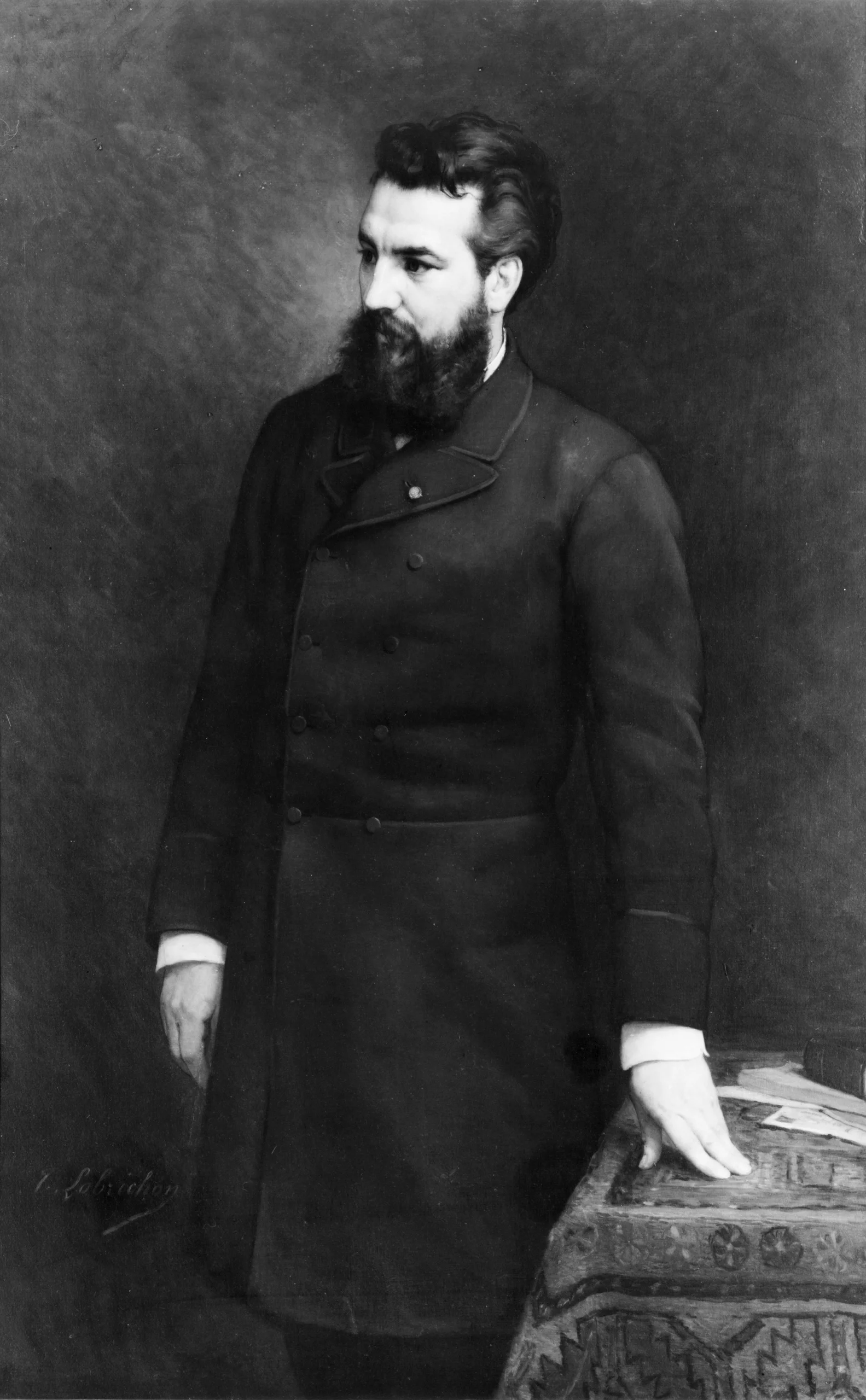
Alexander Graham Bell
 United Kingdom
Inventor•scientist•engineer•teacher of the deaf
Also known as: A. G. Bell, Alexander Bell, H. A. Largelamb
Birthday
March 3, 1847
Birth Sign
Pisces
Birthplace
Edinburgh, Scotland
Age
Died at 75
About
Alexander Graham Bell was a Scottish-born inventor, scientist, engineer, and teacher of the deaf who is credited with patenting the first practical telephone. Born in Edinburgh on March 3, 1847, and educated in Scotland and London, he spent his working life in Canada and the United States, where his research into hearing and speech led to the device that made him famous. He secured U.S. Patent 174,465 on March 7, 1876, and three days later made the first intelligible telephone call from Boston to his assistant Thomas Watson in the next room.
Bell's later career ranged far beyond the telephone. He co-founded the American Telephone and Telegraph Company in 1885, served as president of the National Geographic Society from 1898 to 1903, and conducted experiments in aeronautics, hydrofoils, and human heredity. He died in 1922 at his estate in Nova Scotia. His name remains attached to the telephone, to the Bell System, and to a persistent debate over who truly invented the device. More than a century after his death, the 150th anniversary of the telephone in 2026 returned him to the center of public conversation, with retrospectives from NPR, the Brookings Institution, WBUR, and AT&T.
Early Life & Background
Bell grew up in Edinburgh in a household dominated by speech. His father, Alexander Melville Bell, was an elocutionist and the author of a system called Visible Speech, a set of symbols designed to represent the position of the lips, tongue, and throat during articulation. His grandfather, also named Alexander Bell, had made a career on the London stage and in speech instruction, and his older brother Melville James Bell followed the same path. The family trade was teaching people how to speak, and Bell absorbed it early.
His mother, Eliza Grace Symonds Bell, was a painter and pianist who began to lose her hearing as a young woman. Bell learned to communicate with her by pressing his lips close to her forehead so she could feel the vibrations of his voice, a practice that gave him an unusually tactile understanding of sound. He was educated at the Royal High School in Edinburgh, where he was an indifferent student, and later at the University of Edinburgh and University College London. He never completed a degree; the family moved to Canada in 1870 after the deaths of both his brothers from tuberculosis, settling in Brantford, Ontario.
In 1871 Bell moved to Boston to teach at the Clarke School for the Deaf in Northampton, Massachusetts, and later at the Boston School for Deaf Mutes. He became a professor of vocal physiology and elocution at Boston University in 1873, a period that anniversary coverage in 2026 revisited as the formative chapter of his career. His work with deaf students convinced him that speech could be taught mechanically, and he began experimenting with devices that could reproduce sound. By 1874 he was working on the harmonic telegraph, a device intended to send multiple telegraph messages over a single wire. The telephone emerged from that research, almost as a byproduct. Bell did not set out to invent a telephone. He was chasing the era's holy grail of multiplex telegraphy, and the speaking device was the accidental result.
Career Growth
Bell filed his telephone patent on February 14, 1876, and it was granted on March 7. Three days later, on March 10, he spoke the first intelligible sentence over the wire to Thomas Watson: Mr. Watson, come here, I want to see you. The device was demonstrated later that year at the Philadelphia Centennial Exhibition, the 1876 World's Fair, where Bell's exhibit initially drew little attention until the Brazilian emperor Pedro II took an interest. That demonstration helped launch the telephone commercially.
In 1877 Bell founded the Bell Telephone Company with his father-in-law Gardiner Greene Hubbard. The company grew rapidly, and in 1885 Bell co-founded the American Telephone and Telegraph Company, AT&T, which became the parent of the Bell System. He was a founder of the American Institute of Electrical Engineers in 1884, a predecessor of IEEE, and served as its president from 1891 to 1892. From 1898 to 1903 he was the second president of the National Geographic Society, where he helped shape the society's magazine.
Bell's later work included early experiments in optical telecommunications, the development of hydrofoil boats, and aeronautical research. He also conducted a long study of human heredity, publishing records of deafness in families that some historians regard as among the soundest American heredity research of the nineteenth century, and he was inducted into the National Inventors Hall of Fame. He received numerous honors in his lifetime, including the Volta Prize from the French government in 1880, which he used to establish the Volta Bureau for the study of deafness. He died in 1922, but the institutions he founded and the patent he secured shaped telecommunications for the next century.
Career Timeline
Public Image & Style
Bell's public image is that of the archetypal inventor: curious, wide-ranging, and slightly detached from the commercial machine his invention became. He is remembered as the man who spoke the first telephone sentence, but also as a teacher of the deaf who spent much of his life on speech and hearing. His later work on hydrofoils and aeronautics gave him a reputation as a restless experimenter who moved from one field to the next.
In the deaf community, his legacy is more complicated. Bell advocated oralism, the teaching of speech and lip-reading rather than sign language, and his views on deafness and heredity have been criticized by some historians and deaf activists. A 2026 Verywell Health article reexamined his controversial views on deafness, noting that his advocacy for oral education shaped deaf education for generations. His public image today is split between the heroic inventor and the flawed reformer.
Fame & Fandom (iFAMOUS Rankings)
iFANN has not yet collected fame data for Alexander Graham Bell, so no ranking is available. He does not appear on the September 2026 iFAMOUS Rankings flagship list.
Bell has no formal fandom in the modern sense. There is no fan club, no organized base, and no fandom name. His admirers are more likely to be historians of technology, collectors of antique telephones, and readers of popular science. The 150th anniversary of the telephone in 2026 brought a wave of retrospectives from NPR, the Brookings Institution, WBUR, Axios, Smithsonian Magazine, and AT&T, but these were journalistic and institutional tributes rather than fan-driven campaigns. His name persists in the Bell System, in the Bell Labs research tradition, and in the many schools and foundations named for him, but the emotional attachment usually reserved for celebrities does not apply. He is remembered as a historical figure, not a fandom icon.
Interesting Facts and Legends
Bell wrote for National Geographic under the anagram pseudonym H. A. Largelamb. He refused to keep a telephone in his study, regarding it as an interruption to his scientific work. He was an early pioneer of the hydrofoil, and one of his designs, the HD-4, set a world marine speed record of 70.86 miles per hour in 1919. He also experimented with aeronautics, building tetrahedral kites and a man-carrying kite called the Cygnet that flew in 1907.
The story most often retold about Bell is the first telephone call itself. On March 10, 1876, in Boston, he summoned Watson with the words Mr. Watson, come here, I want to see you. The phrase has become one of the most quoted sentences in the history of technology, and 2026 marked its 150th anniversary.
A second legend concerns the Philadelphia Centennial Exhibition, where Bell nearly skipped his own demonstration; he was persuaded to attend, and the telephone made its public debut before a crowd that included Emperor Pedro II of Brazil. A third, more contentious legend is the persistent claim that Bell did not invent the telephone at all. The U.S. House of Representatives passed a resolution in 2002 honoring Antonio Meucci as the true inventor, and the Library of Congress notes that the question of credit remains contested. Bell's defenders point to his patent and his working device; his critics point to Meucci's earlier experiments and to Elisha Gray's caveat filed on the same day as Bell's patent application.
Notable Quotes
“Mr. Watson, come here, I want to see you.”
“The day will come when the man at the telephone will be able to see the distant person to whom he is speaking.”
“Before anything else, preparation is the key to success.”
“Concentrate all your thoughts upon the work at hand. The sun's rays do not burn until brought to a focus.”
“Great discoveries and improvements invariably involve the cooperation of many minds.”
Family & Personal Life
Bell's father, Alexander Melville Bell, was a prominent elocutionist and the inventor of Visible Speech, a system for teaching the deaf to speak. His mother, Eliza Grace Symonds Bell, was a painter and musician who was deaf, a fact that made deafness a central theme of Bell's personal and professional life. His grandfather, also Alexander Bell, was a speech teacher in London and Edinburgh. Bell had two brothers, Melville James and Edward Charles, both of whom died of tuberculosis in the 1860s. The family moved to Brantford, Ontario, in 1870.
Bell married Mabel Gardiner Hubbard in 1877. Mabel was the daughter of Gardiner Greene Hubbard, a lawyer and early financial backer of Bell's work who became the first president of the Bell Telephone Company. She had lost her hearing at age five after a bout of scarlet fever and was one of Bell's students before their marriage. They had four children: Elsie May Bell, Marian Daisy Bell, and two sons, Edward and Robert, who died in infancy. The family lived at Beinn Bhreagh, Bell's estate in Nova Scotia, and also maintained a home in Washington, D.C.
Notable Connections
Thomas Watson, his assistant and the recipient of the first telephone call; Gardiner Greene Hubbard, his father-in-law and early financial backer; Mabel Gardiner Hubbard Bell, his wife and a former student; Helen Keller, whom he mentored; and the Volta Bureau, which he founded with the Volta Prize money.
Relationships & Dating History
Bell's romantic life was simple and well documented. He met Mabel Gardiner Hubbard, the daughter of his financial backer Gardiner Greene Hubbard, in the early 1870s. Mabel had lost her hearing at age five and was one of Bell's students in Boston. They married on July 11, 1877, in Cambridge, Massachusetts, and remained married until his death in 1922, a union of 45 years.
There are no other documented romantic relationships. Bell was married to Mabel at the time of his death, and she survived him by less than a year, dying in January 1923. As of 2026, Bell is deceased and has no current partner.
- MarriedMabel Gardiner Hubbard1877 - 1922Married until his death in 1922; she was deaf and one of his former students.
Death & Aftermath
Died
August 2, 1922 (aged 75)
Death Place
Beinn Bhreagh, Baddeck, Nova Scotia, Canada
Cause of Death
Complications of diabetes (pernicious anemia reported)
Bell died on August 2, 1922, at Beinn Bhreagh, his estate on Cape Breton Island near Baddeck, Nova Scotia. He was 75. The reported cause was complications of diabetes, though contemporary accounts also cited pernicious anemia; the supplied research does not include an autopsy or official ruling, so the precise medical sequence remains a matter of historical record rather than confirmed documentation.
News of his death prompted tributes from scientific institutions and telephone exchanges across North America. On the day of his funeral, telephone service in the United States and Canada was silenced for one minute in his honor, a gesture that underscored how thoroughly his invention had woven itself into daily life. He was buried at Beinn Bhreagh.
The estate at Beinn Bhreagh passed to his daughters, Elsie May Bell Grosvenor and Marian Bell, and later to the Grosvenor family. His scientific papers and experimental records were eventually donated to the Library of Congress and other archives, where they remain available to researchers. The Bell Telephone Company, later AT&T, continued to grow into one of the largest corporations in the world, and the 150th anniversary of the first telephone call in 2026 brought renewed attention to his life and the contested history of the invention itself.
Net Worth (Estate Value)
$10 Million
iFANN Editorial Team estimate
Alexander Graham Bell's estate at the time of his death in 1922 was never publicly valued in full, but the iFANN Editorial Team's analysis of his patent holdings, corporate shares, and real estate points to a present-day estate value of roughly $10 Million, adjusted for inflation and the historical value of his holdings. The figure is an estimate, not a probate record. No modern celebrity net-worth tracker publishes a figure for him, since he died in 1922.
Bell's wealth came primarily from the telephone patents. He assigned his patent rights to the Bell Telephone Company, which his father-in-law Gardiner Greene Hubbard helped organize in 1877. The company grew into the Bell System, and Bell retained a substantial block of shares. He also earned income from his writings, lectures, and the Volta Bureau, which he endowed with the 50,000-franc Volta Prize awarded by the French government in 1880. His estate at Beinn Bhreagh, a large property on Cape Breton Island, included laboratories, a boathouse, and experimental buildings. He also owned a home in Washington, D.C.
After Mabel's death in 1923, the property was divided among the heirs. The Bell Telephone Company, later AT&T, became one of the most valuable corporations in the world, but Bell's personal fortune did not grow with it; he had sold much of his stock early and devoted his later years to research rather than business. The estate's current value is difficult to calculate because the property has changed hands and the original buildings have been altered, but the iFANN estimate of $10 Million reflects the historical value of his holdings and the enduring worth of his name.
Awards Won (3)
Bell received the Volta Prize from the French government in 1880, the Hughes Medal from the Royal Society in 1913, and the Edison Medal from the American Institute of Electrical Engineers in 1914. He was inducted into the National Inventors Hall of Fame and received numerous honorary degrees and foreign decorations.
1914 · Engineering
Telephone and electrical communication
1913 · Science
Telephone and electrical communication
Known For
Invention of the telephone
1876 · Inventor
Founding of AT&T
1885 · Co-founder
President of the National Geographic Society
1898 · President
Teaching the deaf
1871 · Teacher
Keywords
Sources
Quick Facts
- Profession
- Inventor, scientist, engineer, teacher of the deaf
- Born
- March 3, 1847
- Birthplace
- Edinburgh, Scotland
- Died
- August 2, 1922
- Death Place
- Beinn Bhreagh, Baddeck, Nova Scotia, Canada
- Gender
- Male
- Spouse
- Mabel Gardiner Hubbard
- Birth Sign
- Pisces
Personal Details
- Full Name
- Alexander Graham Bell
- Spouse
- Mabel Gardiner Hubbard
- Children
- Elsie May Bell, Marian 'Daisy' Bell, Edward Bell (died in infancy), Robert Bell (died in infancy)
- Education
- University of Edinburgh; University College London
Frequently Asked Questions
What was Alexander Graham Bell best known for?
Did Alexander Graham Bell marry a deaf person?
Who was the real inventor of the telephone?
What is Alexander Graham Bell's net worth in 2026?
When did Alexander Graham Bell make the first phone call?
Similar People
Join the community
fans discussing