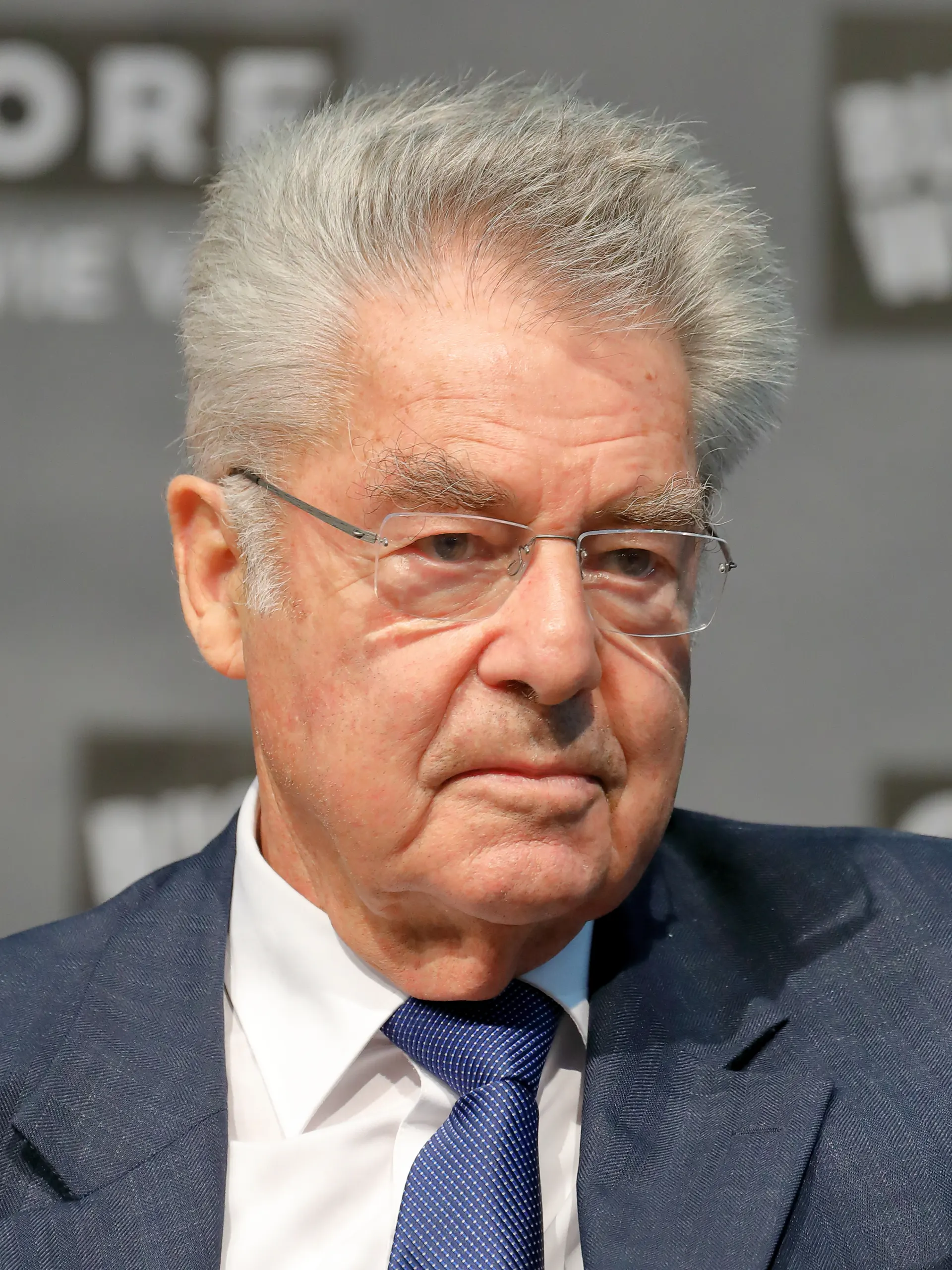
Heinz Fischer
 Austria
politician•jurist•university teacher
Birthday
October 9, 1938
Birth Sign
Libra
Birthplace
Graz, Styria, Austria
Age
88 years old
About
Heinz Fischer is an Austrian politician and jurist who served as the 11th president of Austria from 2004 to 2016. A member of the Social Democratic Party (SPÖ), he suspended his party membership upon taking office to maintain constitutional neutrality. Before the presidency, he was the minister for science and research from 1983 to 1987 and president of the National Council from 1990 to 2002.
His presidency was marked by a push for European integration, dialogue with the Islamic world, and Austria's role as a bridge between East and West. He was the first Western head of state to visit Iran in over a decade, meeting President Mahmoud Ahmadinejad in 2013. After leaving office, he co-chaired the Ban Ki-moon Centre for Sustainable Development in Vienna and remained active in international diplomacy.
Known for a reserved, scholarly demeanor, Fischer is respected across the Austrian political spectrum for his integrity and adherence to constitutional norms. He remains married to Margit Fischer, and the couple has two children.
Early Life & Background
Heinz Fischer was born on October 9, 1938, in Graz, Styria, into a working-class family. His father worked as a railway employee and his mother was a homemaker. He attended the local elementary school and later the Bundesrealgymnasium in Graz, where his interest in law and politics began to take shape.
In 1956, Fischer enrolled at the University of Vienna to study law and political science. He completed his doctorate in law in 1962, specializing in constitutional and administrative law. Following his studies, he worked as a legal advisor and lecturer, building a foundation in academia that would later inform his political career.
His entry into politics came through the Social Democratic Party, where he rose through the ranks in the late 1970s. In 1979, he became chairman of the SPÖ parliamentary club, a role he held until 1983. His early career in parliament and law set the stage for his first ministerial appointment under Chancellor Bruno Kreisky.
Career Growth
Fischer's breakthrough came in 1983 when Chancellor Bruno Kreisky appointed him Minister of Science and Research. During his tenure until 1987, he focused on university reform and expanding research funding. In 1990, he was elected President of the National Council, the lower house of the Austrian Parliament, a position he held for twelve years until 2002, making him one of the longest-serving occupants of that office.
In 2004, Fischer ran as the SPÖ candidate for president and won the runoff with 52.4% of the vote against Norbert Steger. He was re-elected in 2010 with 52.3% against Barbara Rosenkranz, becoming the first president in the Second Republic to win a second term. His presidency prioritized European integration and dialogue with the Islamic world. In 2013, he made a landmark visit to Iran, the first by a Western head of state in over a decade, meeting President Mahmoud Ahmadinejad.
After leaving office in 2016, Fischer co-chaired the Ban Ki-moon Centre for Sustainable Development in Vienna, advocating for global development goals. In 2025, he was nominated as a UN special envoy, a role that drew controversy after he made critical remarks about Israel's actions in Gaza. He continued his work with the Centre and participated in academic conferences on the EU and migration.
Career Timeline
Public Image & Style
Fischer's public persona is that of a scholarly statesman, often described as a 'professor president.' He favors a traditional, reserved style, prioritizing dialogue and consensus. His integrity and adherence to constitutional norms earned him respect across the political spectrum. He is seen as a unifying figure, committed to European integration and international stability. His social media presence is minimal, reflecting his preference for formal communication.
Fame & Fandom (iFAMOUS Rankings)
Heinz Fischer commands a following defined by civic duty rather than the fervent adoration reserved for entertainers; his public audience consists of citizens and diplomats who view him as a steady constitutional figure rather than a celebrity, meaning no formal fandom name or organized fanbase exists to claim his legacy. This distinction separates his career from the realm of pop culture mythology, where interactions are typically reciprocal and ritualized. Instead, his standing is measured by his enduring influence on Austrian governance and international diplomacy. Within the broader landscape of global notoriety, Heinz Fischer holds specific, documented positions in the iFANN Global Fame Rankings. He is currently ranked as the 25th most famous person from Austria, a placement that has remained stable across recent assessment cycles. This ranking reflects his sustained visibility in historical records and diplomatic archives, placing him among the most recognized figures originating from the nation. These standings are derived from the comprehensive data maintained by the iFANN Global Fame Rankings, which aggregates signals of global attention across media coverage, search activity, and cultural consumption without exposing its proprietary algorithms. While he does not generate the viral spikes seen with modern influencers, his consistent presence in official state functions ensures his name remains relevant in political discourse worldwide.
Interesting Facts and Legends
Heinz Fischer is an avid skier and enjoys hiking in the Alps, hobbies common among Austrians. He speaks English, French, and Spanish in addition to his native German. He authored several books on constitutional law and political theory before entering full-time politics. His nickname among colleagues was 'the professor' for his academic bent. A notable moment in his diplomatic career occurred in July 2013 when he addressed the grounding of Bolivian President Evo Morales' aircraft in Vienna, publicly clarifying that Austria had not searched the plane to de-escalate tensions. In September 2015, he made history as the first Austrian head of state to visit Iran since 2004, a move widely covered as a significant diplomatic breakthrough during nuclear negotiations. Throughout his tenure, he hosted numerous high-profile figures, including U.S. President George W. Bush at Hofburg Palace in June 2006 and Russian President Vladimir Putin in April 2015, marking key moments in Austria's foreign relations.
Notable Quotes
“Dialogue is the only way to overcome differences and build a common future.”
“The President is not a ruler, but a guardian of the constitution and a unifying figure for all Austrians.”
“We must not shy away from criticizing violations of international law, even if it is uncomfortable for our partners.”
Family & Personal Life
Heinz Fischer married Margit Scherz in 1968, a fellow student he met at the University of Vienna. Margit, a former teacher, has been a supportive partner throughout his career. The couple has two children: a son, Christian, and a daughter, Maria. The family primarily resides in Vienna, with a secondary residence in Graz. Fischer's father was a railway employee and his mother a homemaker, details that shaped his working-class upbringing. He has not publicly shared much about his siblings.
Notable Connections
Relationships & Dating History
Heinz Fischer has been married to Margit Fischer (née Scherz) since 1968. The couple met during their university days in Vienna and have remained together for over five decades. They have two children, Christian and Maria. There are no public records of prior relationships or divorces; his marriage to Margit is widely cited as a stable, long-term partnership. As of 2026, Heinz and Margit Fischer remain married.
- MarriedMargit Fischer1968 - presentCurrentMet at university in Vienna; married since 1968, with two children.
Salary, Net Worth In 2026
$2 Million
iFANN Editorial Team estimate
As a public official and academic, Heinz Fischer's net worth is not derived from commercial ventures or endorsements. His income comes from his pension as a former president, his salary as a university professor, and lecture fees. Estimates for former Austrian heads of state place their annual income in the range of €100,000 to €150,000 post-office. Per iFANN's editorial analysis, his accumulated wealth stands at $2 Million as of 2026, a sum built through decades of public service and academic work.
Awards Won (3)
Heinz Fischer has received numerous high-level national and international honours, including the Grand Decoration of Honour in Gold with Sash for Services to the Republic of Austria (1995), the Order of Merit of the Federal Republic of Germany (1998), and the Grand Cross of the Order of Merit of the Italian Republic (2004). He holds honorary doctorates from the University of Graz and the University of Vienna.
1995 · National
Services to the Republic of Austria
1998 · National
Contributions to German-Austrian relations
Known For
President of Austria
2004-2016 · 11th President
President of the National Council
1990-2002 · President
Minister of Science and Research
1983-1987 · Minister
Keywords
Sources
Quick Facts
- Profession
- politician, jurist, university teacher
- Born
- October 9, 1938
- Birthplace
- Graz, Styria, Austria
- Gender
- Male
- Spouse
- Margit Fischer
- Children
- 2
- Education
- University of Vienna (Dr. iur., 1962)
- Political Party
- Social Democratic Party (SPÖ)
- Presidency
- 2004-2016
Personal Details
- Full Name
- Heinz Fischer
- Spouse
- Margit Fischer
- Children
- 2
- Education
- University of Vienna (Doctor of Law, 1962)
Frequently Asked Questions
How old is Heinz Fischer?
Who is Heinz Fischer married to?
What did Heinz Fischer do after being president?
Why was Heinz Fischer controversial in 2025?
Is Heinz Fischer still alive?
Social Media
Similar People
Join the community
fans discussing