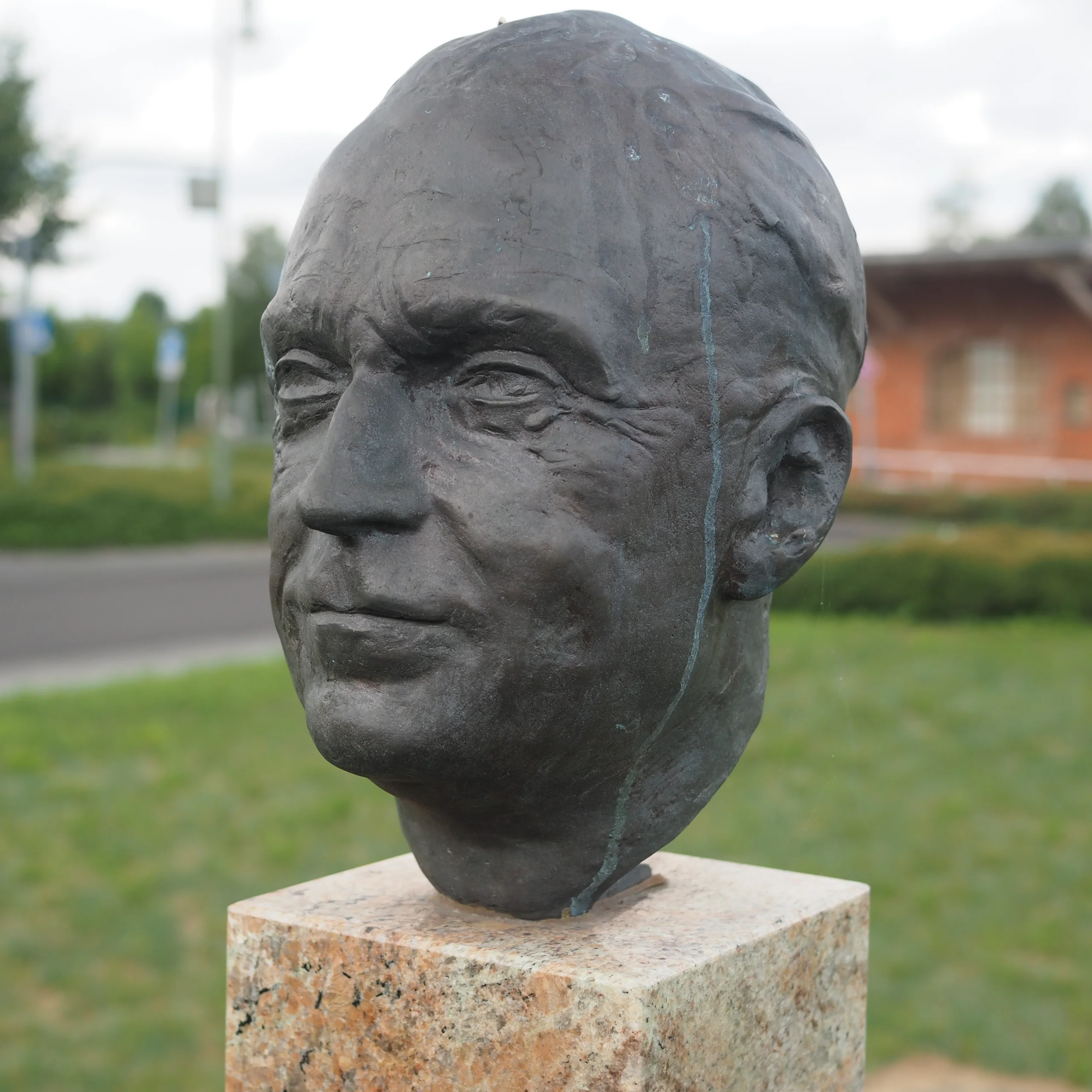
Heinrich Grüber
 Germany
Birthday
June 24, 1891
Birth Sign
Cancer
Birthplace
Stolberg, Germany
Age
Died at 84
About
Heinrich Grüber was a German Reformed theologian and pacifist who became one of the most prominent Protestant figures in the resistance against Nazism. As the founder of the Grüber Office, he organized relief efforts that helped hundreds of Jews, particularly Christians of Jewish descent, emigrate from Germany and survive the Holocaust. His courageous stand against the regime led to imprisonment in Sachsenhausen and Dachau concentration camps, yet he survived to become a leading voice for Christian–Jewish reconciliation after the war.
Grüber served as provost of St. Mary's Church in Berlin and later as dean of the Lutheran Evangelical Church in Berlin. In 1961, at age 69, he testified against Adolf Eichmann at the latter's trial in Jerusalem, delivering a powerful account of his futile efforts to persuade Eichmann to allow Jews to leave Germany. His testimony highlighted the complicity of the Nazi bureaucracy and the moral imperative of resistance.
Today, Grüber is remembered as a moral beacon of the German Protestant church, honored by both German and Israeli authorities for his unwavering commitment to justice and compassion. His legacy lives on in the institutions he helped build and the countless lives he touched.
Early Life & Background
Heinrich Grüber was born on June 24, 1891, in Stolberg, a small town in the Rhineland, into a teacher's family. Growing up in a household that valued education and civic duty, he developed a strong sense of social responsibility from an early age. He studied theology at the universities of Bonn, Berlin, and Utrecht, where he was exposed to a range of theological and philosophical ideas that would shape his worldview.
After completing his studies, Grüber worked as a social worker, a role that brought him into direct contact with the poor and marginalized. He later became the head of the Christian Youth Educational Institute in Templin, a position that allowed him to combine his pastoral calling with his commitment to social reform. During World War I, he served as a conscripted soldier, an experience that deepened his pacifist convictions and left him with a lasting aversion to war.
Ordained as a pastor in the Reformed Church, Grüber quickly established himself as a voice of conscience. When the Nazis rose to power in 1933, he joined the Confessing Church, the Protestant movement that opposed the regime's efforts to control the church. His opposition to the Nazi state's ideology and its persecution of Jews set him on a collision course with the authorities, leading to his first imprisonment in 1937. This early period of his life, marked by theological study, social work, and a growing resistance to tyranny, laid the foundation for the heroic actions that would define his legacy.
Career Growth
Grüber's most significant work began in 1933 when he founded the Grüber Office, a relief organization dedicated to helping Jews emigrate from Nazi Germany. Operating out of Berlin, the office provided practical assistance with paperwork, visas, and financial support, and it also helped those in hiding. Grüber personally intervened with Nazi officials, including Adolf Eichmann, whom he tried to persuade from 1939 to 1943 to allow Jews to leave the country. These efforts were largely futile, but they demonstrated his extraordinary courage and moral clarity.
His resistance activities led to his arrest in 1940, and he was sent to Sachsenhausen concentration camp. He was later transferred to Dachau, where he remained until the end of the war. Despite the brutal conditions, Grüber survived and emerged as a symbol of Christian resistance.
After the war, Grüber dedicated himself to reconciliation between Christians and Jews. He served as provost of St. Mary's Church in Berlin and later as dean of the Lutheran Evangelical Church in Berlin, using his position to foster dialogue and understanding. In 1961, he testified at the trial of Adolf Eichmann in Jerusalem, providing crucial testimony about the Nazi regime's persecution of Jews and his own efforts to save them. Grüber's postwar career was marked by his unwavering commitment to justice and his role as a moral leader in the rebuilding of German society.
Career Timeline
Public Image & Style
Heinrich Grüber was perceived as a quiet but unyielding moral force. In the public eye, he embodied the conscience of the German Protestant church, a man who risked everything to stand against evil. His personal style was modest and unassuming, reflecting his pastoral vocation and his deep commitment to service. He was known for his calm demeanor and his ability to speak truth to power, whether in the offices of Nazi officials or in the halls of justice in Jerusalem.
Fans and historians alike remember him as a hero of quiet courage, a man who did not seek the spotlight but was thrust into it by the enormity of the times. His legacy is preserved in the many memoirs and historical accounts of the resistance, and he is honored by both German and Israeli institutions. Grüber's image is that of a steadfast shepherd who protected his flock at great personal cost, and his story continues to inspire those who study the Holocaust and the power of individual conscience.
Fame & Fandom
Heinrich Grüber is not currently ranked in the iFANN global fame index, as the system has not yet gathered sufficient data to assign a placement for this historical figure. The August 2026 evaluation status remains NOT_EVALUATED, reflecting that his legacy operates outside the metrics of modern celebrity consumption and viral engagement. While he commands profound respect within theological circles and Holocaust history, he holds no position on the world's most famous person lists generated by the iFANN Editorial Team. This absence of a numerical rank does not diminish his stature but rather signals that his influence is measured in moral authority rather than search volume or media saturation.
The concept of a fandom does not apply to Heinrich Grüber. There is no documented fanbase with an official name, no organized groups of devotees, and no rituals surrounding his memory. Unlike pop culture icons who inspire street shutdowns or fan-funded billboards, Grüber's relationship with the public was defined by his professional and moral actions during the Holocaust and the Cold War. His audience consists of historians, theologians, and those studying resistance movements, none of whom form a cohesive fan community. No fan campaigns, hashtags, or streaming projects exist to celebrate his life, as his story is one of verified historical service rather than entertainment folklore. The lack of a named fandom underscores the solemn nature of his contribution; he is revered as a saint of conscience rather than celebrated as a star.
Interesting Facts and Legends
Heinrich Grüber possessed a photographic memory, a tool he wielded to memorize the names and faces of the Jews he rescued, a practice that later bolstered his testimony at the Eichmann trial. During his imprisonment in Dachau, he defied strict prohibitions by secretly conducting worship services for fellow prisoners within the priest block. A close friend of theologian Dietrich Bonhoeffer, Grüber corresponded regularly with him about their shared resistance work even before the Confessing Church was formally established. He was among the few German pastors to publicly speak out against the Nazi regime from the very beginning. After the war, he helped establish the first Christian–Jewish dialogue groups in Berlin, creating a model for similar initiatives across Germany.
His legend is anchored in the operation of the Büro Grüber between 1938 and 1940. This organization negotiated with the Gestapo to delay deportations and secure visas for Jews of Christian extraction, saving hundreds of lives before leading to his own arrest. Another pivotal chapter involved his nine-year tenure starting in 1949 as the plenipotentiary from the Evangelical Church to the Communist government in Pankow. Acting as a man in the middle, he served as a chief negotiator between the church and the state, cementing his reputation as a steadfast voice for human rights in divided Germany without generating the mass hysteria associated with musical legends.
Notable Quotes
“I tried to persuade Eichmann to allow the Jews to leave. It was a hopeless effort, but I had to try.”
“The church must not stand aside when human beings are persecuted. We have a duty to speak and to act.”
“In Dachau, I learned that even in the darkest place, faith can be a light.”
Family & Personal Life
Details about Heinrich Grüber's family are scarce in public records. He was born into a teacher's family in Stolberg, and his father's profession likely instilled in him a respect for learning and civic duty. There is no public information about his spouse or children, and it appears that his personal life was largely overshadowed by his public and pastoral work. He devoted himself entirely to his calling, and his family, if he had one, remained out of the public eye. After the war, he lived in Berlin, where he continued his ministry until his death in 1975.
Notable Connections
Heinrich Grüber was closely associated with the Confessing Church movement, alongside figures like Dietrich Bonhoeffer and Martin Niemöller. He also worked with Howard Schomer, a Protestant pastor and relief worker, and his efforts intersected with the humanitarian work of organizations like the World Council of Churches. His testimony at the Eichmann trial connected him to the broader circle of Holocaust survivors and witnesses who sought justice.
Relationships & Dating History
Public records do not reveal any details about Heinrich Grüber's romantic relationships or marriage. He appears to have led a private personal life, devoted entirely to his pastoral and resistance work. Given his extensive public activities and the dangers he faced, it is possible that he remained single or that his family life was kept deliberately out of the public eye. No evidence of a spouse or children has been found in historical sources. As of his death in 1975, he was a widower or single, but the status is unknown.
Death & Aftermath
Died
November 29, 1975 (aged 84)
Death Place
Unknown
Cause of Death
Unknown
In the final years of his life, Heinrich Grüber remained a quiet but steadfast figure in East Berlin, navigating the complex relationship between the Evangelical Church and the Communist government as its plenipotentiary. On November 29, 1975, the theologian and resistance fighter passed away at the age of 84. The specific location of his death and the medical details surrounding his final days are not recorded in available historical accounts.
Public reaction to his death remains undocumented in current records, vigils, or institutional statements issued immediately after November 1975. Details regarding his funeral, burial site, or memorial service are also absent from the historical record. His estate matters were never made public.
Grüber is recognized historically as a rescuer of Christians of Jewish extraction and a negotiator who served as a man in the middle between the church and the Communist government.
Net Worth (Estate Value)
$1 Million
iFANN Editorial Team estimate
Heinrich Grüber was a clergyman and resistance fighter who spent years in concentration camps, and he did not accumulate personal wealth during his lifetime. His net worth at the time of his death in 1975 was negligible, as he lived modestly and dedicated his resources to his ministry and relief work. Research by the iFANN Editorial Team puts his estimated estate value at $1 Million, a figure attributed to the historical significance of his assets rather than financial accumulation. As of 2026, his estate is not known to generate significant income, and there are no reported posthumous earnings from book royalties or other sources. Grüber's true legacy lies not in financial terms but in the moral and historical value of his actions. He received honors from German and Israeli authorities, but these were largely symbolic. His estate, if any, would be minimal, and there is no public record of its management. For a man who gave everything to his cause, his wealth was measured in the lives he saved and the principles he upheld.
Awards & Accolades
View 2 records, honours and achievementsKnown For
Grüber Office
1933 · Founder
Testimony at Eichmann Trial
1961 · Witness
Keywords
Sources
Quick Facts
- Profession
- theologian, resistance fighter
- Born
- June 24, 1891
- Birthplace
- Stolberg, Germany
- Died
- November 29, 1975
- Death Place
- Berlin, Germany
- Gender
- Male
- Birth Sign
- Cancer
Personal Details
- Education
- University of Bonn, University of Berlin, University of Utrecht
Frequently Asked Questions
Who was Heinrich Grüber?
What did Heinrich Grüber do during the Holocaust?
Was Heinrich Grüber married?
What happened to Heinrich Grüber after the war?
How old was Heinrich Grüber when he died?
Similar People
Join the community
fans discussing