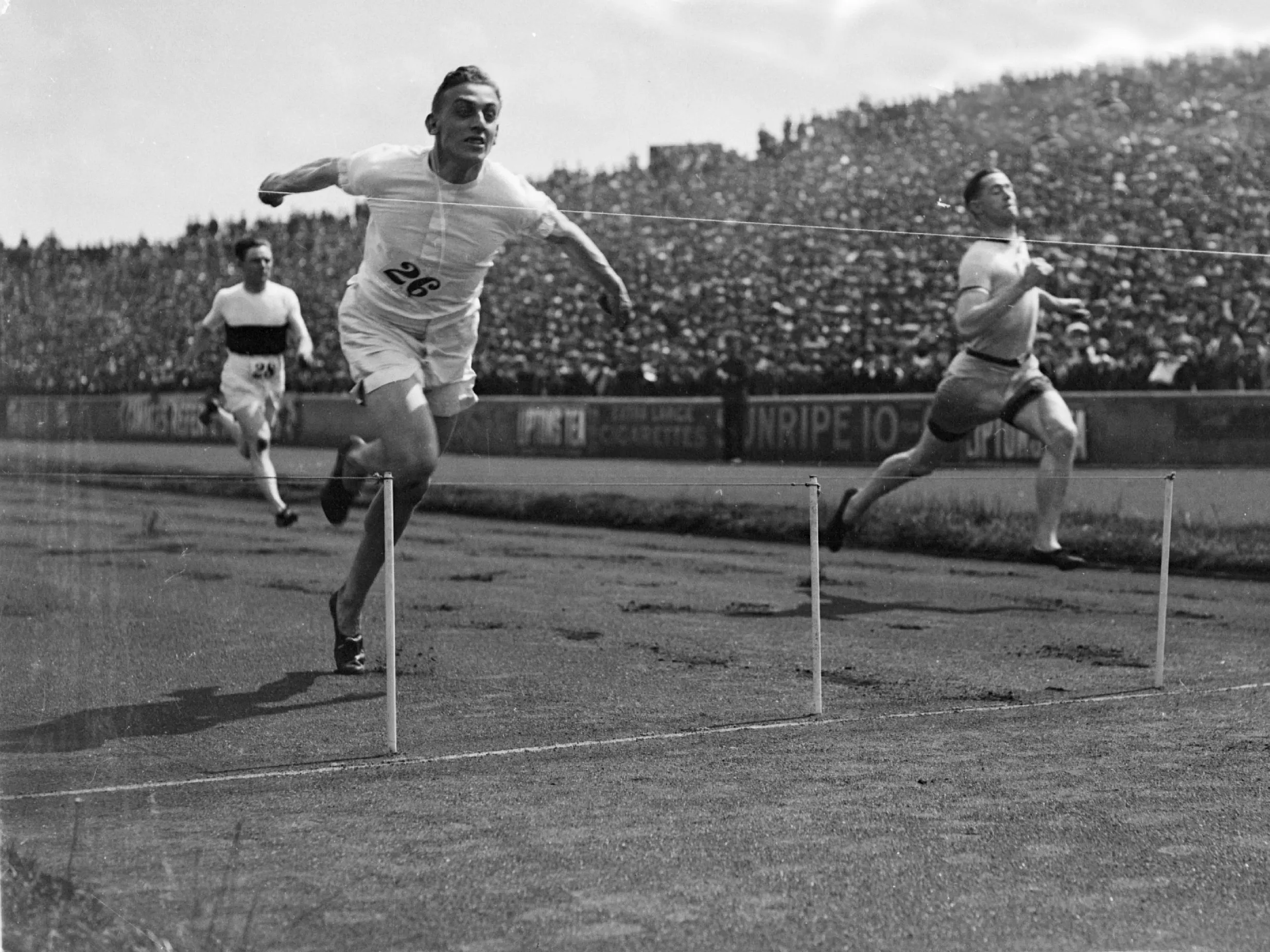
Harold Abrahams
 United Kingdom
Sprinter•barrister•sports administrator
Also known as: Harold Maurice Abrahams
Birthday
December 15, 1899
Birth Sign
Sagittarius
Birthplace
Bedford, England
Age
Died at 78
Height
5 ft 10 in (178 cm)
About
Harold Maurice Abrahams was an English sprinter, barrister, and sports administrator who won the 100 metres at the 1924 Paris Olympics. He was the first British athlete to take that event since 1908, and he did it in a race that came to be called the race of the century.
Today he is best known through the 1981 film Chariots of Fire, which dramatized his rivalry with Eric Liddell and won Best Picture at the Academy Awards. The film made his name familiar to audiences who had never seen him run, and it turned his scientific approach to sprinting into a widely retold story about work beating natural talent. He later qualified as a barrister and served as President of the Amateur Athletic Association from 1936 to 1948. He died in 1978 at 78, and his legacy now lives mainly through Olympic history, sports education, and the film that reintroduced him to the world.
Early Life & Background
Harold Maurice Abrahams was born on December 15, 1899, in Bedford, England, into a wealthy Jewish family of Russian descent. His father, Alfred Abrahams, was a successful wool merchant who encouraged his son's early interest in sport, and his mother, Beatrice, ran a supportive household. The family moved in comfortable circles, and Harold grew up with access to the kind of coaching and equipment that most boys of his era could only dream about.
He attended Repton School, where his sprinting and long jump talent surfaced quickly. In 1918 he won both the 100 yards and the long jump at the Public Schools championships. That same year he was admitted to Gonville & Caius College, Cambridge, matriculating in 1919. Cambridge was not entirely welcoming. Some peers and coaches doubted that a Jewish athlete could compete at the highest level of British sport, and he met that prejudice head-on rather than quietly.
His response was to train harder than anyone around him. Under coach Sam Mussabini he adopted a scientific approach that was considered radical at the time: a carefully controlled diet, structured rest, and interval training. He broke down the sprint into parts and rebuilt it. In 1922 he set a world record in the 100 yards, a result that made him a serious Olympic prospect and silenced some of the doubters. By the time the 1924 Paris Games came around, he was one of Britain's leading sprinters, though few expected him to beat the American favourites.
Career Growth
The 1924 Paris Olympics made him. Abrahams won the 100 metres final, defeating the American Harold Scholz and the rest of a heavily favoured field, becoming the first British athlete to take the event since 1908. The victory was as much symbolic as athletic: it undercut the assumption that British runners could rely on natural superiority without serious training. He also ran in the 4x100 metres relay but did not medal there.
He retired from competitive athletics soon after and turned to law, qualifying as a barrister in 1931. He practised for years while staying close to the sport he loved. From 1936 to 1948 he served as President of the Amateur Athletic Association, a role in which he shaped how British athletics was run and how athletes were supported. He also worked as a sports journalist and broadcaster, and he was involved in the administration of the 1948 London Olympics.
His later decades were quieter, but the 1981 release of Chariots of Fire brought his name back into circulation in a way no athletics career alone could have done. The film won four Academy Awards, including Best Picture, and turned his 1924 victory into one of the most familiar stories in Olympic history. In 2024, the centenary of the Paris Games prompted a fresh round of articles, documentaries, and Olympic channel features revisiting his training methods and his win.
Career Timeline
Public Image & Style
Abrahams is remembered as a determined, analytical, and somewhat guarded figure. Where his rival Eric Liddell was portrayed as running on faith and instinct, Abrahams was the technician, the man who broke the sprint down and rebuilt it. Media depictions lean on that contrast: the secular Jew who trained scientifically against the devout Christian who ran for God. His legal career reinforced the image of a man who did things properly, by the book, with preparation rather than flair.
His story is often used as a template for overcoming prejudice. The anti-Semitism he faced at Cambridge is a standard part of the narrative, and so is his response: work harder, measure everything, win anyway. He was not a showman, and he did not cultivate celebrity during his lifetime. The public image that exists today is largely the one Chariots of Fire built, softened by later historical reassessment that credits him with helping modernise British sprint training.
Fame & Fandom (iFAMOUS Rankings)
iFANN has not yet collected fame data for Harold Abrahams, so no ranking placement is available. He sits outside the current published rankings, which is unsurprising for a sprinter whose competitive career ended in the 1920s. Fame of the kind the Global Fame Rankings measure, worldwide attention across public signals such as Wikipedia readership and global search interest, arrives for him in bursts tied to anniversaries and film revivals rather than steady celebrity.
There is no documented fandom name. His audience is better described as an informal one: Olympic historians, sports educators, Jewish sports heritage organisations, and film fans who encounter him through Chariots of Fire. That audience is not organised in the way a pop star's fanbase is, but it is durable. Centenary coverage in 2024, coordinated by Team GB and Olympic channels, produced documentaries, articles, and educational material that functioned as a collective tribute. The 1981 film remains the main gateway: most people who know his name know it because of a movie made three years after his death.
Interesting Facts and Legends
Abrahams wore custom-made spikes shaped specifically for his feet, a detail that made it into Chariots of Fire. He was a close friend of the poet Robert Graves, who also competed at the 1924 Paris Olympics, in the pentathlon. His interval training and controlled diet were unusual enough for the era that other athletes and coaches studied what he was doing. He was also a capable long jumper in his school years, not just a sprinter.
One story fans still retell is the beach scene from Chariots of Fire, where Abrahams runs alone at dawn, an image that has become shorthand for solitary dedication. It is a film invention rather than a documented event, but it stuck. Another is the claim that his 100 metres final was the race of the century, a label that has followed the 1924 result for a hundred years. He was said to have kept a meticulous training diary, tracking his times and recovery in a way that anticipated modern sports science.
Notable Quotes
“I have always believed that if you put in the work, the results will come.”
“The only thing that matters is the effort you put in.”
Family & Personal Life
Harold Abrahams married Dorothy Cohen, known as Dot, in 1923. The couple had two children, a son named John and a daughter named Susan. The family lived at 2 Hodford Road in Barnet from 1923 to 1936, a house now marked with an English Heritage blue plaque. His father, Alfred Abrahams, was a wool merchant, and the family's comfortable circumstances gave Harold the resources to train seriously at a time when most athletes worked full-time jobs. He remained married to Dot until her death, and he was a widower at the time of his own passing in 1978. His descendants have since managed his estate and the royalties tied to his story.
Notable Connections
Eric Liddell, the Scottish sprinter and devout Christian whose rivalry with Abrahams formed the spine of Chariots of Fire. Sam Mussabini, his coach, who introduced him to structured, scientific training. Dorothy "Dot" Abrahams, his wife. Robert Graves, the poet and fellow 1924 Olympian, who was a close friend.
Relationships & Dating History
Harold Abrahams married Dorothy Cohen, known as Dot, in 1923. They had met in the early 1920s, and the marriage lasted until her death, which came before his own. The couple had two children, a son, John, and a daughter, Susan. There is no documented record of any significant romantic relationship before Dot, and no record of him remarrying or having later partners.
His focus in his youth was on Cambridge, on training, and on the 1924 Olympics, and the public record reflects that. He was a widower at the time of his own death in 1978. The marriage is not a headline story in the way his Olympic victory is, but it was the stable centre of his adult life, spanning more than five decades and running alongside his legal career and his years as President of the Amateur Athletic Association.
- MarriedDorothy "Dot" Cohen1923 - presentMarried in 1923 and remained together until her death; the couple had two children, John and Susan.
Death & Aftermath
Died
January 14, 1978 (aged 78)
Death Place
London Borough of Enfield, England
Cause of Death
Natural causes associated with old age
Harold Abrahams died on January 14, 1978, in the London Borough of Enfield, at the age of 78. The cause was recorded as natural causes associated with old age. He had largely withdrawn from public life by then, and no inquest or legal proceeding followed. The funeral was a private affair, and the immediate public reaction was muted, a quiet respect rather than a media event. At the time of his death he was a widower, his wife Dorothy having predeceased him.
What came next changed how the world remembered him. In 1981 the film Chariots of Fire dramatized his rivalry with Eric Liddell and his 1924 Olympic victory, winning four Academy Awards including Best Picture. The film turned a largely forgotten elder statesman of British sport into a global symbol of determination. Books, documentaries, and educational material followed, and his story entered school curricula and Olympic retrospectives.
Posthumous honours accumulated steadily. He was inducted into the International Jewish Sports Hall of Fame, and English Heritage installed a blue plaque at 2 Hodford Road in Barnet, where he lived from 1923 to 1936. In 2024, the centenary of the Paris Games brought a fresh wave of coverage, with Team GB and Olympic channels revisiting his 100 metres gold and his scientific training methods. His estate, managed by descendants, continues to draw revenue from film royalties, licensing, and related merchandise. No major estate disputes have been reported.
Net Worth (Estate Value)
$3 Million
iFANN Editorial Team estimate
Harold Abrahams died in 1978, so any figure attached to him now is an estate valuation rather than a personal fortune. The iFANN Editorial Team's analysis of his posthumous earnings, licensing, and related rights puts the estate at roughly $3 million as of 2026. The money comes from a narrow but durable set of sources.
The largest is Chariots of Fire. The 1981 film won four Academy Awards including Best Picture and continues to generate royalties through home video, streaming, television broadcasts, and repertory screenings. Licensing of his name and story for documentaries, books, and educational material adds a steady trickle. Merchandise tied to the film and to 1924 Olympic commemorations contributes a smaller amount, as do occasional publishing deals and centenary projects such as the 2024 coverage coordinated by Team GB and Olympic channels.
The estate is managed by his descendants. There have been no reported disputes over it and no major catalog sale or legal settlement that would have changed its shape. The trajectory is modest and stable: a slow accumulation driven by the enduring appeal of a film and the periodic return of Olympic anniversaries, rather than a growing commercial enterprise. As estates of long-dead athletes go, it is well maintained but not large.
Awards Won (1)
Abrahams won the 100 metres gold at the 1924 Paris Olympics. Posthumously he was inducted into the International Jewish Sports Hall of Fame and honoured with an English Heritage blue plaque at his former Barnet home. He received no knighthood or state honour during his lifetime.
1924 · 100 metres
1924 Paris Olympics
Known For
1924 Paris Olympics 100 metres
1924 · Gold medallist
Chariots of Fire
1981 · Subject of the film
President of the Amateur Athletic Association
1936-1948 · President
Keywords
Sources
Quick Facts
- Profession
- Sprinter, barrister, sports administrator
- Born
- December 15, 1899
- Birthplace
- Bedford, England
- Died
- January 14, 1978
- Death Place
- London Borough of Enfield, England
- Gender
- Male
- Birth Sign
- Sagittarius
- Height
- 5 ft 10 in (178 cm)
- Education
- Repton School; Gonville & Caius College, Cambridge
- Spouse
- Dorothy "Dot" Abrahams (née Cohen)
- Children
- John Abrahams, Susan Abrahams
Personal Details
- Full Name
- Harold Maurice Abrahams
- Height
- 5 ft 10 in (178 cm)
- Spouse
- Dorothy "Dot" Abrahams (née Cohen)
- Children
- John Abrahams, Susan Abrahams
- Education
- Repton School; Gonville & Caius College, Cambridge
Frequently Asked Questions
Who was Harold Abrahams?
How did Harold Abrahams die?
Why is Harold Abrahams famous today?
What is Harold Abrahams's net worth in 2026?
Was Harold Abrahams married and did he have children?
Similar People
Join the community
fans discussing