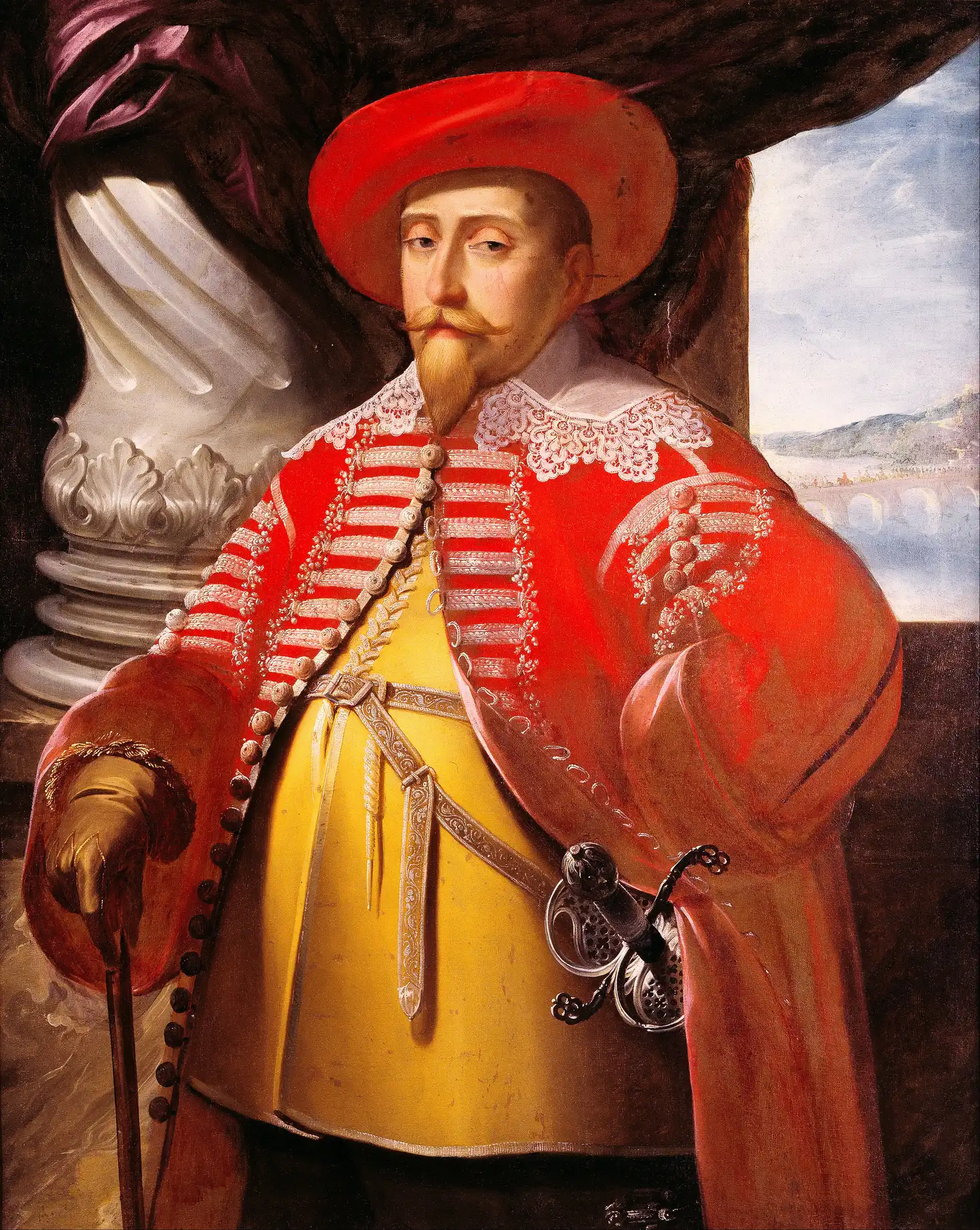
Gustavus Adolphus of Sweden
 Sweden
Also known as: Gustav II Adolf, Gustavus Adolphus the Great, The Lion from the North, The Golden King
Birthday
December 9, 1594
Birth Sign
Sagittarius
Birthplace
Stockholm Palace, Stockholm, Sweden
Age
Died at 37
About
Gustavus Adolphus was King of Sweden from 1611 to 1632 and the only Swedish monarch to be styled "the Great," a title the Riksdag granted him posthumously in 1634. He is remembered as one of the most influential military commanders of the early modern period, known for mobile artillery and combined-arms tactics that changed how wars were fought. His victory at Breitenfeld in 1631 was his defining battle, and his death at Lützen in 1632 cut short a reign that had already turned Sweden into a European great power.
He was born on 9 December 1594 at Stockholm Palace and came to the throne at just 16, inheriting three ongoing wars. Beyond the battlefield, he reformed Sweden's administration, creating a professional standing army and a more efficient system of taxation and conscription. Protestants across Europe remember him as a defender of their cause, and his name lives on in churches, foundations, and institutions, including the Gustav-Adolf-Werk and Gustavus Adolphus College in Minnesota. His chancellor, Axel Oxenstierna, served as regent after his death and kept his policies going.
Early Life & Background
Gustav was born in Stockholm to Charles IX of Sweden and Christina of Holstein-Gottorp. His childhood was shaped by his father's dynastic war against his cousin Sigismund III Vasa of Poland, the deposed Swedish king of the Vasa line. He was educated as a crown prince with tutors in theology, law, history, and, unusually for a prince, practical military science. He is credited with fluency in Latin, German, Dutch, French, Italian, and Russian alongside Swedish.
By his teens he was already involved in state business, and when his father died in 1611 he inherited the throne at 16. He took over three simultaneous wars: against Denmark-Norway (the Kalmar War), against Russia, and the ongoing conflict with Poland-Lithuania over the Swedish crown. He was crowned in 1617. His early years as king were spent securing his kingdom's borders and learning the art of war firsthand, groundwork that would later earn him the epithet "the Father of Modern Warfare."
Career Growth
Gustavus Adolphus's reign from 1611 to 1632 was a period of almost constant war and reform. He settled the Kalmar War with Denmark-Norway by the Treaty of Knäred in 1613 on harsh terms, then ended the Russian war with the Treaty of Stolbovo in 1617, which cut Russia off from the Baltic and is often cited as a major Swedish strategic gain. He fought intermittently against Poland-Lithuania through the 1620s, notably at Wallhof in 1626 and in the Prussian campaigns.
His domestic reforms, carried out with Chancellor Axel Oxenstierna, included the 1617 Riksdag ordinance, the 1620s parish registration for taxation and conscription, the founding of the Swedish postal system, and the creation of a professional standing army through conscription and the "military colony" system of soldier-farmer allotments. He modernized artillery by standardizing light mobile field guns, including the lighter 3- and 4-pounder pieces, and developed combined-arms tactics pairing cavalry with musketeers and mobile artillery, emphasizing offensive action. His artillery corps was shaped by commanders such as Lennart Torstensson, later a field marshal, alongside Johan Banér and Gustav Horn.
He intervened in the Thirty Years' War in 1630, landing in Pomerania. The 1631 victory at Breitenfeld near Leipzig, alongside the Saxon army, destroyed the Imperial army under Tilly and reshaped the war's balance. He was killed leading his troops at Lützen in 1632.
Career Timeline
Public Image & Style
Gustavus Adolphus is remembered as the archetypal warrior king: a Protestant hero who led from the front and died in battle. His image in history is one of a military innovator and a champion of the Protestant cause. He is often depicted in armor, and his nickname "the Lion from the North" captures his reputation for aggression and courage. He is also remembered as "the Golden King" and as "the Father of Modern Warfare." In popular culture, he is celebrated in songs and videos, such as Sabaton's "The Lion From the North," which have introduced him to new audiences.
Fame & Fandom (iFAMOUS Rankings)
iFANN has not yet collected fame data for Gustavus Adolphus, so no ranking is available. He is not on the September 2026 iFAMOUS Rankings flagship list. His modern fanbase has no formal name, but he is remembered by history enthusiasts and fans of military history. Sabaton's song "The Lion From the North," the band's 2021 history video about him, and Epic History TV videos have brought his story to a wider audience, and his legacy is honored by institutions like Gustavus Adolphus College.
Interesting Facts and Legends
Gustavus Adolphus is often called "the Lion from the North," a nickname that reflects his role in the Thirty Years' War. The famous last words attributed to him at Lützen are tradition rather than securely sourced fact. The "leather gun," a light artillery piece often cited as his innovation, is debated by historians. Napoleon is said to have admired him, though no verbatim quote is securely documented. His spoils of war included raids on Jesuit libraries, making him an effective book collector as well as a general. No reliably verbatim quotes from him appear in the sources, and his height is not reliably documented.
Family & Personal Life
Gustavus Adolphus was the son of Charles IX of Sweden and Christina of Holstein-Gottorp. He married Maria Eleonora of Brandenburg, who lived from 1599 to 1655, on 25 November 1620 in Stockholm. The marriage was reportedly difficult, with Maria Eleonora described as emotionally volatile and deeply attached to him. They had three children: a stillborn daughter in 1621, Christina (1623–1624) who died in infancy, and Christina (1626–1689), who became Queen Christina of Sweden. After Gustavus's death, Maria Eleonora's grief was extreme; she reportedly kept his heart in a golden casket and clashed with the regency over custody of Christina before being sidelined politically.
Notable Connections
Relationships & Dating History
The dating story of Gustavus Adolphus centers on a single documented match: Maria Eleonora of Brandenburg, whom he wed on 25 November 1620 in Stockholm. The union was reportedly difficult, with Maria Eleonora described as emotionally volatile and deeply attached to him. They had three children: a stillborn daughter (1621), Christina (1623–1624, died in infancy), and Christina (1626–1689), who became Queen Christina of Sweden. After Gustavus's death, Maria Eleonora's grief was extreme; she reportedly kept his heart in a golden casket and clashed with the regency over custody of Christina before being sidelined politically. There are no documented other romantic relationships, and pre-marital affairs are not credibly attested in the sources. As of 2026, Gustavus Adolphus is deceased (killed in battle, 1632); his spouse Maria Eleonora died in 1655, and there is no current partner.
- MarriedMaria Eleonora of Brandenburg1620 - 1632Married on 25 November 1620 in Stockholm; marriage lasted until his death in 1632.
Death & Aftermath
Died
November 16, 1632 (aged 37)
Death Place
Lützen, Saxony, Germany
Cause of Death
Killed in battle
Gustavus Adolphus fell at the Battle of Lützen on 16 November 1632 (Gregorian; 6 November in the Swedish Julian calendar), about 19 km southwest of Leipzig. Contemporary accounts describe him separated from his main body in the fog and cut down; his body was recovered later, stripped and identified. The exact wounds, whether shot, sabre cuts, or both, remain a matter of historical reconstruction, and the famous last words attributed to him are tradition rather than securely sourced fact. No formal inquiry followed; the death was established by eyewitnesses on the field. He was 37.
He was embalmed and eventually interred in Stockholm at Riddarholmen Church, though the funeral and burial details are not fully established in the sources here. His daughter Christina succeeded as a minor, with Axel Oxenstierna leading the regency and continuing his policies. Commemoration began almost immediately: he was mourned as a Protestant martyr and "the Golden King." Institutions bear his name, notably Gustavus Adolphus College in St. Peter, Minnesota, which holds an annual St. Lucia Festival and hosted a visit by the King and Queen of Sweden on 5 October 2012. The Gustav-Adolf-Werk, a Protestant charitable foundation, also carries his name. His memory is kept alive in popular culture as well, through Sabaton's song "The Lion From the North" and Epic History TV videos, and recent commemorative items include a History Today piece on omens of the Thirty Years' War from October 2026 and a Swedish Academy visit to Greifswald in August 2026 touching on Swedish cultural heritage.
Net Worth (Estate Value)
As a 17th-century monarch, Gustavus Adolphus's wealth was tied to the Swedish crown and its revenues, not to modern celebrity net worth. No reliable estimate exists for his personal fortune, and iFANN does not provide a figure for historical figures. His estate would have included crown lands, tax revenues, and military spoils, but these are not quantifiable in today's terms. He received no modern entertainment awards or commercial endorsements; his distinctions are historical, including the posthumous title "the Great" granted in 1634 and the naming of churches, towns, universities, and the Gustav-Adolf-Werk after him.
Awards & Accolades
View 1 records, honours and achievementsKnown For
King of Sweden
1611–1632 · Monarch
Battle of Breitenfeld
1631 · Commander
Battle of Lützen
1632 · Commander
Keywords
Sources
Quick Facts
- Profession
- King of Sweden
- Born
- December 9, 1594
- Birthplace
- Stockholm Palace
- Died
- November 16, 1632
- Death Place
- Lützen, Saxony, Germany
- Gender
- Male
- Spouse
- Maria Eleonora of Brandenburg
- Birth Sign
- Sagittarius
- Title
- Gustavus Adolphus the Great
Personal Details
- Full Name
- Gustav II Adolf
- Spouse
- Maria Eleonora of Brandenburg
- Children
- Christina of Sweden (1626–1689); two children who died in infancy
- Education
- Tutored in theology, law, history, military science, and languages
Frequently Asked Questions
What is Gustavus Adolphus famous for?
How did Gustavus Adolphus die?
Was Gustavus Adolphus Protestant?
What did Napoleon say about Gustavus Adolphus?
Who was the greatest King of Sweden?
Join the community
fans discussing