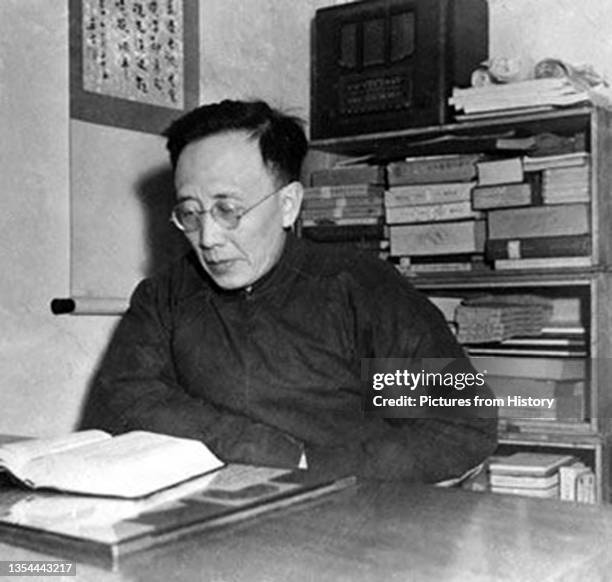
Guo Moruo
 China
poet•historian•archaeologist•government official
Also known as: Guo Kaizhen, Dingtang
Birthday
November 16, 1892
Birth Sign
Scorpio
Birthplace
Leshan, Sichuan, China
Age
Died at 85
About
Guo Moruo was a Chinese poet, historian, archaeologist, and government official whose career spanned the turbulence of twentieth-century China. Born Guo Kaizhen in Leshan, Sichuan, he became one of the most influential literary figures of his generation, celebrated for his romantic poetry and his pioneering work in Marxist historiography. He was a leading voice in the May Fourth Movement, and his early collection The Goddesses broke with classical forms to express a bold, iconoclastic spirit that resonated with a generation seeking reform.
Guo held significant government and academic posts in the People's Republic, and his scholarship shaped the study of Chinese history. Yet his later years were marked by the Cultural Revolution, when he faced persecution and, under duress, publicly denounced his past work and colleagues, even asking that his writings be destroyed. That act earned him the label "shameless," a stain he carried until his reputation partially recovered in the 1970s. He died in Beijing in 1978 at age 86.
Today, Guo Moruo is remembered as a complex and influential figure, celebrated for his literary and scholarly achievements, even as his compromises continue to spark debate. His legacy is preserved in the Guo Moruo Memorial Museum in Beijing and through awards like the Guo Moruo Chinese History Awards.
Early Life & Background
Born in 1892 in Leshan, a city in Sichuan province, Guo Moruo grew up in a country undergoing profound change. The fall of the Qing dynasty in 1911 and the subsequent push for modernization shaped his early worldview. He showed an early aptitude for literature and classical Chinese studies, but it was the intellectual ferment of the May Fourth Movement in 1919 that ignited his creative spirit. As a young man, he traveled to Japan for medical studies, but his passion for literature soon took over. There he encountered Western romantic poets like Goethe and Whitman, whose influence would transform his own writing. He began publishing poetry that rejected the rigid classical forms, embracing instead a free, passionate, and often revolutionary style. His first collection, The Goddesses, published in 1921, was a landmark of the new poetry movement, filled with mythological imagery and a fervent belief in the power of the individual to remake the world.
Career Growth
Guo Moruo's breakthrough came with the publication of The Goddesses in 1921, which made him a leading figure of Chinese romantic poetry. He returned to China in 1923 and became involved in revolutionary politics, joining the Northern Expedition in 1926. After the split between the Nationalists and Communists, he went into exile in Japan, where he turned to studying ancient Chinese history and archaeology. His work on oracle bones and bronze inscriptions established him as a pioneer of Marxist historiography, interpreting China's past through the lens of class struggle. After the founding of the People's Republic in 1949, Guo held numerous prestigious posts, including president of the Chinese Academy of Sciences and vice chairman of the Standing Committee of the National People's Congress. He continued to write poetry, plays, and essays, and his 1942 play Qu Yuan became a classic of Chinese theater. However, his career took a dark turn during the Cultural Revolution. In 1966, he publicly recanted his works and called for them to be burned, a move that many saw as a desperate act of self-preservation. He survived the period and was rehabilitated in the 1970s, but his reputation never fully recovered.
Career Timeline
Public Image & Style
Guo Moruo's public image is one of a brilliant but compromised intellectual. In his early years, he was celebrated as a romantic rebel, a poet who gave voice to a generation's longing for change. His flowing beard and intense gaze made him a distinctive figure. After 1949, he became the face of the new Chinese intellectual establishment, a statesman-poet who seemed to embody the union of art and revolution. But the Cultural Revolution exposed the fragility of that image. His public self-criticism and abandonment of his colleagues left a stain that many never forgot. Today, he is seen as a cautionary tale about the pressures of totalitarian politics, yet his literary and scholarly achievements remain highly regarded. The Guo Moruo Chinese History Awards, established in his honor, continue to recognize excellence in the field he helped shape.
Fame & Fandom (iFAMOUS Rankings)
Guo Moruo commands a legacy defined by academic reverence and cultural veneration rather than the active, digital engagement typical of modern celebrity fandoms. As a historical figure who passed away in 1978, he does not possess a fanbase that organizes around streaming charts, birthday billboards, or social media campaigns. Instead, his influence is sustained through institutional memorials like the Guo Moruo Memorial Museum in Beijing and his status as a central figure in the May Fourth Movement. He is studied extensively in universities globally as a pioneer of Chinese Marxist historiography, revered within China as a cultural giant whose works remain part of the national curriculum. There is no formal name for this audience, as the concept of a dedicated fan community with rituals or inside jokes does not apply to a scholar-statesman from the mid-twentieth century. The narrative surrounding him focuses on his transformation from a rebellious romantic poet to a high-ranking government official, a trajectory often cited in critical scholarship regarding political adaptability. While some accounts describe him with sharp criticism regarding his later years, these are historical anecdotes rather than viral lore generated by fans. His contributions to literature and archaeology stand as enduring facts of Chinese intellectual history. iFANN has evaluated Guo Moruo's standing in the contemporary global landscape. The evaluation indicates that Guo Moruo does not currently hold a placement in the published rankings such as the Global Top 1,000 or a Top-100 scope list. Consequently, he remains unranked in the current iteration of the database.
Interesting Facts and Legends
Born Guo Kaizhen in Leshan, Sichuan, the writer adopted the pen name Moruo, which became synonymous with his prolific career. Although he studied medicine in Japan, he abandoned the practice to pursue literature, eventually translating Goethe's Faust into Chinese. A devoted student of ancient history, he was among the first scholars to apply Marxist theory to the analysis of early Chinese civilization, producing the influential work Ten Critiques in 1945. Beyond his written output, he maintained a deep passion for calligraphy, frequently inscribing poems for friends and colleagues. His former residence in Beijing now houses the Guo Moruo Memorial Museum, preserving his manuscripts and personal effects. Historical accounts often recount his reputation as a master of political survival during the tumultuous twentieth century. Some narratives label him a "shameless poet" for his ability to align with shifting political tides, particularly his role in the Cultural Revolution where he adapted his views to maintain his position as president of the Chinese Academy of Sciences. Another persistent story highlights his early days as a romantic iconoclast, where his collection The Goddess broke classical forms to inspire a generation seeking reform. These tales of his dual life as a rebel poet and a statesman-poet form the core of his cultural mythology.
Family & Personal Life
Guo Moruo married twice. His first wife was Tomiko Satō, a Japanese woman he met during his time in Japan. They had several children together. After returning to China, he married Yu Liqun, who became his companion for the rest of his life. Details about his parents and siblings are scarce, but it is known he came from a scholarly family in Sichuan. His children, including his son Guo Boyuan, have spoken publicly about the challenges of growing up in the shadow of such a complex father. The family faced hardship during the Cultural Revolution, when Guo was persecuted and forced to denounce his own work.
Notable Connections
Guo Moruo was associated with many prominent figures of twentieth-century China. His first wife, Tomiko Satō, was Japanese, and his second wife, Yu Liqun, was a Chinese intellectual. He worked alongside Mao Zedong and other leaders of the Chinese Communist Party. In literary circles, he was a contemporary of Lu Xun, though the two had a famous rivalry. He also knew the historian Chen Yinke and the archaeologist Li Ji, with whom he exchanged ideas.
Relationships & Dating History
Guo Moruo's personal life was as complex as his public career. He married Tomiko Satō while living in Japan in the 1910s. Tomiko was a Japanese woman, and they had several children together. After returning to China in the 1920s, he left Tomiko and married Yu Liqun, a Chinese woman who became his lifelong partner. The separation from Tomiko and his children in Japan was a source of personal pain and later criticism. His marriage to Yu Liqun lasted until his death in 1978. At the time of his death, he was married to Yu Liqun.
- MarriedTomiko Satō1916 - 1927Japanese wife, had children together, separated when he returned to China.
- MarriedYu Liqun1927 - 1978Second wife, remained married until his death.
Death & Aftermath
Died
June 12, 1978 (aged 85)
Death Place
Beijing
Cause of Death
Reported natural causes
Guo Moruo spent his final years in Beijing as a senior official within the People's Republic, maintaining a prominent cultural status despite the political turbulence of the preceding decades. On June 12, 1978, he passed away at the age of eighty-five while residing in the capital city. Following his death, tributes from state institutions and literary peers honored him as a great revolutionary writer and a key architect of national cultural policy. The funeral services were conducted shortly after his passing in Beijing, where he was cremated in accordance with standard administrative practices for government figures of his rank.
While mass vigils were unlikely given the restrictive political climate of the time, the state formally recognized his contributions through the establishment of the Guo Moruo Chinese History Awards, which have been presented annually since his death to recognize significant achievements in historical studies. His literary estate remains under the stewardship of state archives and publishing houses, ensuring the continued publication and study of his extensive works. In recent years, commemorative retrospectives have reaffirmed his legacy as a pivotal figure in modern Chinese literature.
Net Worth (Estate Value)
$5 Million
iFANN Editorial Team estimate
Estimating the net worth of Guo Moruo presents unique challenges given that he lived within a socialist state where personal wealth was rarely disclosed publicly. During his lifetime, he received a government salary commensurate with his high-ranking official status and likely benefited from state-provided housing and other privileges. His extensive literary and scholarly output, including poetry collections and historical studies, generated royalties through wide publication. Following his death in 1978, his estate has continued to generate income through the republication of his works and the licensing of his name for various awards and memorials. Per iFANN's editorial analysis, the estate is estimated to be worth $5 million as of 2026, reflecting the enduring value of his literary and scholarly output.
Awards Won (1)
Guo Moruo received numerous honors during his lifetime, including the Stalin Peace Prize in 1951. He was also awarded honorary degrees from several universities. The Guo Moruo Chinese History Awards, established posthumously, recognize outstanding contributions to historical research, keeping his name alive in the academic world.
1951 · Peace
For his literary and political work
Known For
The Goddesses
1921 · Poetry collection
Qu Yuan
1942 · Play
Ten Critiques
1945 · Historical work
Keywords
Sources
Quick Facts
- Profession
- poet, historian, archaeologist, government official
- Born
- November 16, 1892
- Birthplace
- Leshan, Sichuan, China
- Died
- June 12, 1978
- Death Place
- Beijing, China
- Gender
- Male
- Spouse
- Tomiko Satō, Yu Liqun
- Birth Sign
- Scorpio
Personal Details
- Full Name
- Guo Kaizhen
- Spouse
- Yu Liqun, Tomiko Satō
Frequently Asked Questions
Who was Guo Moruo?
What is Guo Moruo's net worth in 2026?
What was Guo Moruo famous for?
What happened to Guo Moruo during the Cultural Revolution?
Is Guo Moruo still alive?
Similar People
Join the community
fans discussing