 United Kingdom
About
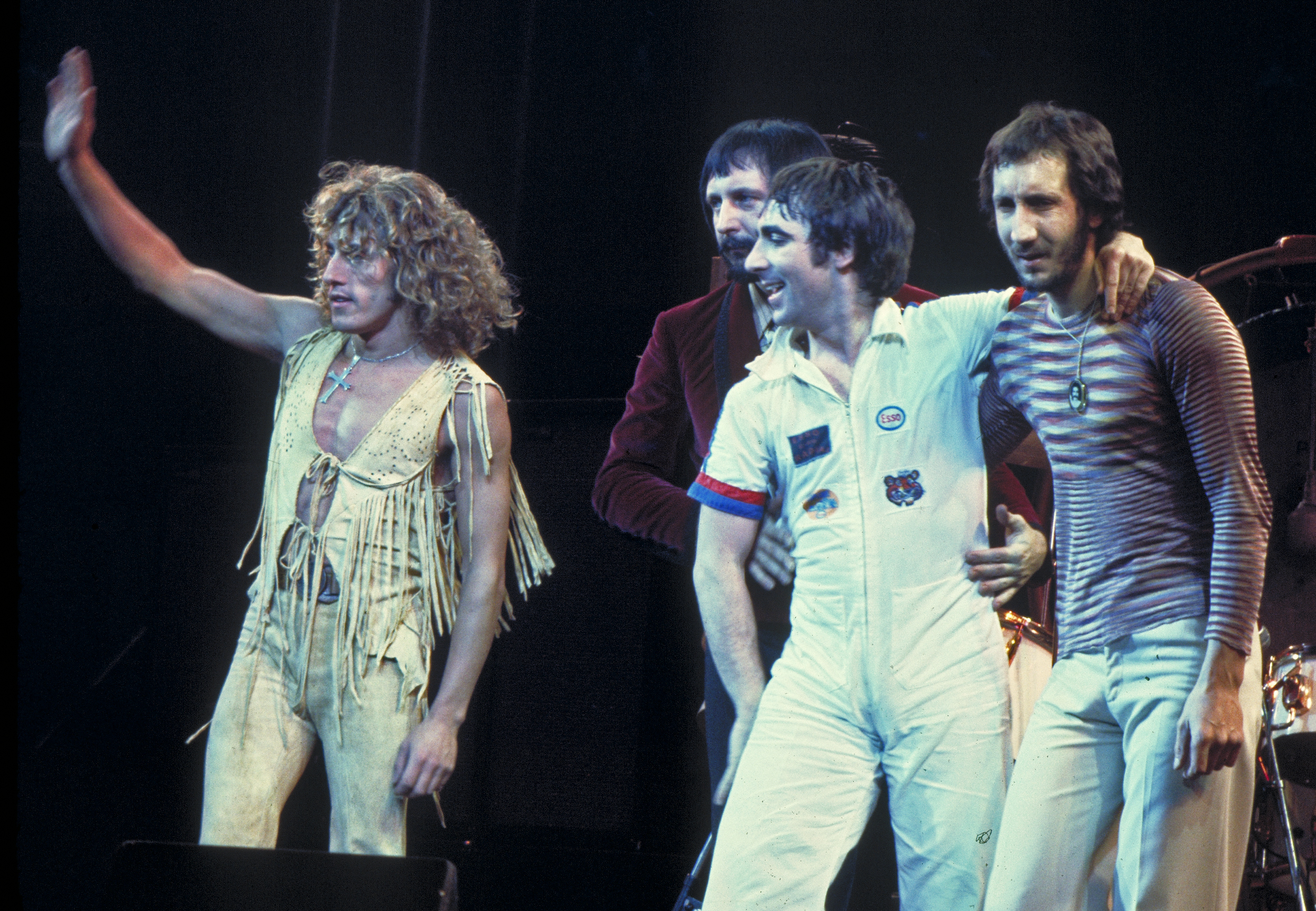
The Who is a British rock band known for their energetic live performances, innovative songwriting, and enduring influence on popular music. The band has sold over 100 million records worldwide, with major successes including the rock operas Tommy and Quadrophenia, and the acclaimed 1971 album Who's Next. Today, surviving original members Roger Daltrey and Pete Townshend continue to perform and record, carrying on the band's legacy. They are distinctive for their powerful blend of hard rock, early synthesizer use, and Daltrey's commanding vocals, captivating generations of fans with their raw, sophisticated sound.
" } ]Formation Story
The Who's origins trace back to London, England, in 1961, when Roger Daltrey formed a rhythm and blues band called The Detours. He was soon joined by bassist John Entwistle, followed by guitarist Pete Townshend. This nascent trio spent the early 1960s honing their craft by playing R&B covers in small clubs and developing a distinctive stage presence. The group, which would eventually become The Who, began to solidify its iconic lineup around February 1, 1964, though finding a permanent drummer proved challenging until April 1964. It was then that Keith Moon, a charismatic and wild musician, auditioned. Moon's explosive, idiosyncratic drumming style, which combined technical brilliance with utter unpredictability, immediately impressed the others. His audition famously concluded with him smashing his drum kit, an act that sealed the classic lineup. This solidified the core of The Who: Roger Daltrey, the charismatic frontman with a powerful voice; Pete Townshend, the band's principal songwriter, whose guitar playing combined furious strumming with feedback-laden theatrics; John Entwistle, known as "The Ox," whose inventive bass lines provided a melodic counterpoint and anchored their sound; and Keith Moon, "The Loon," whose dynamic drumming became a hallmark of their sound.
With their classic lineup established, the band briefly performed as The High Numbers, even releasing one single, "I'm the Face." However, by late 1964, under the guidance of managers Kit Lambert and Chris Stamp, the group rebranded themselves as The Who. Emerging from London, they quickly distinguished themselves from their British Invasion peers with a unique blend of aggressive rhythm and blues, pop sensibility, and a confrontational stage presence. Together, they crafted a sound that was both raw and sophisticated, perfectly capturing the restless energy of their generation. Their official debut as The Who came in January 1965 with the release of their debut single, "I Can't Explain." This raw, energetic track quickly climbed to number 8 on the UK Singles Chart, marking their first significant breakthrough. The band's early years were further defined by instrument smashing and rebellious anthems, leading to their debut album, My Generation, released in December 1965. This seminal record not only defined the mod movement's sound and attitude but also cemented their status as mod icons, establishing The Who as a potent new force in British rock.
Members
Former Members
Musical Style
The Who's sound evolved dramatically over their career, starting with the aggressive pop-art and R&B influences of their early years. On their 1965 debut, My Generation, they presented a raw, feedback-laden take on mod rock, characterized by Pete Townshend's power chords and Roger Daltrey's snarling vocals. John Entwistle's melodic, horn-like bass lines and Keith Moon's frenetic, polyrhythmic drumming gave them a distinctive, powerful rhythm section.
As the 1960s progressed, their music incorporated psychedelic and more experimental elements, evident in 1967's The Who Sell Out, a concept album structured like a pirate radio broadcast. Townshend's ambition grew, leading to the pioneering rock opera Tommy in 1969, a sprawling narrative that demonstrated rock music's potential for complex storytelling. This expansion continued with 1973's Quadrophenia, another intricate rock opera exploring identity and mod culture.
By 1971, with Who's Next, the band perfected a blend of hard rock power and sophisticated arrangements. This album notably featured extensive use of the ARP 2500 synthesizer, particularly on tracks like "Baba O'Riley" and "Won't Get Fooled Again," introducing arpeggiated synth patterns that became a hallmark of their sound. After Keith Moon's death, the band's later albums, like Face Dances and It's Hard, adopted a more polished, new wave-influenced style, reflecting a different rhythm section and the changing musical landscape of the early 1980s.
Discography
| Title | Year |
|---|---|
| Endless Wire | 2006 |
| It's Hard | 1982 |
| Face Dances | 1981 |
| You Better You Bet | 1981 |
| Who Are You | 1978 |
| Who Are You | 1978 |
| The Who by Numbers | 1975 |
| Quadrophenia | 1973 |
| Who's Next | 1971 |
| Won't Get Fooled Again | 1971 |
| Baba O'Riley | 1971 |
| See Me, Feel Me | 1970 |
| Tommy | 1969 |
| Pinball Wizard | 1969 |
| The Who Sell Out | 1967 |
| I Can See for Miles | 1967 |
| Pictures of Lily | 1967 |
| A Quick One | 1966 |
| Happy Jack | 1966 |
| I'm a Boy | 1966 |
| My Generation | 1965 |
| My Generation | 1965 |
| I Can't Explain | 1965 |
Tours
The Who Hits Back! Tour
2022-2023
Moving On! Tour
2019-2020 · 50 shows
The Who Hits 50! Tour
2015-2016
The Who Tour 2006-2007
2006-2007
The Who Live Tour
2002-2004
The Who Tour 1982
1982
The Who Tour 1979
1979
The Who Tour 1975
1975
The Who Tour 1973
1973
The Who Tour 1971
1971
The Who Tour 1969
1969
Cultural Impact
The Who left a distinct mark on popular culture, influencing not just music but also fashion and youth movements. As central figures in the 1960s mod subculture, they helped define its aesthetic, popularizing sharp suits, parkas, and the rebellious, stylish image that became synonymous with the era. Their early single, "My Generation," particularly resonated, becoming an anthem for youthful defiance and the generation gap, its stuttering vocal delivery and aggressive sound capturing a restless spirit.
Musically, their impact was profound. They are widely credited with pioneering the rock opera format, pushing the boundaries of what a rock album could achieve with narrative works like Tommy and Quadrophenia. Their high-volume, instrument-smashing stage performances, though initially accidental, became a powerful symbol of rock's destructive energy, inspiring punk rock and heavy metal acts for decades. Moreover, their innovative use of synthesizers on albums such as Who's Next opened new sonic avenues for rock bands, blending electronic textures with raw guitar power.
Beyond their music, The Who's work crossed into other mediums. The film adaptations of Tommy in 1975 and Quadrophenia in 1979 introduced their stories to wider audiences, with the latter becoming a cult classic that rekindled interest in mod culture. Roger Daltrey and Pete Townshend have also engaged in significant charity work and performed at major global events like Live Aid in 1985, the Concert for New York City in 2001, and the closing ceremony of the 2012 London Olympics, demonstrating their enduring presence on the world stage.
Fandom Culture
Fans of The Who are simply known as "Who fans" or "The Who fans," reflecting a community built around the music rather than a formally designated name. Unlike some modern groups, there isn't an official lightstick or specific fan color associated with the band. Instead, the fandom expresses its enthusiasm through shared traditions rooted in the band's history and live performances.
At concerts, it's common to see fans mimicking Pete Townshend's signature "windmill" guitar strumming motion. Communal singalongs to anthems like "My Generation" and "Baba O'Riley" are also a regular feature, creating a powerful, collective experience. While the band no longer smashes instruments on stage as they famously did in their early days, fans sometimes pay tribute to this iconic, destructive energy in their own ways, acknowledging a practice that helped define The Who's wild live reputation.
Awards Won (40)
The Who have collected a significant number of awards over their long career, recognizing both their musical output and their lasting influence. They earned two Grammy Awards, one for their album It's Hard in 1983 and another for a live instrumental performance of "The Real Me" in 2000. The band also received the BRIT Award for Outstanding Contribution to Music in 1988 and were named Best British Group multiple times at the NME Awards throughout the 1960s and 70s. Their pioneering works, including Tommy, My Generation, and Who's Next, have all been inducted into the Grammy Hall of Fame, underscoring their enduring musical quality.
Best Rock Instrumental Performance
for: The Real Me (Live)
Best Rock Performance by a Duo or Group with Vocal
for: It's Hard (album)
Album Induction
for: My Generation
Album Induction
for: Who's Next
Song Induction
for: My Generation
Album Induction
for: Tommy
Century Award
for: Pete Townshend
Favorite Pop/Rock Band/Duo/Group
for: The Who Live at Leeds
Best Video from a Film
for: Love, Reign o'er Me (from Quadrophenia)
Best British Group
for: Quadrophenia
Fame & Fandom (iFAMOUS Rankings)
Trivia
Pete Townshend's famous "windmill" guitar strum, where he swings his arm in a large circle before hitting the strings, was initially inspired by watching Keith Richards of The Rolling Stones. Keith Moon, known for his wild antics, once drove a car into a swimming pool as part of his notorious behavior, earning him the nickname "Moon the Loon." John Entwistle's bass playing was so powerful and distinct that he often used a separate amplifier specifically for his bass, making his sound a key, driving element of the band's overall noise. The band's first recording session under the name The Who was for their debut single, "I Can't Explain," produced by Shel Talmy. The Who's legendary instrument-smashing act began completely by accident in 1964 when Townshend, frustrated by a broken guitar string, smashed his instrument, and Moon followed by kicking over his drum kit; the crowd's enthusiastic reaction encouraged them to make it a regular part of their show.
Keywords
Group Info
- Fandom
- The Who fans
- Formed
- 1964-02-01
- Debut
- 1965-01
- Debut Song
- I Can't Explain
- Origin
- London, England
- Label
- Polydor Records, Geffen Records
- Status
- Active
Also Known As
Join the community
fans discussing