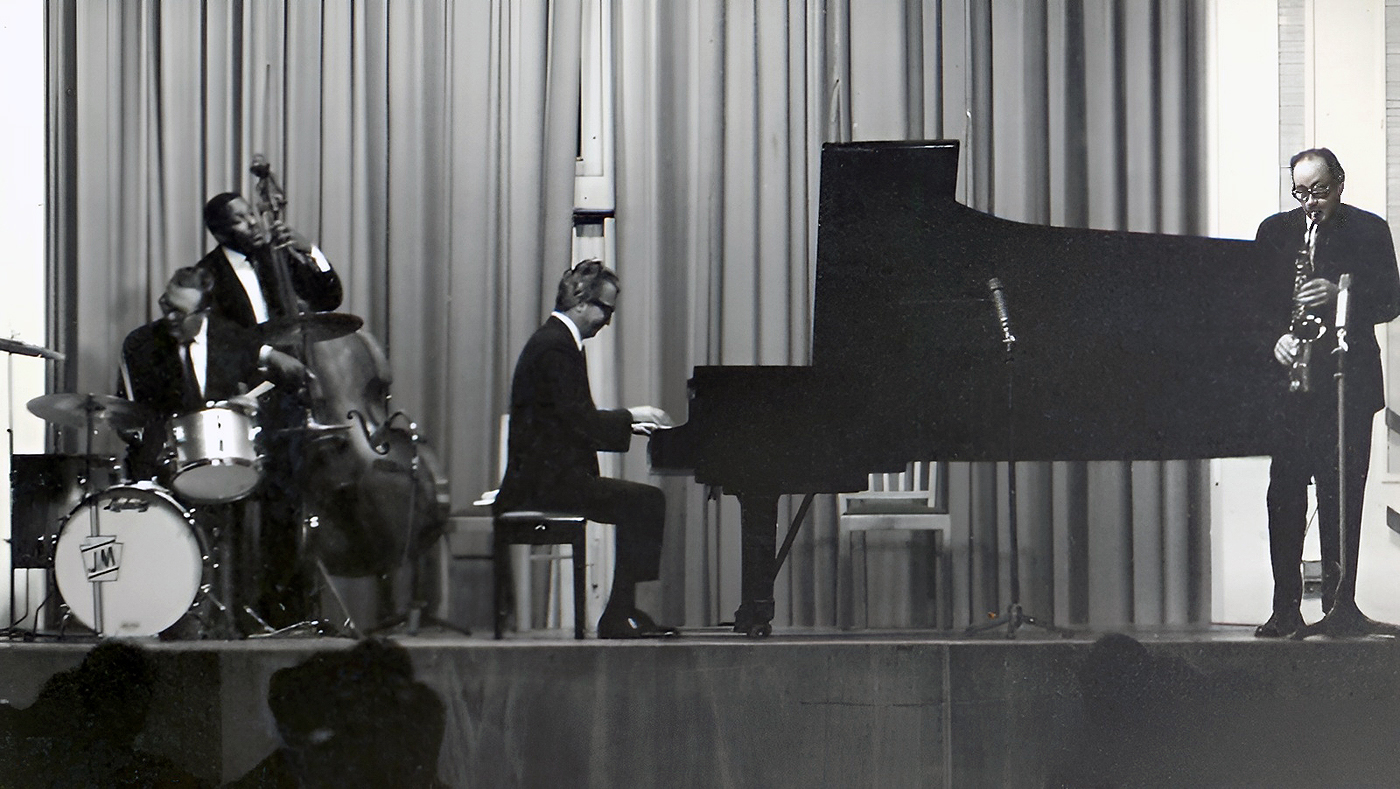
The Dave Brubeck Quartet
 United States
Pioneers of cool jazz and complex time signatures
About
The Dave Brubeck Quartet stands as one of the most commercially successful and influential jazz groups in history. Active primarily between 1951 and 1967, the band is best known for its "Classic Quartet" lineup, which combined Dave Brubeck's classical-influenced piano playing with Paul Desmond's lyrical alto saxophone tone. Their sound moved away from the frenetic energy of bebop toward a more relaxed, intellectual approach often labeled as "cool jazz." The group achieved unprecedented commercial success for a jazz act, becoming the first jazz album to sell over one million copies with Time Out.
Beyond sales figures, the quartet reshaped musical theory by popularizing unusual time signatures in popular music. Tracks like "Take Five" (5/4 time) and "Blue Rondo à la Turk" (9/8 time) challenged listeners and musicians alike, proving that complex rhythms could be both accessible and danceable. The group also played a significant role in the Civil Rights Movement. As an integrated band touring the segregated American South in the late 1950s, they refused to play venues where segregation was enforced, facing cancellations and hostility but maintaining their principles.
Following the departure of Paul Desmond in 1967, the original lineup disbanded, though Brubeck continued to perform with various lineups for decades. The group's legacy endures through its vast discography, educational influence on jazz curricula worldwide, and the continued relevance of its recordings. In recent years, the estate has seen renewed interest with catalog management deals and auctions of personal memorabilia, ensuring the music remains part of the cultural conversation.
Formation Story
Dave Brubeck formed his first professional trio in 1949 with vibraphonist Cal Tjader and bassist Ron Crotty, but the core identity of the quartet began taking shape shortly after. By 1951, Brubeck had recruited alto saxophonist Paul Desmond, who brought a smooth, fluid style that perfectly complemented Brubeck's angular, chord-heavy piano work. The two met earlier at a jam session in 1942, but it wasn't until the early 1950s that they solidified their partnership. The group launched with a residency at the Blackhawk nightclub in San Francisco, where they spent months refining their sound before hitting the road.
Their rise to fame was driven by a strategic focus on American university campuses. Rather than chasing traditional nightclubs, Brubeck booked hundreds of dates at colleges across the country. This decision paid off immensely; students hungry for new sounds embraced the quartet, leading to the release of live albums like Jazz at Oberlin (1953) and Jazz Goes to College (1954). These records captured the energy of their live performances and built a dedicated fanbase that supported their experimental studio work.
The lineup stabilized into the legendary "Classic Quartet" in 1958 when drummer Joe Morello and bassist Eugene Wright joined the fold. Morello replaced Billy Holt, bringing technical precision and polyrhythmic flair, while Wright replaced Norman Bates, adding a deep, resonant bass presence. This four-piece unit remained intact for nine years, recording the majority of their famous catalog including Time Out and At Carnegie Hall. The stability of this lineup allowed them to develop a cohesive musical language that pushed boundaries without losing their signature warmth.
Former Members
Musical Style
The quartet's sound evolved from a standard swing and bebop foundation into a distinct "Cool Jazz" aesthetic characterized by relaxed tempos and lyrical improvisation. Brubeck's background in classical composition heavily influenced the group's approach to harmony and structure. He frequently employed modal jazz techniques and complex harmonies that differed from the standard changes of the era. The collaboration between Brubeck and Desmond created a unique sonic texture where the piano and saxophone wove intricate counterpoint rather than simply trading solos.
A defining characteristic of their mature style was the use of odd time signatures. Brubeck experimented with meters such as 5/4, 7/4, and 9/8, initially meeting resistance from Columbia Records executives who feared radio stations would reject the songs. Despite these concerns, tracks like "Take Five" and "Blue Rondo à la Turk" became massive hits, demonstrating that complex rhythms could have broad appeal. This period marked a shift toward what Brubeck called "Third Stream" music, blending classical compositional rigor with jazz improvisation.
After the Classic Quartet dissolved in 1967, Brubeck's subsequent groups explored fusion, world music influences, and avant-garde structures. However, none of these later iterations replicated the mainstream success or critical acclaim of the late 1950s and early 1960s. The classic sound remains the benchmark for the group's artistic achievement, celebrated for its intellectual depth and emotional accessibility.
Discography
| Title | Year |
|---|---|
| Time Out | 1959 |
| Time Further Out | 1961 |
| Countdown: Time in Outer Space | 1962 |
| Time Changes | 1964 |
| Time In | 1964 |
| Jazz Impressions of Japan | 1965 |
| Hello, Dolly! | 1964 |
| At Carnegie Hall | 1963 |
| Jazz at Oberlin | 1953 |
| Jazz Goes to College | 1954 |
Tours
European Tour
1958 · 45 shows
Soviet Union Tour
1961 · 20 shows
Japan Tour
1964 · 30 shows
Cultural Impact
The Dave Brubeck Quartet fundamentally altered the landscape of jazz by making complex musical concepts accessible to a mass audience. Their success proved that jazz did not have to be confined to small clubs or niche enthusiasts; it could fill concert halls and top pop charts. The group's integration during the height of segregation in the American South also made them pioneers in the Civil Rights Movement. They faced numerous challenges, including being denied hotel rooms and canceled gigs because of Eugene Wright's race, yet they consistently refused to compromise their values. This stance earned them respect from civil rights leaders and highlighted the power of art to challenge social norms.
Their influence extended beyond jazz into rock, progressive metal, and classical music. Bands like King Crimson, Yes, and Rush cited Brubeck's rhythmic innovations as a key inspiration for their own experiments with odd time signatures. The song "Take Five" alone has been covered by countless artists across genres, cementing its status as a standard. Furthermore, the group served as unofficial cultural ambassadors for the United States during the Cold War, touring countries like India, the Soviet Union, and Japan under State Department sponsorship to foster diplomatic relations through music.
Fandom Culture
Unlike modern pop acts, the Dave Brubeck Quartet did not have a formalized fandom with official colors, lightsticks, or organized fan clubs. Instead, their support base consisted of jazz enthusiasts, music students, academics, and older generations who appreciated the sophistication of their work. Fans often gathered at jazz festivals, universities, and concerts to experience the music live. The community is united by a shared appreciation for Brubeck's compositional genius and Desmond's melodic inventiveness. Over the decades, fans have kept the legacy alive through record collecting, academic study, and tribute performances by contemporary artists.
Awards Won (12)
The group won six Grammy Awards throughout their career, spanning categories from Best Jazz Performance to Best Historical Album. Notable wins include the 1962 award for Time Out and the 2012 posthumous win for The Complete RCA Victor Collection. Beyond Grammys, Dave Brubeck received the National Medal of Arts, the Kennedy Center Honors, and the Presidential Medal of Freedom. The quartet also holds a Guinness World Record for the best-selling jazz album of all time.
Best Historical Album
for: The Complete RCA Victor Collection
Best Large Jazz Ensemble Album
for: Remembering Bud Powell
Best Traditional Jazz Performance
for: The Duke Ellington Centennial Concert
Best Traditional Jazz Performance
for: In London
Best Contemporary Jazz Album
for: The Last Time Around
Best Jazz Performance, Group
for: Time Out
Milestones
Formation of the quartet with Paul Desmond
Release of Jazz at Oberlin
Formation of the Classic Quartet
Release of Time Out
"Take Five" becomes a pop culture phenomenon
Disbandment of the Classic Quartet
Reunion of the Classic Quartet for 25th anniversary
Dave Brubeck receives Kennedy Center Honors
Death of Dave Brubeck
Primary Wave partners with Brubeck family to manage catalog
Trivia
Keywords
Sources
Quick Facts
- Origin
- United States
- Label
- Columbia Records, Philips Records, Fontana Records, Fantasy
- Genres
- jazz
- Status
- Active
Group Info
- Formed
- 1951-01-01
- Debut
- 1951-06-15
- Debut Song
- Take Five
- Origin
- San Francisco, California, United States
- Company
- Dave Brubeck Productions
- Label
- Columbia Records, Philips Records, Fantasy Records, Fontana Records
- Status
- Disbanded (1967-12-31)
Also Known As
Join the community
fans discussing